The follow market in insurance is the group of underwriters who write shares of a risk after the lead underwriter has set the terms: the broker takes the lead's agreed slip to them, and each decides whether to join and for what share until the risk is fully placed. Follow markets win business mainly by answering in time with a usable line, because the terms are already set and the broker's task is to fill the slip; a follower that needs days to read a slip it has largely accepted before is easy to replace. Botminds' Digital Follow Underwriting is built for that seat: it reads the slip and every lead endorsement against what the follower has already accepted and checks the line against its authority, so the follow underwriter answers on the few differences in minutes, inside its own rules.
The market descriptions below come from the European Commission's 2007 inquiry into business insurance, the FCA's 2019 wholesale broker study, the PRA and English judgments. The figures for the follow desk come from the fictional sample book in the solution, a follower called Fenmarch Syndicate; they are sample data, not results at any syndicate.
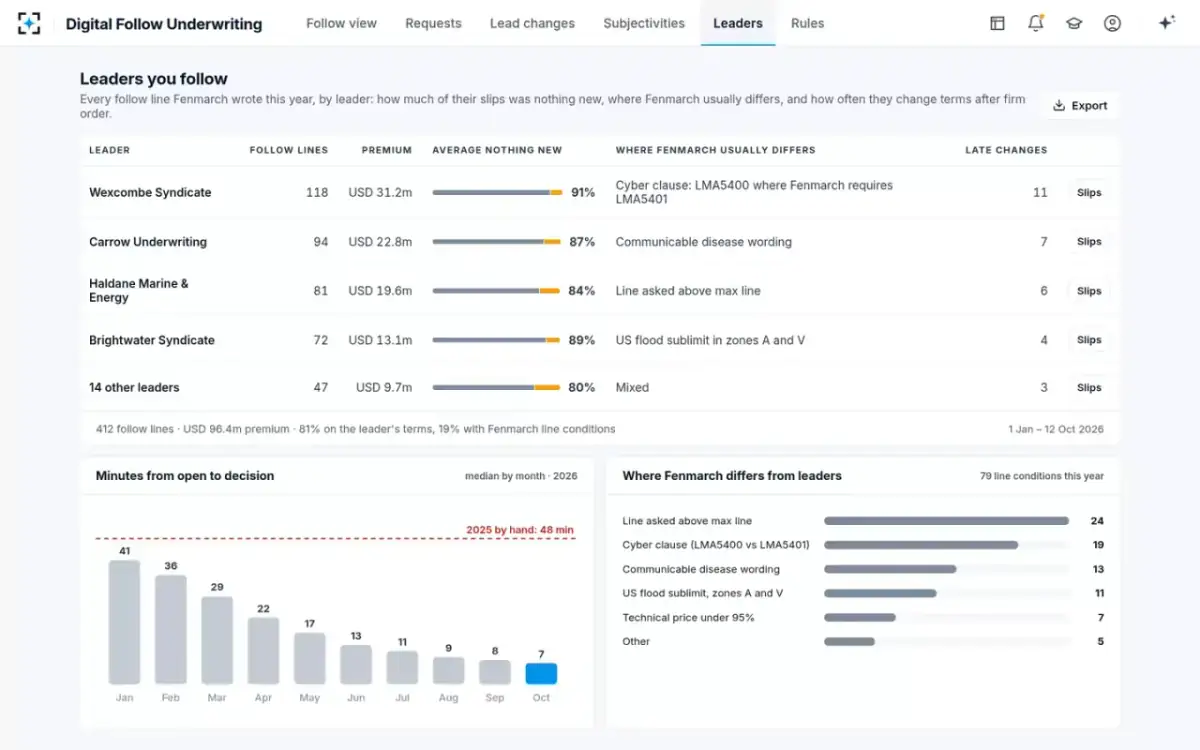
On the sample book, the median follow decision fell from 41 minutes in January to 7 in October
What is the follow market in insurance?
It is the second step of a subscription placement. The European Commission, which studied the practice across EU business insurance, described the broker-led procedure this way: once a lead insurer has been chosen and terms agreed with it, "The broker subsequently approaches the follow market to fill 100% of the slip and the offer agreed with the lead insurer is advised to a selection of insurers" (Commission staff working document SEC(2007) 1231, section 3.1.1). Each follower that accepts writes its own line, and in London each line is a separate contract with the insured.
The follow market is not a separate group of firms. The same syndicate leads some risks and follows on others, often in the same week, and a company-market insurer may follow a Lloyd's leader. What changes is the job: the leader negotiates the contract; the follower decides whether that contract, as written, fits its own book.
Why do brokers fill the follow market fast?
Because the terms are fixed and followers are many. The Commission recorded that the broker's selection of followers often includes insurers "who are seeing the risk for the first time", and that "The number of insurers available to act in this capacity is potentially greater given that it does not require the same degree of specialization" (SEC(2007) 1231, section 3.1.1). It also found the cover "is normally completed on a “take it or leave it” basis". A leader is chosen; a follower is one of several who could fill the same line.
The broker's position adds to the pressure. The FCA's 2019 study describes the London market as one in which "the broker is the route to market for underwriters. This tends to strengthen brokers’ bargaining position. Soft market conditions have enhanced this feature of the market" (FCA MS17/2.2, para 2.18). In January 2026 the PRA told insurers' boards it was observing a continuing softening of the cycle in many lines, with pressure on pricing, terms and conditions, and that this appeared most pronounced in some London wholesale lines (PRA, insurance supervision priorities, 15 January 2026). In a softening market, capacity is plentiful and the broker can fill the slip with whoever answers.
Intermediated market: The central feature of the LIM is that brokers act as clients’ intermediaries for almost all transactions. This creates a market structure where the broker is the route to market for underwriters.
FCA, Wholesale Insurance Broker Market Study, final report MS17/2.2 (2019), para 2.18
How do follow markets win business?
By answering in time, with a line the broker can use, on terms the broker does not have to renegotiate. Those three things are the follower's product. A slip fills in order; once written lines pass 100%, lines are signed down, and a follower that answers after the broker has closed the slip may get no line at all. How written lines are signed down is explained in a companion guide.
What a broker needs from a follower, and what slows each one down
| The broker needs | Why it matters to the placement | What slows a follower down |
|---|---|---|
| An answer before the deadline | The slip is filled in order and the broker reports to the client | Reading every line of a long slip, most of it unchanged |
| A usable line size | A line the broker can count towards 100% | Working the max line, personal authority and aggregates by hand |
| Few conditions, clearly stated | Each condition may have to go back to the leader or the other markets | Finding the clause that breaks a rule, late |
| Agreement to the leader's later changes | A follower that has not agreed a change creates a different contract | Finding endorsements agreed after firm order |
| Subjectivities the broker can clear | Open subjectivities keep the placement unfinished | Copying them from the slip into a list |
How do followers price behind a lead?
Mostly, they do not: on a true subscription, the premium is the lead's and the follower decides whether that price is adequate for its book. The Commission reported that "It is generally acknowledged on the part of market participants that the subscription procedure leads to a single premium", the first of its scenarios being that "The offer agreed with the lead insurer is accepted by all the other coinsurers, on the same terms and conditions (including premium)" (SEC(2007) 1231, section 3.1.1). A follower's pricing work is a test, not a quote: the lead's premium against the follower's own technical price.
That is why the technical price check sits among the follower's authority checks rather than in a pricing step. On the solution's sample renewal, the lead's premium of USD 18.4 million for 100% was 103% of the follower's technical price, above its 95% floor, so the check passed and the follower's share at 7.5% was USD 1,380,000 gross.
Can a follower change terms set by the lead?
Yes, for its own line, by writing subject to a condition; but each condition has a cost, because the broker may have to take it back to the leader or the other markets. The Commission described that path: a coinsurer may accept the share offered "but request additional conditions or introduce their own terms", which it thought more likely "in a tight capacity market or for a specific risk", after which the broker may renegotiate until one set of terms is accepted by all (SEC(2007) 1231, scenario b).
English cases show the result in practice. In a 2025 Commercial Court case about a reinsurance programme placed in London, each layer "was placed independently with individual reinsurers writing only for their respective shares", and "some reinsurers wrote on terms which included a hierarchy clause, while others did not" (Tyson International v GIC Re [2025] EWHC 77 (Comm), paras 30 and 31). A follower's conditions are legitimate; the commercial point is to need few of them and to state them at once.
Two ways for a follower to answer faster: loosen the rules, or read less
Faster by loosening: Higher personal authorities, fewer referrals, more leaders on the approved list.
Faster by reading less: The same rules, applied by agents to every line before the underwriter opens the slip.
Faster by loosening: The same slip, faster, or less of it at random.
Faster by reading less: Only the lines that differ from what the syndicate has accepted, with the reason each differs.
Faster by loosening: Found if someone happens to read the endorsements.
Faster by reading less: Read on arrival and put in front of the underwriter who wrote the line.
Faster by loosening: Discipline weakens exactly when the PRA has asked boards to hold it.
Faster by reading less: Discipline is unchanged; only the reading is faster.
Faster by loosening: Speed, and a rising share of lines written on the leader's terms.
Faster by reading less: Speed, plus where the syndicate differs from each leader and how often.
Why time pressure at renewal makes reading harder, not easier
Renewals are where follow markets win or lose most lines, and they are the moment the courts accept that reading is compressed. In ABN Amro v RSA the Commercial Court found that "When policies are renewed, the evidence indicated that the time available for the broker was limited. The underwriter would expect the broker to draw his attention to matters of interest. He would not painstakingly read through the terms line by line" ([2021] EWHC 442 (Comm), para 588).
That describes the trade a follow desk makes every renewal season: rely on the broker to point out what changed, or read every line and answer late. The follow clause has a commercial purpose that cuts the same way. A follow settlements clause, the Commercial Court said in 2014, "saves time and costs and also makes co-insurance more marketable which is attractive to those seeking insurance" (San Evans Maritime v Aigaion [2014] EWHC 163 (Comm), para 14). Speed is part of what the follow market sells; the question is only whether it is bought with reading or with discipline.
What a faster follow line is worth: a model to fill with your numbers
The value of answering faster has three parts and one cost, and only one part can be read from a desk's own diary. No regulator or independent study publishes London follow volumes, hit ratios or decision times, so the model below uses the solution's fictional sample where it has a figure and leaves the rest to your own books.
The value of a faster follow answer, term by term
Desk hours returned
Follow decisions a year × (minutes by hand − minutes with agents) ÷ 60
Sample: 412 decisions in under ten months × (48 − 7) minutes ≈ 280 hours of underwriter time
Head of underwriting operations
Lines kept
Requests answered after the broker closed the slip × average follow premium × margin
Sample average follow premium: USD 96.4m ÷ 412 lines ≈ USD 234,000. Lost lines: from your own broker feedback
Follow underwriting manager
Changes caught
Late lead changes needing your agreement × the exposure each one shifts
Sample: 31 late changes this year; one deductible cut moved up to USD 1.98m of one follower's share
Class underwriter
Cost
Subscription and set-up + underwriter time to write and maintain the follow rules
Your quote, plus the hours to set max lines and clause positions by class
COO
The first term is the easiest to measure and the least important. The second is the commercial case, and only the follower's own brokers can say how many lines it lost to slow answers. The third is the risk case: one late change missed on one large risk can cost more than a year of the first term. A pilot should measure all three on last quarter's requests before anyone signs a licence.
Leaders you follow: lines, premium, where you usually differ and how often each leader changes terms late
Where Digital Follow Underwriting fits on a follow desk
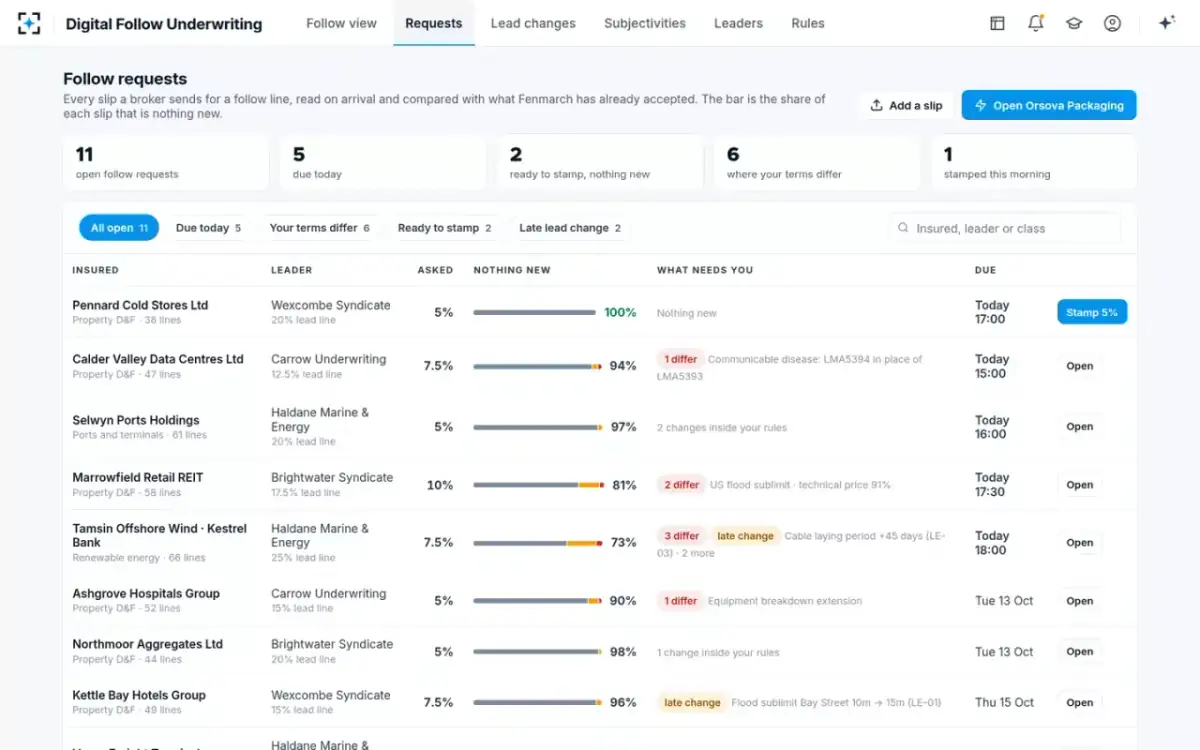
Digital Follow Underwriting fits a follower whose brokers want answers faster than its underwriters can read. Five agents read each slip and every lead endorsement on arrival, grey out what the syndicate has already accepted, check the line against max line, authority, aggregates, technical price, territory, sanctions and the approved leaders list, and draft the reason. The follow underwriter sees the differences, chooses the line and stamps; a slip that is entirely nothing new can be stamped from the list if the syndicate switches that setting on.
The morning's requests, each with what needs the underwriter and when it is due
It does not make the follower write more lines on the leader's terms, and it does not answer the broker for the follower: no agent stamps, agrees a lead change or sends anything. What the FCA found about the cost of subscribing puts the follower's speed in the context of the whole market, and which follow tasks move to agents sets out the division of work. The solution page walks through one request from open to stamp.
Questions people ask
What is the difference between lead and follow insurance?
They are two roles on the same subscription risk, not two kinds of insurance. The lead negotiates the terms and price and usually writes first; the followers write their own shares on those terms, each as a separate contract, and may add conditions for their own line.
What is a line condition?
A condition a follower attaches to its own line, such as writing "subject to" a clause its rules require in place of one the leader accepted. On the solution's sample renewal, the follower wrote 7.5% subject to the LMA5401 property cyber exclusion because its class rules require it, although the leader had moved to LMA5400.
Do followers get paid less than the lead?
On a true subscription the premium rate is normally the same for every line, as the European Commission found in 2007, so each follower earns its share of the lead's premium. Deductions such as brokerage are set on the slip; a follower can negotiate its own terms only at the cost of a condition.
How fast should a follow market answer?
Inside the broker's deadline, which is set by the placement, not by the follower. No public statistic gives a typical answer time; the useful measure is the follower's own, minutes from opening a request to a decision, which on the solution's sample book fell from an estimated 48 by hand to a median of 7.
Does answering faster mean accepting more risk?
Not if the speed comes from reading less rather than checking less. The PRA asked boards in January 2026 to hold underwriting discipline as the cycle softens; a faster desk that still applies every max line, aggregate and clause rule to every line keeps that discipline.