A funder’s look-to-book ratio in equipment lending, the share of its approvals that become signed, funded contracts, turns on one thing above all others: who answers the dealer first. A customer standing at the counter with a quote for a loader or a delivery van can let the dealer send the same application to two or three funders at once, and Regulation B, the rule on credit notices, expressly provides for it. Whichever funder comes back with a yes the customer takes books the deal; the others' analysis, however sound, decided nothing. The race bites harder in equipment finance than in most small-business credit, because equipment loans are already approved more often than any other product the Federal Reserve's small-business survey measures, so the answers funders give tend to look alike. Botminds' Vendor Finance Credit Decisioning is built around that fact: in its sample program, the agents that decide an application-only deal are competing against a clock the dealer's customer is already watching, not against a competitor's policy.
One application, three funders, one winner
At the point of sale, an application often does not travel alone. A dealer with financing programs from more than one funder can put the same deal in two or three queues at once, and none of those queues knows about the others. The regulation already assumes this happens: when an application is made on a customer's behalf to more than one creditor and the customer "expressly accepts or uses credit offered by one of the creditors, notification of action taken by any of the other creditors is not required" (12 CFR 1002.9(g)). The funders who were not chosen owe no notice, and usually receive none either: the application simply stops moving.
The product already decides fastest: outcomes on a loan, line of credit or cash advance, 2025
71%
of auto or equipment loan applicants fully approved — the highest share of any product measured
17%
partially approved
11%
denied — the lowest denial share of any product measured
That 71% figure is not a reason to relax; it is the reason the race is close. When most applicants for a product are fully approved, two funders looking at the same clean deal will usually both say yes, and what the dealer notices is which yes arrived while the customer was still there.
Why auto and equipment loans approve faster than almost anything else
Fully approved, by product, 2025 survey
The survey does not say why, but the likeliest reason equipment loans are approved more often is that the collateral does much of the underwriting's work. A loader or a delivery van is a known asset with a known resale value, titled and traceable, which gives a funder a floor under its risk that an unsecured line of credit or a cash-flow-based business loan does not have. That structural advantage is also why the product lends itself to speed: a funder underwriting against the equipment and the guarantor's bureau, rather than a full set of financials, has fewer documents standing between an application and an answer.
What a dealer actually loses by waiting on a slow funder
Speed is the first reason borrowers give for choosing an online lender
Borrowers who choose on speed are telling lenders what they will leave for. A funder without a standing relationship with the customer, which describes most funders a dealer sends a deal to, competes in the column where speed is the deciding factor, not the column where relationship is.
A slow funder on a shopped application does not usually get a decline on its own books; it gets nothing. The deal is booked elsewhere, the application sits unresolved, and the slower funder's underwriting — however accurate — never gets to matter. That is a different kind of loss than a credit loss, and it shows up nowhere in a denial-rate statistic: a funder with excellent underwriting and a slow queue can lose volume to a funder with merely adequate underwriting and a fast one.
Look-to-book: the number a program manager watches instead of volume
Raw application volume tells a vendor program manager how many deals arrived, not how many it actually won, which is why a program manager watching for speed problems tracks look-to-book instead — the share of approved applications that convert into a signed, funded contract. A program approving plenty of deals but converting few of them is usually losing the race after the approval, not failing the underwriting before it.
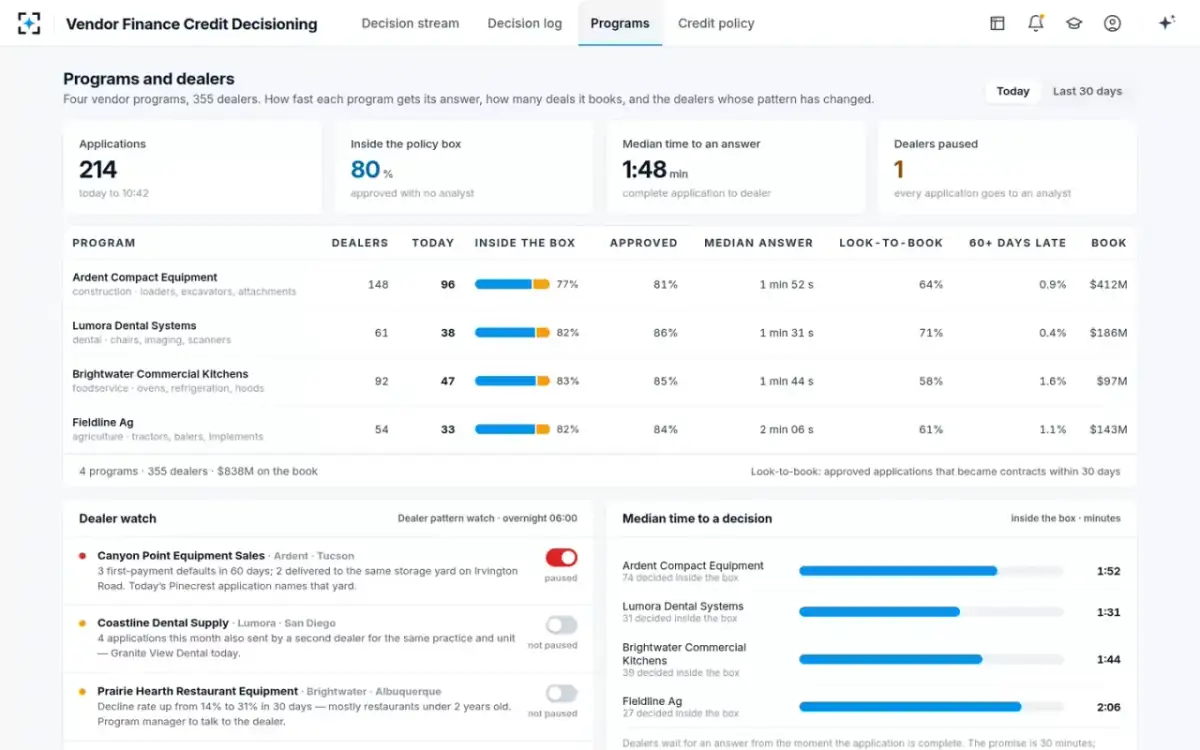
The spread can be wide even inside one funder. In the fictional sample, four programs answer at medians between 1 minute 31 seconds and 2 minutes 6 seconds and approve 81% to 86% of applications, yet their look-to-book, counted as approvals that became contracts within 30 days, runs from 58% to 71%. The slowest-converting program is not the slowest to answer, which is the point: once answers are fast, what separates programs is whether the approval was one the dealer could close on, the right terms on the right equipment, and that is a question for the rate card and the counter ladder rather than for the clock.
The three-funder race, drawn as a timeline from send to each funder's answer
In Vendor Finance Credit Decisioning's sample program this month, Elena Brandt, the program manager for Ardent Compact Equipment's four dealer programs, watches each program's median answer time and look-to-book alongside the raw count of applications — because a program with a fast median answer and a weak look-to-book usually has a different problem than slow underwriting: an offer dealers do not trust enough to close on, or terms that lose to a competitor after the approval rather than before it.
Why online lenders are taking share from banks in this exact race
The lenders gaining ground in small-business credit are the ones built around answering fast. The share of applicants that sought financing at online fintech lenders rose from 17% in the 2020 survey to 29% in the 2025 survey (Federal Reserve Banks, 2026 Report on Employer Firms). Applicants still most often apply at large banks, but the channel whose applicants name speed first is the one that has grown.
That shift is not about online lenders approving more: in the same survey 57% of small-bank applicants were fully approved, against 38% at online lenders, and 60% of online-lender borrowers said their actual borrowing costs were higher than expected. It is about when the applicant decides who gets the business: before the credit decision, when speed and presence matter, not after it, when approval odds and price would.
Waiting is a complaint about banks more than about fast lenders
What a captive or vendor-program funder can do that a bank branch can't
A vendor program funder has a structural answer-time advantage a branch-based bank lender rarely matches: it is already wired into the dealer's point of sale, with a pre-agreed credit policy and, in a program like the sample one here, a pre-signed counter ladder for the near-misses that policy alone cannot approve. A branch lender meeting a new small-business borrower for the first time has to build that context from scratch on every application; a vendor program funder built it once, for the whole dealer network, before the first application of the day arrived.
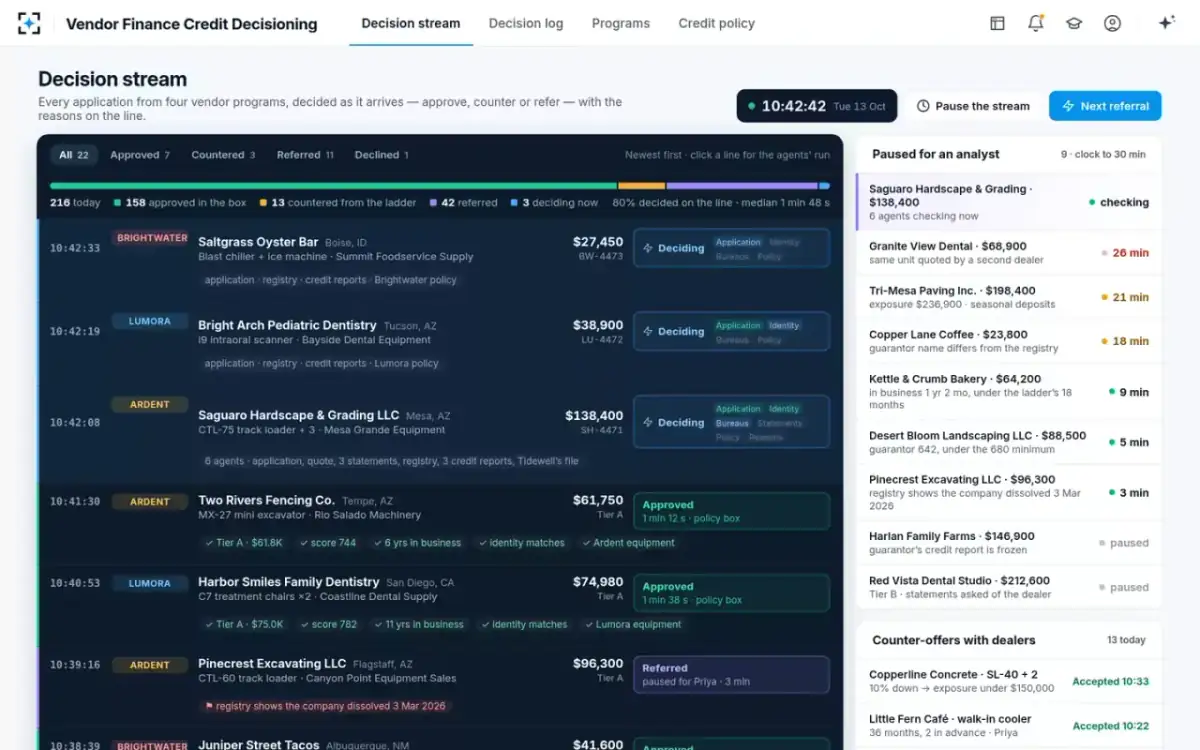
The decision stream: four vendor programs, one live line
The economics of being second: a declined deal that was never really declined
The costliest outcome in this race carries no paperwork at all. A deal lost to a faster competitor is not a decline on the slower funder's book, not a counted denial, not a data point anywhere in its own portfolio statistics — it is simply an application that stopped updating. A funder measuring its own performance only by its approval rate and its denial rate can look healthy by every number it tracks while steadily losing volume it never sees as lost.
That is also why a dealer promise, a program's own committed answer window, is as much a competitive setting as a credit-policy one. In the sample program the promise is 30 minutes. Its fictional head of equipment finance, Dana Whitlock, sees 96% of this month's applications answered inside it, against 61% before May, when every exception still went to a queue. Both figures are fictional sample data, not an industry benchmark or a customer's result; they are the kind of number a program manager should watch, because it moves before look-to-book does.
What a funder owes on a deal the dealer shopped, by how the race ends
| How it ends | What this funder owes the applicant | Rule |
|---|---|---|
| The customer takes another funder’s offer | No notice of action taken | 12 CFR 1002.9(g) |
| This funder approves; nobody comes back to ask | May treat the application as withdrawn after 30 days if the parties expected the applicant to inquire | 12 CFR 1002.9(e) |
| No funder offers credit, or the customer takes none | Each funder that took adverse action must notify, directly or through the dealer, naming itself | 12 CFR 1002.9(g) |
| This funder counters and the customer declines | Adverse action notice within 90 days of the counter (business of $1 million revenue or less) | 12 CFR 1002.9(a)(1)(iv) |
| This funder declines | Notice within 30 days of a completed application (smaller business), or a reasonable time (larger) | 12 CFR 1002.9(a)(1), (a)(3) |
Programs and dealers: median answer, look-to-book and the overnight watch
Which loan type gets approved fastest for a small business?
Among the products measured in the Federal Reserve's 2025 Small Business Credit Survey, auto or equipment loans had both the highest fully-approved share, 71%, and the lowest denial share, 11%, of any product category reported — ahead of business lines of credit, SBA loans and general business loans. The survey does not measure speed directly, but a product that clears most applicants on collateral and bureau data alone is also the product best suited to answering in minutes rather than days, which is the gap a vendor-program funder is built to close further still.
Questions people ask
Why do dealers send the same application to multiple lenders?
Because it costs the dealer and the customer little and raises the chance of a quick yes while the customer is still there. Regulation B expects it: when a third party sends an application to several creditors and the customer takes one offer, the others owe no notice (12 CFR 1002.9(g)).
What is look-to-book rate in equipment finance?
It is the share of approved applications that actually convert into a signed, funded contract. A program with a high approval rate but a low look-to-book is typically losing deals after the approval — to a faster competitor, or to terms the dealer does not trust — rather than failing to approve good applicants in the first place.
Why does speed matter in vendor finance programs?
Because the application in front of a program may also be in front of other funders at the same moment, and borrowers say speed decides where they go: 64% of online-lender applicants and 44% of finance-company applicants in the Federal Reserve's 2025 survey named speed of decision or funding. Underwriting quality decides whether an approval was sound; answer time decides whether it is used.
How do online lenders compare to banks for equipment loans?
On approval rate alone, small banks outperform online lenders in the Federal Reserve's survey — 57% fully approved against 38%. Online lenders have nonetheless grown their share of applicants from 17% to 29% over five years, which points to speed and accessibility, not approval odds, as what is driving the shift.
What happens if two funders approve the same deal?
The customer and dealer choose one, and the other approval goes unused. Under Regulation B the funder not chosen owes the customer no notice, and nothing obliges anyone to tell it that it lost, which is why a program manager tracking only approvals can miss how often it happens; look-to-book is the number that shows it.
How do equipment finance companies compete for dealer volume?
On answer time, presence in the dealer's application flow, and the rate card. When approval odds on a clean deal are similar across funders, a pre-agreed credit policy and counter ladder that answer in minutes compete on a different axis from a slightly better rate the customer may never wait to compare.