Equipment finance ROI is usually pitched against a single number — days to approve — and that number is both unreliable and, for this product specifically, pointed the wrong way. Auto and equipment loans already approve faster and more often than almost any other small-business credit product; the real cost is not days lost waiting, it is loaded hours spent on the exceptions that don't fit a policy box cleanly. This guide builds that cost from six tasks, a wage and a volume — numbers a finance team can check and replace with its own.
The worked figures come from a fictional sample vendor program running Vendor Finance Credit Decisioning. The wage and approval-rate research is published and linked where it appears; the hourly cost built from it is our own arithmetic, shown step by step.
Auto and equipment loans already approve fastest — so the cost isn't the wait
71%
of auto/equipment loan applicants fully approved, 2025 — the highest of any product
17%
partially approved
11%
denied — against 28% for business loans and 40% for SBA loans/lines
Why "days to approve" is the wrong number to start from
A published "days to approve" figure mixes two very different clocks: the time a file actually needs working, and the time it sits in a queue before anyone opens it. Only the first is something a program's own process controls, and it is the only one a return-on-investment case should be built from — queue time changes with staffing and season, not with the tool doing the underwriting.
It also matters which number gets compared against which. Figures for how many days an equipment loan takes to approve, or what share of underwriting time is administrative, circulate without a published method behind them, so this guide builds its case from the Federal Reserve's own Small Business Credit Survey instead, which measures something different and more useful: not how long approval takes, but how often it happens at all, by product.
Auto and equipment loans already approve fastest — so what is the cost?
In the Fed's 2025 survey, auto or equipment loan applicants were fully approved 71% of the time, partially approved 17% of the time, and denied just 11% — the highest full-approval share of any product measured, ahead of business lines of credit (45%), business loans (37%) and SBA loans or lines of credit (32%). If speed and approval odds were the whole story, this product would already be the easy case, not the one needing an ROI argument.
That is exactly why the honest cost argument is not about the wait. It is about what it takes, in loaded hours, to get from "application received" to "decision made" on the minority of applications that do not clear a policy box cleanly — the ones a small-ticket program is built to approve in minutes, until something about the file needs a person to actually look.
The 17% "partially approved" share is its own cost line most ROI arguments skip. A partial approval is not a fast no; it is a counteroffer — a smaller amount, a shorter term, a higher rate — and reaching one still takes the same reading and verifying as a full approval, often with an extra round of structuring on top. A cost model that only counts fully approved and denied files as "handled" is quietly leaving out more than one application in six.
Six tasks, and where the hours actually go
One exception application breaks into six tasks, each with its own estimated hours: reading the application and the dealer's quote, verifying the business and its owner, pulling the credit bureaus and adding up exposure, reading the bank statements, running policy and pricing, and writing the decision and the dealer's notice. Before agents, that adds up to roughly six hours of working time per exception; with agents doing the reading, cross-checking and arithmetic, the same six tasks take about half an hour, and the hours that remain sit overwhelmingly in verification — the one task that is a judgement call, not a lookup.
Six tasks, six hours before agents — about half an hour with them
Before agents: 6.0 hours on one exception
- Reading the application and quote · 8%
- Verifying the business, owner and contact details · 25%
- Pulling bureaus and adding up exposure · 13%
- Reading the bank statements · 25%
- Running policy, pricing and structure · 16%
- Writing the decision, reasons and notice · 13%
With agents: 0.55 hours on the same exception
- Reading the application and quote · 9%
- Verifying the business, owner and contact details · 28%
- Pulling bureaus and adding up exposure · 9%
- Reading the bank statements · 18%
- Running policy, pricing and structure · 18%
- Writing the decision, reasons and notice · 18%
Building the cost of one exception from loaded wages
A hard number needs a wage, and the closest published one for this seat is O*NET's median annual wage for credit analysts, $83,510 for 2025. Divided across a standard 2,080-hour work year, that is $40.15 an hour — not a fully loaded cost once benefits and overhead are added, but a defensible floor a finance team can mark up with its own numbers. At $40.15 an hour, six hours of exception work costs $240.90; thirty-three minutes costs $22.08.
Wages are not the whole cost of an hour. The Bureau of Labor Statistics measures what employers actually pay: in June 2026, private-industry wages and salaries averaged $32.82 an hour worked and "accounted for 70.0 percent of employer costs", with benefits the other 30.0% (Employer Costs for Employee Compensation, released 9 September 2026). Dividing the analyst's median wage by 0.70 gives $57.36 an hour with benefits, before any office, systems or management overhead, which a finance team adds from its own books.
One exception, priced at the wage floor: $240.90 before agents, $22.08 with them
That $218.82 is the per-file number at the wage floor, and $312.60 with benefits. What it is worth to a program depends on how many exceptions it actually sees, which is the next thing to measure rather than assume.
What falls out of the box, and how often
On one day in the fictional sample program, 42 of 214 applications — about one in five — were referred to a credit analyst as exceptions; the rest were approved or countered automatically. Reasons for a fuller denial, from the Fed's survey, suggest what tends to push a file out of a clean box in the first place even when it is not declined outright.
What pushes an application off a clean approval, by share of applicants not fully approved
None of those reasons is unique to small-ticket equipment finance, but they show where an exception's hours go. "Too much debt already" is established by adding up exposure from the bureaus and reading the statements for payments nobody listed, and statement reading is a quarter of an exception's hours by hand. "Insufficient collateral" is the equipment-share and lien check. "Lender requirements too strict" is the applicant's view of the box itself, which costs nothing to establish and a good deal to explain.
"Low credit score" and "weak sales" sit differently again. Neither is something a credit analyst spends much working time establishing — the bureau pull returns a score in seconds, and sales strength is read straight off the statements the bank statement analyst already works through. Where the hours actually concentrate is not in finding these numbers but in deciding what to do once a number is borderline rather than clearly over or under a threshold: a guarantor score four points under the Tier B minimum, or fixed payments at 11.8% against a 12% ceiling. Those borderline cases are exactly the ones a signed counter ladder is built to answer without queuing the file at all, which is its own cost story, not this one.
The return formula, with your own numbers in it
The formula underneath this guide is simple on purpose, so it survives being re-run with a program's own numbers: (hours saved per exception × loaded hourly rate) × exceptions per month. On that one sample day, that is $218.82 × 42 exceptions, about $9,190; across 21 business days at the same referral rate, about 882 exceptions and $193,000 a month at the wage floor. That is the arithmetic on one fictional day, not a projection for any program's volume.
The same formula at three volumes and two hourly rates, per month
| Exceptions a month | At the median wage, $40.15 an hour | With benefits, $57.36 an hour |
|---|---|---|
| 100 | $21,882 | $31,260 |
| 400 | $87,527 | $125,039 |
| 882 (the sample day × 21) | $192,997 | $275,710 |
A finance team building its own case should substitute three things: its own loaded hourly rate for the seat doing exception work (the $57.36 with benefits above is still before overhead), its own count of exceptions per month, and its own measured hours per task if it has them — the six-task breakdown above is this sample program's estimate, offered as a starting shape, not a benchmark.
What this ROI does and doesn't cover
This number prices working hours on exceptions only. It does not price what happens to the 80% of applications that already clear the box without an analyst — those hours were never an analyst's to begin with, so there is no saving to count there, only speed, which this guide deliberately set aside. It also does not price the cost of a missed exception: a cash advance that goes uncaught, or a contact-detail mismatch nobody calls back on, which is a risk cost, not a labor cost, and belongs in a different calculation entirely.
It is also only as good as the six-task estimate underneath it, which is this sample program's own and not a published benchmark. A finance team with even a month of its own timing data — how long an analyst actually spends on the identity check versus the statement read — should replace every hour in the table above with its own, the same way it should replace the $40.15 floor with its team's fully loaded rate. The arithmetic does not change; only the inputs do, and the inputs are the part worth checking before the number goes in front of a CFO.
Programs and dealers: what the program manager reads before the ROI
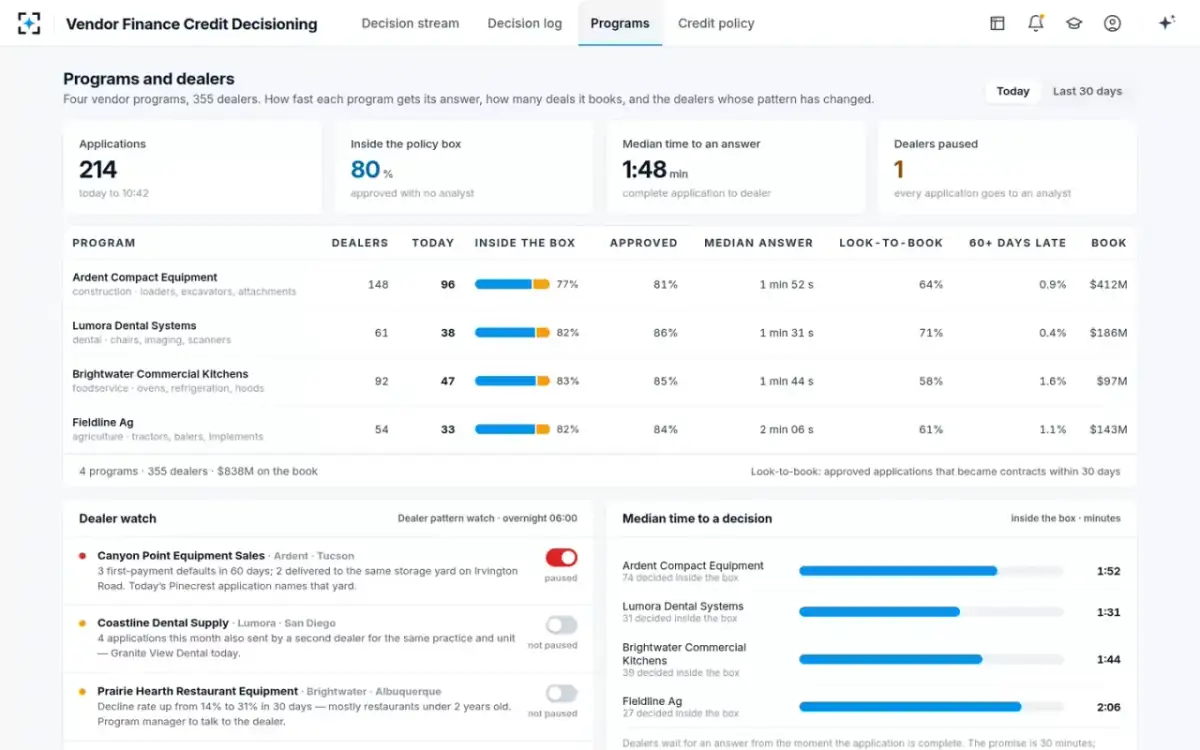
Applications by half hour, against time to a decision
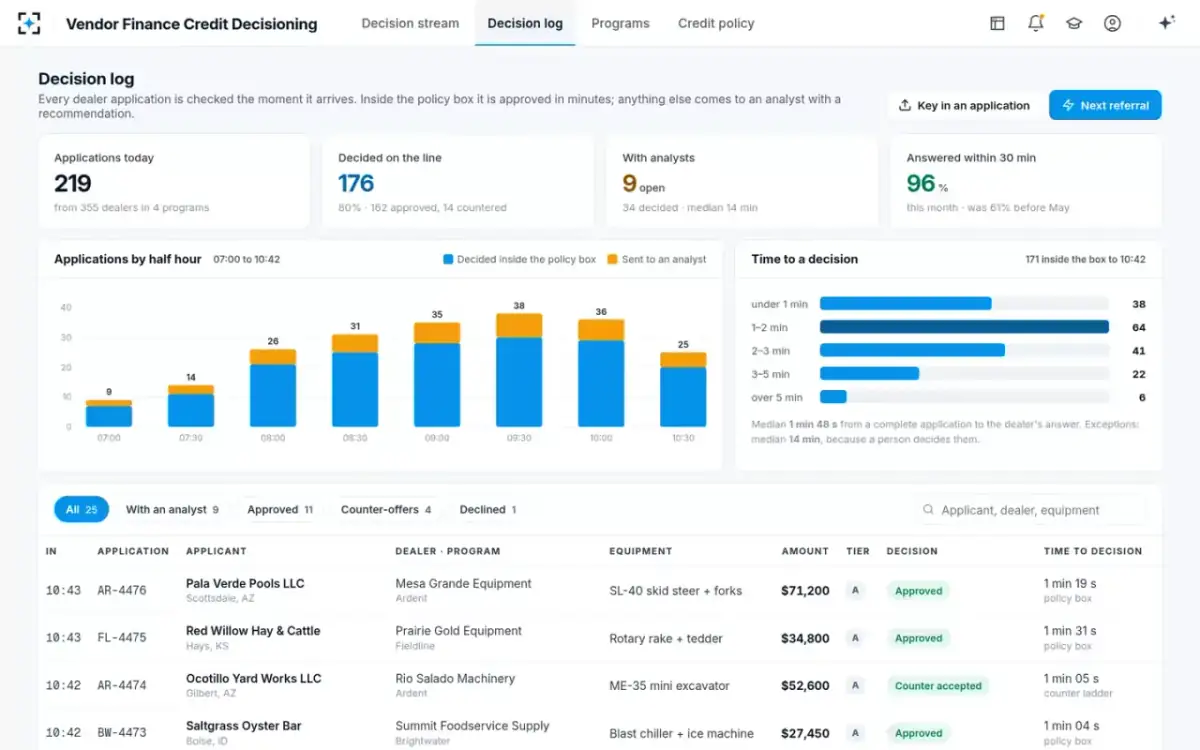
What it does cover, honestly, is the part of the cost a finance team can act on without changing anything about the credit policy itself: the same six tasks, the same exceptions, done in loaded minutes instead of loaded hours. Where those six tasks sit in the actual credit decision, and who still signs each one, is covered in who decides a vendor finance application, seat by seat.
How do you measure the roi of equipment finance automation?
Price one exception from its real tasks and a loaded wage, not from an industry-wide approval-time figure that was never specific to this product. Multiply the hours saved per exception by the loaded hourly rate, then by how many exceptions the program actually sees in a month — a number pulled from the program's own decision log, not assumed. Everything else, including the speed a dealer experiences, is a separate and real benefit that this cost formula does not need in order to be honest.
Questions people ask
What does it cost to underwrite a business loan?
There is no single published figure, because it depends on the loaded wage of whoever does the work and how long the file actually takes. On this sample program's estimate, a credit analyst's time on one exception application costs about $241 before agents and $22 with them at the median wage, or $344 and $32 once benefits are added.
How much does a credit analyst cost per application?
At O*NET's published 2025 median wage for credit analysts, $83,510 a year, the hourly rate works out to about $40.15 before benefits and overhead. BLS data put benefits at 30% of private employers' compensation costs, which takes it to about $57 an hour. Applied to this sample program's six-task estimate, that is $241 to $344 per exception before agents, and $22 to $32 with them; only the applications that need a person carry the cost.
How many hours does it take to underwrite an equipment loan?
For the roughly one in five applications that don't clear a policy box automatically, this sample program estimates about six hours of working time across six tasks — reading, verifying, pulling bureaus, reading statements, running policy and writing the decision. The other four in five are decided automatically, in minutes, with no analyst hours at all.
What is the ROI of AI underwriting?
It is the loaded hours saved per exception, multiplied by the loaded hourly rate, multiplied by how many exceptions a program actually sees in a month — not a single industry multiplier. On this sample program's estimated hours, that is about $219 saved per exception at the median wage, or $313 with benefits, before volume is factored in.
How much of underwriting time is administrative?
On this sample program's own six-task estimate, verifying the business, the owner and the contact details, checking records against a registry and a file rather than judging the credit, is tied with reading bank statements as the largest task by hand, a quarter of the time each, and is the largest with agents, about 27%. That is closer to administrative than analytical, though it still ends in a judgement call when something doesn't match.
Is automated underwriting worth the cost for small tickets?
On the cost side alone, the arithmetic favors it for any program with a meaningful volume of exceptions: at about $219 saved per exception at the median wage, a hundred a month is about $22,000, and in the sample program the clean majority of small-ticket applications never needs an analyst at all. The honest caveat is that this guide prices labor, not the risk of a missed exception, which is a separate question worth its own review.