Can AI legally decide a business loan? Regulation B covers business credit as well as consumer credit, and its answer does not turn on who or what made the decision. The rule asks for the real, specific principal reasons behind an adverse action, and the Consumer Financial Protection Bureau has already said a creditor cannot use a model's complexity as an excuse for failing that standard. For a fair-lending reviewer looking at an agentic system like Botminds' Vendor Finance Credit Decisioning, the test is the same test Regulation B has always set for a person doing the underwriting: can the decision point to its real reasons, in writing, on request. What changes with an agentic engine is how much evidence is available to answer that question, not the question itself.
Regulation B doesn't ask who decided — it asks for the reasons
Regulation B's adverse-action rule is built around content, not authorship. A creditor that declines an application, in whole or in part, owes the applicant "a statement of specific reasons for the action taken" (§1002.9(a)(2)(i)), and that statement "must be specific and indicate the principal reason(s) for the adverse action" (§1002.9(b)(2)). Nowhere does the rule ask whether a loan officer, a committee or a model produced that decision. It asks only whether the applicant can be told, specifically and accurately, why.
That framing is good news and a trap in the same sentence for an AI-run credit engine. Good news, because it means an agentic system is not disqualified by being an agentic system — Regulation B was written to be indifferent to the decision-maker. A trap, because "indifferent to the decision-maker" is not the same as "lenient on the reasons." A system that cannot produce the specific, accurate reason behind every adverse action fails the same test a human underwriter who waves at a dashboard and says "the numbers didn't work" would fail.
Why "the model scored it low" has never been a sufficient reason
Long before agentic AI, Regulation B already ruled out the shortcut a complex model invites. The rule states plainly that "statements that the adverse action was based on the creditor's internal standards or policies or that the applicant ... failed to achieve a qualifying score on the creditor's credit scoring system are insufficient" (§1002.9(b)(2)). A credit score, by itself, was never an acceptable reason — only the specific factors a score or a rule actually weighed are.
That is the standard a decision writer has to clear whether the engine behind it is a committee's judgment, a traditional scorecard, or six specialised agents. "Declined by policy" says nothing a reviewer, or an applicant, can act on. "Declined because total exposure of $184,600 exceeds the $150,000 application-only limit, driven by a 2024 contract the bureau also shows" says exactly what to check and exactly what would have to change.
The CFPB's own words on complex algorithms and AI
"A creditor cannot justify noncompliance with ECOA and Regulation B's requirements based on the mere fact that the technology it employs to evaluate applications is too complicated or opaque to understand."
Consumer Financial Protection Bureau, Circular 2022-03
Circular 2022-03 was written specifically to close the door an opaque model might otherwise open. It rests on Regulation B's own official interpretation, which it quotes: "the specific reasons disclosed ... must relate to and accurately describe the factors actually considered or scored by a creditor" (comment 9(b)(2)-2). The same interpretation adds that disclosing more than four reasons "is not likely to be helpful to the applicant", so the job is to find the principal ones, not to list everything the engine looked at. A creditor using a model it cannot fully explain does not get a lower bar for its reasons; it gets the same bar, with the added burden of having to produce an explanation its own technology was not necessarily built to give.
That is precisely the design question an agentic credit engine has to answer before a fair-lending reviewer asks it: can every reason the decision writer drafts be traced back to a named rule, a named bureau finding, a named bank-statement line — or does it, at some point, fall back to a number nobody downstream of the model can explain. Vendor Finance Credit Decisioning's architecture answers that by keeping the policy a readable ladder of named rules rather than a composite score, so a reason is a citation, not a summary of one.
A counteroffer is not an adverse action — until it's declined
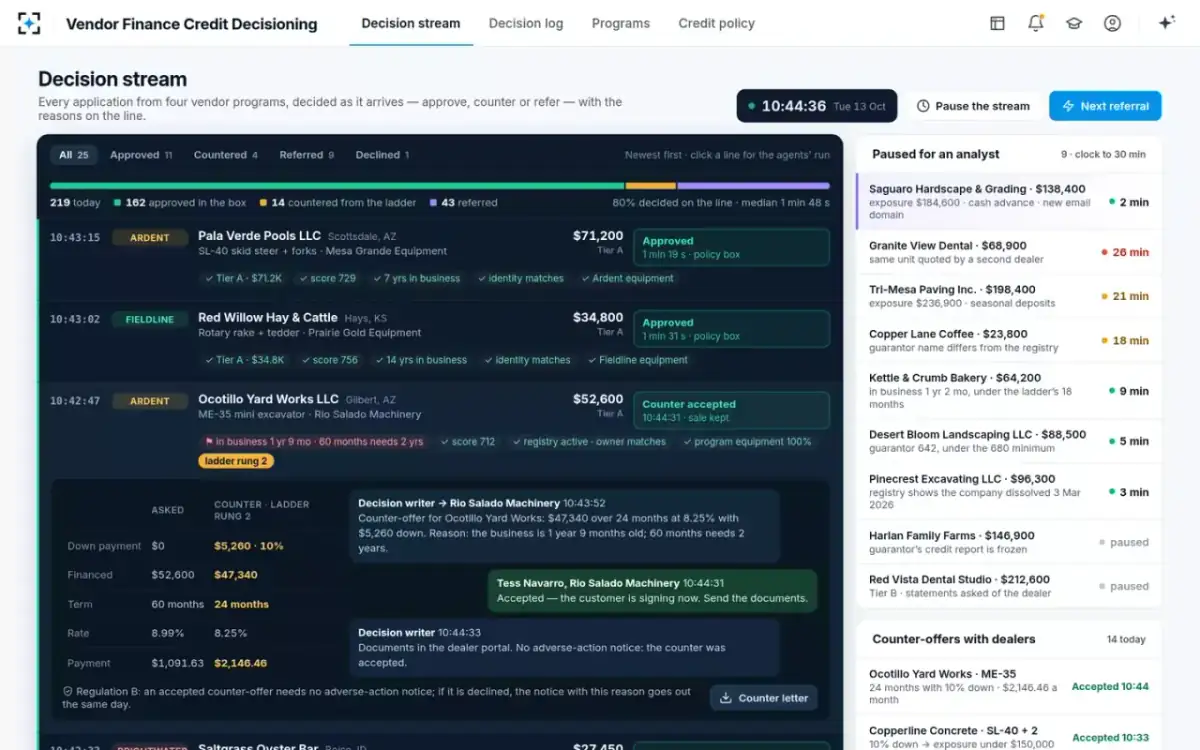
Not every answer short of a full approval is an adverse action in the first place. Regulation B's own definition excludes "a refusal to grant credit in substantially the amount or on substantially the terms requested in an application unless the creditor makes a counteroffer ... and the applicant uses or expressly accepts the credit offered" (§1002.2(c)(1)(i)). An AI-run counter ladder sits squarely inside that carve-out: an accepted counter was never a refusal to begin with, agentic or not.
The carve-out is specific to acceptance, and an engine that treats every counter as automatically notice-free misreads it. A counter that is declined, ignored, or only partly accepted falls straight back into the ordinary reasons-and-notice rules — which means a decision writer has to be able to draft the full adverse-action notice for a declined counter just as readily as it skips one for an accepted counter. How a counter ladder turns a near-miss into a signed yes works through one accepted counter in detail.
Business credit's own notice rules, and the $1 million line
Business credit is not notified exactly like consumer credit, and the difference turns on the size of the business. For an applicant with gross revenues of $1 million or less in its preceding fiscal year, the creditor follows the consumer timetable, 30 days from a completed application, with two easements: the statement of the action taken may be oral or written, and the disclosure of the right to a statement of reasons may be given at the time of application. A business over that line gets a lighter obligation: notice of the action taken "within a reasonable time", orally or in writing, and a written statement of reasons only if it asks in writing within 60 days (§1002.9(a)(3)). The creditor may rely on what the applicant says its revenue is.
Which notice rules a business applicant gets, by who is lending and how large the business is
| Applicant | Timing | The action taken | The reasons |
|---|---|---|---|
| Business with $1 million or less of gross revenue last fiscal year (and any start-up) | Within 30 days of a completed application; 90 days after an unaccepted counter | Orally or in writing | In writing, or a written disclosure of the right to ask for them, which may be given at application |
| Business with more than $1 million of revenue | Within a reasonable time; 30 days always counts as reasonable | Orally or in writing | In writing, if the applicant asks in writing within 60 days |
| Trade credit: a seller financing its own goods, such as a supplier financing equipment | As for the larger business, whatever the applicant’s size | Orally or in writing | In writing, on written request within 60 days |
| Credit from a bank or other financial institution for the same equipment | Not trade credit: by revenue, as in the first two rows | As above | As above |
The trade-credit row matters for vendor finance in particular. Regulation B's official interpretation limits trade credit to "a financing arrangement that involves a buyer and a seller—such as a supplier who finances the sale of equipment", and says the term does not apply to credit from "a bank or other financial institution for the financing of such items" (comment 9(a)(3)-2). Whether a manufacturer's finance arm, or a funder lending through a dealer, sits in the lighter row is a question for counsel to settle before the engine is configured, not after the first complaint.
For a vendor finance program running mostly small-ticket deals, the $1 million line is not a technicality — it decides which notice regime the decision writer has to be built to produce by default, and which one it only has to be ready to produce on request. A system that assumes every business applicant sits above the line, because most of its own book happens to, will eventually meet one that does not.
What a compliant AI-drafted reason actually looks like
Reasons that fail Regulation B, and the same decisions with reasons that pass
Insufficient: Does not meet our credit standards.
Specific, from the rule that missed: Total exposure with us of $184,600, including an existing 2024 contract, is above the $150,000 limit for an application-only decision.
Insufficient: Application score below our threshold.
Specific, from the rule that missed: Business formed 1 year 9 months ago; a 60-month term requires 2 years in business.
Insufficient: Declined by policy.
Specific, from the rule that missed: Fixed payments, including a cash advance debited daily since 17 August, would be above 12% of average monthly deposits.
Insufficient: Unable to verify.
Specific, from the rule that missed: We could not confirm the application with the owner at the telephone number on our existing contract.
"Compliant" is not a label a product can wear; it is a property of each individual reason, checked against the rule that governs it. The table below maps four of Regulation B's obligations to the specific control in Vendor Finance Credit Decisioning's sample program that is meant to satisfy each one, and the evidence a reviewer could ask to see.
Regulation B's obligations, mapped to a control and its evidence
A statement of specific reasons for adverse action (§1002.9(a)(2)(i))
The controlThe decision writer drafts reasons from the policy rules and the agents’ own findings, not a model score
The evidenceEach reason cites the rule, the applicant’s value and the threshold it missed
Internal standards or a bare low score are insufficient (§1002.9(b)(2))
The controlPolicy and pricing engine approves or counters against named, signed rules, never a composite score
The evidenceThe policy ladder a reason points to is itself readable, rule by rule
A prohibited basis may never be used
The controlCredit bureau analyst’s own limit: never uses a prohibited basis under Regulation B
The evidenceInputs are bureau, bank-statement and registry facts, named in the reason
A signature on every decline or off-ladder counter
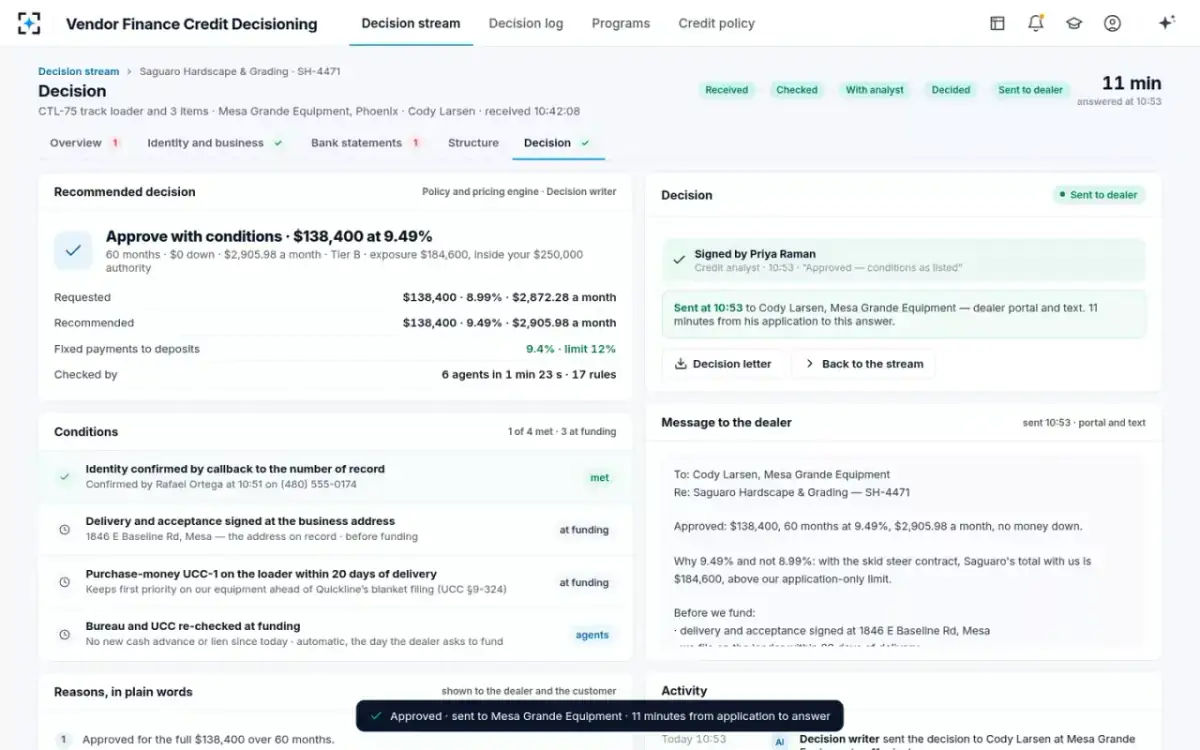
The controlDecision writer never sends one without a credit analyst’s or manager’s signature
The evidenceThe signed decision carries who signed it and when
The decision writer's own job, in the sample program, is written narrowly on purpose: it writes the reasons in plain words, the conditions and when each must be met, and — when a decline or an off-ladder counter is needed — the Regulation B notice with specific reasons, but it never sends a decline or an off-ladder counter without a credit analyst's or manager's signature. The credit bureau analyst carries its own limit alongside it: it never uses a prohibited basis under Regulation B. Neither claim is a certification. Both are the specific, checkable constraints a reviewer can ask to see enforced, decision by decision.
The signed decision: reasons, conditions and a signature with its meaning
An accepted counter: no adverse-action notice needed, and why
Where SR 26-2's silence on agentic AI leaves a fair-lending reviewer
The four texts a fair-lending review will cite, and how much each one binds
| Text | What it is | What it says about an AI decision |
|---|---|---|
| Regulation B, 12 CFR 1002.9 | Regulation, binding on every creditor | Specific principal reasons for adverse action; internal standards or a failed score are insufficient |
| Official interpretations, Supplement I | The Bureau’s binding reading of the regulation | Reasons must relate to and accurately describe the factors actually considered or scored; more than four is unlikely to help |
| CFPB Circular 2022-03 | Policy statement on how the Bureau reads the law | Complexity or opacity of the technology is no excuse for missing the reasons requirement |
| SR 26-2, model risk guidance (April 2026) | Supervisory guidance from the Federal Reserve, FDIC and OCC | Generative and agentic AI are outside its scope; the bank’s own governance should decide the controls |
The banking agencies' own model risk guidance does not currently reach into this question at all. The Federal Reserve, FDIC and OCC's Supervisory Guidance on Model Risk Management, issued with SR 26-2 on 17 April 2026, states in a footnote: "Generative AI and agentic AI models are novel and rapidly evolving. As such, they are not within the scope of this guidance." The same footnote adds that a bank's "risk management and governance practices should guide the determination of appropriate governance and controls for any tools, processes, or systems not covered in this document" — so the absence of specific coverage is not an absence of obligation, only an absence of a tailored federal framework to point to.
For fair lending specifically, that gap matters less than it first appears to. ECOA and Regulation B do not wait on a model risk framework to apply to a credit decision; they apply to the decision itself, however it was produced. A fair-lending review of an agentic credit engine today rests on the same statute and the same regulation it would rest on for a human underwriter — SR 26-2's silence changes what a model-risk team can cite, not what a fair-lending team has to check.
What a fair-lending reviewer should ask an AI credit decisioning vendor for
- Every adverse-action reason, traced to a named rule or finding
Not a model score or a composite risk tier — the specific policy test, bureau line or statement figure the reason points to.
- The counteroffer logic, and what happens when one is declined
An engine that treats every counter as notice-free, rather than every accepted one, is misreading the exclusion.
- Where the $1 million business-revenue line is applied
Confirm the system knows which notice regime a given business applicant falls under, not just one default.
- What inputs can and cannot be used
Ask specifically how a prohibited basis is excluded from every input the engine reads, not only the final rule.
- Who signs a decline, and who signs an off-ladder counter
An engine that can send either without a person’s signature has already failed the question before the reasons are checked.
Can a lender say the computer decided?
Not as a reason, no. "The computer decided" or "the model scored it low" has never satisfied Regulation B's specific-reasons requirement, for any model, and the CFPB's 2022 circular closes off the version of that answer that hides behind complexity instead of a plain refusal to explain. What a lender can say is what the specific rule, bureau finding or statement figure was that drove the outcome — which is a harder standard to meet with an opaque model, and exactly the standard an agentic system's own design should be built to meet by keeping its reasons traceable from the start.
Questions people ask
Does Regulation B apply to AI lending decisions?
Yes, in full. Regulation B governs credit decisions, not the method used to make them, so an AI-run or agentic credit engine owes every applicant the same specific-reasons and notice obligations a person-run process would owe.
What does an adverse action notice have to say for business credit?
A statement of the action taken and the specific principal reasons for it, on a clock and in a form that depends on the business's revenue. A business with $1 million or less in gross revenue is notified within 30 days, orally or in writing, with the reasons or the right to ask for them in writing; a larger business is owed notice within a reasonable time and written reasons if it asks in writing within 60 days.
Does accepting a counter offer require an adverse action notice?
No. Regulation B's definition of adverse action excludes a counteroffer the applicant uses or expressly accepts. A counter that is declined, or only partly accepted, is not covered by that exclusion and falls back into the ordinary notice requirements.
What reasons are not specific enough for an adverse action notice?
Any reason that names a process rather than a fact — "the creditor's internal standards or policies," or a bare statement that the applicant did not achieve a qualifying score. Regulation B states both explicitly as insufficient; a sufficient reason names the actual factor that was considered or scored.
What is the CFPB's position on AI and complex credit models?
That technical complexity is not a defense. Circular 2022-03 states that a creditor cannot excuse noncompliance with Regulation B's reasons requirement on the grounds that its own technology is too complicated or opaque for it to explain, and that the reasons it gives must accurately describe the factors the technology actually considered.
How does fair lending apply to an AI credit decisioning engine?
The same way it applies to any credit decisioning process: every outcome has to trace to specific, accurate, non-prohibited reasons, and the engine has to be able to produce them on the same terms Regulation B has always required. An agentic engine with no federal model-risk framework specifically naming it is not exempt from ECOA and Regulation B, which apply directly regardless.