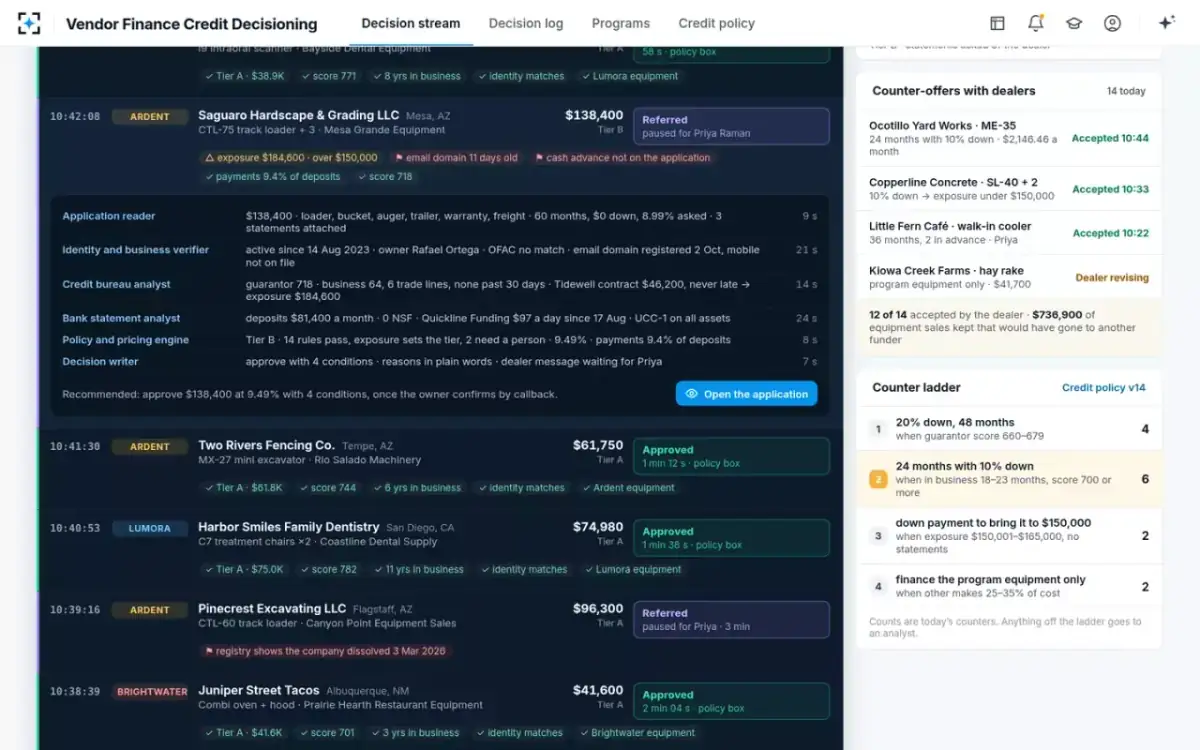
Agentic AI for loan underwriting, done honestly, is not one model that reads an application and spits out a decision. In Vendor Finance Credit Decisioning it is six specialist agents, each doing one narrow job a careful underwriter already does by hand — reading the application, verifying the business, pulling the bureaus, reading the bank statements, applying the policy, writing the decision — and each one built with a specific thing it may never do on its own. On a fictional $138,400 application the six agents check seventeen policy rules and stop for a person in 1 minute 23 seconds, as they should. What makes that defensible to a technical evaluator or a compliance reviewer is not the minute and a half; it is the four lines no agent crosses.
The example on this page is a fictional sample application: Saguaro Hardscape & Grading, $138,400 for a compact track loader, run through a fictional vendor program. The regulatory and research sources are linked where they appear.
Six agents, seventeen rules, one referral stopped for a person
6
specialist agents on every application, every time
17
policy rules checked on the $138,400 Saguaro application
1:23min
for all six agents to run and stop for a person
0
declines or off-ladder counters an agent may sign by itself
Where the 1 minute 23 seconds went, agent by agent
- Application reader9 s
- Identity and business verifier21 s
- Credit bureau analyst14 s
- Bank statement analyst24 s
- Policy and pricing engine8 s
- Decision writer7 s
Six agents, four stages, one application
The six agents sit in roughly the order an underwriter would work a file: read it, verify it, pull the bureaus and the statements, apply the policy, write the decision. Nothing about that order is new — it is the same sequence a credit analyst already followed by hand. What changes is who reads every page of every statement and who checks the registry against the file before a person ever opens the application.
One application, six agents, and the line none of them crosses
Agent
Application readerReads the application, quote and invoice, and splits cost into program equipment, other makes and soft costs.
Never: Never alters a figure the dealer sent — reports differences instead.
Agent
Identity and business verifierChecks the state registry and OFAC lists, and compares email, phone and address with the file on record.
Never: Never clears a fraud flag itself, and never calls the number on the application.
Agent
Credit bureau analystReads the guarantor’s personal report, the business report and equipment payment history, and adds up exposure.
Never: Never uses a prohibited basis under Regulation B; a soft pull only, before a decision.
Agent
Bank statement analystReads every statement page in any layout: deposits, balance, NSF, recurring debits, cash advances and UCC filings.
Never: Never counts a transfer between the borrower’s own accounts as revenue.
Agent
Policy and pricing engineApplies the signed policy, sets the tier and rate, and offers a counter when exactly one rule misses and a rung covers it.
Never: Never declines — a decline, or any counter off the ladder, goes to a person.
Agent
Decision writerWrites the reasons in plain words, the conditions, and the Regulation B notice when one is needed.
Never: Never sends a decline or an off-ladder counter without a signature.
A person decides
Credit analyst or credit managerSigns anything the six agents could not finish alone — a decline, an exception, a callback result, a judgement call.
Four stages fall out of that chain naturally: reading (the application reader), verifying (identity and business, credit bureau, bank statements — three agents working the same file from three different sources), deciding (the policy and pricing engine), and writing (the decision writer). The middle stage is where most of the actual checking happens, and it is also where three separate agents are deliberately kept from simply trusting each other's output — the bureau analyst's exposure total and the statement analyst's fixed-payments figure both feed the policy engine independently, each citing its own source.
The application reader: never changes a number the dealer sent
The application reader's job sounds trivial and is not: read the dealer's application, quote and invoice, and split the cost into program equipment, other makes and soft costs, because a program's policy often treats those differently. On the Saguaro file that means separating the Ardent CTL-75 track loader from the attachment and the trailer, since one program rule caps non-program equipment as a share of the deal.
Its one hard limit matters more than its reading: it never alters a figure the dealer actually sent. If the invoice and the application disagree, the reader reports the difference rather than picking one — a quiet design choice that keeps every later agent working from the dealer's own numbers, not a corrected or smoothed version of them, and cites the page and field for every value it reads.
The identity and business verifier: never clears its own fraud flag
Business impersonation is built around facts that usually check out: the name, the formation date, the address. The identity and business verifier finds the business in the state registry, screens the entity and its owners against the OFAC lists, and compares the application's email, phone and delivery address against the file already on record — including the age of the email domain, since a freshly registered domain on an otherwise clean application is the pattern impersonation leaves behind.
Who counts as an owner worth screening is its own small rule. For a bank, the Financial Crimes Enforcement Network's customer due diligence rule defines a beneficial owner by two tests: "each individual, if any, who, directly or indirectly ... owns 25 percent or more of the equity interests" of the business, and "a single individual with significant responsibility to control, manage, or direct" it (31 CFR 1010.230(d)). A nonbank funder is not bound by that rule, but a program that adopts the same two tests screens the same people a bank would; the sample program's policy also requires a guarantee from owners of 51% or more. And whatever the verifier finds, it never resolves itself: a changed email or phone, or a domain under 90 days old, needs a person to call the number of record — never the number on the application — and record what that call found.
The credit bureau analyst: a soft pull, never a prohibited basis
The credit bureau analyst reads three reports for one application: the guarantor's personal credit, the business's own report, and the equipment payment history, then adds the customer's other open contracts to a single exposure total — the number that decides which tier, and which limit, the rest of the file is tested against. On Saguaro, that total included a 2024 skid steer contract the application itself did not mention, which is what pushed exposure to $184,600 against a $150,000 application-only limit.
Its limit is a compliance line, not a technical one: the agent never uses a prohibited basis under Regulation B, and it pulls softly, before any decision is made, rather than running a hard inquiry that would itself cost the applicant something. What the bureau analyst returns is a number and a history, never a reason — the reason, if one is owed to the applicant, is written downstream by a different agent entirely.
The bank statement analyst: never counts a transfer as revenue
Bank statements are where small-ticket underwriting spends the most unglamorous hours, because they arrive in every bank's own layout and a one-off cash advance rarely announces itself as one. The bank statement analyst reads every page: deposits by month, average daily balance, NSF and overdrafts, every recurring debit by name, and any cash advance along with its UCC filing. On Saguaro's three months of statements, it found $35,000 deposited from Quickline Funding on 15 August, a $97 debit every business day since, and a UCC-1 filed against all of Saguaro's assets three days later — a merchant cash advance the dealer's application never listed.
Its limit protects the one number the rest of the policy depends on: it never counts a transfer between the borrower's own accounts as revenue, which would otherwise inflate the deposits a fixed-payments ratio is measured against. With the Quickline debit included, Saguaro's fixed payments came to 9.4% of deposits — inside the program's 12% Tier B maximum, but only once the undisclosed advance was actually counted.
The policy and pricing engine: approves inside the box, counters from the ladder, never declines
The policy and pricing engine is the one agent that looks like a model from the outside and, by the current interagency guidance's own definition, is not quite one. Supervisory guidance on model risk management defines a "model" as a method that "applies statistical, economic, or financial theories to process input data into quantitative estimates," and explicitly excludes "deterministic rule-based processes and software where there are no statistical, economic, or financial theories underpinning their design or use" — the category a seventeen-rule, credit-manager-signed policy ladder sits closest to. The same guidance puts "generative AI and agentic AI models" outside its scope altogether, so the agents that read and verify are governed by the bank's own controls, which is one more reason each carries a written limit.
What it actually does is narrow by design: apply the policy in force, set the tier, set the rate, and approve when every Tier A or Tier B rule passes. When exactly one rule misses and a rung of the signed counter ladder covers it, it offers that counter — Ocotillo Yard Works' business was three months short of the two years a sixty-month term needs, so the line offered twenty-four months at 10% down instead of queuing the file, and the dealer accepted thirty-nine seconds after the offer. Its hard limit is the one line that keeps all of this inside what a person actually signed: it approves only inside the box the credit manager sets, counters only from the ladder he signs, and never declines — a decline, and any counter that is not on that ladder, goes to a person every time.
The decision writer: never sends a decline or an off-ladder counter unsigned
The decision writer turns an approval, a counter or a referral's recommendation into the words a dealer and a borrower actually read: the reasons in plain language, the conditions and when each has to be met, and, when the answer is not the one asked for, the Regulation B notice with specific reasons. Those reasons have to be real ones — the regulation is explicit that statements resting on "internal standards or policies" are not a sufficient reason for an adverse action, so the writer's job is to name the actual finding, not a policy code.
On Saguaro's approval, the conditions included a purchase-money filing on the loader within twenty days of delivery, because a blanket lien had already been found on the business's assets. That timing is not arbitrary: a purchase-money security interest in equipment keeps its priority over an earlier blanket lien only if it is "perfected when the debtor receives possession of the collateral or within 20 days thereafter," under the Uniform Commercial Code. The writer's hard limit covers the other side of the same coin — it never sends a decline, or a counter that is not on the signed ladder, without a person's signature on it first.
Six agents, four lines none of them crosses
| Agent | Decide or send a decline alone | Change what the dealer or statements said | Clear a flag without going back to the source | Use a basis the law forbids |
|---|---|---|---|---|
| Application reader | — | Never | — | — |
| Identity and business verifier | — | — | Never | — |
| Credit bureau analyst | — | — | — | Never |
| Bank statement analyst | — | Never | — | — |
| Policy and pricing engine | Never | — | — | — |
| Decision writer | Never | — | — | — |
What happens when none of the six agents can finish the job?
Most applications never need an answer to this question — on a sample day, 80% of applications were decided on the line with no analyst at all, at a median of 1 minute 48 seconds. The ones that do are the point of the whole design: a deal the box can't approve and the ladder can't counter stops, with every agent's finding already cited, and goes to a credit analyst with a recommendation rather than a blank file.
What the policy and pricing engine proposes, against what a person actually decides
The policy and pricing engine: Approves at the program rate. Nothing is queued.
A credit analyst or credit manager: Not involved — there is nothing to sign.
The policy and pricing engine: Offers the pre-agreed counter; the dealer accepts or declines it.
A credit analyst or credit manager: Not involved at the moment of the offer — the ladder was signed in advance.
The policy and pricing engine: Stops and recommends a decision, with every finding cited.
A credit analyst or credit manager: An analyst decides: the callback, the judgement call, the structure.
The policy and pricing engine: Drafts the reasons and, if needed, the Regulation B notice.
A credit analyst or credit manager: An analyst or the credit manager signs it before it goes anywhere.
The policy and pricing engine: Recommends only — it has no authority here at all.
A credit analyst or credit manager: The credit manager decides and signs, every time.
A referral, opened with the run already done
The policy ladder, rule by rule
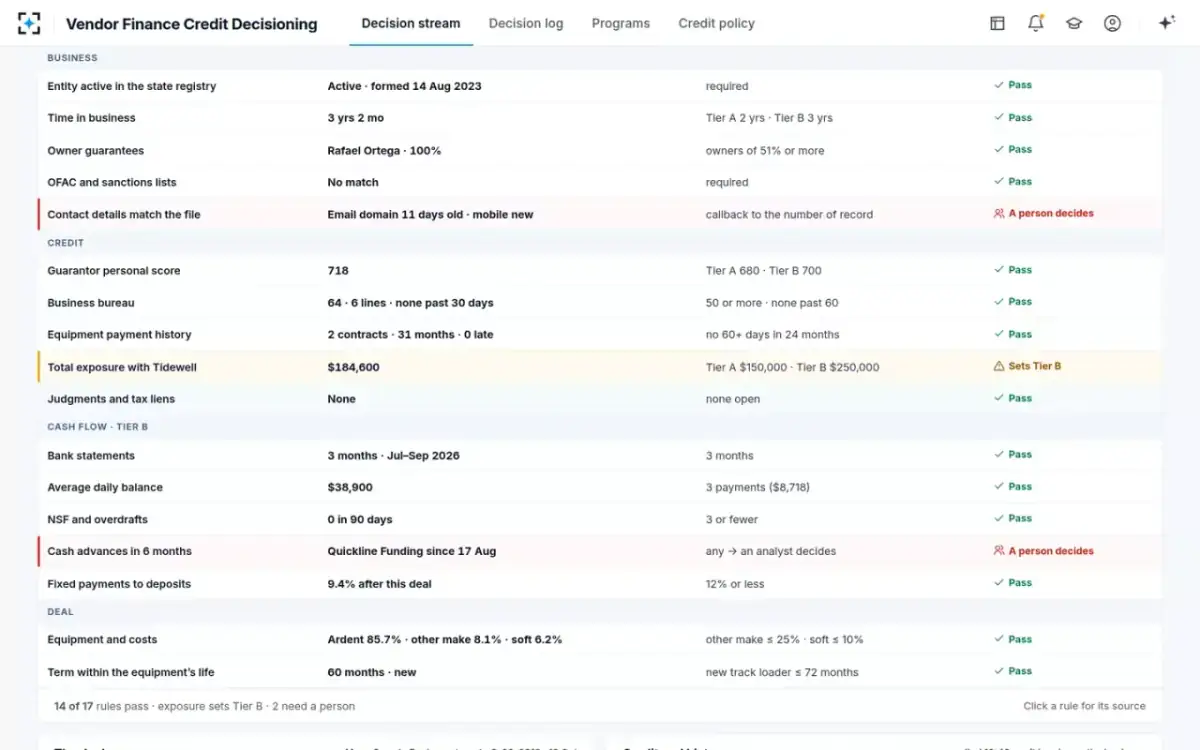
Nothing about a referral is a dead end for the agents, either: their work is still the evidence a person works from, which is why Priya Raman's screen on a referral opens with the run already finished rather than a blank application. What the six agents never do is substitute for the signature a decline, an exception or an off-ladder counter still needs. For how that referral actually gets decided — the callback, the structure calculator, the signature — see who decides a vendor finance application, seat by seat.
Questions people ask
What is agentic AI for loan underwriting?
It is a set of specialist agents, each handling one part of the underwriting work — reading the application, verifying the business, pulling the bureaus, reading statements, applying policy, writing the decision — rather than one model producing a single score. In Vendor Finance Credit Decisioning that is six agents, each with a specific thing it may never do alone.
Can AI agents approve a loan by themselves?
Yes, inside a box a credit manager has already signed. The policy and pricing engine approves automatically when every rule in the signed policy passes, and offers a pre-agreed counter when exactly one rule misses. It never approves outside that box, and it never declines — any decline goes to a person.
What can’t an AI agent do in loan underwriting?
In this system, specifically: change a number the dealer sent, clear its own fraud flag, use a basis Regulation B forbids, or send a decline or an off-ladder counter without a person's signature. Each of the six agents carries its own version of one of these limits, not a general promise to "be careful."
What stops an AI agent from declining an application?
A design limit stated on the policy and pricing engine itself: it approves inside the box and counters from the signed ladder, and nothing else — a decline is outside both, so it is drafted by the decision writer and signed by a credit analyst or credit manager before it is ever sent.
How many agents does an AI underwriting system use?
There is no fixed number across vendors; it depends on how finely the work is divided. This system uses six — application reading, identity and business verification, credit bureau analysis, bank statement analysis, policy and pricing, and decision writing — each with its own cited sources and its own stated limit.
AI credit underwriting vs AI mortgage underwriting: what’s different?
The shape is similar — read the application, verify identity, pull credit, check cash flow, apply policy, write the decision — but the documents and the rules differ. Equipment and vendor-finance underwriting reads dealer quotes and invoices and checks UCC filings on the collateral; mortgage underwriting reads appraisals and title work and checks a different set of federal disclosures entirely.