AI credit decisioning is usually judged by one question — how accurate is it — and that question is the wrong place to start. The current interagency guidance on model risk management does not ask how accurate a system is before anything else; it asks what the system actually is, because the answer changes which rules apply. A seventeen-rule policy ladder a credit manager signs is not tested, documented or governed the same way a statistical model is, and the guidance says so in its own definitions. This guide works through what that means for a real referral, not an abstract one.
The worked example is a fictional sample application, Saguaro Hardscape & Grading's $138,400 equipment loan, as it runs through Vendor Finance Credit Decisioning. The regulatory sources are linked where they appear, and quoted exactly as the current guidance states them.
What a model-risk reviewer has to account for on one referral
6
agents whose findings a reviewer can trace
17
policy rules checked, each against a named threshold
4
distinct sources cited for Saguaro’s flags — contract, domain record, statement, UCC search
$138,400
the deal this guide works through, dollar by dollar
The question is not "is it accurate", it's "what is it"
Accuracy is measurable, but it is not the first fork in the road. Supervisory guidance on model risk management treats a model's governance, testing and documentation obligations as a function of what it is and how material its output is — not of how well it happens to perform on a backtest. A policy engine that is formally outside a bank's model inventory can still make a consequential decision on every application it touches, and the two questions — is it a model, and can it be trusted — do not have the same answer.
That distinction is not a technicality a vendor gets to wave away. It decides who has to sign off on a change to the engine, how often it is independently reviewed, and what has to be on file if an examiner asks why a given application was approved, countered or referred.
What SR 26-2 calls a model — and what it explicitly does not
The Federal Reserve, FDIC and OCC's joint Supervisory Guidance on Model Risk Management, issued 17 April 2026 as SR Letter 26-2, defines a model for the purposes of bank supervision, and the definition has teeth: it covers a method that applies "statistical, economic, or financial theories to process input data into quantitative estimates," and it explicitly excludes simple arithmetic and "deterministic rule-based processes and software where there are no statistical, economic, or financial theories underpinning their design or use." A seventeen-rule policy ladder — if a guarantor's score clears a threshold, if time in business clears a minimum, if exposure stays under a limit — is arithmetic and comparison, not statistics.
The guidance goes further on the newest technology, in a footnote: "Generative AI and agentic AI models are novel and rapidly evolving. As such, they are not within the scope of this guidance." The same passage adds that its principles still "apply to traditional statistical and quantitative models and non-generative, non-agentic AI models" — leaving a six-agent credit decisioning engine formally outside SR 26-2's scope, even though its own principles are the obvious yardstick to measure the engine against voluntarily.
Does a 17-rule policy ladder count as a model?
By the guidance's own text, no — and that answer is doing real work, not splitting hairs. The policy and pricing engine compares a dozen or so values against thresholds a credit manager set and signed; there is no statistical or economic theory producing those thresholds, only a program's own risk appetite written down as a rule. That puts it squarely inside the guidance's own exclusion for deterministic, rule-based software, the same way a loan amortization spreadsheet is excluded even though it processes numbers into an estimate.
What is less settled is everything around the ladder: the agents that read the application, verify the business and read the statements before the ladder ever runs. None of them score or predict in the statistical sense either — they extract and compare — but "agentic AI" is the guidance's own phrase for exactly this kind of system, and the guidance says plainly that agentic systems sit outside its scope for now. A bank relying on this engine inherits the gap: the guidance's principles are the right standard to apply, but applying them is the bank's own choice, not something SR 26-2 requires of an agentic system today.
SR 26-2's own elements of model risk, mapped against this engine
| SR 26-2 element | What the guidance means by it | What it looks like on this engine |
|---|---|---|
| Inherent risk | Assumptions, complexity, input quality and data constraints built into the method itself. | A rule ladder has few assumptions and no training data to drift — its risk is in whether the written rule still fits. |
| Model exposure | "The significance of the model output to a banking organization’s business decisions," measurable by portfolio size. | Measurable in dollars on every file: $138,400 requested, $184,600 once the 2024 contract is added. |
| Model purpose | A qualitative read of how the output is used; models that help meet regulatory requirements or manage the bank’s financial risk exposures are “generally considered to be of greater risk”. | A credit decision manages credit risk exposure, and the engine decides or recommends on every application the program sends it. |
| Model materiality | Purpose and exposure together, deciding how much oversight a given use actually needs. | One $138,400 approval is immaterial to a bank’s book; the same ladder across every small-ticket deal in a program is not. |
Model exposure and materiality, applied to a $138,400 deal
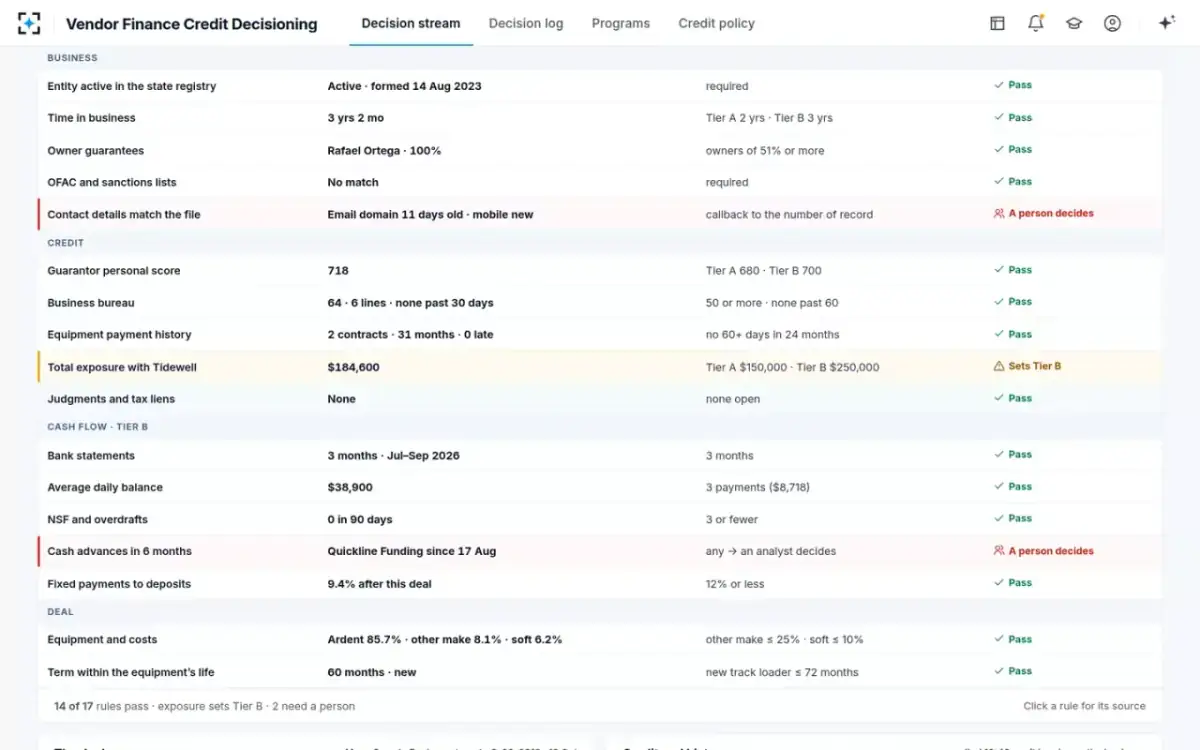
Exposure and materiality are not abstractions once a real number is behind them. Saguaro's requested amount was $138,400; its total exposure, once the 2024 skid steer contract the application did not mention was added in, came to $184,600 — the figure that actually decided which tier and which policy rules applied. One file at that size is immaterial to almost any bank's portfolio on its own. What makes materiality the right question for a risk committee is the aggregate: the same seventeen-rule ladder, deciding or recommending on every application a vendor program runs, however small each one looks alone.
That is also why "model exposure" is a cleaner test here than accuracy. The guidance defines it as "the significance of the model output to a banking organization's business decisions," and says it "can be quantitatively measured (e.g., by portfolio size)." A program running a hundred applications a week through the same policy settings has real exposure to whatever that policy gets wrong, consistently, in one direction — which is a different risk than any single decision being inaccurate.
Effective challenge: who checks the checker
Sound model risk management, under the guidance, leans on what it calls effective challenge: "critical analysis conducted by objective experts who evaluate model risk and effect appropriate changes throughout the model lifecycle, from model development to ongoing monitoring." The three qualities the guidance names are specific — the right expertise, real independence, and enough organizational standing to actually force a change — and all three are worth asking about even for a system the guidance does not formally require them of.
On this engine, the closest analogue to effective challenge sits with the credit manager who signs the policy and the ladder, and with whoever reviews his decisions above $250,000 or on a policy exception. Whether that reviewer is independent of the person who built the policy, and whether they have standing to actually change a rule that is producing bad outcomes, is a governance question the product's own settings do not answer — it is the bank's own org chart that does.
Why "internal standards" is not an acceptable reason under Regulation B either
A second, older body of law sets its own bar, independent of anything SR 26-2 decides about models. Regulation B requires a specific statement of reasons for an adverse action, and is explicit that statements that the action "was based on the creditor's internal standards or policies ... are insufficient." That rule does not care whether the decision came from a person, a statistical model or a deterministic rule ladder — a reason has to name the actual finding, not point at a policy.
Read next to SR 26-2's silence on agentic AI, this is the useful overlap: whatever a risk committee decides about whether the engine is a model, the decision writer's reasons still have to pass the older, better-settled test. On Saguaro's file the reasons were specific — exposure over the limit, a new email domain, an undisclosed cash advance — which is the standard either way.
A statistical model's risk profile, against a deterministic rule ladder's
A statistical or machine-learning model: Assumptions, training data and drift as conditions change.
This engine's policy and pricing ladder: Whether the written rules still match today’s risk appetite — a question for a person, not the engine.
A statistical or machine-learning model: Out-of-sample and out-of-time testing against the model’s design objective.
This engine's policy and pricing ladder: Replaying past applications against the current ruleset and checking the result by hand.
A statistical or machine-learning model: A model owner, through validation and model governance.
This engine's policy and pricing ladder: The credit manager, with every change versioned and signed.
A statistical or machine-learning model: Squarely in scope — the guidance’s main subject.
This engine's policy and pricing ladder: Excluded by the guidance’s own text on deterministic, rule-based software.
How to measure it: replay closed applications, and count by kind of error
Accuracy still has to be measured; it just has to be measured in the right units. The test the guidance describes for any model, whether it "performs as intended", becomes a replay for a rule-and-agent engine: take a set of the program's own decided applications, run them through the engine on the policy version that was in force, and compare every reading, every rule result and every final answer with what the analysts decided and what the documents show. One percentage hides the errors that matter, so the replay counts each kind separately.
What a replay of closed applications should count, and the line we would set
| What is counted | How | Our suggested line before go-live |
|---|---|---|
| Readings wrong: a figure the agents took from a document | Every extracted value against the source page | Each field read correctly on at least 99% of files; any misread amount on the deal itself fails the batch |
| Rule results different from the policy | Each of the 17 rule results against the same rule worked by hand | None: a rule ladder is deterministic, so any difference is a defect to fix, not a rate |
| False approvals | Approved on the line, where the documents show a rule should have failed | None in the replay set, with the sample large enough to bound the rate (next figure) |
| Flags missed | A changed contact detail, a cash advance or a lien the analyst found and the agents did not | None on the fraud and lien flags; each miss traced to a cause |
| Needless referrals | Sent to an analyst, where every rule in fact passed | Measured and reported; a cost, not a risk |
| Reasons that would fail Regulation B | Each drafted adverse-action reason against §1002.9(b)(2) | None |
The hard part is the zero rows. A replay with no false approvals does not prove the rate is zero; it bounds it. The statistician's rule of three, set out by Hanley and Lippman-Hand in JAMA in 1983, says that if no event is seen in n independent trials, the upper limit of a 95% confidence interval for its rate is about 3 ÷ n. That turns "how many files do we replay?" into arithmetic.
How low a clean replay can prove the false-approval rate, by number of files
On a program deciding about 200 applications a day, as in the sample, 600 closed files is three days of volume, and the replay can be drawn from the last quarter so it includes the referrals, counters and declines, not only the clean approvals. The same replay is the test for every later change to the policy: run the proposed version over the same files and read the differences before anyone signs it.
What a defensible activity trail has to show
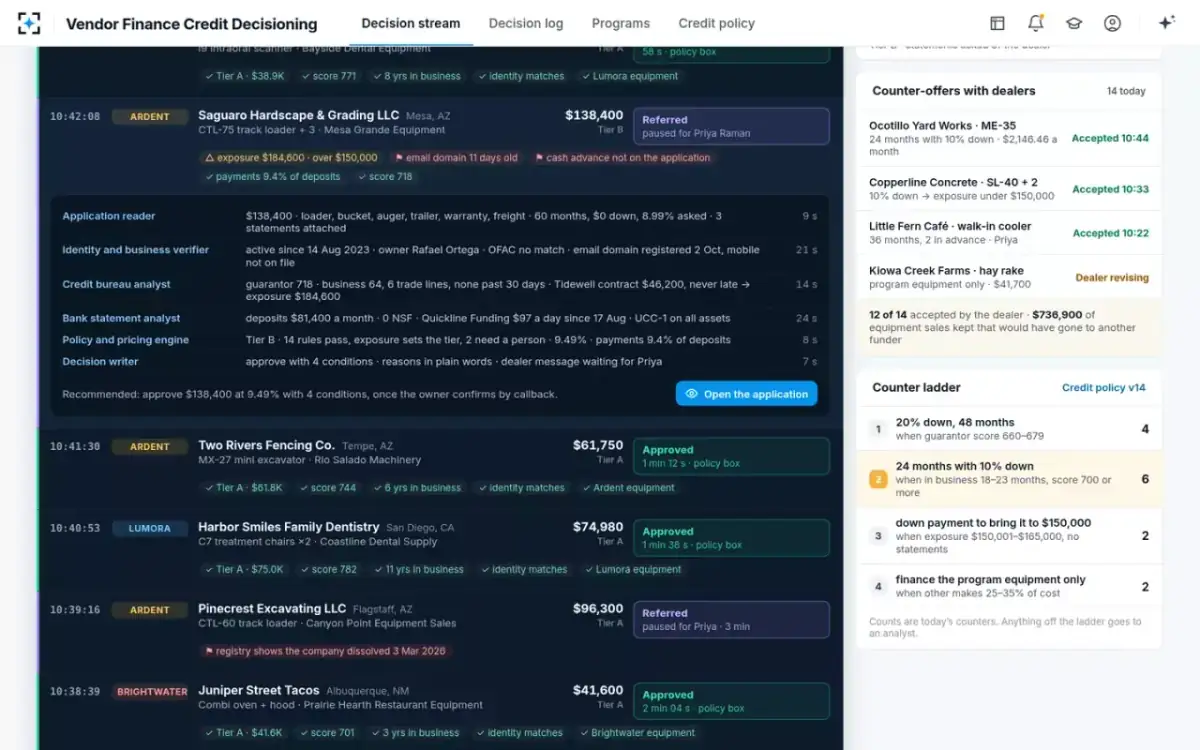
Whatever a risk committee decides the engine is, the thing it actually has to defend is a decision, not a model class. On the Saguaro referral, every flag the agents raised links back to the document behind it — the 2024 contract, the domain registration record, the statement line, the UCC search — so a credit analyst, and later an examiner, is looking at evidence rather than taking an agent's word for it.
The referral: three flags, four sources, nothing unexplained
The policy ladder: every rule, every threshold, every result
What a trail like this does not do, by itself, is tell a risk committee the policy's thresholds are the right ones — that is a judgement the credit manager makes when he signs the box, and it is worth a second, independent look on the same cadence a bank already reviews its other credit policies. A daily view of volume and referrals, the kind a head of equipment finance watches across a program, is a reasonable place to notice if that judgement has started to drift; who decides a vendor finance application, seat by seat, covers who actually owns each of those views.
What a risk committee should ask before relying on it
None of the questions below need a vendor's permission to ask, and most of them have answers that do not depend on resolving whether the engine counts as a model under SR 26-2 at all.
Eight questions for a model risk committee, before relying on an agentic credit engine
- What exactly decides, and what falls outside the guidance by definition?
SR 26-2 excludes agentic AI from its own scope — ask what internal framework is standing in for it.
- Is the deciding component a model, a rule set, or a documented human judgement in automated form?
The answer changes which governance obligations actually apply.
- What is the model exposure in dollars — on a typical file, and on the largest the box will approve?
Materiality is purpose and exposure together, not a flat statement that the system is "low risk."
- Who performs effective challenge, and are they independent of whoever built the policy?
Expertise, independence and standing to force a change are the guidance’s own three tests.
- What does the activity trail show for one decision, start to finish?
Every agent step, citation and signature should be traceable without asking the vendor to pull logs.
- How is a policy or ladder change tested before it goes live?
Replaying past applications against a proposed change is the deterministic-system equivalent of out-of-sample testing.
- Does every adverse-action reason name a specific finding, not a score or an internal standard?
Regulation B’s bar applies regardless of what SR 26-2 decides about the engine.
- What happens when the engine can’t finish, and who signs what it hands off?
A decline, an exception or an off-ladder counter should always carry a named person’s signature.
A system that cannot answer most of these honestly is not safer for sitting outside SR 26-2's scope — it is simply unreviewed. One that can is in a defensible place: outside the letter of the current guidance, but inside the practice it describes.
Questions people ask
Is AI credit decisioning accurate?
There is no single published accuracy figure for AI credit decisioning in general — it depends entirely on the system, the policy it runs and the population of applications it sees. The more useful question for a risk committee is whether the system's decisions are traceable to evidence and consistent with a policy a person actually signed, which can be checked file by file.
Is AI credit decisioning a model under bank regulation?
Not necessarily, and the current interagency guidance (SR 26-2) is explicit on two points: deterministic rule-based software with no statistical or economic theory behind it is excluded from the definition of "model," and generative and agentic AI are separately stated to be outside the guidance's scope entirely, for now.
How do you validate an AI credit decision engine?
By testing it the way SR 26-2 describes testing any model: replay past, already-decided applications through the current policy and compare the results, check that every finding links back to a real document, and confirm a person signs anything the engine itself is not authorized to finish — a decline, an exception or an off-ladder counter.
Does SR 26-2 cover agentic AI?
No. The guidance states plainly that "generative AI and agentic AI models are novel and rapidly evolving" and "are not within the scope of this guidance," while noting that its principles still apply to traditional statistical models and to non-generative, non-agentic AI.
How do banks test AI underwriting before using it?
SR 26-2 describes model testing as evaluating "whether a model performs as intended," including out-of-sample and out-of-time testing. For a deterministic engine like a policy ladder, the equivalent is replaying a bank's own closed applications through the proposed settings and checking the results against what actually happened before any live file is decided on it.
What should a risk committee ask about AI credit decisioning?
Start with what the system actually is under SR 26-2's definitions, then ask about model exposure in dollars, who performs effective challenge, what the activity trail shows for one decision, and whether every adverse-action reason names a specific finding rather than an internal standard — Regulation B requires the last one regardless of how the model question is answered.