Verifying a business before you fund it means checking that every fact a credit application makes about who is borrowing has a source behind it, not just a form field that was filled in. That matters because business impersonation fraud rarely invents a company out of nothing — it reuses a real one. A real legal name, a real formation date, a real address on file somewhere, with only the contact details swapped for ones the fraudster controls. Botminds' Vendor Finance Credit Decisioning runs an identity and business verifier against every dealer application for exactly this reason: the fields most likely to be true are the ones a program should spend the least time on, and the field most likely to carry the fraud is the one most applications never ask a person to double-check.
What application-only verification has to take on faith, and what it can't
An application-only tier is built to avoid collecting a full underwriting file, which means it is also built to avoid most of what would normally let a person catch an impersonation by instinct — no in-person meeting, no site visit, often no phone call at all unless something trips a flag. What it cannot afford to take on faith is identity itself: if the applicant is not who the application says, nothing else about the credit decision matters. The fields a verifier checks are chosen because each has an independent source that does not depend on the application having told the truth.
In Vendor Finance Credit Decisioning's sample program, the identity and business verifier runs this check on every application, not only the ones that look suspicious, because the pattern it is built to catch does not announce itself. A changed email domain and a changed phone number read, on their own, like an unremarkable update. Compared against what an earlier file on the same business says, the same two changes read like exactly what business impersonation looks like.
Five fields, five sources: name, formation, address, owner, tax ID
Five facts carry almost all of the weight of confirming who is actually asking for credit, and each has one authoritative source a verifier checks it against rather than taking the application's word for it.
Five identity fields, their source, and how each can fail
Legal name
SourceState business registry
Common failure modeA near-identical name or an old trade name, not a mismatch most readers would catch
Status and formation date
SourceState business registry
Common failure modeA company the registry shows as dissolved, still applying in its old name
Address
SourceState registry and a prior contract or file
Common failure modeA new delivery address, often a storage yard or a site the business has never used
Owner
SourceState registry and the prior file, compared
Common failure modeA signatory swapped for someone with access to the business’s paperwork but not its building
Tax ID
SourceThe prior file, last four digits
Common failure modeA stolen or mistyped number, which passes a format check but fails a match
An impersonator has little reason to change these five, because each can be checked against a source the applicant does not control, and changing one means forging a record rather than typing into a form. The fields that are not on this list, the email and the phone number, are a way to reach the person behind the business rather than a fact about it, and they are where the pattern shows up instead.
The order of the identity checks, and where a person takes over
Agent
Sanctions screenThe entity and every owner against the OFAC lists, first, so nothing else is spent on a file that cannot be funded.
Agent
State registryLegal name, status, formation date, registered address and members, from the state of formation.
Agent
The file on recordOwner, tax ID, address, email, phone and delivery address against the funder’s earlier contracts with the same business.
Agent
Contact signalsThe age of the email domain and whether the phone is on file; a domain under 90 days old or a new phone needs a callback.
Never: clears a flag itself, or calls the number on the application
A person decides
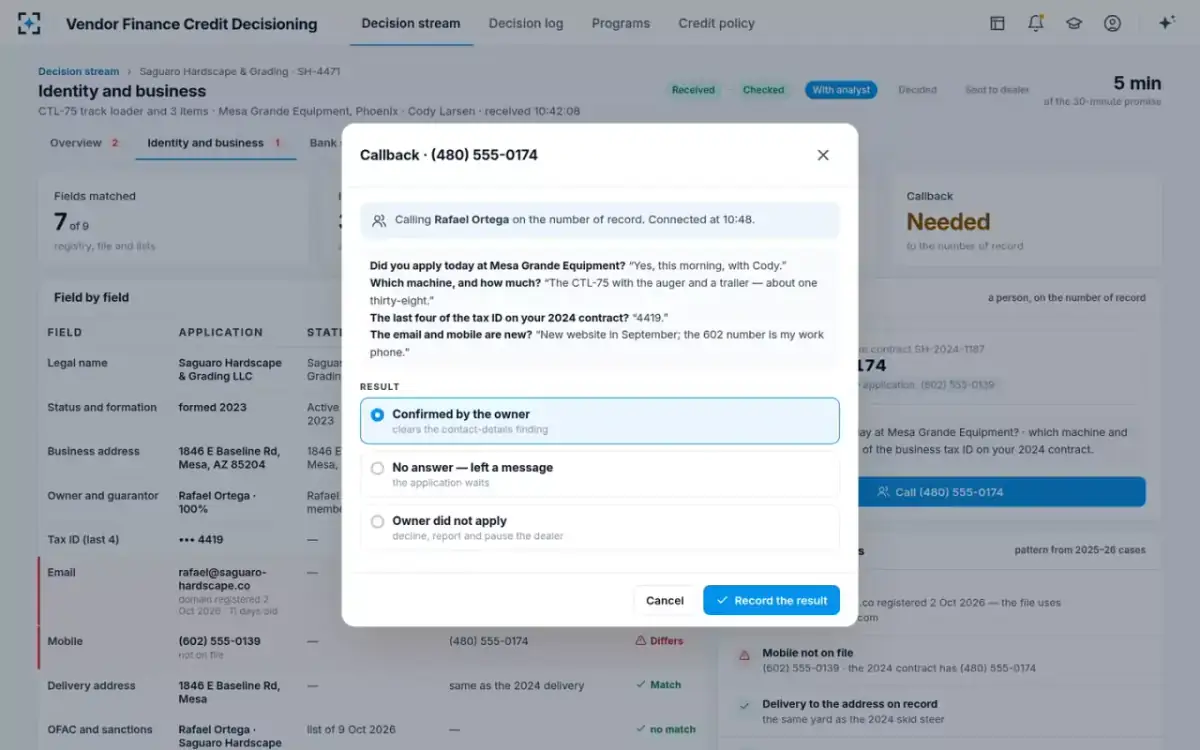
Credit analystCalls the number of record, asks the set questions and records one of three results.
The one field impersonation almost always gets wrong: contact details
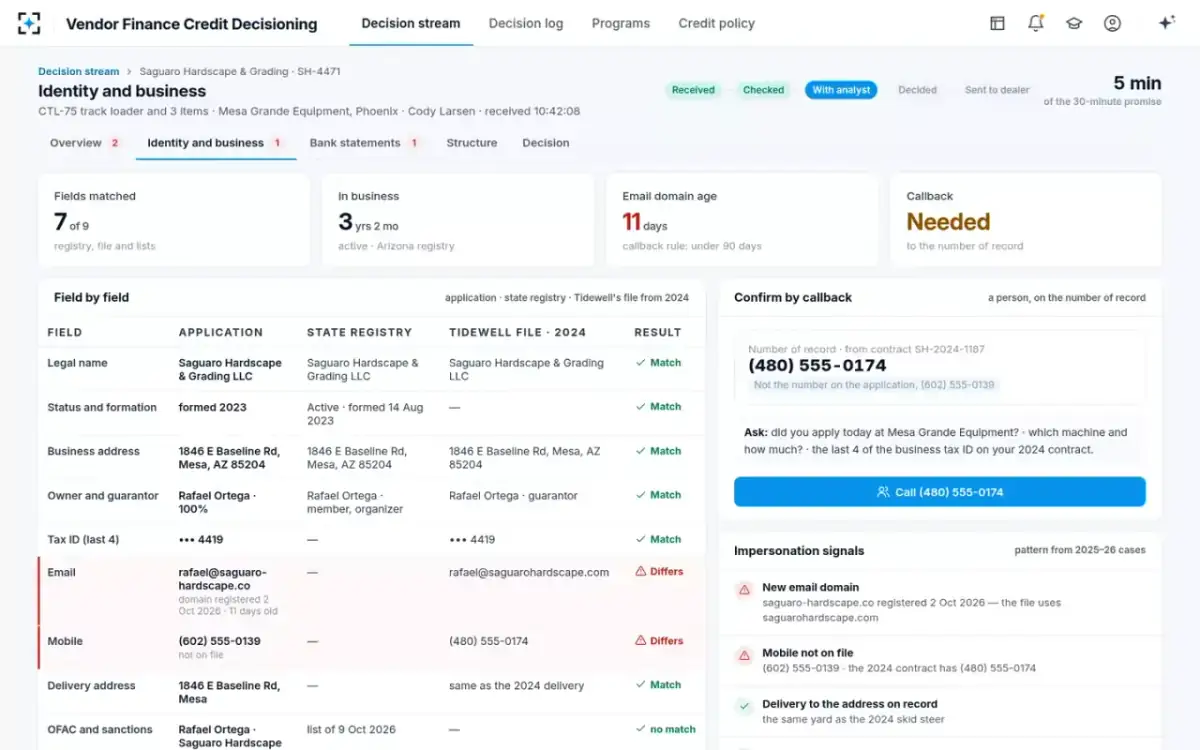
Saguaro Hardscape & Grading's application, in the sample program, is the clean case. Legal name, status and formation, address, owner and tax ID all matched the Arizona state registry, the funder Tidewell's own 2024 file, or both: seven of nine fields. What did not match was the email and the mobile number: the application gave an email on the domain saguaro-hardscape.co, registered on 2 October 2026 — eleven days before the application arrived — where the 2024 file had saguarohardscape.com, and a mobile number that was not the one on file either.
What the Saguaro application stated against what the registry and the 2024 file show
2024 file / state registry: Match the state registry
This application: Match
2024 file / state registry: Matches the 2024 file
This application: Match
2024 file / state registry: Matches the 2024 file
This application: Match
2024 file / state registry: saguarohardscape.com
This application: saguaro-hardscape.co, registered 11 days earlier
2024 file / state registry: The number on the 2024 contract
This application: A different number
That split is not a coincidence of this one file; it is the shape of business impersonation. The facts a fraudster cannot easily move — who the state says owns the business, when it was formed, where it is registered — are left alone, because moving them would require forging a government record rather than simply typing a different email into a form. The facts that exist only inside the application itself — how to reach the "owner" right now — are the ones changed, because they are the ones the fraudster actually needs to control to receive the money.
Why vendor and client impersonation overtook CEO impersonation
The clearest public measurement of this pattern comes from payments rather than credit. In July 2019 FinCEN reported what banks' suspicious activity reports showed about business email compromise, the fraud in which a criminal poses as someone a business trusts to redirect a payment: reports describing it rose from about 500 a month in 2016 to more than 1,100 a month in 2018, and the attempted thefts in them from $110 million to $301 million a month. Over the same period the method changed, from posing as the company's own chief executive to posing as an outside vendor or client.
Fraudulent-invoice impersonation overtakes CEO impersonation, 2017 to 2018
The shift matters for a vendor finance program specifically, because a dealer's credit application is a vendor-and-client relationship by definition: a dealer vouching for a customer, a funder relying on both. A fraud technique built around impersonating a trusted counterparty rather than a company's own executive fits that relationship exactly, which is why business impersonation on a dealer application looks less like a forged document and more like a quietly updated contact field. The FinCEN figures are about payment redirection, not credit applications; the lesson that carries over is where the change sits.
Signals a verifier can test, and the source that tests each
| Signal | What it can mean | The independent source |
|---|---|---|
| Email on a newly registered domain | A channel set up for the scheme | The domain registration date, against the domain on the file |
| A phone number not on file | A line the impersonator answers | The number on an earlier contract |
| Delivery to a new address | Equipment going somewhere the business does not operate | The address on the registry and on earlier deliveries |
| Registry shows the company dissolved | An old name being reused | The state registry’s status and dissolution date |
| The same unit quoted by a second dealer | One machine financed twice | Applications across the funder’s dealer programs |
| First-payment defaults clustered at one dealer | A dealer, or someone using one, as the channel | The funder’s own payment history by dealer |
Beneficial ownership: the 25% test and the one-person control test
Verifying a business is not only verifying the entity; it is verifying who controls it, and the rule that defines that is written as two separate tests rather than one. FinCEN's customer due diligence rule for banks and other covered institutions defines a beneficial owner as "each individual, if any, who, directly or indirectly ... owns 25 percent or more of the equity interests of a legal entity customer", the ownership prong, and separately as "a single individual with significant responsibility to control, manage, or direct a legal entity customer", the control prong (31 CFR 1010.230(d)). A nonbank funder is not bound by the rule but can adopt its two tests. A business can have several owners clearing the first test and exactly one person clearing the second, and both matter: ownership tells a verifier who benefits, control tells it who can actually sign.
A personal guarantee folds a third identity into the same check. Among employer firms with outstanding debt in the Federal Reserve's 2025 Small Business Credit Survey, 59% used a personal guarantee to secure their debt (Federal Reserve Banks, 2026 Report on Employer Firms). On an application-only deal that relies on a guarantor's personal credit as much as the business's own standing, the guarantor's own identity is part of what a verifier has to confirm — not a formality attached to the business check, but a check of its own.
Why OFAC screening happens before anything else
Before a credit decision is a question, a legal one is: can this business or its owners be dealt with at all. The Office of Foreign Assets Control's own guidance states plainly that "U.S. persons are generally prohibited from dealing with the individuals and entities on the SDN List" (OFAC FAQ 91). That is not a credit-policy setting a program can choose to relax. The same FAQ explains why owners matter as much as the entity: under OFAC's "50 Percent Rule", a company owned 50 percent or more, directly or indirectly, by one or more blocked persons is itself blocked, even if its own name appears on no list. So the screen runs first, on the entity and on every owner the beneficial-ownership tests identify, before any bureau is pulled or any policy rule is tested.
Running the sanctions screen first also protects the rest of the process: there is no reason to spend a bureau pull or a bank-statement read on an application that cannot legally be funded regardless of what those documents show. In the sample program, the identity and business verifier checks the entity and its owners against the OFAC lists in the same pass that confirms the registry and the prior file, so a sanctions hit stops the file before any of the credit-specific checks run at all.
The rule the identity verifier never breaks: call the number on file, not the application
Finding the pattern is not the same as resolving it, and Vendor Finance Credit Decisioning's identity and business verifier is built to know the difference. Its own limits: it never clears a fraud flag itself, and it never calls the number on the application to do so. A changed email domain, especially one registered only days before the application arrived, and a changed phone number together are exactly the signature a verifier is watching for, and finding that signature is where the agent's job ends — a person calls the number of record, meaning the number on an earlier file the business itself cannot have just supplied, not the one sitting on the form in front of everyone.
Identity and business: field by field, against the registry and the 2024 file
Priya Raman, the credit analyst on this file, called the number from the 2024 contract rather than the one on the application, and asked the screen's own questions: did the owner apply today, for which machine and how much, and the last four digits of the tax ID. Rafael Ortega confirmed the application, the CTL-75 with the auger and a trailer for about $138,000, and the last four digits, and explained the rest: a new website in September, and the 602 number was his work phone. Priya recorded "Confirmed by the owner," which is what actually clears a contact-details finding — a person's judgment on a call to a number the applicant did not choose, never an agent's own conclusion.
The callback: the questions to ask, and what the analyst can record
Does a lender check OFAC before approving a business loan?
A lender must not deal with a person or entity on OFAC's SDN list, so a screen is the practical way to comply, and it is best run before the rest of the credit review: running it after a bureau pull and a policy test means doing real work on a file that may never have been fundable. The screen should cover the entity and its owners, because OFAC's 50 Percent Rule blocks a company owned 50% or more by blocked persons even when its own name is on no list.
Questions people ask
What is business impersonation fraud?
It is fraud that uses a real company's own identifying details — its legal name, formation date, address and often its tax ID — while substituting new contact information the fraudster controls, so the application looks like it comes from a legitimate, verifiable business rather than an invented one.
How does business identity theft happen?
Most often by gathering identifying details that are already public, in a state registry filing or an old contract, and pairing them with a new email domain and phone number, then applying for credit as if continuing an existing relationship with a lender, dealer or vendor the real business has dealt with before.
Why do fraudsters use a new email domain?
Because they need a channel for the funder's documents and communications to reach them rather than the real business, and a domain they control, registered specifically for the scheme, is the simplest way to get one. A domain registered only days before the application it appears on is one of the more reliable signals a verifier can check.
How to check if a business is real before lending to it?
Confirm its legal name, formation date, address, owner and tax ID against independent sources — a state business registry and, where one exists, an earlier file on the same business — rather than against the application alone, then screen the entity and its beneficial owners against the OFAC sanctions lists before anything else.
What is vendor impersonation fraud?
It is business email compromise carried out by posing as a vendor or client rather than a company executive, usually through a fraudulent invoice or a changed payment and contact detail. FinCEN's data shows it overtaking CEO impersonation as the leading method between 2017 and 2018, which matters to a vendor finance program because a dealer application already sits inside a vendor-and-client relationship.
What is beneficial ownership verification?
It is confirming who actually owns and controls a business applicant, under two tests: anyone who owns 25% or more of its equity, and separately, one individual with significant responsibility to control, manage or direct it. A business can clear both tests with different people, and a verifier checks for both.