Application-only equipment financing is the promise that a dealer's customer can sign for a loader, a forklift or a delivery van on the credit application alone — no bank statements, no financials, nothing beyond the guarantor's credit report and a check of the business itself. It sounds like a product, something a lender either offers or doesn't. It is closer to a line: a credit policy sets a box in dollars of exposure, years in business and guarantor score, and every application that lands inside that box gets decided on the application alone, while everything outside it needs more. Botminds' Vendor Finance Credit Decisioning runs six agents against every dealer application the moment it arrives and tests it against that box. Under the box in its sample program, a clean $94,000 forklift deal from a three-year-old business is answered on the line in about two minutes, while the same deal from a business one month short of two years cannot be: the line, not the credit behind it, is what decides which of the two waits.
That distinction matters because of how much of a vendor program's volume the line is built to clear. Among employer firms that applied for a loan, line of credit or cash advance in the prior twelve months, 37% sought less than $50,000 and 59% sought $100,000 or less (Federal Reserve Banks, 2026 Report on Employer Firms, from the 2025 Small Business Credit Survey). A credit policy that cannot answer requests of that size in minutes pushes most applicants into the same queue as a six-figure, multi-asset deal, which is the queue the line exists to keep small.
Most small-business credit requests sit well inside an application-only line
Application-only is a line, not a product
The line is drawn before any application arrives. A credit manager sets a box — a maximum total exposure, a minimum time in business, a minimum guarantor score — and signs it into the program's credit policy. Every application that passes every test in the box is approved on the application alone. Every application that fails even one test needs something more: a bank statement, a structure change, a person's judgment. The line is the only thing that decides which queue a deal joins; the credit decision behind either queue can be identical.
A deal that is one guarantor point, one month of time in business, or one dollar of exposure outside the box does not fail on the merits — it fails on the box, and on a desk that reads exceptions by hand that has meant the same underwriter's queue, and the same wait, as a deal that genuinely needed a fuller look. Vendor Finance Credit Decisioning's point is not to lower the box; it is to decide every application against the box in the same minute it arrives, so the only applications that wait are the ones a credit manager actually wants a person to see.
What the line usually asks for below it
Inside the box, an application-only tier usually asks for four things, and nothing else: the signed credit application with the guarantor's identifying details, the dealer's quote or invoice for the equipment, a credit bureau pull on the guarantor and the business, and a check that the business itself is real — a state registry lookup and a sanctions screen. No bank statements. No years of financials. No structure negotiation. The application states what is being financed and who is asking, the bureaus and the registry confirm it, and the policy either clears every test or does not.
In Vendor Finance Credit Decisioning's sample program, a fictional equipment maker's four dealer programs, that covers most of the day. On the sample day 80% of applications are decided on the line with no analyst, at a median of 1 minute 48 seconds: approved inside the box or countered from a signed ladder, with the rest referred to a person. The six agents that make that possible split the work rather than sharing it: one reads the application and the quote, one checks the business and screens for sanctions, one reads the bureaus, and a policy engine runs every rule in the box against what the other three found. None of that changes what application-only financing covers. It changes how quickly a box that was always narrow gets tested.
What crosses the line and needs more — statements, structure, time
A second, wider tier exists for exactly the deals the first one cannot answer alone, and it is also a line, not a discretionary review. In the sample program, a deal that needs bank statements — usually because its exposure is larger, or one of the application-only tests came back thin — moves to a second box: a higher exposure ceiling, a higher guarantor score, and one more test that only a bank statement can answer, fixed payments against deposits, capped at 12%. Below that ceiling, the application-only tests still apply; above it, nothing is approved on the application alone, however clean the guarantor's score.
The two boxes, side by side: what each tier asks for and where it stops
Total exposure limit
Tier A$150,000
Tier B$250,000
Time in business
Tier A2 years
Tier B3 years
Guarantor personal score
Tier A680
Tier B700
Fixed payments to deposits
Tier Anot tested
Tier B12% maximum
Rate adjustment
Tier Aprogram rate
Tier Bprogram rate +50 bp
What it asks for
Tier Aapplication, quote and invoice
Tier Bthe above, plus bank statements
Reading bank statements by hand is where a credit team's time disappears. Botminds' estimate of the working time on one application outside the box puts reading three months of statements, for recurring debits, average balances and any cash advance nobody listed, at about an hour and a half by hand and about six minutes with the statement-reading agent, which cites the statement line behind every figure. The estimate is ours, from walking through the steps, not a customer's measured result. It is still the argument for keeping the first tier narrow and exact: every deal the application-only line answers is a deal that never needs that hour and a half.
Why time-in-business is almost always the line's trigger
Of the three settings in the box, time in business is the bluntest, because nothing on the file can move it. A guarantor score a few points under the floor is a gradated number that a bureau refresh or a co-guarantor can change; exposure can be cut with a down payment. A business eighteen months into a two-year minimum has simply not existed long enough, and no amount of revenue changes that before its anniversary. That is why the one live counter in the sample program, below, answers a time-in-business miss with a shorter term rather than a different price.
The Federal Reserve's 2025 Small Business Credit Survey shows why lenders lean on firm age at all. Among applicants for loans, lines of credit or cash advances, firms 0–5 years old were fully approved 48% of the time, firms 6–20 years old 51%, and firms 21 years or older 63%. The survey says plainly that these shares are not adjusted for profitability or credit risk, so age is standing in for much else a young firm lacks: a payment history, a second year of statements, a track record with suppliers. A tier line that uses time in business as a hard setting writes that correlation into a rule a program can test in a second, instead of a rule of thumb that varies from file to file.
Older firms are fully approved more often, before anything else is adjusted
What a blanket lien does to an otherwise clean application
A blanket lien — a prior lender's filing against all of a business's assets, not just one piece of equipment — is the other common line-crosser, and it behaves differently from the first two. It does not fail the application; it adds a condition. Equipment finance relies on a purchase-money security interest, which keeps its priority over an earlier blanket lien only if it is "perfected when the debtor receives possession of the collateral or within 20 days thereafter" (UCC §9-324(a)). Found early, that is a filing deadline a program can meet without blinking. Found late, after the equipment has already been delivered, the window may already be closing.
In the sample program, a blanket lien found on the bureau or the bank statements does not decline the deal; it converts to a purchase-money filing condition on the approval itself, due inside the UCC's window, while everything else in the box still has to pass. That is a narrower, cheaper response than a decline, and it is also the kind of condition that is easy to miss by hand on a file read quickly, because a blanket lien rarely announces itself — it sits in a UCC search a reader has to think to pull.
How a credit manager actually sets and moves the line
None of the numbers above are fixed by the software; they are settings, and a credit manager moves them the way a credit policy has always been moved — by deciding, documenting and signing a change, then watching what it does to the book. In the sample program the exposure limits, the time-in-business minimums, the guarantor floors, the fixed-payments ceiling, the rate adjustment, the response to a blanket lien and the dealer promise are each a value chosen from a short list of alternatives, not a free-text field, so a change is a choice among tested options rather than an untested guess.
Eight settings a credit manager reviews before moving the line
- The application-only exposure limit
The sample program runs $150,000; the alternative is simply a different number, moved with − and +.
- The second tier's exposure ceiling
Set from $200,000, $250,000 or $300,000 — the point past which nothing clears on application alone.
- Time in business, both tiers
From 1 & 2 years, 2 & 3 years, or 3 & 5 years — the single setting most likely to trip an otherwise clean file.
- Guarantor score, both tiers
From 660 & 680, 680 & 700, or 700 & 720.
- Fixed payments against deposits
A second-tier-only ceiling, from 10%, 12% or 15% of monthly deposits.
- The rate adjustment on the second tier
From +25, +50 or +75 basis points over the program rate.
- What a blanket lien does to a clean file
Purchase-money filing required, a subordination letter required, or a decline — a choice the credit manager makes, not a default.
- The dealer promise
From 15, 30 or 60 minutes — the clock a referral is measured against once it leaves the line.
Credit policy: the box, the ladder and who may change it
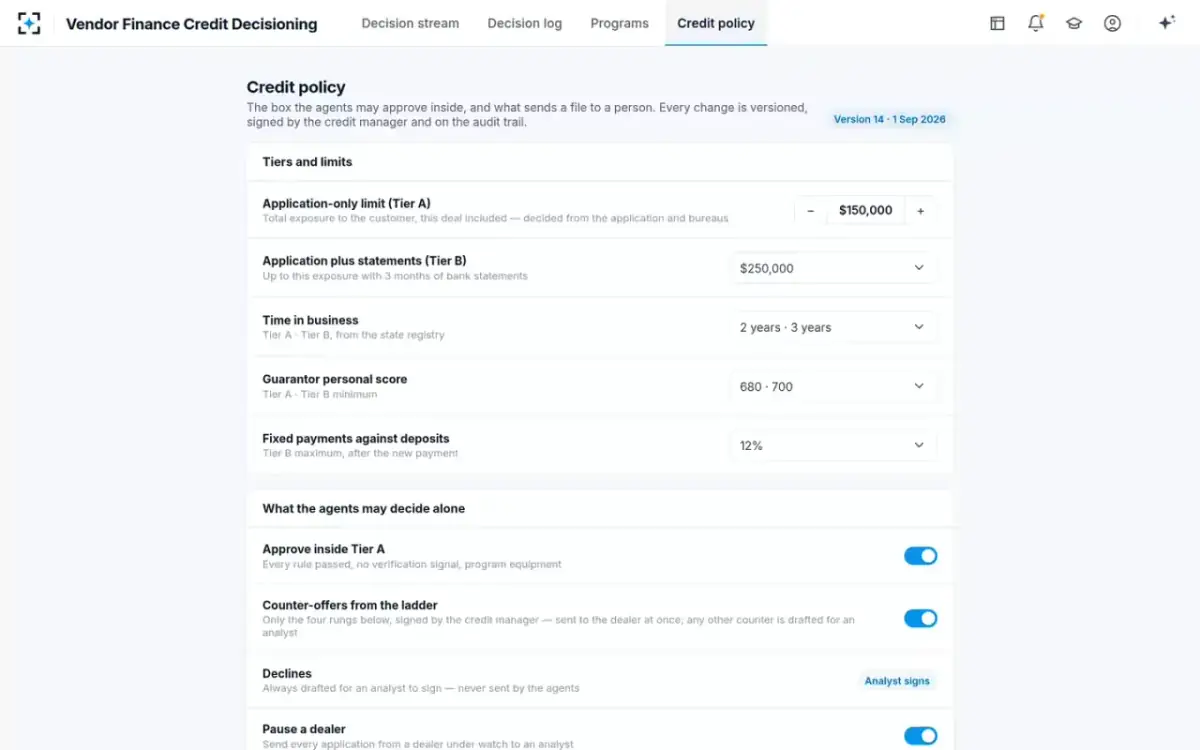
Moving a setting does not touch an application already decided under the version before it — each decision carries the policy version that produced it, so a later change to the box never rewrites yesterday's answer.
What falls just off the line, and what that costs
A deal that fails exactly one test in the box does not necessarily join the same queue as a deal that fails three. In the sample program, missing one rule by a margin the program's credit manager has pre-agreed to accept can route to a signed counter offer instead of a referral — a separate mechanism covered on its own. Missing on exposure, on a fraud flag, or on more than one rule at once routes to a credit analyst, with the agents' findings and a recommendation already attached rather than a blank file.
Why applicants were turned down: most reasons are tests a policy box writes down
The policy ladder: every rule, the applicant's value, and the result
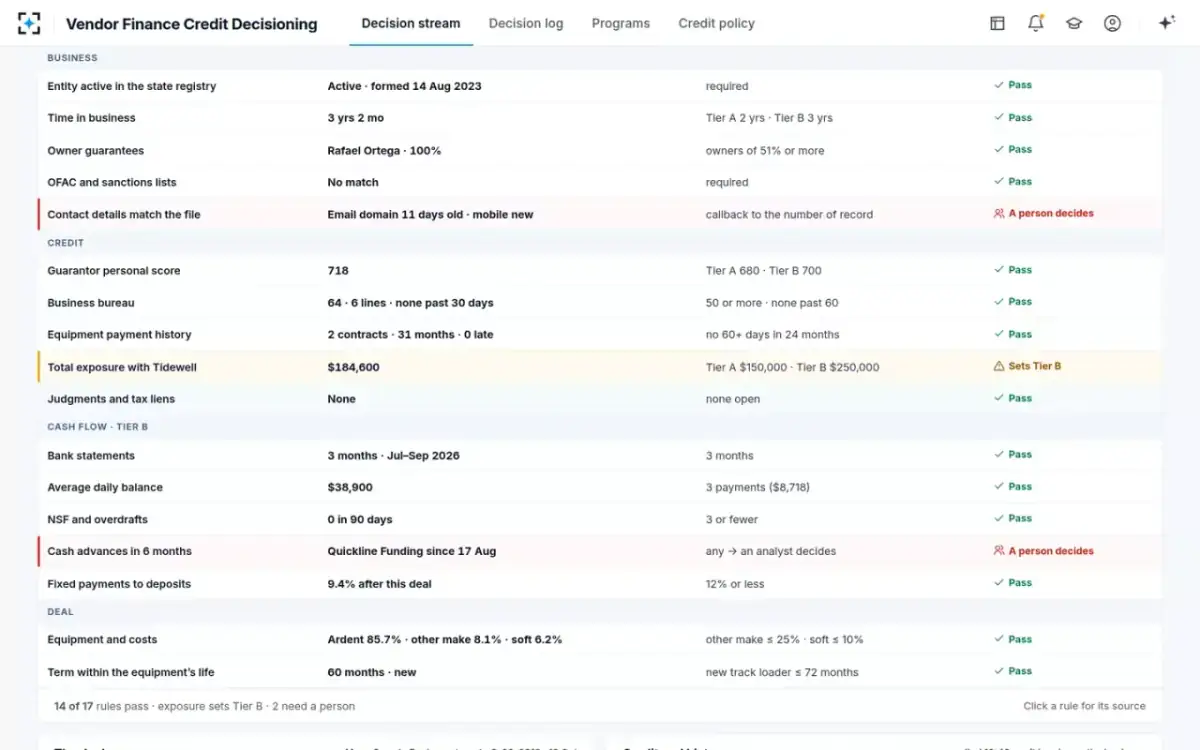
Read against the box, those reasons sort cleanly. Too much debt is the exposure and fixed-payment tests; a low credit score is the guarantor floor; insufficient collateral is the equipment-share and purchase-money tests. Only the first reason, requirements the applicant thought too strict, is not a test at all: it is how the box looks from outside, and the reason a box should be written down where a dealer can be told which part of it a deal missed.
What falls just off the line costs more than the minutes an analyst spends on it. A guarantor a few points under the floor, read alone, often does not warrant a decline — it warrants a second look at what else the file shows. A policy ladder that shows fourteen of seventeen rules passing, and names the two that did not, turns that second look into a few minutes rather than a full re-read, because the analyst already knows which three facts to check rather than which seventeen.
What the applicant is owed when the answer is not a yes
Application-only does not mean notice-free. Regulation B covers business credit, and the moment a deal falls off the line the program owes the applicant something on a clock. The rule splits business applicants at $1 million of gross revenue in the preceding fiscal year: below it, the creditor follows the consumer timetable, with the statement of the action allowed orally or in writing; above it, notice comes "within a reasonable time" and written reasons only if the applicant asks in writing within 60 days (12 CFR 1002.9(a)(3)). Most small-ticket equipment customers sit below the line.
Each answer off the line, and what Regulation B says the applicant is owed
| The answer | Business with revenue of $1 million or less | Business with revenue over $1 million |
|---|---|---|
| Approved inside the box | Notice of approval within 30 days of a completed application; delivering the credit is notice enough | The same |
| Counter-offer from the ladder | The counter within 30 days; if it is not accepted or used, an adverse action notice within 90 days of the counter | Notice within a reasonable time; the 30-day timetable always counts as reasonable |
| Declined | Within 30 days: the action taken (orally or in writing) and either the specific reasons or the right to ask for them within 60 days | Within a reasonable time, orally or in writing; written reasons if asked for in writing within 60 days |
| Incomplete, more documents needed | Within 30 days: either a decision, or a notice of what is missing and the time allowed to supply it | Notice of the action within a reasonable time |
| Records kept | 12 months after notice for business credit: the application, anything used to evaluate it, and the notice | The same |
The clock is one more reason to keep the box written down. A decline, an unaccepted counter or a request for statements each starts a 30-day count from a completed application, and each needs a reason that names the actual test, not "did not meet our standards", which the rule itself calls insufficient. In the sample program the decision writer drafts that notice from the rule that missed, and a person signs it.
How much down payment does application-only financing need?
Inside the box, usually none. An application-only approval is built to clear on the application, the quote and the bureaus alone, and a program that required a down payment on every Tier A deal would be adding a document the tier exists to avoid collecting. Down payment enters once a deal needs restructuring to fit — most often because time in business or guarantor score missed by a margin the program is willing to work with, and a lower principal or a shorter term brings the rest of the numbers back inside an acceptable range.
When that happens, down payment is one of three levers a credit analyst or the line itself can move, alongside term and whether payments are taken in advance or in arrears — and in the sample program, every combination is tested against the policy as it is chosen, not just at the end. A deal that needed a specific combination of down payment and term to clear the box is a deal that was restructured, not a deal that was approved on the application alone; how a near-miss becomes a signed counter instead of a queued file walks through one worked example end to end.
Questions people ask
What is a small-ticket equipment lease?
It is a lease or loan for equipment at the lower end of a funder's range, small enough to be decided on an application-only or lightly documented basis rather than a full underwriting file. There is no regulatory definition; each funder sets its own ceiling. "Small ticket" describes the size of the deal; application-only describes how much paper the program needs to decide it.
How much can you finance with application-only equipment leasing?
Whatever the program's credit manager has set as the application-only exposure limit: it is a policy setting, not a law, and it differs from funder to funder. In Vendor Finance Credit Decisioning's sample program that limit is $150,000 of total exposure to one borrower, counting every open contract, not just the one being applied for, which is why a $138,400 loader request from a customer with a 2024 contract outstanding lands in the second tier.
Why do some equipment finance applications need more documents?
Almost always because one of three things is true: the exposure is larger than the application-only tier covers, the business has not been operating as long as the policy requires for that size of deal, or something the bureau or the registry returned — a thin file, a blanket lien, a mismatch in the business's identifying details — needs a bank statement or a human read to resolve. The documents asked for track the specific gap, not a blanket escalation.
What is a credit tier in equipment finance?
A tier is a named box inside a credit policy: a combination of exposure limit, time-in-business minimum and guarantor score floor that a deal either fits inside or does not. Most small-ticket programs run two or three tiers, from application-only at the smallest and cleanest to a fuller file at the largest, and every deal is sorted into exactly one tier before it is decided.
What happens when an application falls outside the credit box?
It does not automatically fail. Depending on which test it missed and by how much, it either routes to a pre-agreed counter offer that restructures the deal to fit, or to a credit analyst with the findings and a recommendation attached. In the sample program the agents never decline: a decline is drafted for a person to sign, and Regulation B's 30-day clock for notifying the applicant runs from the completed application.
Can a credit manager change the application-only limit later?
Yes, and in a program built to version its policy, doing so does not touch applications already decided. A change takes effect for applications from the moment it is signed forward; everything decided under the limit that was in force when it was tested keeps the policy version that produced it, so widening or narrowing the box later is an audit-safe choice rather than a rewrite of history.