Credit decisioning software is hard to evaluate from a features list, because every vendor's list looks similar: reads applications, checks credit, applies policy, writes decisions. The more honest test is one real application, run through four different approaches to deciding it, and a plain look at what each one actually catches. This guide runs a fictional $138,400 sample application four ways, then sets out the path from a convincing demo to a program's own first live decision — a pilot on closed applications, not a leap of faith.
The worked example is Saguaro Hardscape & Grading's sample application, as it runs through Vendor Finance Credit Decisioning. The approval-rate and regulatory research is published and linked where it appears.
Where an applicant goes changes its odds: full approval by lender, 2025
57%
fully approved at a small bank — the highest lender-source share measured
50%
at a finance company
38%
at an online lender
27%
at a CDFI — the lowest measured
One application, four ways to decide it
Saguaro's application asked for $138,400 over sixty months at 8.99% for an Ardent CTL-75 track loader. On paper it looked clean: guarantor score 718, business 3 years 2 months old, no NSF in ninety days. Underneath, two things did not show up on the application itself — a 2024 contract that pushed total exposure to $184,600, and a merchant cash advance debiting $97 a day that only the bank statements carried. How each of four approaches handles those two facts is the real evaluation.
The same $138,400 application, decided four different ways
| By hand | A rules engine alone | A bureau scorecard alone | Six agents, signed box | |
|---|---|---|---|---|
| Time to a decision | Whenever an underwriter reaches it, then the hours the file takes | Seconds, for what it checks | Seconds, but a score with no reasons | 1 min 23 s to run, then a person if needed |
| Catches the undisclosed cash advance | Only if someone reads every statement page | No — not a bureau field | No — reads the bureau, not the statements | Yes — every statement page, every debit |
| Catches the impersonation pattern | Only if someone checks the registry by hand | No, unless identity is explicitly coded | No — a score says nothing about who applied | Yes — compared field by field against the file |
| Gives a specific reason, not a score | Yes, if the underwriter writes good notes | Only the rule that failed | No — a bare score is an insufficient reason | Yes — reasons drafted in plain words, signed |
| Who signs a decline | The underwriter, from memory and notes | Whoever reviews the output, if anyone does | Whoever reviews the score, if anyone does | A credit analyst or manager, every time |
By hand: thorough, and the dealer waits
An experienced underwriter working Saguaro's file by hand would likely catch both findings eventually — the registry check and a careful read of three months of statements are standard practice, not special skill. What hand underwriting cannot promise is consistency under load: the same checks, done thoroughly on a quiet day, get compressed on a busy one, and a dealer at the counter is waiting the whole time regardless of which day it is.
The quieter cost of hand underwriting is not the occasional missed finding; it is the hours spent confirming the things that usually check out anyway — the registry entry, the formation date, an address that matches. On a file like Saguaro's, most of a careful underwriter's time goes to confirming facts that turn out to be fine, and only a fraction of it to the two facts that actually mattered. Software does not change which facts matter; it changes how much of the confirming work a person still has to do by hand before reaching them.
A rules engine alone: fast, but blind to the cash advance
A rules engine that only checks structured fields, such as guarantor score, time in business and exposure from the funder's own books, would move Saguaro to Tier B on exposure and pass it on everything else in seconds. It has no mechanism for reading a bank statement PDF in whatever layout a bank happens to produce, so a cash advance that never appears as a labeled field simply does not exist to it. Fast and wrong in the same breath is the actual risk of a rules-only approach on anything but the cleanest files.
A rules engine can, in principle, be taught to check more fields — a flag for "unexplained deposit over $X," say. What it still can't do on its own is read the statement to find that deposit in the first place, or tell a merchant cash advance apart from a customer's own large payment, without a document-reading step ahead of it. A program evaluating "a rules engine" against this product is usually, without realizing it, comparing one piece of a six-agent system against the whole thing.
A bureau scorecard alone: a number, with no reasons attached
A bureau scorecard narrows the question further, to a single number built from credit history. It would likely score Saguaro well — nothing in the bureau itself flags the cash advance or the new email domain — and a score alone cannot become a Regulation B reason even when the decision does need one: the regulation is explicit that a statement resting on the applicant's failure to "achieve a qualifying score on the creditor's credit scoring system" is insufficient on its own. A scorecard can rank risk; it cannot, by itself, satisfy what the law requires when the answer is not approval.
Six agents and a credit manager's signed box: fast and accountable
The six-agent approach is not faster because it skips steps; it runs the same checks a thorough underwriter would, each in seconds, and runs them the same way on the fortieth file of the day as on the first. On Saguaro's application it found what the rules engine and the scorecard could not see: the undisclosed cash advance with its UCC filing, and the new email domain and mobile number that match the impersonation pattern, alongside the 2024 contract pushing exposure over the application-only limit. It stopped for a person rather than guessing, with both findings cited to their source.
What makes that accountable rather than just thorough is the box it runs inside: the policy and pricing engine approves only within limits a credit manager has signed, and a decline or an off-ladder counter always carries a person's signature before it goes anywhere. The speed and the accountability are the same design choice, not a trade-off between them.
It is worth being precise about what "fast" bought on Saguaro's file. The agents did not shorten the credit decision itself — fourteen of seventeen policy rules still had to be checked, the bureaus still had to be pulled, the statements still had to be read in full. What the 1 minute 23 seconds bought was doing all of that before a person opened the file, so the analyst's minutes went to the callback and the judgement rather than to three months of statements. The decision that follows, once a person is actually needed, still takes however long a careful callback and a judgement call take.
How to evaluate credit decisioning software, in practice
The comparison above is the template: take one of your own past applications, ideally one with a finding that was easy to miss, and ask each candidate approach the same questions. A vendor demo on a clean file answers none of them honestly, because a clean file is exactly the case every approach handles the same way.
Seven questions to ask of a demo run on your own closed file
- How long from a complete application to an answer, and what happened in that time?
Ask for the run step by step, with timings, not a single total.
- What did it find that is not on the application?
An earlier contract, a cash advance, a lien, a changed phone number: the findings that decided your file.
- Where is the evidence for each finding?
A link to the statement page, the registry record or the bureau line, not a confidence score.
- Which of your policy rules did it apply, and in which version?
Your box, your thresholds, readable rule by rule.
- What reason would the applicant receive?
It must name the factor, not an internal standard or a score (12 CFR 1002.9(b)(2)).
- What could it do without a person?
Approve inside the box, counter from a signed ladder, nothing else; who signs a decline?
- What happens when a document is unreadable or a source is down?
It should stop and say so, not decide on what it has.
The channel a program competes in is worth factoring in too. The share of small-business applicants who sought financing at online fintech lenders rose from "17% in the 2020 survey to 29% in the 2025 survey", and 64% of those applicants said speed of decision or funding influenced where they applied (Federal Reserve Banks, 2026 Report on Employer Firms). Software that cannot answer the clean majority of applications in minutes is already behind, whatever it catches on the exceptions.
The pilot: your own closed applications, re-run
The honest way to trust any of this before a single live decision is to replay a program's own past, already-decided applications through the proposed settings and compare the results — the deterministic-system version of what supervisory guidance on model risk calls testing: evaluating "whether a model performs as intended," including "out-of-sample and out-of-time testing." A closed file has a known outcome; running it back through new software and checking whether the result still makes sense is a test a vendor cannot dress up, because the comparison is against a program's own history, not a demo.
A pilot in five steps, and what must be true before the next one
| Step | What goes in | What must be true to move on |
|---|---|---|
| 1. Capture the policy | The signed credit policy, rate cards, counter ladder, notice templates, approval authorities | The credit manager signs the settings as written, rule by rule |
| 2. Choose the replay set | Closed applications from the last quarter, with their files and the decisions taken | Approvals, counters, referrals and declines all represented, and the hard cases kept in |
| 3. Replay | Each file run on the policy version in force when it was decided | Every difference from the recorded decision explained: an agent error, a policy gap, or a human error the agents caught |
| 4. Read the reasons | Every drafted reason for a decline or unaccepted counter | Each names a factor actually considered; none rests on an internal standard or a score |
| 5. Walk through and go live | The program’s own files on the screens the desk will use | The analysts and credit manager agree to sign on the new screens; live files start inside the box |
The product's own account of this is consistent with that shape: it is built and deployed from a program's own requirements — credit policy, rate cards, notice templates and a sample of past dealer applications — and it goes live once every quality check has passed, with a walkthrough on a program's own applications before anything else. No fixed duration is promised, because none of the steps are fixed-length by nature; a simple single-tier policy and a complex multi-program one do not take the same time to capture.
Testing a structure live, before it ever reaches a dealer
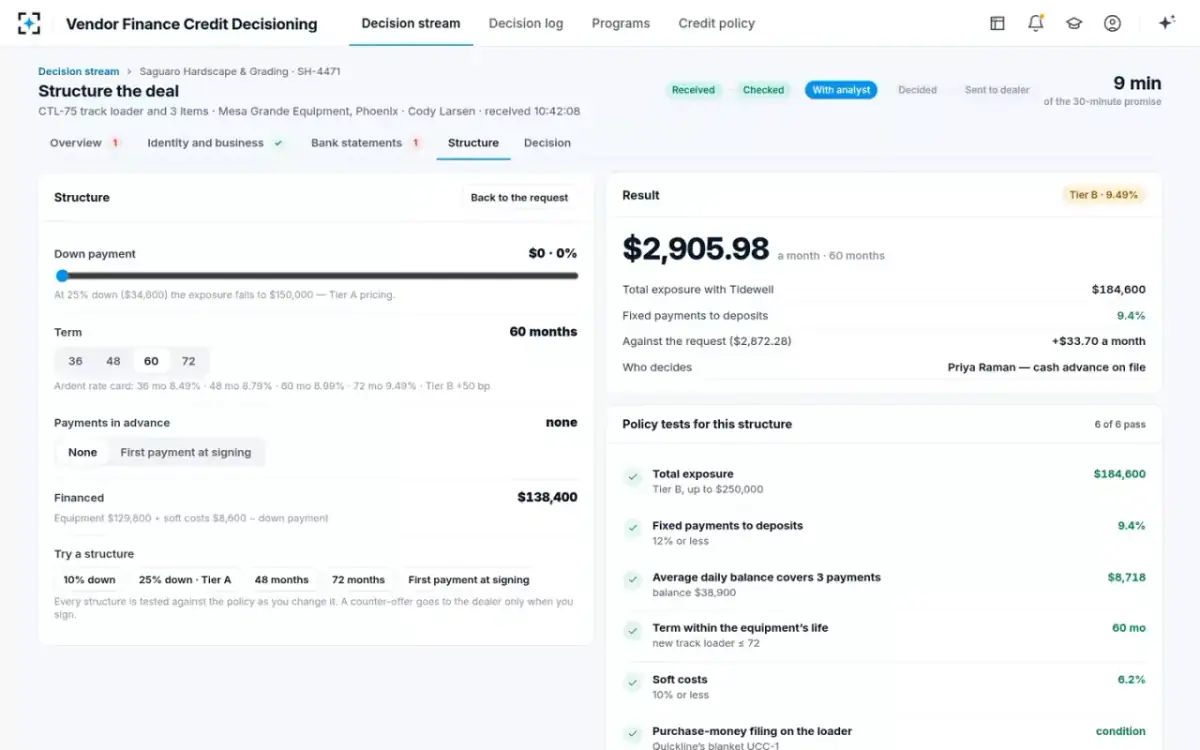
What changes before go-live, and what doesn't
What a credit manager can set before go-live, and what stays fixed
Settings, versioned and signed: Application-only and Tier B exposure limits; time in business and guarantor pairs; the fixed-payments ceiling.
Fixed by design: Nothing is approved outside the limits the credit manager signed.
Settings, versioned and signed: The rungs of the ladder and the band each covers.
Fixed by design: A counter off the ladder is drafted for a person, never sent.
Settings, versioned and signed: The age of email domain that needs a callback; how cash advances are treated.
Fixed by design: A fraud flag is cleared only by a person calling the number of record.
Settings, versioned and signed: Who may sign, and up to what exposure.
Fixed by design: Every decline is signed by a person, with specific reasons.
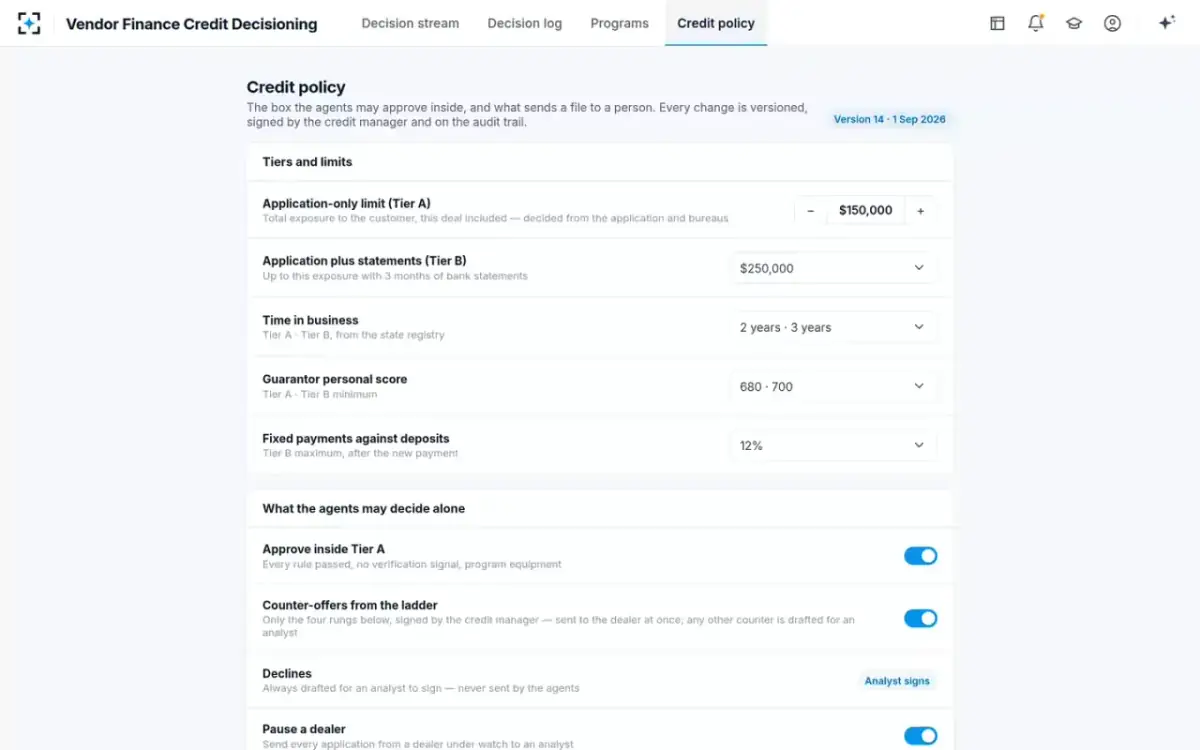
What changes is almost entirely upstream of any single decision: the application-only and Tier B exposure limits, the time-in-business and guarantor-score pairs, the fixed-payments ceiling, the counter ladder's rungs, and the dealer promise are settings a credit manager sets and can move, each one versioned and signed. What doesn't change, by design, is who signs a decline or an exception — that stays a person's seat before go-live, on day one, and indefinitely after.
That distinction is worth putting in front of whoever signs off on the pilot, because it answers the question evaluators usually ask last: what is actually being bought. Not a black box that replaces a credit manager's judgement, but a faster, more consistent way of running the same judgement he has already written down — which is also why a pilot that only tests the agents' reading accuracy, and never touches the settings a credit manager actually owns, has tested the easier half of the system.
The settings a credit manager actually owns
Ongoing oversight after go-live follows a similar shape to any vendor relationship a bank already manages. Interagency guidance on third-party risk "outlines the third-party risk management life cycle and identifies risk management principles applicable to each stage," from planning and due diligence through ongoing monitoring — the same rhythm a pilot's quality checks are meant to start, not finish. For what the six agents may and may not decide once live, see agentic AI for loan underwriting, and what none of them may do.
Questions people ask
What is credit decisioning software?
Software that reads a credit application and the documents behind it, checks it against a lender's own policy, and produces or recommends a decision — approve, counter or decline. The better versions, like the six-agent system on this page, cite the source behind every finding and keep declines and policy exceptions with a named person to sign.
What is the best credit decisioning software?
There is no single best answer independent of a program's own policy, document mix and volume. The evaluation this guide walks through — one real application, run through each candidate, checked for speed, what it catches, whether it gives a real reason, and who signs what it can't finish — travels better than any features list.
How long does it take to implement credit decisioning software?
It depends on the policy's complexity and how ready the program's own data is, and a fixed figure promised independent of both is a warning sign. What is fixed is the sequence: capture the requirements and policy, replay closed applications, pass quality checks, walk through the result on the program's own files, then go live.
Credit decisioning software vs a rules engine: what's different?
A rules engine alone checks the structured fields it was built to check and nothing else — it cannot read a bank statement in an arbitrary layout or compare an application against a file on record. Credit decisioning software built from specialist agents extends the same policy logic with agents that read unstructured documents, verify identity against outside sources, and write a specific, signable reason for the result.
How do you pilot credit decisioning software?
Replay a program's own closed, already-decided applications through the proposed settings, and compare the new result against what actually happened on each file. That is the deterministic-system equivalent of the out-of-sample testing that supervisory guidance on model risk describes, and it is the step that happens before any live application is decided.
What data do you need to implement credit decisioning software?
A signed credit policy and counter ladder, rate cards, notice templates, and a sample of the program's own past dealer applications to test against — the same four things this product's own description lists as what it is built and deployed from, before a single review step is signed off.