A counter offer loan is what a lender proposes when it will not grant the credit an applicant asked for, but will grant something else — a smaller amount, a shorter term, more money down. Many borrowers hear it as a soft no. Regulation B does not: an accepted counteroffer is written out of the definition of a refusal entirely, which means it never has to clear the same bar a decline does. Botminds' Vendor Finance Credit Decisioning turns that legal distinction into an operating one. In its sample program, a deal that misses the credit policy's box by exactly one rule does not join the queue a genuine decline would — it gets a pre-agreed counter from a signed ladder, in the same second the miss is found, and the dealer can accept it before the customer leaves the counter.
At 10:42:47, a deal the box would have queued
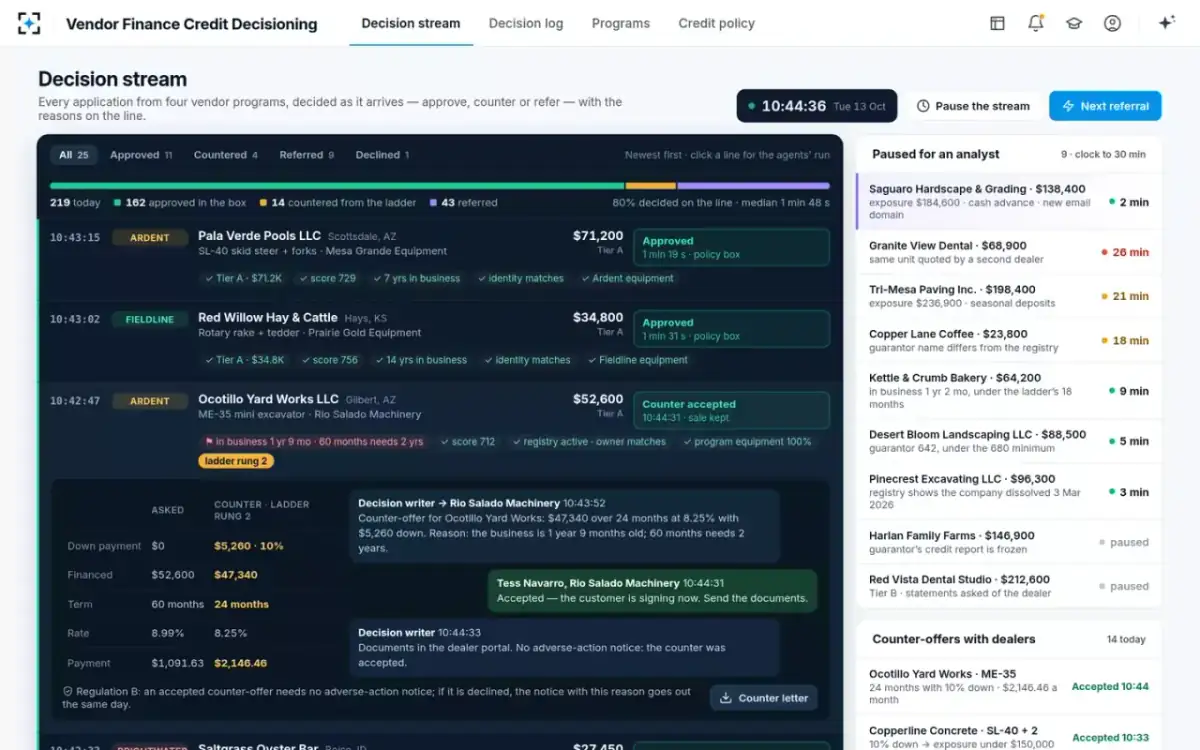
Ocotillo Yard Works asked for $52,600 over 60 months, nothing down, for an ME-35 mini excavator. Every number the credit policy tests came back clean except one: the guarantor's personal score was 712, well over the program's floor; the business was active in the state registry with the owner matching; every item on the quote was program equipment. The one number that did not clear was time in business — one year nine months, against a two-year minimum the program requires for a 60-month term.
A business three months short of two years is not a thin file or a bad credit. It is one rule, missed by three months, on an application that passed every other test a credit analyst would otherwise have to read to confirm. That is precisely the situation a counter ladder exists for: a near-miss specific enough that a credit manager was willing to pre-write its fix months before this application ever arrived.
What a counter offer legally is, and is not
Under Regulation B, "adverse action" is defined to exclude a case the credit world calls a decline in every other sense of the word. The rule's own text: "a refusal to grant credit in substantially the amount or on substantially the terms requested in an application unless the creditor makes a counteroffer (to grant credit in a different amount or on other terms) and the applicant uses or expressly accepts the credit offered" (§1002.2(c)(1)(i)). Read closely, the exclusion has two conditions, not one: the creditor has to make the counteroffer, and the applicant has to use or expressly accept it. A counter that is never accepted is not exempt from anything — it falls straight back into the ordinary adverse-action rules, which is the detail a program's ladder has to get right as much as the rung itself.
Offering less than was asked is common, and turning it down is not rare. In the 2025 Small Business Credit Survey, only 42% of applicants for a loan, line of credit or cash advance received all the financing they sought; and among those who did not, 37% said the business did not accept some or all of the approved financing (Federal Reserve Banks, 2026 Report on Employer Firms). A counter is only worth making if it is one the applicant will take, which is the argument for a ladder: terms a credit manager chose to fit the specific miss, offered while the customer is still at the counter, rather than a reduced amount decided a day later.
Fewer than half of small-business applicants got everything they asked for
Why only one missed rule gets a counter, not a decline
A counter ladder only works if it is narrow about what it covers, and Vendor Finance Credit Decisioning's policy and pricing engine is built narrow on purpose: it counters only when exactly one rule in the credit policy's box is missed, and only when a rung of the ladder the credit manager has signed covers that specific miss. Two rules missed, or one rule missed by more than its rung's margin, is not a counter — it is a referral, with the agents' findings attached for a person to weigh.
A ladder of pre-signed fixes, and what falls below all of them
Agent
Rung 1: guarantor score 660–679Just under the 680 floor: 20% down and a 48-month term.
Agent
Rung 2: in business 18–23 months, score 700 or moreToo young for a 60-month term: 24 months with 10% down. Ocotillo Yard Works, below.
Agent
Rung 3: exposure $150,001–$165,000, no statementsJust over the application-only limit: a down payment that brings exposure back to $150,000.
Agent
Rung 4: other makes 25–35% of costToo much non-program equipment: finance the program equipment only.
A person decides
Everything elseMore than one rule missed, or a miss no rung covers, goes to a credit analyst with a recommendation already attached.
Never: counters anything that is not on a rung the credit manager signed
The engine's own limits are as deliberate as what it is allowed to do: it approves only inside the box a credit manager sets, counters only from a signed rung, and never declines on its own — a decline, like any counter that is not on the ladder, is drafted for a person to sign. The ladder is narrow so that the fast path stays trustworthy; everything it does not cover still gets a person's judgment.
Rung 2, worked: $52,600 over 60 months becomes $47,340 over 24
Rung 2 of the signed ladder covers exactly a business that is too young for the term it asked for, and the fix is arithmetic a credit manager chose and signed before the deal arrived: shorten the term to 24 months, and ask for 10% down. On $52,600, that is $5,260 down, financing $47,340. The shorter term also prices lower, 8.25% against the 8.99% asked at 60 months, and the monthly payment comes to $2,146.46. None of the other tests moved: the guarantor score, the registry and the equipment mix were already clean, and the rung changed exactly the one thing that had failed.
Rung 2 on the Ocotillo deal: every number re-derivable from the application
Down payment
10% × $52,600 = $5,260
The rung’s fixed share of the equipment cost.
Amount financed
$52,600 − $5,260 = $47,340
Total exposure falls by the same amount.
Monthly payment
$47,340 × r ÷ (1 − (1 + r)^−24), r = 8.25% ÷ 12
= $2,146.46, against $1,091.63 a month on the 60-month ask at 8.99%.
What the dealer’s customer pays in total
$5,260 + 24 × $2,146.46 = $56,775
Against $65,498 over 60 months as asked: a higher payment, a smaller total.
10:42:47 to 10:44:31: the Ocotillo counter, from arrival to acceptance
- Application read, checked and tested; time in business misses by 3 months; Rung 2 counter written and sent at 10:43:5265 s
- Tess Navarro, Rio Salado Machinery, reads and accepts at 10:44:3139 s
39 seconds: the dealer's acceptance, and what it skips
"Accepted — the customer is signing now. Send the documents."
Tess Navarro, Rio Salado Machinery, accepting the counter 39 seconds after it was offered
Thirty-nine seconds is how long it took a dealer to read $5,260 down, 24 months and $2,146.46 a month, and say yes, one minute and 44 seconds after the application arrived. What that acceptance skips is the queue: no referral, no analyst reading seventeen rules to confirm what the policy engine had already confirmed, no day spent while the customer shops the same application to a second funder. The moment Rio Salado Machinery accepts, the only adverse-action question Regulation B's own definition asks — did the applicant use or expressly accept the credit offered — is already answered.
What happens when a counter is declined instead
An accepted counter and a declined one are not the same event under Regulation B, and a ladder's design has to treat them differently from the moment the dealer says no. The counter itself is a notice of action and is due within 30 days of a completed application (§1002.9(a)(1)(i)). If the applicant does not expressly accept or use it, the creditor owes an adverse action notice "90 days after notifying the applicant of a counteroffer" (§1002.9(a)(1)(iv)), with reasons that are "specific and indicate the principal reason(s) for the adverse action" (§1002.9(b)(2)). That timetable applies to a business with $1 million or less of gross revenue in its last fiscal year. A larger business is owed notice "within a reasonable time", and written reasons if it asks in writing within 60 days (§1002.9(a)(3)(ii)).
A counter-offer under Regulation B: what each outcome owes, and when
| What happens | What the creditor owes | Rule |
|---|---|---|
| The counter is sent | It is itself the notice of action taken; due within 30 days of a completed application | §1002.9(a)(1)(i) |
| The applicant accepts or uses the credit | Nothing further: the counter is not adverse action | §1002.2(c)(1)(i) |
| The applicant declines, ignores or does not use it | An adverse action notice within 90 days of the counter, with specific reasons; it may be combined with the counter in one notice | §1002.9(a)(1)(iv); official interpretation 9(a)(1)-6 |
| The deal was shopped to several funders and the customer took another one | No notice from the funders not chosen | §1002.9(g) |
| Business with over $1 million revenue | Notice within a reasonable time; written reasons on written request within 60 days | §1002.9(a)(3)(ii) |
| Every outcome | Keep the application, what was used to evaluate it and the notice for 12 months (business credit) | §1002.12(b) |
What will not pass, for a declined counter any more than for an outright decline, is a reason that just names the process. Regulation B's own text rules out "statements that the adverse action was based on the creditor's internal standards or policies" as insufficient (§1002.9(b)(2)). "The ladder didn't cover it" is exactly that kind of statement. The reason a declined counter has to carry is the real one underneath — which rule missed, by how much, and why the rung on the ladder did not reach far enough to cover it.
A decline-only policy against a signed counter ladder, on the same missed-rule deal
Decline-only policy: A decline, or a queue while an analyst works out a manual counter.
Signed counter ladder: A computed counter the instant the one miss is found.
Decline-only policy: Whenever an analyst reaches the file and works out a counter by hand.
Signed counter ladder: 1 minute 44 seconds from arrival to the dealer’s acceptance.
Decline-only policy: Required on the decline, with specific reasons.
Signed counter ladder: None needed once the counter is accepted — still required, with specific reasons, if it is declined.
Decline-only policy: Likely to a second funder while the first queue runs.
Signed counter ladder: Nowhere — the customer signs before leaving the counter.
How a credit manager builds and signs a ladder
Read the bands as well as the fixes. Each rung names the range it covers, 660 to 679 on the score, 18 to 23 months in business, $150,001 to $165,000 of exposure, so a miss by more than the band is a referral, not a bigger counter. The second rung even carries a second condition, a guarantor of 700 or more: a young business with a thin guarantor is two misses, and two misses go to a person.
A ladder is not discretion written down after the fact; it is discretion written down and signed before any deal tests it. A credit manager chooses which single-rule misses are worth a pre-agreed fix, writes the fix as arithmetic — a shorter term, a larger down payment, a pricing adjustment — rather than a judgment call, and signs the ladder into the credit policy alongside the box itself. Each version of the ladder is kept with the policy version that produced it, so widening or narrowing what a rung covers next quarter never rewrites what Ocotillo's deal was offered this morning.
The discipline that makes a ladder safe to automate is the same discipline that makes it defensible to a regulator later: every rung covers exactly one setting, every rung's fix is arithmetic a person can re-derive from the application alone, and anything a rung does not reach — more than one miss, or a miss outside any rung's margin — is never countered, only referred. A ladder that tried to cover every possible combination of misses would stop being a pre-agreed fix and start being a second underwriting decision disguised as one.
Counter accepted: asked, offered and accepted, side by side
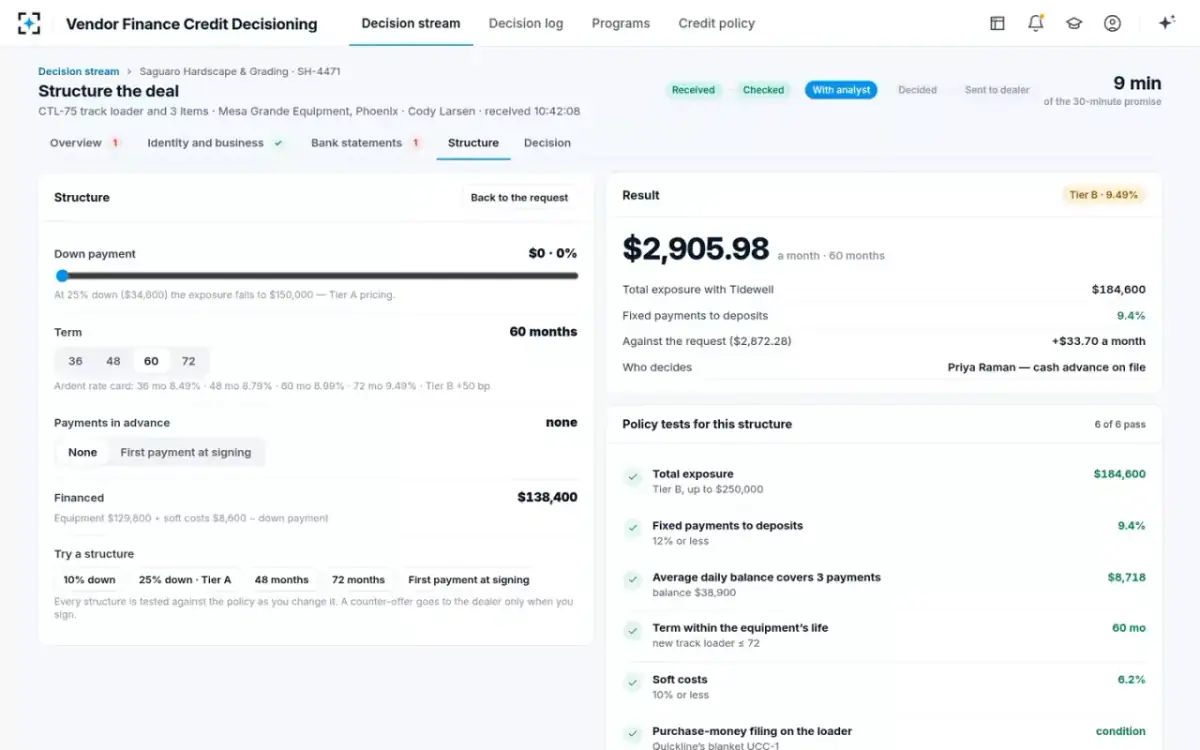
Structure: testing a different down payment and term before a counter is sent
Does accepting a counter offer need an adverse-action notice?
No — not once it is accepted. Regulation B's definition of adverse action carves out a counteroffer the applicant uses or expressly accepts from the start (§1002.2(c)(1)(i)), so an accepted counter is not a refusal under the rule at all, and nothing in §1002.9 requires a notice for it. That carve-out is specific to acceptance, not to counters in general: a counter the applicant declines, ignores, or only partly accepts falls back into the ordinary notice-and-reasons rules exactly as a decline would. A program that assumes every counter is notice-free, rather than every accepted one, will eventually miss a notice it owed.
Questions people ask
What does a counter offer on a loan mean?
It means the lender will not approve the amount or the terms asked for, but will approve something else instead — usually a smaller amount, a shorter term, more money down, or a different rate. Under Regulation B, it is legally distinct from a decline the moment the applicant accepts it.
Does a counter offer count as a loan denial?
Only if it is declined, not used, or not expressly accepted. Regulation B's definition of adverse action specifically excludes an accepted counteroffer; a counter that is turned down becomes adverse action, with a notice due within 90 days of the counter and the same specific-reasons requirement as any other.
How is a loan counter offer calculated?
In a signed counter ladder, it is not calculated fresh each time — it is read off a rung the credit manager pre-agreed, matched to the specific rule the application missed. On the Ocotillo deal, the rung for a business too young for its term produced a shorter term and a down payment, computed the instant the miss was found rather than negotiated case by case.
Can you negotiate a counter offer on an equipment loan?
Within a signed ladder, usually not at the rung level — the rung's terms are fixed in advance so the offer can go out in the same second the miss is found. A dealer or applicant who wants different terms than a rung offers is asking for a structure the ladder does not cover, which routes to a credit analyst rather than a second automatic counter.
What happens if you decline a counter offer?
The application falls back into the ordinary adverse-action rules. For a business with $1 million or less in revenue, the lender owes an adverse action notice within 90 days of the counter-offer; above that line, within a reasonable time. The reasons have to be specific, not a reference to internal standards or a policy the applicant cannot inspect.
Why did I get a counter offer instead of an approval?
Usually because the lender will lend, but not on the terms asked: a smaller amount, a shorter term or more down. In a program with a signed ladder, it means one setting in the credit policy was missed by a margin the lender had already agreed to fix, such as a business a little young for the term asked, and the rest of the application passed. The notice must say which setting.