In equipment finance underwriting, the credit analyst decides the applications a vendor program’s own credit policy cannot decide by itself. That is not every application, nor the ones the policy is built to catch, but the ones that sit just off the box: a business a few months too young, a changed phone number, a cash advance nobody listed. Four other seats touch the same application before it is done: the dealer’s own rep, who sends it; the credit manager, who decides above the analyst’s authority and signs the policy itself; the vendor program manager, who watches the whole relationship instead of one deal; and the head of equipment finance, who owns the day across every program at once. Botminds’ Vendor Finance Credit Decisioning puts six specialist agents on every application the moment it lands, and none of the five seats disappears; each one decides something narrower, and faster, than it decided before.
The example on this page runs through a fictional vendor finance program: Ardent Compact Equipment, its dealer Mesa Grande Equipment and Mesa Grande’s rep Cody Larsen, credit analyst Priya Raman, credit manager Marcus Feld, vendor program manager Elena Brandt and head of equipment finance Dana Whitlock. The wage and outlook figures are published research, linked where they appear.
Five seats, one application
Every application a dealer sends starts the same five-seat relay, whether it is decided in under two minutes on the line or referred to a person. The seat that acts changes with the deal, not with a shift schedule: most applications never reach past the second seat, and the one that does is usually there for a specific, nameable reason.
The same application, five seats, before and after agents
Today
Stands at the counter with a customer who wants an answer now, and sends the same application to two or three funders at once.
With agents
Gets an approval, a counter or a signed answer in the dealer portal and by text, usually in minutes.
Today
Reads every application by hand: the registry, the bureau, the bank statements, in whatever layout they arrive.
With agents
Opens a referral with the run already done and the findings cited, and spends her minutes on the judgement, not the reading.
Today
Sees deals that missed the policy box by one rule sit in a queue until the dealer shops them elsewhere.
With agents
Signs the policy box and a four-rung counter ladder once; the line approves and counters only inside what he signed.
Today
Hears about a slow answer or a bad dealer from the dealer, after the damage is done.
With agents
Watches every program’s median answer time, look-to-book and 60-plus-days-late by the day, not the quarter.
Today
“If we answer second, we don’t get the deal”, and finds out who answered second a week later.
With agents
Sees the day as it runs: applications by half hour, time to a decision, across all four programs at once.
A business applicant is owed a decision quickly, whichever seat makes it: a creditor must notify the applicant of the action taken on a completed application “within 30 days” under Regulation B. But a dealer-channel deal can be sent to several funders at once, a case the same regulation provides for (§1002.9(g)), so the clock that decides who books it is minutes, not weeks. That clock runs under every one of the five seats, whether the answer takes ninety seconds on the line or eleven minutes with a person.
The dealer’s rep: a yes or a number, now
Cody Larsen’s seat is the one with the least patience built into it. The customer is standing at the counter with a machine already picked out, and Cody needs a yes, a counter or a number to give them, not a status. He is not the one deciding; he is the one who feels every minute the decision takes, because the same application may be sitting with another funder at the same time.
That urgency is not misplaced. Cody is not a loan officer by title, but the seat he represents at the point of sale has to turn a customer’s “can I get this today” into a real number before they walk, and the dealer’s reputation with that customer rides on how fast the financing answer comes back.
The credit analyst: the deals the box can’t decide alone
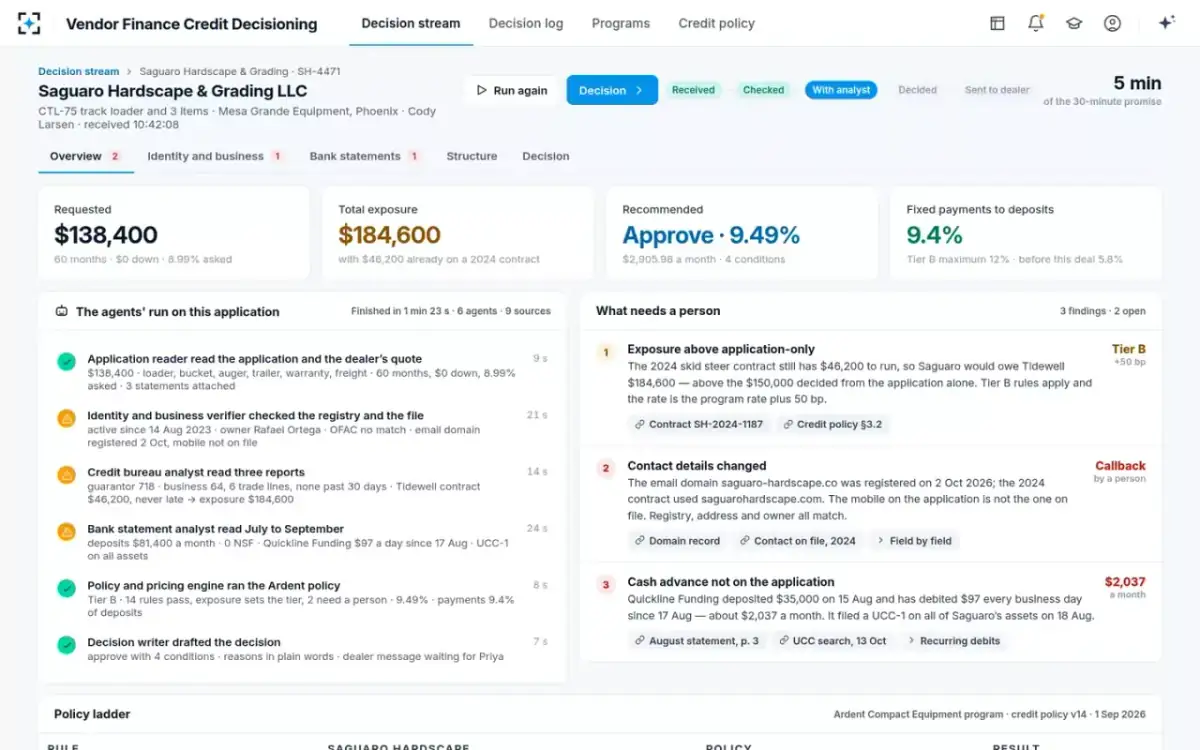
Priya Raman’s seat exists for the applications the policy box is not built to approve on its own. They are not bad credit; something about them needs a person’s judgement: an exposure total that crosses the application-only limit, a new email domain, a cash advance that showed up on the bank statements but not on the application. When one of those reaches her, the run is already done: findings cited to their source, a recommended decision, and a short list of what still needs her specifically.
Part of what makes an analyst’s seat specific to this work is whose credit is actually on the desk. Most of these loans carry a personal signature behind the business one: of firms that have any debt, 59% secured it with a personal guarantee, against 51% that used business assets, according to the Federal Reserve’s 2025 Small Business Credit Survey. A guarantor’s own bureau report is not a side detail on a small-ticket application; for most applicants it is half of what the decision rests on, which is why the credit bureau analyst agent reads the guarantor’s personal report alongside the business’s.
The analyst’s screen: the run done, three findings open
The credit manager: the box itself, and the ladder
Marcus Feld does not decide applications one at a time; he decides the box every other decision runs inside. He signs the policy (the application-only limit, the time-in-business and guarantor-score pairs, the fixed-payments ceiling), and he signs the four-rung counter ladder that lets the line turn a near-miss into an offer instead of a queue. Above $250,000 of exposure, and for any policy exception, the decision is his alone, with reasons, not a score, behind it.
What makes his seat different from Priya’s is not authority alone but scope: he is accountable for every deal the box ever approves or counters, not just the ones that reach a person. Every change he makes to the policy or the ladder is versioned and signed, and the agents never approve or counter outside what he has signed. The policy and pricing engine’s own limit is that it approves only inside the box and counters only from the ladder, never on its own judgement of a deal it has never seen before.
Who may sign what, on one vendor finance desk
| Decision | Who signs | What the agents may do |
|---|---|---|
| Approve inside the Tier A or Tier B box | Nobody: the credit manager signed the box in advance | Approve, when every rule passes and no verification signal is open |
| Counter-offer on one of the four rungs | Nobody at the time: the ladder was signed in advance | Send the counter to the dealer at once |
| Clear a changed email, phone or new domain | The credit analyst, after a call to the number of record | Flag it; never clear it, never call the number on the application |
| Approve, counter off the ladder or decline, up to $250,000 of exposure | The credit analyst | Recommend, with every finding cited |
| Anything above $250,000, or any exception to policy | The credit manager | Recommend only |
| Change the box, the ladder or the approvers | The credit manager, versioned and signed | Nothing |
The vendor program manager: not one deal, 148 dealers
Elena Brandt’s seat is the one built around a relationship a single application can’t show her. She looks after 148 dealers for Ardent Compact Equipment, and a program manager who only sees deals one at a time finds out a dealer has a problem from the dealer, usually after it has already cost a few lost sales. Her view is the program as a whole: median answer time, look-to-book (how many approvals actually turn into signed contracts) and 60-plus-days-late, plus an overnight watch for patterns like first-payment defaults and shared delivery addresses across dealers.
Four programs, one line: what a vendor program manager watches
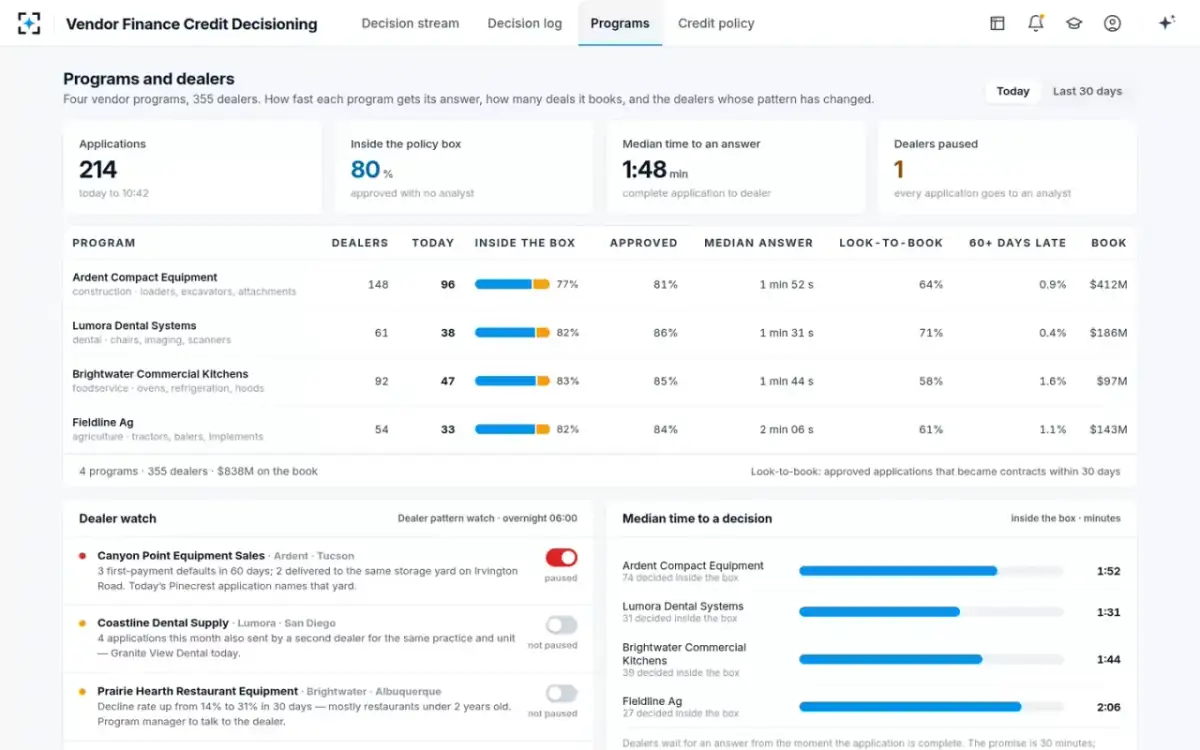
The seat matters because the dealer relationship, not the single deal, is what the program is actually built to protect. A dealer whose applications keep getting approved but whose contracts keep falling through (a weak look-to-book rate) is a different problem from a dealer whose applications are simply slow, and no single application tells Elena which one she has.
The head of equipment finance: the day as it runs
Dana Whitlock’s seat sits above all four programs at once, and her question is rarely about one deal either: it is whether the business, this week, is answering fast enough to keep winning the deals it is shown. On the sample day the story on this page walks through, 214 applications arrived across four programs: 158 approved inside the box, 13 countered from the ladder, 42 referred to a credit analyst, and one, the application this page follows, still on its way through. That last number, not the other two, is the one Dana watches for drift: a quiet rise in referrals is usually the first sign that a program’s policy no longer fits the deals its dealers are sending.
One application, five people, in the order it actually travels
A person decides
Cody Larsen, dealer sales repSends the application, the quote and the invoice the moment the customer is ready to sign something.
A person decides
Priya Raman, credit analystDecides every application the policy box can’t, up to $250,000 of exposure: the callback, the judgement, the structure.
A person decides
Marcus Feld, credit managerDecides above $250,000 and any policy exception, and signs the box and the four-rung counter ladder everyone else works inside.
A person decides
Elena Brandt, vendor program managerWatches her 148 dealers’ numbers as a program, not one deal at a time: median answer, look-to-book, defaults.
A person decides
Dana Whitlock, head of equipment financeOwns the day across four programs: volume, losses, and whether the 30-minute dealer promise held.
What does a credit analyst actually do all day?
On the sample day, 42 of 214 applications, about one in five, were referred to a credit analyst, and each one arrived with the reading already finished. Saguaro Hardscape & Grading’s $138,400 application is typical of why: its total exposure of $184,600 crossed the program’s $150,000 application-only limit, its email domain was eleven days old, and its bank statements carried a cash advance that never showed up on the application itself. Fourteen of the policy’s seventeen rules passed cleanly; the other three were exactly the kind of thing a person, not a rule, has to weigh.
Priya’s actual day is built from that kind of file: a short callback to the number on an old contract, not the number on the new application, to confirm a changed email or phone is really the business and not someone impersonating it; a look at whether a merchant cash advance changes what the business can actually afford to pay; and, when the numbers are close, running a different term or down payment through the structure calculator to see whether a deal that looks marginal at sixty months is comfortable at thirty-six. None of that is reading; the reading, by the time it reaches her, is already done and cited.
Will agents remove a seat from the desk?
Not on the numbers available, and not by the product’s own design. O*NET projects credit analyst employment to see a “Decline (-1% or lower)” over 2025–2035, and loan officers, the closer BLS category, are projected to grow a scant 1% over the same period, “slower than the average for all occupations” (BLS). Read plainly, neither figure describes a seat about to disappear; both describe one that is no longer growing the way it once did, for reasons that predate any agent on this page.
What changes, on this evidence, is the shape of the six hours a credit analyst spends on an exception application, not whether the seat exists. Before agents, verifying the business, the owner and the contact details alone took about a quarter of that time, as much as reading every page of the bank statements. With agents doing the reading and the comparing, that same verification work is still the largest single share of what is left, because confirming a changed phone number really belongs to the business on file is a judgement call, not a lookup.
Verification stays the biggest job on the desk, before and after agents
Before agents: six hours of exception work
- Reading the application and quote · 8%
- Verifying the business, owner and contact details · 25%
- Pulling bureaus and adding up exposure · 13%
- Reading the bank statements · 25%
- Running policy, pricing and structure · 16%
- Writing the decision, reasons and notice · 13%
With agents: about 33 minutes left
- Reading the application and quote · 9%
- Verifying the business, owner and contact details · 28%
- Pulling bureaus and adding up exposure · 9%
- Reading the bank statements · 18%
- Running policy, pricing and structure · 18%
- Writing the decision, reasons and notice · 18%
That is the accurate version of “will AI replace the underwriter”: the six agents on this solution never decline an application and never clear a fraud flag themselves: a person always calls the number of record, and a person always signs a decline or a counter that is not on the ladder. What moved is the six hours, not the five seats. To see the application and policy screens these seats actually work from, start from Vendor Finance Credit Decisioning, or read how the six agents divide the work in agentic AI for loan underwriting, and what none of them may do.
Questions people ask
What is an equipment finance underwriter?
It is the person who decides whether a vendor-program dealer application should be approved, countered or declined, checking the business’s identity, its credit and its bank statements against the program’s policy. In a program running Vendor Finance Credit Decisioning, that title usually maps to the credit analyst seat: an underwriter who now opens a file with the reading and the cross-checking already done, rather than doing it by hand.
Who approves a vendor finance application?
Most applications are approved or countered by the policy and pricing engine, strictly inside the box and ladder a credit manager has signed. Anything that misses the box, or needs a decline, goes to a credit analyst up to $250,000 of exposure, and to the credit manager above that or for any policy exception. The agents never send a decline or an off-ladder counter without a person’s signature.
What does a credit manager decide that an analyst cannot?
A credit manager decides the policy itself (the limits, the tiers and the counter ladder every other decision runs inside), plus anything above $250,000 of exposure and any exception to the signed policy. An analyst works inside that box; the credit manager is the one who moves its edges, and every move is versioned and on the record.
How many applications does a credit analyst handle in a day?
It depends on the program’s volume and policy, but the sample program on this page shows the shape: of 214 applications in one day, 42 (about one in five) were referred to an analyst, with the rest approved or countered automatically. That referral share, not the raw count, is what a vendor program manager actually tracks over time.
Will AI replace equipment finance underwriters?
The published outlook does not show the seat disappearing, and the product is built so it cannot decide a decline or an off-ladder counter on its own. What changes is the six hours an exception used to take: agents now do the reading, the cross-checking and the arithmetic, while a person still makes every judgement call the data alone can’t settle.