UCP 600 article 14 is the "Standard for Examination of Documents": every bank that examines must decide, "on the basis of the documents alone, whether or not the documents appear on their face to constitute a complying presentation" (14(a)), within at most five banking days after the day of presentation (14(b)). Its other ten paragraphs say how: transport documents presented within 21 days of shipment (14(c)), data that "need not be identical to, but must not conflict with" the other documents (14(d)), conditions that name no document disregarded (14(h)), and rules on dates, addresses and issuers. Article 16 then says what a bank must do when the answer is no. These are the paragraphs behind most of the questions examiners take to a senior checker. Botminds' UCP 600 & ICC Rules Search answers those questions with a cited verdict that opens the exact paragraph, labelled apart from standard practice and the bank's own procedure.
Rule text is quoted from ICC's free Digital Library and applies only where a credit incorporates UCP 600 without modifying the article. Examples of the solution come from a fictional sample bank, Corvane National Bank, and its sample data.
UCP 600 article 14 in twelve paragraphs: what each says, and where a court applied it
| Para. | What it says, in plain words | Applied or relied on in |
|---|---|---|
| 14(a) | Examine the documents alone, on their face, for a complying presentation. | MAM Apparel (E.D.N.Y. 2020): a “ministerial role” with no duty to go beyond the face |
| 14(b) | Up to five banking days after the day of presentation, for each bank; not shortened by expiry. | MAM Apparel: counting past a weekend to the fifth banking day |
| 14(c) | Original transport documents: present within 21 calendar days of shipment, and before expiry. | Fortis v IOB (2011): whether the bill of lading date was the date of shipment |
| 14(d) | Data need not be identical, but must not conflict, read in context and with standard practice. | — |
| 14(e) | Outside the invoice, goods may be described in general terms that do not conflict. | — |
| 14(f) | A document with no named issuer or content is accepted if it fulfils its function and does not conflict. | Mago v LHB (2d Cir. 2016) |
| 14(g) | A document not required is disregarded and may be returned. | — |
| 14(h) | A condition with no document to show compliance is deemed not stated. | Echoed in 12 CFR 7.1016 for US national banks |
| 14(i) | A document may predate the credit, but not its own presentation. | — |
| 14(j) | Addresses need only be in the same country; contact details are disregarded, with one exception. | — |
| 14(k) | The shipper need not be the beneficiary. | — |
| 14(l) | Any party may issue a transport document that meets articles 19 to 24. | — |
What does UCP 600 article 14 say?
It says how to examine, not what to pay. Article 14 sets the standard, the time and a set of interpretive rules for data, documents and conditions; article 15 says a bank that finds the presentation complying "must honour", and article 16 says what a bank that finds it discrepant may and must do. Read together, they are the whole decision.
Two words carry most of the weight. "Alone" means the examiner does not investigate the goods or the underlying contract; article 5 makes banks deal in documents, not in the goods, services or performance behind them, the principle the doctrine of strict compliance rests on. And "appear" means the test is what the documents show, not what is true. A court in New York put it as "a ministerial role that imparts no obligation to go beyond the face of documents" (MAM Apparel v NCL, E.D.N.Y. 2020).
What is a complying presentation?
A complying presentation is "a presentation that is in accordance with the terms and conditions of the credit, the applicable provisions of these rules and international standard banking practice" (UCP 600, art. 2). It has three tests, and the third, standard practice, lives mostly in ICC's ISBP 821, which is sold rather than published free.
A presentation also has to be a presentation. In Franklin v Industrial Bank of Korea, a beneficiary sent a letter calling itself a presentation without any of the documents the credit required. The Fifth Circuit, citing article 2, held that "The UCP places no obligation on IBK to explain discrepancies or its decision to refuse the purported letter of presentment under these circumstances" (5th Cir. 2018, unpublished). Article 14 starts only when documents arrive.
Article 14(a) and (b): on the face of the documents, within five banking days
Every examining bank, whether the nominated bank, a confirming bank or the issuing bank, gets its own five banking days, following the day of presentation, and an expiry date or last day for presentation that falls on or after the day of presentation does not shorten that period (14(b)). In MAM Apparel the court counted the days, skipping a Saturday and a Sunday, and found the second refusal notice timely on the fifth banking day.
The same case settles what starts the count: documents are presented when they arrive at the bank, not when they are sent. How each day of the clock is spent, and what a slow rules answer costs inside it, is the subject of UCP 600's five banking days.
What is the 21-day rule in UCP 600?
Article 14(c) says a presentation that includes "one or more original transport documents subject to articles 19, 20, 21, 22, 23, 24 or 25" must be made "not later than 21 calendar days after the date of shipment as described in these rules, but in any event not later than the expiry date of the credit". It is a default; a credit can set a shorter or longer period.
Three details catch people. It applies only to original transport documents; a presentation of copies alone is not caught by it. The clock runs from the date of shipment "as described in these rules", so for a bill of lading it is the issue date unless an on-board notation gives another date (art. 20(a)(ii)), the issue that the English courts had to decide in Fortis v IOB. And it is calendar days, unlike the examination period. Article 29(a) extends an expiry date or last day for presentation that falls on a bank closure day, but article 29(c) says the latest date for shipment is not extended.
What does article 14(d) mean by “not conflict”?
It means documents may say the same thing in different words, but may not say different things. "Data in a document, when read in context with the credit, the document itself and international standard banking practice, need not be identical to, but must not conflict with, data in that document, any other stipulated document or the credit" (UCP 600, art. 14(d)).
Identical, different, conflicting: how article 14(d) reads data across documents
Not a conflict: The packing list says “marine radar display units”; the credit and invoice give the full model description (art. 14(e) allows general terms outside the invoice).
A conflict: The packing list names a different model from the invoice.
Not a conflict: The beneficiary’s address on the certificate of origin differs from the credit’s, in the same country (art. 14(j)).
A conflict: The applicant’s address as notify party on the bill of lading differs from the credit’s (art. 14(j) requires it as stated).
Not a conflict: An inspection certificate dated before the credit was issued (art. 14(i)).
A conflict: An insurance certificate dated after shipment with no statement of earlier cover (art. 28(e)).
Not a conflict: An obvious typing error the documents themselves resolve.
A conflict: A word that changes who bears a cost: in Fortis v IOB, a certificate saying the issuing bank’s cost where the credit said “our” cost.
The invoice is held to a stricter line. Article 18(c) requires the invoice's description of the goods to match the credit's, while article 14(e) lets other documents describe the goods in general terms, provided they do not contradict the credit; how to check letter of credit documents quotes both rules and applies them to a sample presentation. Cross-checking data across a whole presentation is document examination work, which Botminds' Letter of Credit Document Checking solution does; the rule questions it raises are what this solution answers.
Article 14(f) and (g): unnamed documents, and documents nobody asked for
If a credit asks for a document "other than a transport document, insurance document or commercial invoice" without saying who issues it or what it must say, "banks will accept the document as presented if its content appears to fulfil the function of the required document" and otherwise complies with 14(d) (14(f)). A document the credit did not ask for "will be disregarded and may be returned" (14(g)).
The function test cuts both ways. In Mago v LHB, a standby required a "photocopy of B/L evidencing shipment of the goods to the applicant". The beneficiary presented unsigned copies; the Second Circuit, quoting the function language of article 14, held that "Without the carrier's signature, the presented copy of the bill of lading does not appear to fulfill the terms of the SLOC" (Mago v LHB, 2d Cir. 2016). A document's function is set by what the credit says it must evidence, not by its title.
What are non-documentary conditions?
A non-documentary condition is a term of the credit that names no document to show it was met, such as "goods must be of Malaysian origin" with no certificate of origin required. Article 14(h) tells the examiner to treat it as if it were not there.
"If a credit contains a condition without stipulating the document to indicate compliance with the condition, banks will deem such condition as not stated and will disregard it."
ICC, UCP 600, article 14(h)
US banking law points the same way. Under the OCC's rule for national banks, the obligation to honour turns on the documents the undertaking specifies, not on conditions outside them or on disputed facts between applicant and beneficiary (12 CFR 7.1016); whether US banks can issue bank guarantees sets that rule out in full. A credit drafted with such conditions is a credit the issuing bank has promised to pay without them, which is why they matter at issuance more than at examination.
Article 14(i) to (l): dates, addresses, shippers and transport document issuers
The last four paragraphs remove grounds for refusal that used to be argued over. A document "may be dated prior to the issuance date of the credit, but must not be dated later than its date of presentation" (14(i)). Addresses of the beneficiary and applicant "need not be the same as those stated in the credit", but "must be within the same country", and contact details such as telephone and email "will be disregarded", except that the applicant's address and contact details as consignee or notify party on a transport document "must be as stated in the credit" (14(j)).
"The shipper or consignor of the goods indicated on any document need not be the beneficiary of the credit" (14(k)), which matters in trading chains where the beneficiary buys from a manufacturer that ships. And a transport document "may be issued by any party other than a carrier, owner, master or charterer" if it meets the requirements of articles 19 to 24 (14(l)), which is how a freight forwarder's document can comply.
How does article 16 follow from article 14?
Article 14 produces the decision; article 16 governs a refusal. A bank that finds the presentation does not comply may refuse; the issuing bank may ask the applicant for a waiver, but the five days keep running while it does; and a bank that refuses must send one notice, saying that it refuses, listing every discrepancy and stating what it is doing with the documents, by the close of the fifth banking day. A bank that gets any of this wrong loses the right to say the presentation did not comply (16(f)). What happens after a discrepancy follows each step with the rule's own words.
From article 14 to article 16: examination, decision, notice
A person decides
Examine (art. 14)Documents alone, on their face, against the credit, the rules and standard practice, within five banking days.
A person decides
Decide (arts. 15–16(a))Complying: honour. Not complying: the bank may refuse.
A person decides
Waiver (art. 16(b))The issuing bank may ask the applicant to waive; the five days keep running.
A person decides
Single notice (art. 16(c)–(d))Refusal, each discrepancy, and hold, return or follow instructions, by the close of day five.
A person decides
Act as stated (art. 16(e)–(f))Hold or return as the notice said; failing either, the bank is precluded.
The link between them is practical, too. Every discrepancy a refusal notice lists has to come from the article 14 examination, because the notice is "single" and must state "each" discrepancy; a ground spotted on day six cannot be added. The OCC's handbook warns that unresolved discrepancies, material errors above all, can cost a bank its protection and its rights (OCC, Trade Finance and Services); what discrepant documents cost prices that out.
How UCP 600 & ICC Rules Search cites article 14 on a live presentation
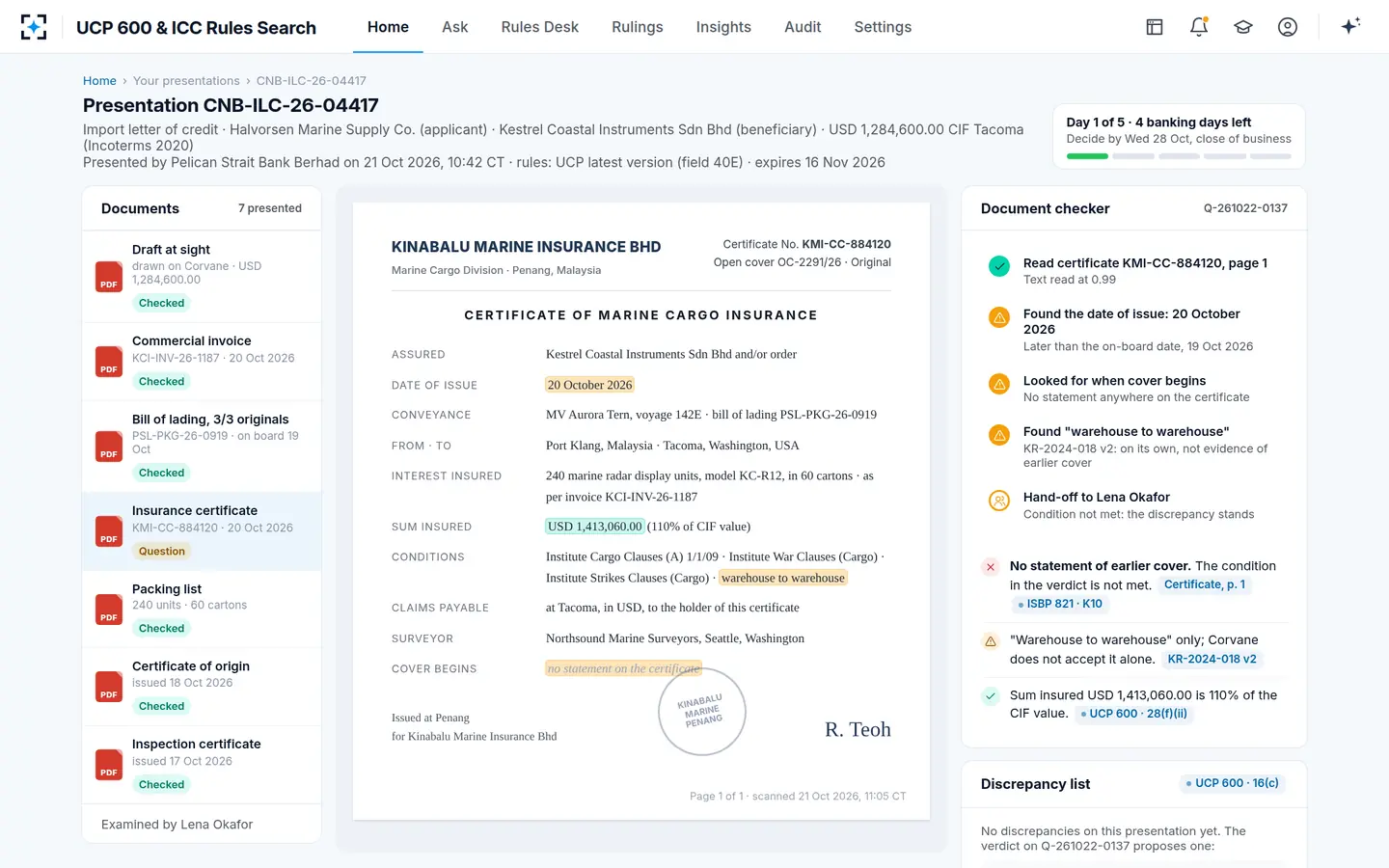
When an examiner asks an article 14 question with a presentation named, the agents read the credit's terms first, because a credit can modify the article, then answer with the paragraph, the practice and the bank's own procedure labelled apart. The document checker looks for the condition the verdict turns on in the presented document images and shows where it found it, or that it is not there; it reports, and the examiner decides.
UCP 600 & ICC Rules Search checks the deciding condition on the document itself
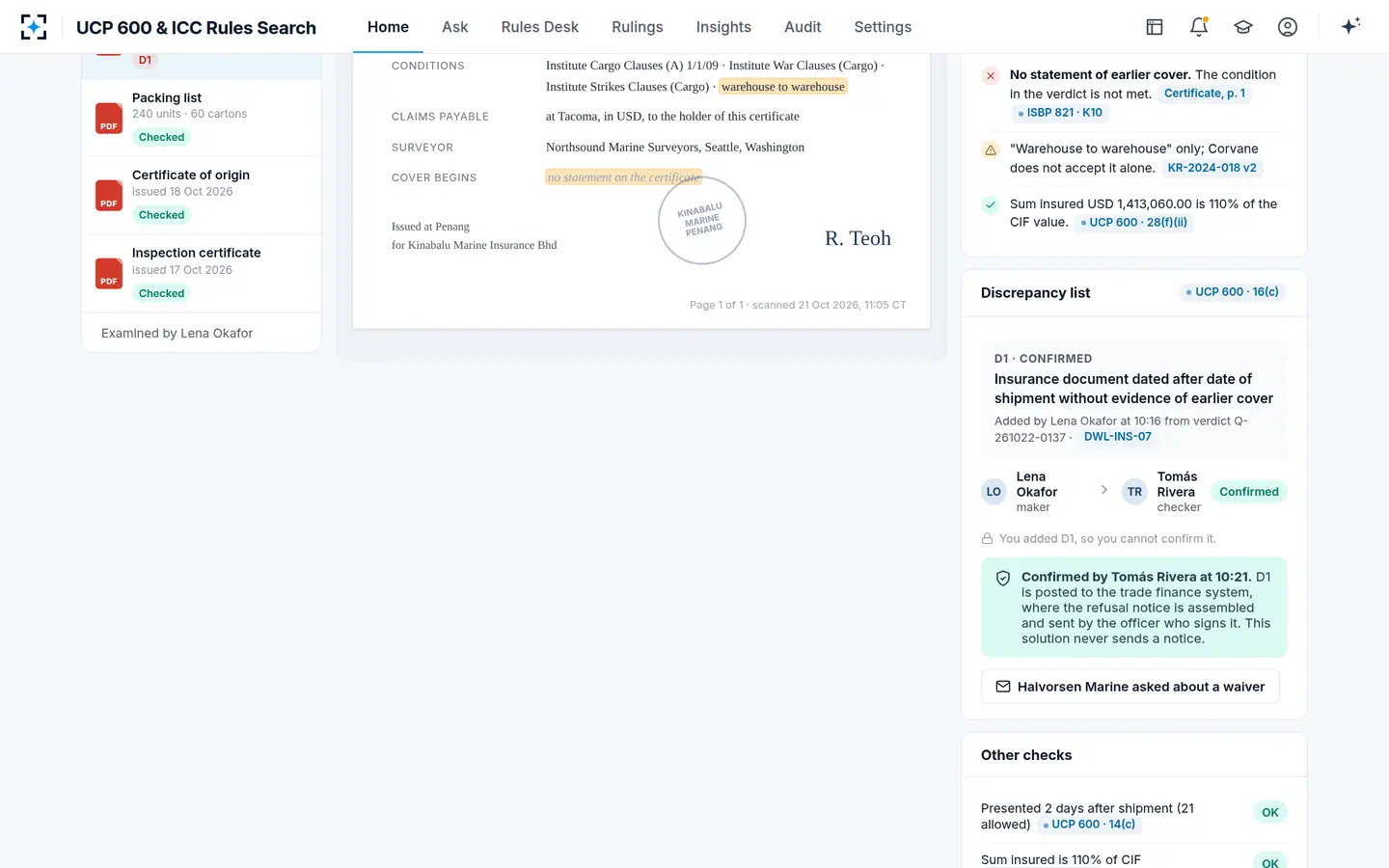
A discrepancy added by one examiner and confirmed by another before it posts
Questions that article 14 does not settle, such as whether a particular clause makes a bill of lading unclean, are answered "not settled" and go to the Trade Rules Desk rather than receiving a confident guess. For the doctrine that sits behind all twelve paragraphs, see the doctrine of strict compliance and its five myths.
Questions people ask
What does "on their face" mean in article 14(a)?
It means the examiner judges what the documents appear to show, without investigating whether they are true or whether the goods match. Article 5 says banks deal with documents, not goods; a US court has called the bank's role ministerial, with no obligation to go beyond the face of the documents. Fraud is handled by separate law, such as UCC § 5-109 in the US.
Does article 14 apply to standby letters of credit?
When the standby is issued subject to UCP 600, yes; article 1 applies the rules to standbys so far as they can apply to them. In Mago v LHB the Second Circuit applied UCP 600's function test to a standby. Many standbys are issued under ISP98 instead, which has its own examination rules.
Can a credit change the 21-day presentation period?
Yes. Article 14(c) is the default for presentations with original transport documents, and article 1 lets a credit modify any rule. A credit that states its own period for presentation after shipment applies that period, still subject to the expiry date.
Are copies of transport documents caught by the 21-day rule?
Article 14(c) applies to presentations "including one or more original transport documents subject to articles 19, 20, 21, 22, 23, 24 or 25". A presentation that includes no original transport document is not caught by it, though the credit's own expiry and terms still apply.
What happens to a non-documentary condition in a credit?
Under article 14(h), a condition that names no document to show compliance is deemed not stated and disregarded. The examiner does not ask for evidence of it. The fix belongs at issuance: the applicant should ask for a document that evidences the condition.