The UCP 600 questions and answers that examiners, students and interview panels use most have short answers in the rules themselves: a bank has a maximum of five banking days to examine a presentation, "on or about" means five calendar days either side of a date, "about" allows 10% either way on the figure it qualifies, and an insurance document may not be dated after shipment unless it shows earlier cover. The answers go wrong when they are given before three other questions: does this credit apply UCP 600 at all, which version, and what do its own terms say? Document examiners meet these questions all day, and many still settle them by asking a senior checker. Botminds' UCP 600 & ICC Rules Search answers them with a cited verdict, and its first agent is built to ask those three questions before anything else.
The rule text quoted here is ICC's, served free on its Digital Library. The examples of the solution come from a fictional sample bank, Corvane National Bank, and its sample data.
Twelve UCP 600 questions and answers, each with the article that settles it
| Question | Short answer | Article |
|---|---|---|
| When does UCP 600 apply? | Only when the credit expressly indicates it is subject to the rules; it can then modify or exclude any of them. | Art. 1 |
| Is a credit irrevocable if it does not say so? | Yes: "A credit is irrevocable even if there is no indication to that effect." | Art. 3 |
| What does "on or about" mean? | Five calendar days before until five calendar days after the date, both ends included. | Art. 3 |
| Are "prompt" and "immediately" binding? | No, unless the word is required to be used in a document; otherwise it is disregarded. | Art. 3 |
| Does "about" allow 10%? | Yes, more or less, but only on the amount, quantity or unit price it is used with. | Art. 30(a) |
| How long does a bank have to examine? | At most five banking days after the day of presentation, not cut short by expiry. | Art. 14(b) |
| How late can documents be presented? | With original transport documents, 21 calendar days after shipment, and never after expiry. | Art. 14(c) |
| Must data be identical in every document? | No. Data need not be identical, but must not conflict, read in context and with standard practice. | Art. 14(d) |
| Can a document be dated before the credit? | Yes, but not later than its date of presentation. | Art. 14(i) |
| Must the commercial invoice be signed? | No. It must appear to come from the beneficiary, be made out to the applicant and be in the credit’s currency. | Art. 18(a) |
| Can the insurance be dated after shipment? | Only if the document shows cover effective from a date not later than shipment. | Art. 28(e) |
| How much insurance cover, if the credit is silent? | 110% of the goods’ CIF or CIP value, as a minimum. | Art. 28(f)(ii) |
Where can I find UCP 600 questions and answers you can rely on?
Start with the rule text, which ICC serves free on its Digital Library, and check every answer against the article before trusting it. A question-and-answer list is only as good as the version of the rules it was written against and the honesty of its sources.
The ICC itself has flagged the problem. An August 2026 report on the ICC Digital Library says the Banking Commission's 2026–27 action plan sets out to counter inaccurate interpretations and unofficial guidance spreading online and on social media (ICC Digital Library, August 2026), though the article says it gives its author's views, not necessarily ICC's; what an AI trade finance rules answer must show takes that worry into chat assistants. A PDF of "UCP 600 questions and answers" that cites no article, or one written for UCP 500, will look as confident as one that is right.
Three tests separate a reliable answer from a plausible one. It names the article. It says what the rule does not settle, such as practice under ISBP 821 or a Banking Commission opinion. And it says whether the answer changes if the credit modifies the rule, which article 1 allows. Our guide to where to download UCP 600 free lists which ICC texts are free and which are sold.
How do I know which rules apply to a letter of credit?
Read the credit. UCP 600 applies only "when the text of the credit expressly indicates that it is subject to these rules", and even then it binds the parties "unless expressly modified or excluded by the credit" (UCP 600, art. 1). The rules are a contract term, not a statute.
The OCC puts it the same way for US examiners: "The UCP does not carry the force of law", and "For the UCP rules to apply, the commercial letter of credit must expressly indicate that it is subject to the rules" (OCC, Trade Finance and Services). A standby can be issued under UCP 600 too; the Second Circuit decided Mago v LHB on a standby that incorporated the UCP. The OCC's own rule on letters of credit lists the recognised alternatives, from UCC Article 5 and UCP 600 to ISP98 and the bank-to-bank reimbursement rules, URR 725 (12 CFR 7.1016).
Some rules carry others with them. An eUCP credit is subject to the UCP as well, without having to say so, and where the two differ the eUCP prevails (eUCP Version 2.1, art. e2); eUCP version 2.1 quotes the article. A question about an electronic presentation answered from UCP 600 alone can therefore be wrong on the clock, the originals and the date of shipment.
What does "UCP latest version" mean in a letter of credit?
It means the credit applies the revision of the UCP in force when the credit was issued, which today is UCP 600. A US federal court read it that way: the credit stated that its "applicable rules" were the "UCP latest version" and that it was "subject to ICC Pub. 600", and the court held that the New York UCC provision the issuing bank relied on, § 5-111, did not apply as a result (Zions Bancorporation v JPMorgan Chase Bank, S.D. Cal. 2021).
The eUCP spells out the same default for its own versions: a credit must name the version it uses, and one that does not takes the version in effect on the day it is issued (eUCP 2.1, art. e1(c)). The version question sounds academic until a rules revision takes effect while credits are outstanding. Why there is still no UCP 700 covers what has and has not changed since 2007.
Does "about" mean 10 percent in UCP 600? And what "on or about" means
"About" or "approximately" allows a tolerance "not to exceed 10% more or 10% less", but only on "the amount, the quantity or the unit price to which they refer" (UCP 600, art. 30(a)). A credit for "about 240 units" at a fixed unit price gives no tolerance on the price.
Without the word, two narrower tolerances apply. Quantity may vary by 5% either way unless the credit states it "in terms of a stipulated number of packing units or individual items", and the drawings may not exceed the credit amount (art. 30(b)). Even when partial shipments are not allowed, the amount drawn may be up to 5% less if the full quantity is shipped and the unit price is not reduced (art. 30(c)). "On or about" is a different rule about dates: five calendar days before until five after, "both start and end dates included" (art. 3).
The same question answered before and after the three questions are asked
Answered at once: No, “about” allows 10%.
Answered after asking: Which figure does “about” qualify, and is the unit price fixed? 252 is 5% over 240, so it is inside 30(a) on quantity; check the amount drawn too.
Answered at once: Yes, discrepant.
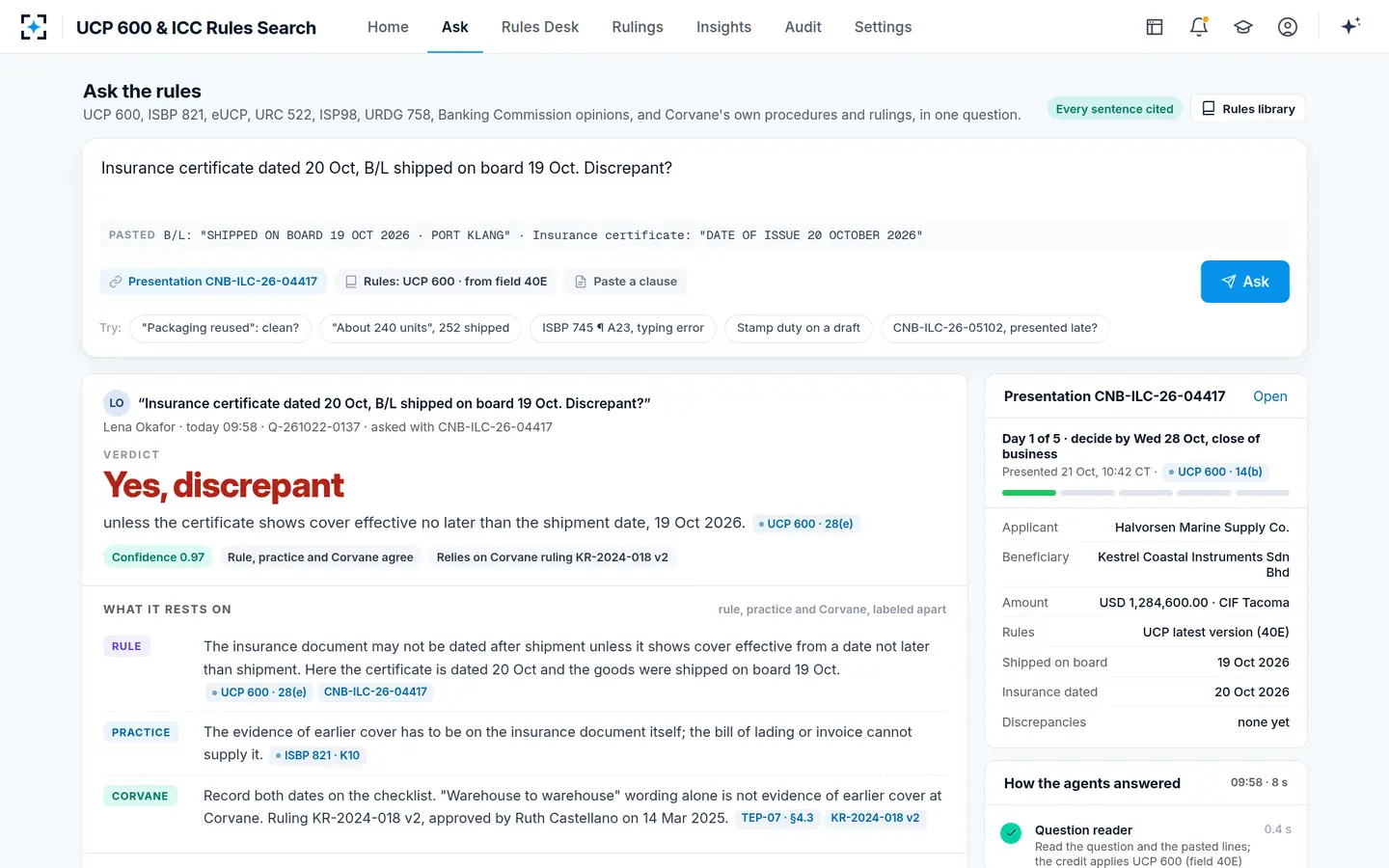
Answered after asking: Does the certificate itself show cover from a date not later than shipment? If so, art. 28(e) is met.
Answered at once: Yes, late.
Answered after asking: Does the credit set its own period, and are original transport documents presented? Art. 14(c) applies only to those.
Answered at once: One original is not a full set.
Answered after asking: Is it an eUCP credit? Under art. e9 one electronic record satisfies any requirement for originals or copies.
The three questions to ask before answering any UCP 600 question
Ask which rules the credit applies, which version, and what the credit's own terms say about the point. Only then does an article answer the question; skip one and the answer is a general statement about the rules, not an answer about this presentation.
The third question is the one that catches most people. In the sample bank's first three weeks of October, examiners overrode 25 of 1,386 verdicts, and the largest group, 11 of the 25, were overrides because the credit's own terms differed from the general rule. Credit terms modify the rules all the time, and article 1 lets them.
How a rules question becomes an answer in UCP 600 & ICC Rules Search: ask, research, cite
A person decides
Examiner asksTypes the question in plain words, with the presentation or a pasted clause as context.
Agent
Question readerFinds the instrument and the rules it applies, from the credit’s applicable-rules field, and loads the credit’s terms when a presentation is named.
Never: Never guesses a rule set the instrument does not name; it asks.
Agent
Rules researcherSearches the rules, standard practice, licensed opinions, the bank’s procedures and its past decisions, by passage and version.
Never: Never uses a superseded edition for a new answer.
Agent
Verdict writerOpens with the verdict and labels rule, practice and bank procedure apart; answers “Not settled” when the sources disagree or are silent.
Agent
Citation checkerReads each sentence back against its passage and removes what the source does not say.
A person decides
Examiner decidesReads the verdict and its passages, checks the document, and decides; a second examiner confirms any discrepancy.
When the honest answer to a UCP 600 question is “not settled”
Some questions have no answer in the rules, and the honest reply says so. Article 27 accepts only a clean transport document, one with no clause or notation that expressly declares the goods or their packaging defective (UCP 600, art. 27). A bill of lading marked "packaging reused" declares nothing about condition in so many words, and the rule does not address the phrase. ICC Banking Commission opinions works through that exact clause.
UCP 600 & ICC Rules Search declines to guess: “Not settled”, with each source shown
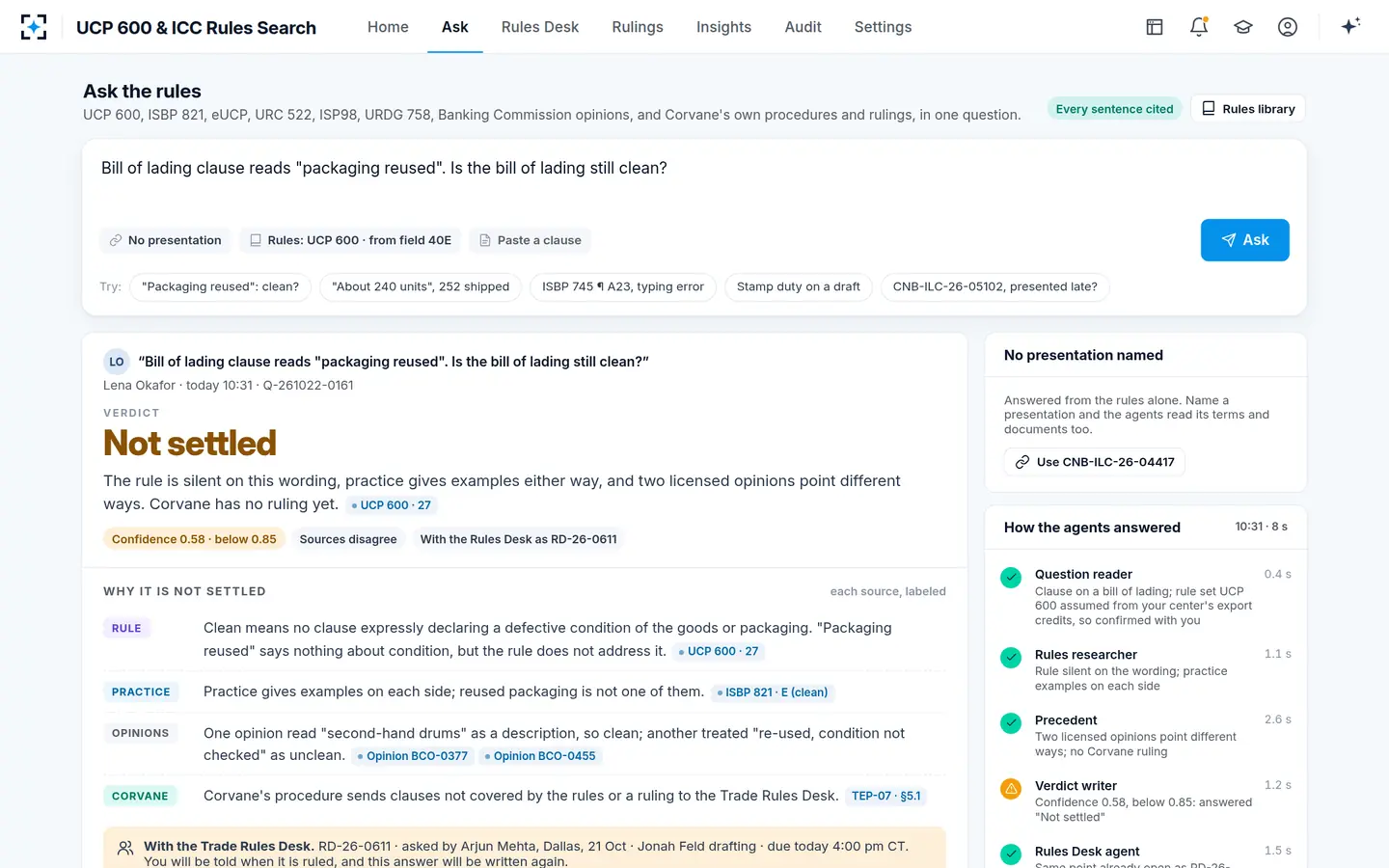
In the sample bank, the agents answered that question "Not settled" at a confidence of 0.58, below the bank's threshold of 0.85, and sent it to the Trade Rules Desk with the conflicting passages attached. A ruling drafted by one specialist and approved by the desk lead settled it later that morning, and the four people who had asked the same thing got the new answer. A list of questions and answers cannot do that; it can only be wrong in the same way for everyone.
Who answers rules questions in a bank?
Nobody, formally. In many trade operations a question climbs from a senior examiner to a rules or policy desk to legal counsel, mostly by chat or email. The OCC expects "competent managers and experienced staff" in trade operations and tests whether documents are reviewed in time and discrepancies resolved (OCC, Trade Finance and Services); it does not prescribe who answers the rule questions in between.
The weakness of the informal route is not the quality of the senior checker's answer. It is that the answer, and the reasoning behind it, disappears once given, so the next center asks again and may hear something different. When the sample bank's month of questions is broken down by where human judgement was needed, the clean-clause questions under article 27 stand out.
Where the sample bank's Trade Rules Desk was needed in one month
UCP 600 interview questions that test judgement, not recall
Interview panels and certification exams ask recall questions because they are easy to mark. The questions below are better, because each has a correct answer that depends on a second question, which is how the work actually arrives.
Six UCP 600 interview questions with a second question hidden inside
- A credit says nothing about irrevocability. Can the issuing bank cancel it?
No: art. 3 makes it irrevocable, and art. 10 requires the beneficiary’s agreement to cancel. Then ask: does the credit apply UCP 600 at all?
- The credit asks for a certificate but names no issuer. Who may issue it?
Anyone, if its content fulfils the function (art. 14(f)); but “first class” or “independent” issuers exclude only the beneficiary (art. 3).
- The bill of lading shows a different notify address from the credit.
Addresses need only be in the same country (art. 14(j)), except the applicant’s details as consignee or notify party on a transport document.
- Shipment “in the first half of May”: is 15 May in time?
Yes: art. 3 reads “first half” as the 1st to the 15th, all dates inclusive.
- The applicant offers a waiver on day four. Does the clock stop?
No: art. 16(b) says approaching the applicant does not extend the period in art. 14(b).
- A transport document says goods “may be loaded on deck”. Clean?
Acceptable: art. 26(a) bars an indication that goods are or will be on deck, not a clause that they may be.
Can a rules assistant answer UCP 600 questions without automating the examination?
Yes, if it researches and cites rather than decides. The Wolfsberg Group, ICC and BAFT wrote in their 2019 Trade Finance Principles that parts of trade document review can be automated but the review as a whole cannot (Wolfsberg Group, ICC and BAFT, 2019; their words are quoted in how technology can assist in combating TBML). That statement is the right test for any tool in this space.
UCP 600 & ICC Rules Search is built to that line. The agents read the question, research the rule, practice, opinions and the bank's own rulings, write a cited verdict and check every sentence against its passage. They never pay or refuse a presentation, never send a notice and never approve a ruling. The examiner reviews the documents and decides, a second examiner confirms, and the Rules Desk lead approves the bank's positions. Five tests to run before trusting any AI rules answer go further into how to check such a tool.
A verdict first, then the rule, the practice and the bank's own position, each cited
Questions people ask
What is UCP 600 in simple words?
UCP 600 is the International Chamber of Commerce's set of rules for documentary credits, in force since 1 July 2007. It applies only when a credit says it is subject to the rules, and it sets how banks examine documents, how long they have and how they refuse. The OCC notes that the UCP does not carry the force of law; it binds as a term of the credit.
How many days does a bank have to check documents under UCP 600?
At most five banking days after the day of presentation, under article 14(b), for each of the nominated bank, any confirming bank and the issuing bank. The period is not cut short by an expiry date falling inside it. A refusal notice must go by the close of the fifth banking day (art. 16(d)).
Can a letter of credit exclude UCP 600 articles?
Yes. Article 1 says the rules bind all parties "unless expressly modified or excluded by the credit", so a credit can change the tolerance, the presentation period or any other article. That is why an answer about the rules is incomplete until the credit's own terms are read.
What is the difference between UCP 600 and ISBP 821?
UCP 600 is the rules; ISBP 821 is the ICC's compilation of standard banking practice for examining documents under them, published on 3 July 2023 to replace ISBP 745. Article 2 of UCP 600 makes standard practice part of what a complying presentation is. ISBP 821 is sold by ICC, while the UCP 600 text is served free on its Digital Library.
Are UCP 600 questions and answers PDFs reliable?
Only if each answer names the article and was written against UCP 600 rather than UCP 500, which it replaced in 2007. The ICC Digital Library has reported ICC's concern about inaccurate interpretations circulating online. Check every answer against the free rule text before relying on it.
Does "about" apply to both quantity and amount?
Only to the figure it is used with. Article 30(a) applies the 10% tolerance to the amount, the quantity or the unit price "to which they refer". Without "about", article 30(b) allows 5% on quantity unless it is stated in packing units or individual items.