Under UCP 600, each bank in a letter of credit has "a maximum of five banking days following the day of presentation to determine if a presentation is complying" (article 14(b)), and a bank that refuses must send a single notice listing every discrepancy "no later than the close of the fifth banking day following the day of presentation" (article 16(d)). The days are banking days at the place of the bank, not calendar or working days; the count starts the day after delivery; and neither an expiry date nor a request to the applicant for a waiver changes it. A bank that misses the deadline is precluded from saying the documents do not comply. Rule questions eat into those five days whenever they wait for a senior checker. Botminds' UCP 600 & ICC Rules Search answers them with a cited verdict beside the presentation's clock, so the time goes on deciding.
Rule text is quoted from ICC's free Digital Library and from the courts. The examples of the solution come from a fictional sample bank, Corvane National Bank, and its sample data.
Five banking days, counted on one sample presentation: the weekend does not count
- Wed 21 · day 0
- Thu 22 · day 1
- Fri 23 · day 2
- Sat–Sun · not counted
- Mon 26 · day 3
- Tue 27 · day 4
- Wed 28 · day 5
- Examination≈1.5 d
- Rule answers≈1 d
- Waiver window≈2 d
- Notice≈0.5 d
Is it 5 banking days or 5 working days under UCP 600?
Banking days. UCP 600 defines a banking day as "a day on which a bank is regularly open at the place at which an act subject to these rules is to be performed" (UCP 600, art. 2). It is not a working day in the abstract, and not the applicant's or beneficiary's calendar; it is whether this bank, at this place, is regularly open.
Two consequences follow. A public holiday at the issuing bank's place is not a banking day there, even if the nominated bank abroad is open. And "Branches of a bank in different countries are considered to be separate banks" (art. 3), so a bank's branch in one country counts its own banking days, not head office's. Article 14(b) gives the five days to the nominated bank, any confirming bank and the issuing bank, which "shall each have" the maximum: a presentation that passes through a nominated bank and a confirming bank to the issuing bank can, in principle, use three successive five-day periods.
The numbers that set the examination clock under UCP 600, and the US default it displaces
5banking days
maximum for each bank to examine, following the day of presentation (art. 14(b))
21calendar days
latest presentation after shipment with original transport documents, never after expiry (art. 14(c))
7business days
the outer limit under UCC § 5-108(b), which an incorporated UCP can displace
When does the five-day clock start?
On the banking day after the day of presentation, and presentation means delivery. Article 2 defines presentation as "the delivery of documents under a credit to the issuing bank or nominated bank or the documents so delivered". A US federal court applied exactly that: presentation "takes place when documents are delivered, not when they are transmitted", so documents sent by overnight courier were presented no earlier than the next day (MAM Apparel v NCL, E.D.N.Y. 2020).
The clock is also indifferent to the credit's own deadlines. The five-day period "is not curtailed or otherwise affected by the occurrence on or after the date of presentation of any expiry date or last day for presentation" (art. 14(b)). A presentation made on the last day of the credit still gets five full banking days of examination. Electronic presentations work differently: under the eUCP the period starts on the banking day after the bank receives the beneficiary's notice that the presentation is complete (eUCP 2.1, art. e7(a)), which our guide to eUCP version 2.1 explains in full.
Do Saturdays count as banking days?
Only if the bank is regularly open on Saturdays at the place where the act is performed. In MAM Apparel the court took judicial notice that a Saturday and a Sunday were not banking days, counted past them, and found that a notice sent on the fifth banking day was timely (E.D.N.Y. 2020). A bank in a jurisdiction with a Sunday-to-Thursday week counts differently, and so does a branch that keeps Saturday hours.
The safe operating rule is to compute the deadline per presentation, at the place of the examining bank, from that bank's calendar, and to show it on the screen the examiner works from. Article 33 adds that "A bank has no obligation to accept a presentation outside of its banking hours", so a document set that arrives after the bank has closed for the day need not be accepted then.
What happens after day five?
The bank loses the right to refuse. If an issuing or confirming bank "fails to act in accordance with the provisions of this article, it shall be precluded from claiming that the documents do not constitute a complying presentation" (UCP 600, art. 16(f)). A discrepancy that is real but notified on day six is, for the bank, no discrepancy at all.
Preclusion reaches beyond the notice. In Fortis Bank v Indian Overseas Bank, the English Court of Appeal held that a bank which said it was returning the documents had to do so "with reasonable promptness", and the bank, having kept them for months, could not rely on a valid discrepancy ([2011] EWCA Civ 58). The OCC's handbook puts the stakes in a US examiner's terms: unresolved discrepancies can cost the bank its protection, its rights and money (OCC, Trade Finance and Services), a cost what discrepant documents cost under UCP 600 works through.
Does asking the applicant for a waiver stop the clock?
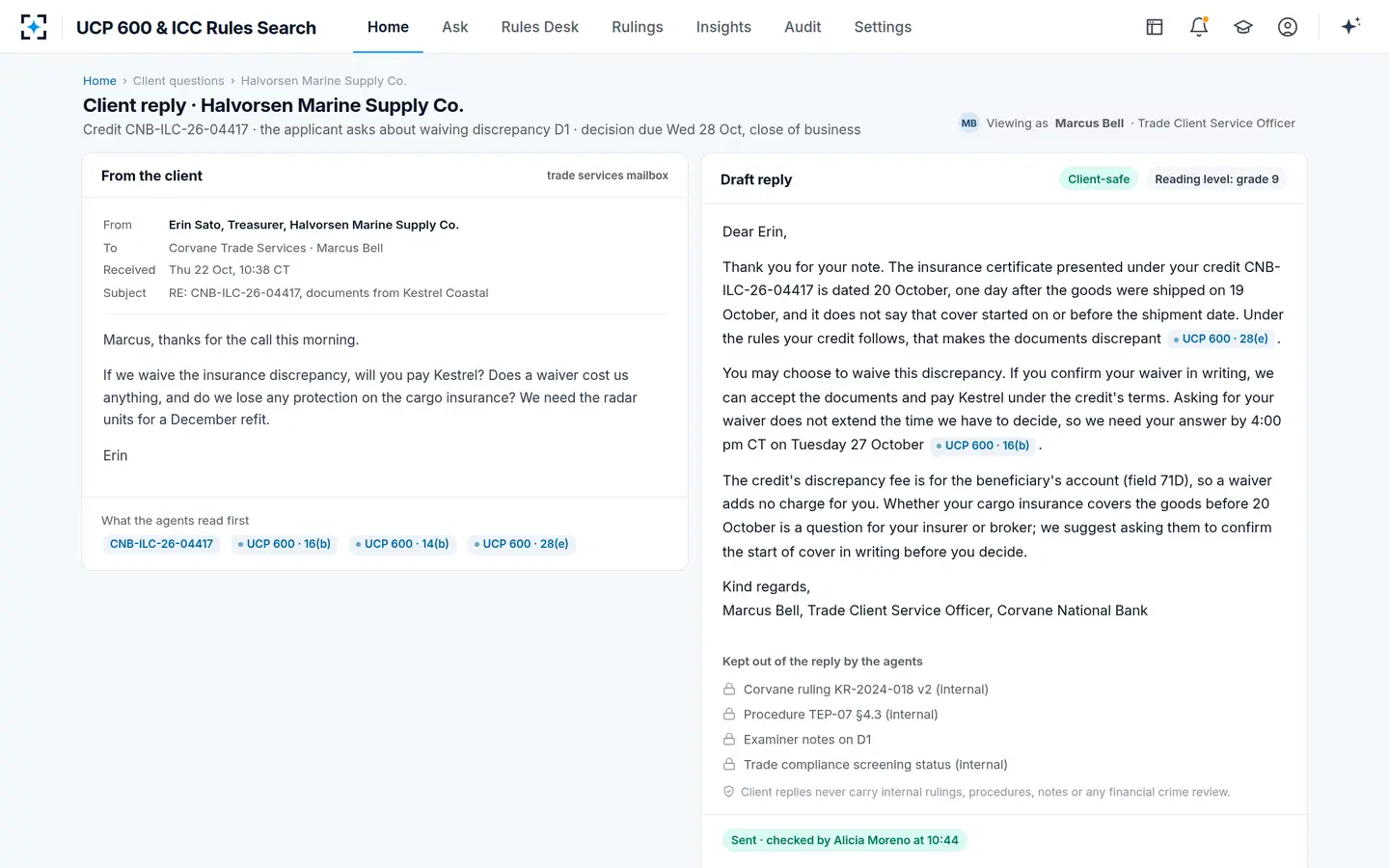
No. Article 16(b) lets an issuing bank, at its own discretion, ask the applicant to waive the discrepancies, and says in the same breath that doing so does not extend the article 14(b) period (UCP 600, art. 16(b)). The waiver conversation happens inside the five days, not after them; how a discrepancy waiver works follows it from request to release.
That is where a slow rules answer costs most. A bank that spends days one and two deciding whether a point is a discrepancy at all leaves the applicant two or three days to decide whether to waive it. Applicants are usually quick, but not always: in Ronald Mann's study of 500 letter of credit files from five US banks in 1999, under the previous rules, UCP 500, applicants waived discrepancies in more than half of the discrepant import files within one business day, and in 84% within a week (Mann, Michigan Law Review, 2000), which leaves a sixth of them beyond a week. Those are the presentations where the rules question has to be answered on day one.
A waiver reply that keeps the clock in view: UCP 600 & ICC Rules Search drafts, a person checks
The other clocks: UCC, ISP98, URDG 758 and the eUCP
The five banking days belong to UCP 600; other rules and the law under them count differently, and a desk that handles standbys, guarantees and electronic credits has to know which clock the instrument chose. In the US, UCC § 5-108(b) gives an issuer a reasonable time after presentation, capped at the end of the seventh business day after it receives the documents, and § 5-116(c) lets the incorporated UCP govern instead.
Five examination clocks a trade operation may run in the same week
| Rules or law | Period | Counted from | Unit |
|---|---|---|---|
| UCP 600, art. 14(b) and 16(d) | Maximum 5; notice by close of day 5 | Day following presentation | Banking days |
| eUCP 2.1, art. e7(a) | The UCP period, started differently | Banking day after the notice of completeness is received | Banking days |
| UCC § 5-108(b) (US default) | Reasonable time, not beyond day 7 | Day of receipt of documents | Business days of the issuer |
| ISP98, rule 5.01 (standbys) | Within 3 “not unreasonable”; beyond 7 “unreasonable” | Business day following presentation | Business days |
| URDG 758, art. 20(a) (demand guarantees) | 5 | Day following presentation of the demand | Business days |
The ISP98 rule differs in kind: notice within three business days is deemed reasonable, notice after seven is deemed unreasonable, and the days between are left to judgement (ISP98, rule 5.01). URDG 758 gives a guarantor five business days after the day of presentation to examine a demand (URDG 758, art. 20(a)). Guarantee and standby questions are the territory of Botminds' Bank Guarantee & Standby LC Issuance solution, whose guide to ISP98 rules explained quotes the standby clock in full; UCP 600 & ICC Rules Search answers the rule questions across all of them.
Where the hours go inside the five days
Most of an examiner's time on a rule question is finding and reading, not deciding. Botminds estimates that a rule question answered by hand takes about 40 minutes of an examiner's time at the top of the range, of which only the last few are the judgement itself; the split below is our estimate, built step by step and kept modest, not a time study.
One rule question, by hand and with cited answers: where an examiner's minutes go
By hand, about 40 minutes
- Finding the checker, book or opinion · 20%
- Reading rule, practice and opinions · 30%
- Checking own procedure and past decisions · 20%
- Finding the deciding condition · 12%
- Writing refusal wording · 10%
- Second examiner confirms · 8%
With cited answers, about 5 minutes
- Finding and reading · 22%
- Own procedure and past decisions · 10%
- Deciding condition on the document · 20%
- Refusal wording · 9%
- Second examiner confirms · 39%
The second bar is not mostly agent time. It is mostly the second examiner's confirmation, which the solution deliberately keeps: an examiner cannot confirm a discrepancy they added. What disappears is the search, and the wait for the one person who knows where the answer is.
What a delayed rules answer costs: a method, not a price
No public source prices an hour of a letter of credit clock, and this guide does not invent one. What a bank can do is price the three ways a delay costs money, from its own volumes, and decide which one it is actually exposed to.
Three terms that make up the cost of a slow rules answer, priced from your own files
Staff time
questions a month × minutes waiting × hourly cost
BLS gives proxy wages only: loan interviewers and clerks average $52,520 a year, credit analysts $100,850 (May 2025).
Trade operations
Squeezed waiver window
discrepant sets × days lost × share of applicants slower than the days left
Mann (2000): 84% of discrepant import files were waived within a week; the rest took longer.
Client service and examiners
Preclusion exposure
late or wrong notices × amount × chance the applicant will not reimburse
Art. 16(f): a late notice precludes the bank from refusing.
Trade risk and legal
What a cited answer returns
the three terms × the share of waiting removed
Measure the removal on your own past questions, not on a vendor’s.
Head of trade operations
For most banks the first term is the one they feel and the third is the one that matters. A month of 1,900 questions, the sample bank's volume, is 950 hours of examiner and senior checker time if each waits 30 minutes for an answer. One precluded refusal on a seven-figure credit, where the applicant then declines to reimburse, can outweigh a year of it. The clock does not care which.
How UCP 600 & ICC Rules Search keeps the clock in view
It puts the presentation's deadline beside every answer. When an examiner names a presentation, the agents load its terms and show the day of the five and the decision deadline, read from the credit and the bank's calendar; the verdict, the passages and the approved refusal wording follow on the same screen.
The presentation, its documents and its clock: day 1 of 5, decide by Wednesday 28 October
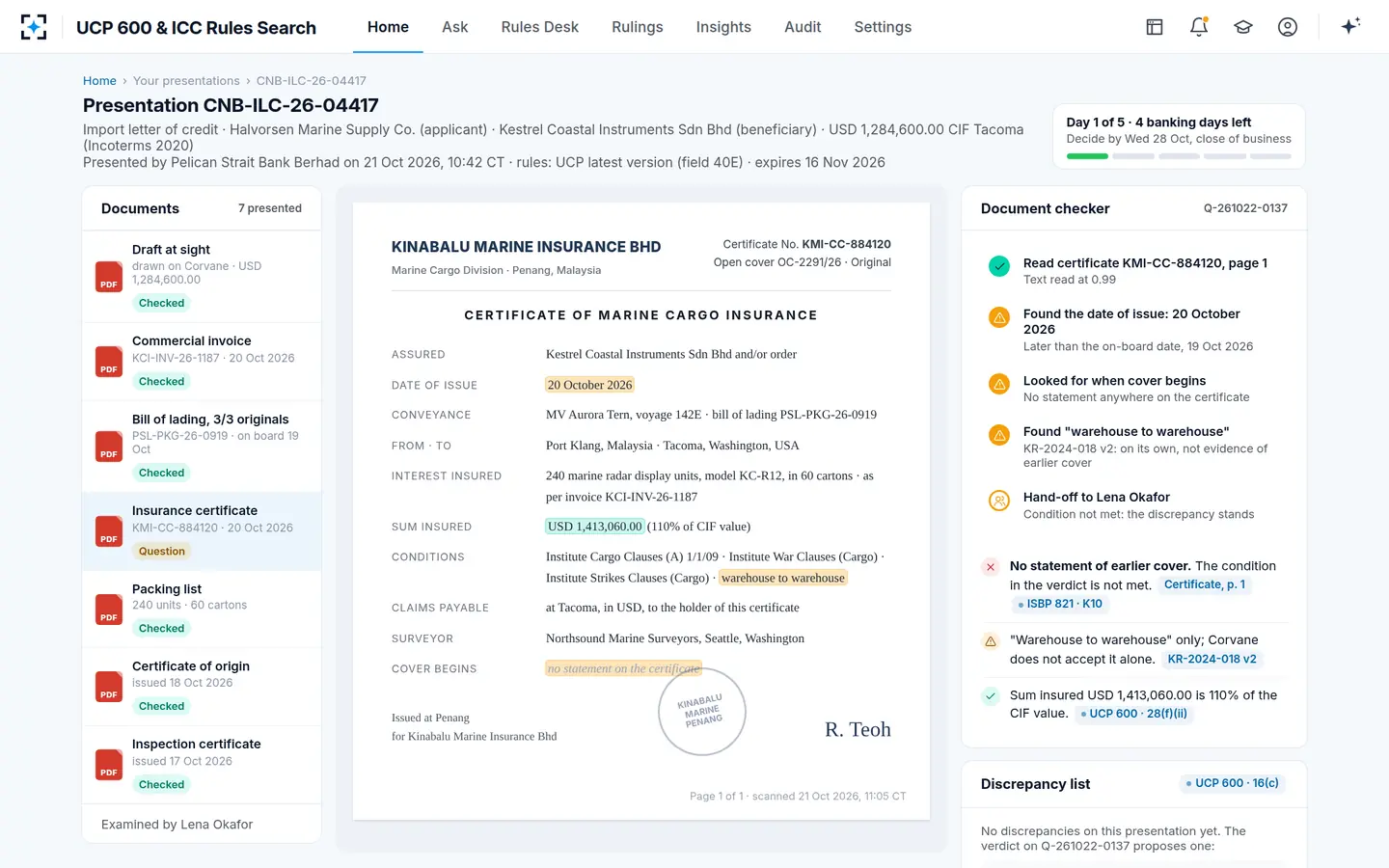
What the solution does not do is as important as what it does. It never sends a refusal notice: a confirmed discrepancy posts to the bank's trade finance system, where the notice is assembled and sent by the officer responsible. It never decides a discrepancy, and it never extends a deadline by telling a client something the rules do not say. When the sources do not settle a question, it says so, and the Trade Rules Desk works to a service level of one banking day for questions tied to a live presentation, three otherwise. The questions it answers most often are gathered in UCP 600 questions and answers.
Questions people ask
Is the day of presentation counted in the five banking days?
No. Article 14(b) gives five banking days "following the day of presentation", so day one is the next banking day. A presentation delivered on a Wednesday at a bank open Monday to Friday has its deadline at the close of the following Wednesday.
Can a bank take longer than five banking days under UCP 600?
Not to refuse. Five days is a maximum, and a refusal notice after the close of the fifth banking day leaves the bank precluded under article 16(f). The parties can change the period in the credit itself, since article 1 lets a credit modify the rules.
Does the credit's expiry date shorten the five banking days?
No. Article 14(b) says the period is not curtailed or otherwise affected by an expiry date or last day for presentation that falls on or after the day of presentation. What the expiry date limits is when the presentation can be made: under article 6(e), on or before it.
What happens if the bank is closed on the fifth day?
The count runs in banking days, so a day the bank is not regularly open at that place is not counted at all. Separately, article 29(a) extends an expiry date or last day for presentation that falls on a closure day, other than a force majeure closure under article 36, to the first following banking day.
How long does a bank have under the UCC if the credit does not incorporate UCP 600?
UCC § 5-108(b) gives the issuer a reasonable time, but not beyond the end of the seventh business day after it receives the documents, to honour or to give notice of discrepancies. Late notice precludes the issuer from relying on the discrepancy, under § 5-108(c), except for fraud, forgery or expiry.