Discrepant documents under UCP 600 are documents that, examined on their face, do not make a complying presentation: they depart from the terms of the credit, from the applicable articles of UCP 600, or from international standard banking practice. A bank that finds a discrepancy in time may refuse to honor; a bank that misses one may pay against documents its customer never agreed to accept, and a bank that finds one but handles the notice badly can lose the right to rely on it at all. The cost of a discrepancy therefore depends less on what it is than on who finds it and when. Botminds' Letter of Credit Document Checking is built to move that finding as early as possible inside the five banking days, and to make the notice that protects the bank complete and on time.
No regulator, standards body or independent study publishes what a missed discrepancy costs on average, what banks charge for discrepancies or how often preclusion bites. This guide therefore sets out the mechanism from the rules and the courts, and a method for pricing it on your own book. Product examples come from a fictional sample bank, Corvane National Bank.
The later a discrepancy is found, the more it costs and the fewer parties can absorb it
The beneficiary, before presenting
WhenBefore the 21-day period and the expiry run out
What it costsA re-issued certificate or a corrected invoice, and some days.
Who bears itThe beneficiary
The ruleArt. 14(c): present within 21 calendar days of shipment and before expiry
The nominated or confirming bank
WhenWithin its own five banking days
What it costsCorrected documents re-presented, if time allows; otherwise a discrepant presentation forwarded for the issuer to decide.
Who bears itThe beneficiary, in time and charges
The ruleArt. 14(b) gives each bank its own five banking days
The issuing bank, with a timely notice
WhenBy the close of the fifth banking day
What it costsA refusal, or a waiver request. Applicants almost always waive, so the cost is usually delay and fees.
Who bears itThe beneficiary, in delay and any charges
The ruleArts. 16(b) to 16(d): one notice, each discrepancy, how the documents are held
Nobody: the bank pays
WhenToo late to refuse
What it costsA payment against documents that did not comply, and a right to reimbursement that is open to challenge.
Who bears itThe paying bank
The ruleArt. 7(c) obliges the issuer to reimburse only a complying presentation
The bank, but its notice or handling fails
WhenAfter the discrepancy was valid
What it costsThe discrepancy is lost. The bank is treated as if the documents complied.
Who bears itThe bank that failed
The ruleArt. 16(f): precluded from claiming non-compliance
What are discrepant documents under UCP 600?
A document is discrepant when the presentation it belongs to is not a complying presentation, which UCP 600 defines in art. 2 as one that follows the credit's terms and conditions, the applicable rules and international standard banking practice (ICC, UCP 600; quoted in article 14 explained). The definition has three legs, and a document can fail any of them: it can contradict the credit, breach an article such as the 21-day rule, or depart from the practice the ICC records in its International Standard Banking Practice, which is sold rather than published free and is therefore described here, not quoted.
The consequence is in art. 16(a): when a bank "determines that a presentation does not comply, it may refuse to honour or negotiate." May, not must. The bank can refuse, approach the applicant for a waiver, or pay anyway at its own risk, and each choice has a price. The rules apply only because the credit incorporates them, which is why the US statute matters too: under UCC §5-116(c), rules a credit is expressly made subject to govern an issuer's liability over Article 5, except where they conflict with its non-variable provisions.
What happens if a bank misses a discrepancy?
If a bank misses a discrepancy and pays, it has honored documents that did not comply, and its protection depends on whether anyone further down the chain will still pay it. The OCC's trade finance booklet puts the risk plainly: "failure to obtain conforming documents or to resolve document discrepancies, especially material errors, may cause the bank to lose its protection and rights and suffer financial loss" (OCC, Trade Finance and Services, version 1.1).
The rules show where the loss lands. An issuing bank undertakes, under art. 7(c), to reimburse a nominated bank that has honored or negotiated "a complying presentation". A confirming or nominated bank that pays against discrepant documents and forwards them may find the issuing bank refusing to reimburse it, and if the issuer has already reimbursed, art. 16(g) entitles it to "claim a refund, with interest". At the end of the chain, an issuing bank that pays against discrepant documents is asking its applicant to reimburse a payment the applicant never agreed to on those terms. Most applicants waive; the bank's risk is the one that does not, often the one whose business has gone wrong.
US law closes the other exit. Under UCC §5-108(i), an issuer that has honored a presentation "as permitted or required by this article" is entitled to be reimbursed by the applicant, and it is "precluded from restitution of money paid or other value given by mistake to the extent the mistake concerns discrepancies in the documents or tender which are apparent on the face of the presentation" (UCC §5-108). A bank that misses a discrepancy it could have seen cannot, as a rule, recover the money from the beneficiary afterwards. The miss is the bank's to carry.
One English case: a valid discrepancy, a confirming bank's payment and a lost right to refuse
$5.02m
claimed by the confirming bank after paying the beneficiary under three credits
US$5,024,041.80
$3.03m
claimed by the beneficiary under two further credits
US$3,033,037.20
89–104
days the issuing bank took to return documents it had said it was returning
What is preclusion under UCP 600?
Preclusion is the rule that a bank which does not handle a refusal exactly as art. 16 requires loses the right to say the documents were discrepant, even when they were. Art. 16(f) says an issuing or confirming bank that does not act as the article requires is precluded from claiming the presentation did not comply (the full text, and how the days run out, are in UCP 600's five banking days). It is the most expensive outcome in the cascade because it converts a valid defence into none.
The Fortis case shows how wide "fails to act in accordance" reaches. The issuing bank had a valid discrepancy: the beneficiary's certificate said documents were sent by courier at the "issuing bank's" cost where the credit required "our" cost. It gave refusal notices in November 2008, most of them stating it was returning the documents, then did not return them until 16 February 2009, "between 89 and 104 days after the 'return' notices" (Fortis v IOB, High Court). The judge held that a bank which elects to return documents must return them with reasonable promptness, and that the breach precluded it from relying on the discrepancy. The Court of Appeal agreed and dismissed the appeal (Fortis v IOB, Court of Appeal).
Five banking days to give the notice; up to 104 days to do what the notice said
- Notice5
- Documents held after a notice saying they were being returned89–104 days
Preclusion is not limited to slow returns. The same article requires a single notice stating each discrepancy and how the documents are held, given by the close of the fifth banking day. A notice that misses a discrepancy cannot be fixed by a second one, a notice sent on day six is late, and a notice that says "holding pending your instructions" binds the bank to follow the presenter's instructions promptly. What happens if there is a discrepancy walks through each requirement on one presentation.
Can a bank refuse after five banking days?
Not on discrepancies, under UCP 600, and not under the US statute either. Art. 16(d) requires the notice by the close of the fifth banking day after the day of presentation, and a late notice triggers art. 16(f). UCC §5-108(c) has the same structure for credits it governs: an issuer "is precluded from asserting as a basis for dishonor any discrepancy if timely notice is not given, or any discrepancy not stated in the notice if timely notice is given" (UCC §5-108).
The statute keeps three defences alive even without timely notice. Under §5-108(d), failing to give notice does not preclude an issuer from relying on fraud or forgery under §5-109(a), or on the credit having expired before presentation. Those are narrow exits; a late shipment date, a short insurance cover or a missing certificate is gone once the clock has run.
The opposite error: refusing a complying presentation
A false discrepancy costs money too, and US law sets out how much. Under UCC §5-111(a), if an issuer wrongfully dishonors, the beneficiary "may recover from the issuer the amount that is the subject of the dishonor", and "may also recover incidental but not consequential damages". Subsection (e) adds that "Reasonable attorney's fees and other expenses of litigation must be awarded to the prevailing party in an action in which a remedy is sought under this article" (UCC §5-111).
That is why a checking process must be measured on false calls as well as misses. A bank that refuses a complying presentation pays the amount anyway, plus incidental damages and the other side's legal costs if it loses, and damages a relationship with a presenting bank that will remember. The ICC's introduction to UCP 600 records the commercial side of the same problem: banks had introduced discrepancy fees, which "highlighted the importance of this issue, especially when the underlying discrepancies have been found to be dubious or unsound" (ICC, UCP 600 Introduction).
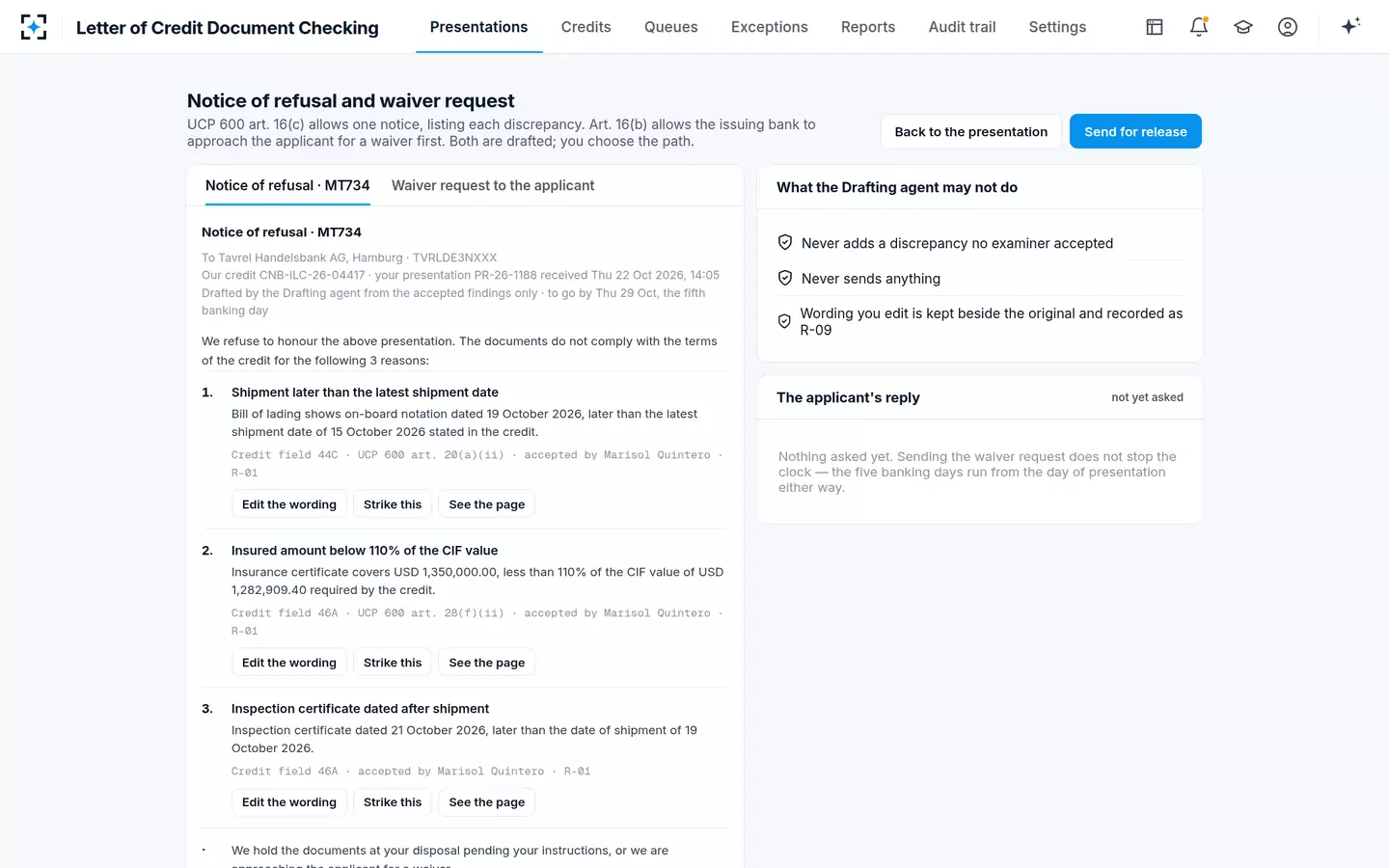
The single notice, drafted from accepted findings only, saying how the documents are held
What does a refusal cost the exporter?
For the beneficiary a refusal costs time, charges and, sometimes, the goods. The Court of Appeal in Fortis put the stakes of documents held by a refusing bank in a sentence: the consequences are "too well known to need enumeration; illustrations are obvious such as in the case of a perishable cargo, or where the market falls or where the ship arrives and seeks to discharge the cargo." The beneficiary in that case also claimed container demurrage and port costs.
Charges are the visible part. In MAM Apparel v NCL, a New York federal court's account of the complaint records that the issuing bank, after notices of discrepancies and the credit's expiry, returned the shipping documents for two shipments and charged the beneficiary "a total of $780.00 in fees" (MAM Apparel & Textiles v NCL Worldwide Logistics, E.D.N.Y. 2020), on a credit of about $96,500. That is one case, not a tariff; we found no public survey of discrepancy fees across banks, and the credit's own charges clause decides who pays them.
What are LC discrepancy charges?
LC discrepancy charges are fees a bank deducts or bills when it handles a discrepant presentation, typically for the extra examination, the notice and the waiver correspondence. UCP 600 does not set them; art. 37(c) says a bank instructing another is liable for the other bank's charges, and if a credit puts charges on the beneficiary but they cannot be collected, "the issuing bank remains liable for payment of charges." The amounts are in each bank's tariff and each credit's charges clause.
The ICC's warning about fees charged on "dubious or unsound" discrepancies is the useful one for a checking desk. A discrepancy fee charged on a discrepancy that does not survive scrutiny is a complaint waiting to happen, and the OCC's request list asks banks for the volume and nature of discrepancies and of customer complaints and disputes. A desk that can show, for each fee, the page and the article behind the discrepancy has an answer when a beneficiary's bank asks.
How to price a missed discrepancy on your own book
Because no public source gives the rates, the price has to be built from the bank's own data. The method below has four terms, each with an owner who can supply it, and it treats misses, false calls and preclusion separately because they behave differently.
The expected cost of discrepancy errors, built from your own files
Misses
presentations × miss rate × share not waived × average loss
Miss rate from a replay on closed files; share not waived from your waiver history; loss net of recoveries.
Trade operations and credit
False calls
presentations × false-call rate × share refused × cost of a wrongful refusal
Amount paid anyway, incidental damages, legal costs, and the presenting bank's goodwill.
Trade operations and legal
Preclusion
notices × share late, incomplete or not followed × amount at stake
From your own notice log: day sent, discrepancies listed, holding option chosen, documents returned when.
Trade operations manager
Examiner time saved
presentations × minutes saved × loaded cost per minute
The gain the three costs are weighed against; measure it on a replay of past presentations, do not assume it.
Finance and trade operations
The terms are uneven. Preclusion should be rare but carries the full amount of a drawing, so a single late or incomplete notice can outweigh a year of examiner savings. Misses are mostly forgiven by waivers, which is why their cost hides until an applicant gets into trouble. False calls are the term most desks never measure, because a refusal that the applicant waives looks like a success.
Where the controls sit in the solution
The solution puts its controls on the expensive rows of the cascade. Every finding is examined twice and every lane where the two examinations differ reaches a person, which attacks misses and false calls together. The clock agent counts the five banking days on the bank's own calendar, escalates on day 3, pages the manager on day 4 and will not let a presentation pass day 5 undecided. The drafting agent writes one notice from accepted findings only, so a struck finding cannot slip in and an accepted one cannot drop out.
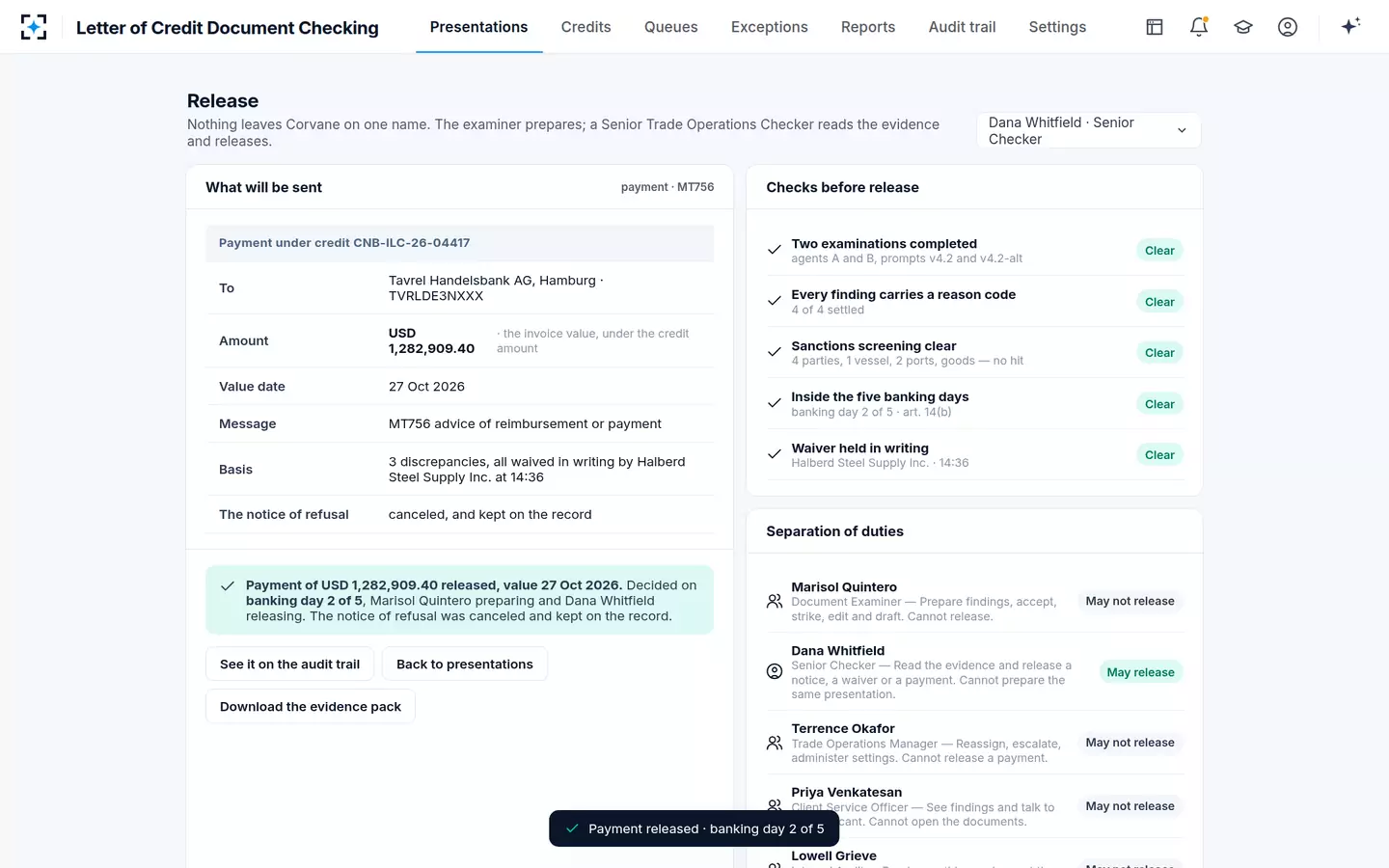
Nothing leaves the bank on one name: the five checks behind a release
None of this removes the bank's judgment, and it should not. What it removes is the reading fatigue that produces misses, the second notice that cannot be sent, and the day-six surprise. The discrepancies that recur most often are the place to start a review of your own misses, and Letter of Credit Document Checking shows the controls on one presentation end to end.
Questions people ask
Who bears the loss if the bank pays against discrepant documents?
The bank that paid, unless someone further along agrees to absorb it. An issuing bank must reimburse a nominated bank only for a complying presentation (art. 7(c)), so a confirming bank that pays against discrepant documents may not be reimbursed; an issuing bank that pays must look to its applicant, who may waive or may not.
Does preclusion apply to a nominated bank that is not confirming?
Art. 16(f) names only "an issuing bank or a confirming bank". Under art. 12(a), a nominated bank that has not confirmed is not obliged to honor or negotiate unless it expressly agreed, so its risk is different: if it chooses to pay against discrepant documents, it may not be reimbursed.
Can the applicant refuse to reimburse the bank?
It may have grounds to. Under UCC §5-108(i) an issuer is entitled to reimbursement for honoring a presentation "as permitted or required" by Article 5, and the bank's own reimbursement agreement with the applicant sets the rest. Where the bank paid against discrepant documents without a waiver, the applicant can contest reimbursement, which is why the sample bank holds a written waiver before any release.
Is a discrepancy that the applicant waives still a cost?
Yes, usually a smaller one. The beneficiary waits for payment and may pay discrepancy and correspondence charges; the issuing bank spends examiner and client service time; and the presenting bank learns how often this beneficiary's documents are wrong. In Mann's 1999 sample, applicants waived in all but one of 365 discrepant files.
Does the US UCC give banks more time than UCP 600?
Yes, where it governs. UCC §5-108(b) allows a reasonable time but not beyond the end of the seventh business day after receipt, against UCP 600's maximum of five banking days after the day of presentation. Where a credit incorporates UCP 600, the shorter UCP period governs under §5-116(c).