To check letter of credit documents, start from the credit as amended and list every fact it sets: the goods, the quantity, the amount and insurance cover, the ports, the latest shipment date, the parties and the documents required. Then test each document against that list, and then test each document against the same facts in every other document. The second test is the one checklists miss, and UCP 600 makes it part of the standard: data in a document need not be identical to the credit or the other documents, but must not conflict with them. Most arguments between banks and beneficiaries happen on that line between a difference and a conflict. Botminds' Letter of Credit Document Checking lays every document's value on each term of the credit, side by side, so the conflicts sit visibly off the line and the harmless differences do not trigger a refusal.
The examples come from a fictional sample presentation at Corvane National Bank: an import credit for 1,200 metric tons of hot-rolled steel coil, CIF Baltimore, with six documents. The rules are quoted from UCP 600 as the ICC publishes it free, and the cases from the courts' own sites.
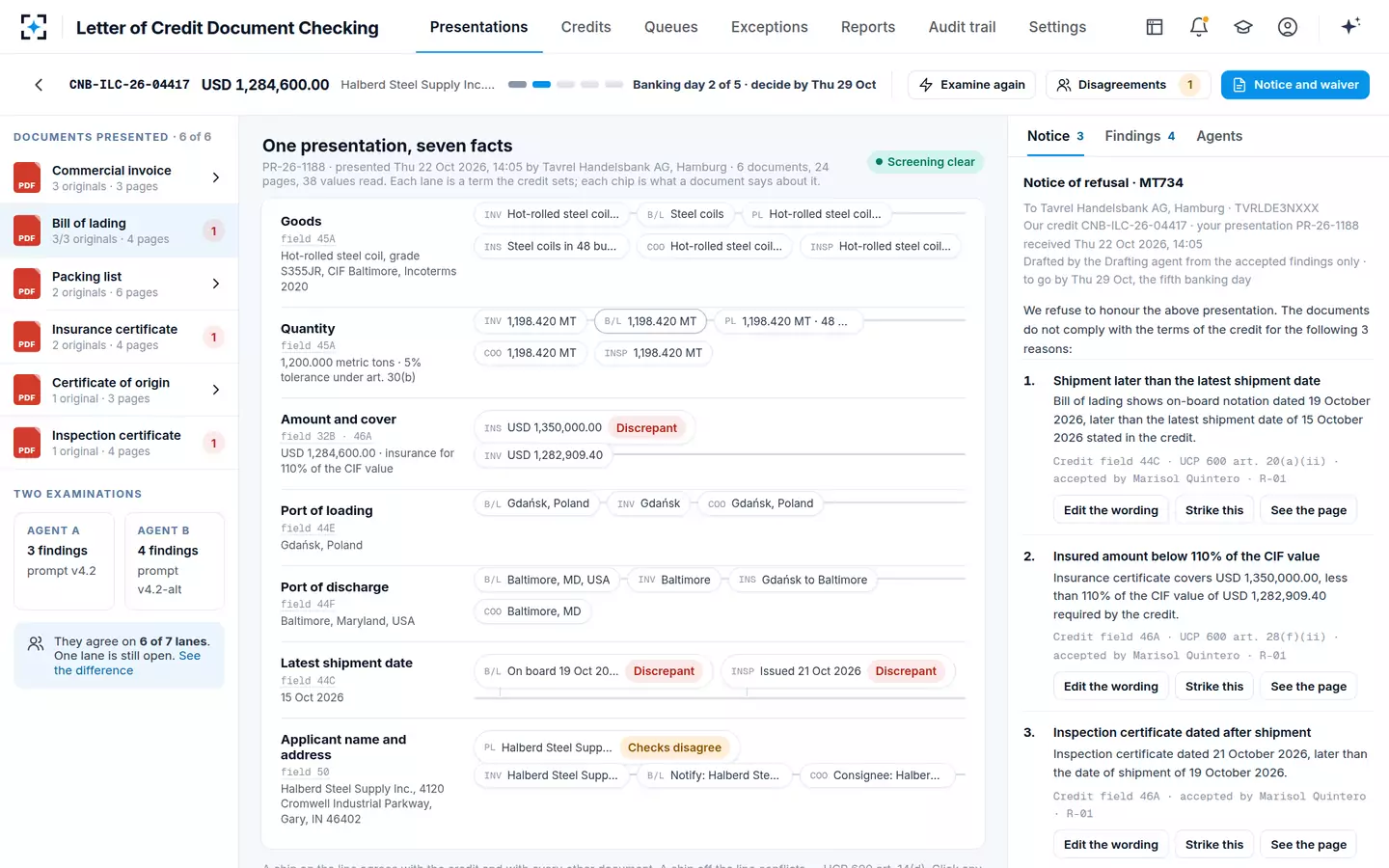
One presentation, side by side: the credit's terms against what each document says
| Term (credit field) | The credit | Commercial invoice | Bill of lading | Other documents |
|---|---|---|---|---|
| Goods (45A) | Hot-rolled steel coil, grade S355JR | Hot-rolled steel coil, as in the credit | Steel coils, said to contain hot-rolled steel coil | Packing list, origin and inspection: as in the credit; insurance: steel coils |
| Quantity (45A) | 1,200 metric tons; 5% tolerance under art. 30(b) | 1,198.420 MT | 1,198.420 MT | 1,198.420 MT on packing list, origin and inspection |
| Amount and cover (32B, 46A) | USD 1,284,600.00; insurance for 110% of CIF value | USD 1,282,909.40 | Not stated | Insurance: USD 1,350,000.00, short of 110% |
| Port of loading (44E) | Gdańsk, Poland | Gdańsk | Gdańsk, Poland | Origin: Gdańsk, Poland |
| Port of discharge (44F) | Baltimore, Maryland, USA | Baltimore | Baltimore, MD, USA | Insurance: Gdańsk to Baltimore; origin: Baltimore, MD |
| Latest shipment (44C) | 15 October 2026, as amended | Not a shipment document | On board 19 October 2026 | Inspection certificate issued 21 October 2026 |
| Applicant (50) | Halberd Steel Supply Inc., 4120 Cromwell Industrial Parkway, Gary, IN | As in the credit | Notify party as in the credit | Packing list: "Pkwy" for "Parkway" |
How do you check letter of credit documents?
Check them in three passes: the credit, then each document against the credit, then the documents against each other. The first pass establishes what the presentation must show, from the credit and every amendment the beneficiary accepted. The second asks whether each document meets the terms that apply to it and the article for its type. The third, the cross-document pass, asks whether any two documents tell different stories about the same fact. Only then does the examiner decide which differences are discrepancies.
The order is not a matter of taste. UCP 600 art. 14(a) asks the bank to decide on the documents alone whether they appear, on their face, to make a complying presentation. The standard is the credit, the rules and international standard banking practice, so starting from the documents risks testing them only for what they say rather than for what is missing.
Must data be identical in all LC documents?
No. UCP 600 art. 14(d) is the rule: read in context with the credit, the document itself and standard practice, data in a document may be worded differently but must not contradict the same document, any other required document or the credit (ICC, UCP 600; article 14 explained quotes it with the cases). Two things follow. Documents can say the same thing in different words, formats or levels of detail. And a document can be discrepant without contradicting the credit at all, simply by contradicting another document, or itself.
The phrase "read in context" does the work. A port written "Baltimore" on the invoice and "Baltimore, MD, USA" on the bill of lading does not conflict, because read in context both are the same port named in field 44F. A quantity of 1,198.420 metric tons on every document, against 1,200 in the credit, does not conflict either, because art. 30(b) allows 5% either way on a credit that does not count packing units. A date of 19 October on the bill of lading against 15 October in the credit conflicts, however it is read.
A difference the rules allow, or a conflict that is a discrepancy
Difference: not a discrepancy: Bill of lading says "steel coils, said to contain hot-rolled steel coil"; art. 14(e) allows general terms outside the invoice.
Conflict: a discrepancy: An invoice describing the goods differently from the credit; art. 18(c) requires it to correspond.
Difference: not a discrepancy: 1,198.420 MT against 1,200 MT, inside the 5% tolerance of art. 30(b).
Conflict: a discrepancy: A packing list showing a weight that disagrees with the bill of lading.
Difference: not a discrepancy: Applicant's address abbreviated or different on the packing list, in the same country (art. 14(j)).
Conflict: a discrepancy: Applicant's address different from the credit in the notify party of a bill of lading.
Difference: not a discrepancy: A certificate dated before the credit was issued (art. 14(i)).
Conflict: a discrepancy: An on-board notation after the latest shipment date; any document dated after presentation.
Difference: not a discrepancy: An obvious misnomer the documents themselves resolve, as the English courts found in Kredietbank.
Conflict: a discrepancy: A certificate saying couriers were paid at the "issuing bank's" cost where the credit said "our" cost.
Check each document against the credit, then against each other
The first comparison is document to credit, and each document type has its article. The invoice must appear to be issued by the beneficiary, be made out in the applicant's name and in the credit's currency (art. 18). The bill of lading must name the carrier, be signed by an identified signer, show shipment on board a named vessel at the credit's port of loading, and come as a full set (art. 20). The insurance document must cover at least the required amount, in the right currency, from no later than shipment (art. 28).
The second comparison is document to document, value by value, and it is where reading fatigue hides conflicts. On the sample, the inspection certificate is dated 21 October; read alone against the credit it raises nothing obvious, but read against the bill of lading it was issued two days after the on-board date, and the credit's 46A wording for it made that a discrepancy. A checker who tests documents one at a time against the credit misses that kind of conflict; a checker who lays them side by side, as the table above does, sees it at once.
Every document's value on each of the credit's terms: conflicts sit off the line
The invoice must correspond; the other documents may be general
UCP 600 holds the invoice to a stricter description test than the rest. Art. 18(c): "The description of the goods, services or performance in a commercial invoice must correspond with that appearing in the credit." Art. 14(e): "In documents other than the commercial invoice, the description of the goods, services or performance, if stated, may be in general terms not conflicting with their description in the credit."
That is why the sample bill of lading's "steel coils, said to contain hot-rolled steel coil" is not a discrepancy while the same words on the invoice would be. The test for the bill of lading is whether its general description conflicts with "hot-rolled steel coil, grade S355JR"; it does not. The test for the invoice is whether it corresponds, and the sample invoice repeats the credit's description. A check that applied the invoice standard to every document would refuse good presentations; one that applied the general standard to the invoice would pass bad ones.
Does the applicant address have to match the credit?
Usually not exactly. Under art. 14(j) the beneficiary's and applicant's addresses on a required document may differ from those in the credit or in other documents, so long as each stays in the same country as the address the credit gives. Contact details are disregarded. The exception is the transport document: where the applicant's address and contact details appear as consignee or notify party, they must match the credit.
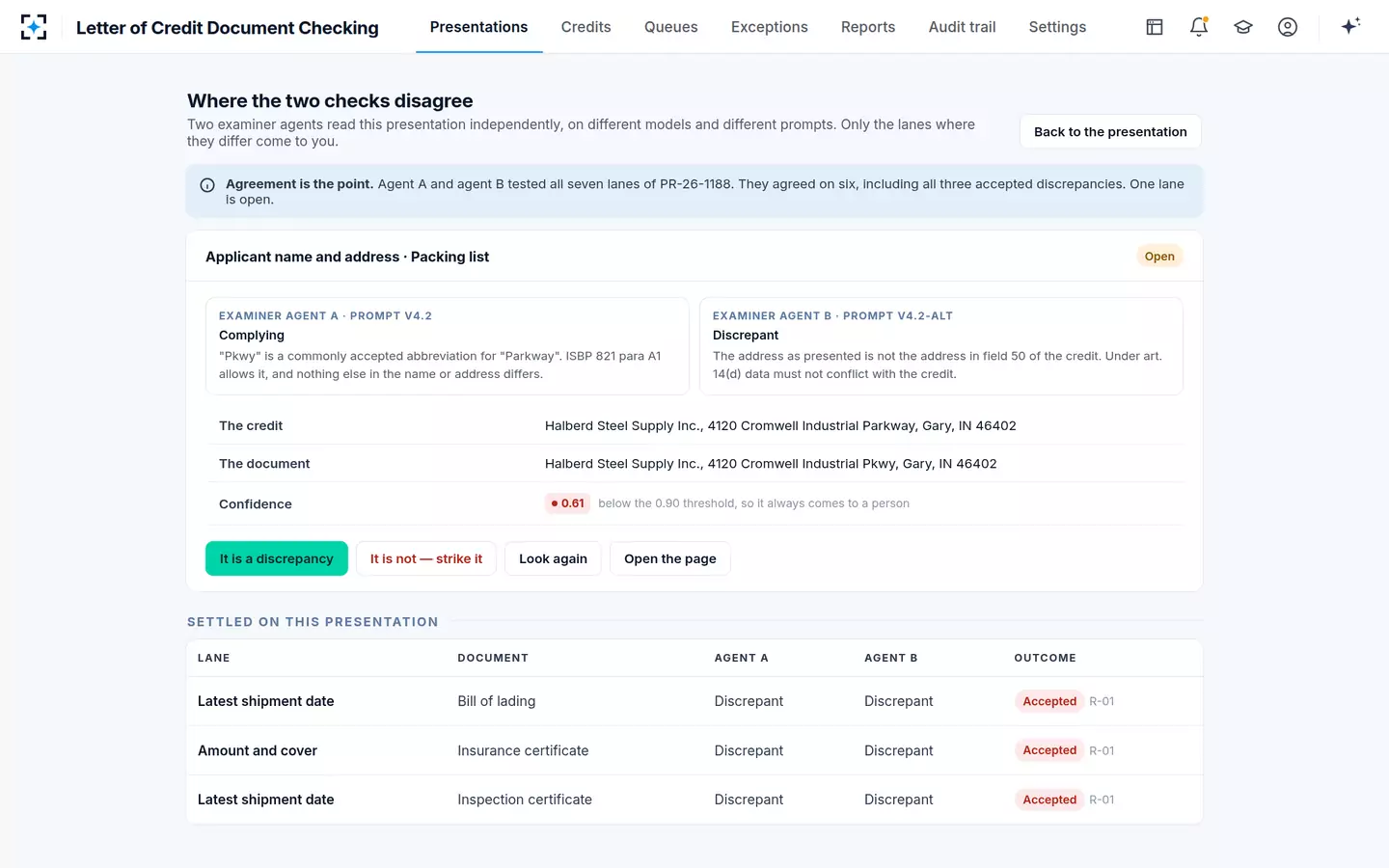
The sample shows why the rule matters to automation. The packing list reads "4120 Cromwell Industrial Pkwy" where the credit reads "Parkway". One examiner agent called it an accepted abbreviation; the other called it a conflict with field 50 under art. 14(d). Neither cited the simpler answer: a packing list is not a transport document, so under art. 14(j) its applicant address need only be in the same country. The examiner struck the finding. Two independent examinations made sure a person saw the disagreement; the person brought the rule that settled it.
Two readings of one address, and the examiner who settles it
Can a single word make LC documents discrepant?
Yes, when the word changes what the document certifies. In Fortis Bank v Indian Overseas Bank, the credit required the beneficiary to certify that the negotiating bank had been advised to send the documents by courier "AT OUR COST". The certificate presented said "AT ISSUING BANK'S COST". The beneficiary argued the difference was trivial, since the beneficiary had in fact paid the courier. The English Court of Appeal disagreed: "I cannot see how 'our' can be read as referring to the issuing bank", and "I cannot accept that the discrepancy can be regarded as trivial" (Fortis v IOB [2011] EWCA Civ 58).
Those checking the documents (including management supervising them) would not have known this; they could not have discerned this from the documents and they were under no obligation to make enquiries of others within IOB.
Thomas LJ, Fortis Bank v Indian Overseas Bank [2011] EWCA Civ 58
The same judgment marks the other boundary. It quotes the earlier Kredietbank case: "the requirement of strict compliance is not equivalent to a test of exact literal compliance in all circumstances and as regards all documents", and recalls that a survey report from a Griffith company, where the credit named "Griffith Inspectorate", was held compliant as an obvious misnomer. The difference is whether the documents themselves resolve the discrepancy. A misnomer they explain is not a conflict; a certificate that states the wrong fact is, whatever happened in reality, because the examiner judges the documents alone.
Are copies of bills of lading acceptable?
Copies are acceptable when the credit asks for copies, and only on the terms the credit sets for them. Art. 17(d): "If a credit requires presentation of copies of documents, presentation of either originals or copies is permitted." But a credit can ask a copy to prove something, and then the copy must prove it.
In Mago International v LHB AG, a standby letter of credit required a photocopy of the bill of lading evidencing shipment of the goods to the applicant. The beneficiary presented unsigned copies. The Second Circuit agreed with the district court that "the unsigned copies did not evidence shipment and thus Mago did not strictly comply", whatever the general practice on copies, because this credit required the copy to evidence shipment and an unsigned bill did not (Mago International v LHB AG, 2d Cir. 2016). The court referred to the ICC's standard banking practice on copies in reaching that view. The lesson for a checker: read what the credit asks the document to show, not just what document it names.
What is ISBP, and how does it fit the check?
ISBP is the ICC's International Standard Banking Practice for the examination of documents under UCP 600, the record of how banks apply the rules to particular documents and wording. It matters because UCP 600 builds it into the test: art. 2 defines a complying presentation as one in accordance with the credit, the rules "and international standard banking practice", and art. 14(d) reads data "in context with" that practice. The ICC's introduction to UCP 600 describes ISBP as having become an essential companion to the rules for deciding whether documents comply (ICC, UCP 600 Introduction).
The current edition, ISBP 821, was published on 3 July 2023 and replaced ISBP 745 (ICC Digital Library, Documentary Credit World). Unlike UCP 600, which the ICC serves free online, ISBP is sold, so this guide describes it rather than quoting it. A bank's checking process, manual or automated, should say which edition it applies and be updated when the ICC changes it.
The order of a cross-document check, one presentation at a time
- Fix the credit as it stands today
Every amendment the beneficiary accepted; every field that sets a fact becomes a term to test.
- Mark conditions with no document as disregarded
Art. 14(h). Show them, so no one wonders whether they were forgotten.
- Test each document against its own article
Invoice art. 18, bill of lading art. 20, insurance art. 28, originals art. 17.
- Lay every document's value on each term
One row per term, one column per document, the source line kept with each value.
- Separate conflicts from differences
Art. 14(d) for conflict; 14(e) for general descriptions; 14(j) for addresses; 30 for tolerances.
- Check dates against each other
Shipment against 44C, insurance and inspection against shipment, every document against the presentation date.
- Decide, with a reason
Every accepted discrepancy and every one struck, with the rule relied on, so a senior checker and an auditor can follow it.
Done by hand, the cross-document pass is the slowest part of the job and the one most likely to slip under time pressure. The solution does it on every presentation and leaves the decisions to the examiner; the step-by-step trace shows the whole sequence, and Letter of Credit Document Checking shows the screens.
Questions people ask
What does "on their face" mean in UCP 600?
It means the bank judges what the documents appear to show, without investigating the facts behind them. Art. 14(a) asks whether the documents appear on their face to comply, and art. 5 says banks deal with documents, not goods. In Fortis, the court held that checkers were under no obligation to ask colleagues whether the certified fact was true.
Do the beneficiary's contact details have to match the credit?
No. Art. 14(j) says contact details such as telefax, telephone and email stated as part of the beneficiary's and the applicant's address "will be disregarded". The address itself need only be in the same country as in the credit, except the applicant's details as consignee or notify party on a transport document.
Must the shipper on the bill of lading be the beneficiary?
No. Under art. 14(k) the shipper or consignor named on any document does not have to be the beneficiary. A shipper that differs from the beneficiary is not a discrepancy for that reason, though a bank may still read it as part of its financial crime checks.
Can a freight forwarder issue the transport document?
Yes, if the document meets the transport articles. Art. 14(l) lets any party, not only a carrier, owner, master or charterer, issue a transport document, provided the document meets the requirements of articles 19 to 24. The test is the document's content, including how it names the carrier and identifies the signer, not who printed it.
Does a packing list have to match the invoice exactly?
No. Under art. 14(d) its data must not conflict with the invoice, the other documents or the credit, and under art. 14(e) it may describe the goods in general terms. A packing list that shows the same weight and bundle count in a different layout complies; one that shows a different weight conflicts.