A trade finance document checker, also called a documentary credit examiner or LC checker, is the person in a bank's trade operations who reads every document presented under a letter of credit against the credit and the rules it incorporates, usually UCP 600, and decides whether the presentation complies. The work is hard for a plain reason: one presentation can carry an invoice, a full set of bills of lading, a packing list, an insurance certificate and a handful of certificates, and every value in them has to agree with the credit and with each other, inside a maximum of five banking days. Botminds' Letter of Credit Document Checking exists to take the reading and the cross-checking off that desk, so the checker's day is spent on the decisions only a person may make.
The day described here belongs to a fictional sample bank, Corvane National Bank, and its trade processing center as they run through the solution. The rules, the regulator's expectations and the labor data come from public sources, linked where they appear.
Where an examiner's minutes go on one presentation, by hand and with agents
- Reading the documents95
- Placing every value beside the credit55
- Deciding what is a discrepancy25
- Notice and waiver request30
- Evidence for the checker15
- Deciding14
- Drafts4
- Evidence1
What does a trade finance document checker do?
A trade finance document checker examines the documents a beneficiary presents under a documentary credit and determines, on the documents alone, whether they make a complying presentation. UCP 600 puts it in one sentence: each bank involved must decide from the documents alone whether they appear on their face to make a complying presentation (UCP 600 art. 14(a), served free by the ICC; article 14 explained quotes it). The rules apply because the credit says so; they are private rules, not law, and they bind only when the credit incorporates them.
In practice the checker does four things with each presentation. They read the credit as amended and list what it demands. They read every document and pull out the values the credit cares about: goods, quantity, amount, ports, dates, parties. They compare each value with the credit and with every other document. And they decide: comply, or refuse with one notice listing each discrepancy, or ask the applicant for a waiver. The first three are reading. Only the fourth is judgment, and it is the one the bank answers for.
A second reading runs alongside the first. The FFIEC's examination manual expects banks, where they can, to read trade documents for anomalies and red flags as well as for compliance with the credit (FFIEC BSA/AML Examination Manual, Trade Finance Activities). A checker who spots a vessel name, a port or a price that does not fit is often the first person in the bank to see it.
No job code isolates the work, so the labor data are proxies
There is no federal occupation code for letter of credit examiners. A keyword search of O*NET, the Department of Labor's occupation database, for "letters of credit" returns only general credit occupations, led by Credit Authorizers, Checkers, and Clerks and Credit Analysts (O*NET OnLine). Any headcount or pay figure for this job is therefore a proxy, and should be read as one.
The nearest federal occupations, May 2025: proxies, not LC checkers
164,790
employed as Loan Interviewers and Clerks, the occupation that verifies and examines documents
median $50,020 a year
64,390
employed as Credit Analysts, closer to a senior checker who weighs risk
median $83,510 a year
0
federal occupation codes that name documentary credit examination
The absence matters beyond pay surveys. A bank cannot benchmark its trade operations staffing against a public figure, and a manager who wants to argue for another examiner has to argue from volumes and deadlines rather than from a market norm. That is one reason the regulator's exam procedures, below, are the most useful description of the job that exists in public.
What do bank examiners expect of trade operations staff?
Bank examiners expect a checker's work to be timely, documented and done by people who know the rules. The OCC's Comptroller's Handbook booklet on trade finance tells examiners to sample letters of credit and consider "timely review of documents after presentation" and "whether resolution of document discrepancies or a discrepancy waiver is obtained" (OCC, Trade Finance and Services, version 1.1). On staffing it is blunt: "Banks should have competent managers and experienced staff to oversee or execute trade business and trade operations in a safe and sound manner."
The same booklet's request list asks the bank for the "Volume and nature of document discrepancies, operational errors, control deficiencies, customer complaints or disputes, policy exceptions, etc., and their resolutions." Read together, those lines describe a checker's day as an examiner sees it: every presentation reviewed in time, every discrepancy resolved by a refusal or a waiver, and a count of both that the bank can hand over. The personnel procedures add what the examiner weighs about the team itself: its expertise, training and headcount, and how often people leave (letter of credit training quotes those procedures).
Monday on a sample desk: the queue is the clock
A checker's day starts with the queue, sorted by how much of each presentation's five banking days is gone. At the sample bank on Monday 26 October 2026, 31 presentations are live across the trade processing center. Twelve are on banking day 1 and nine on day 2; the rest are further along and already escalated to the trade operations manager. One is held before payment because the screening system matched a vessel name, and no checker may release it.
A checker's queue, sorted by the banking days each presentation has used
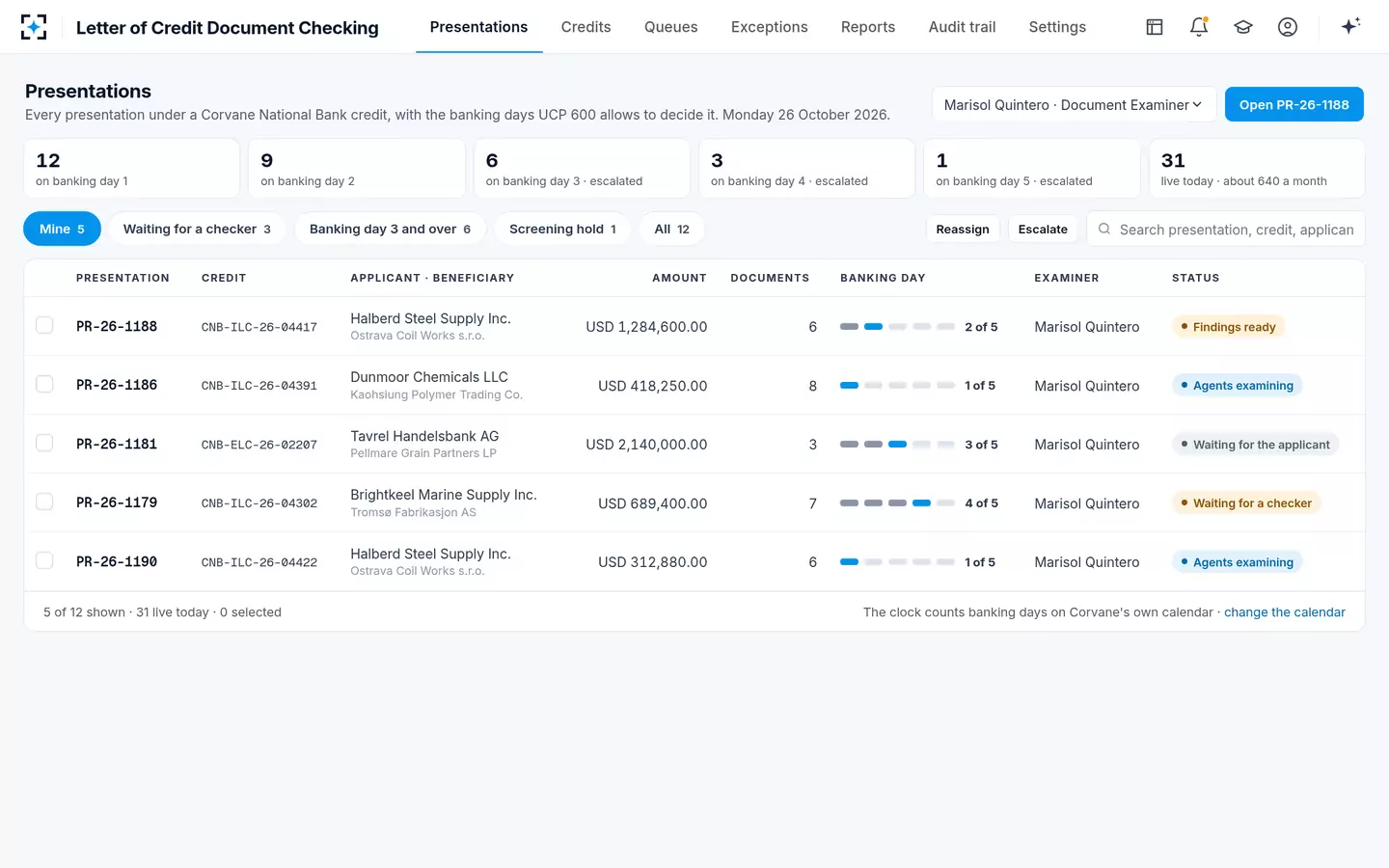
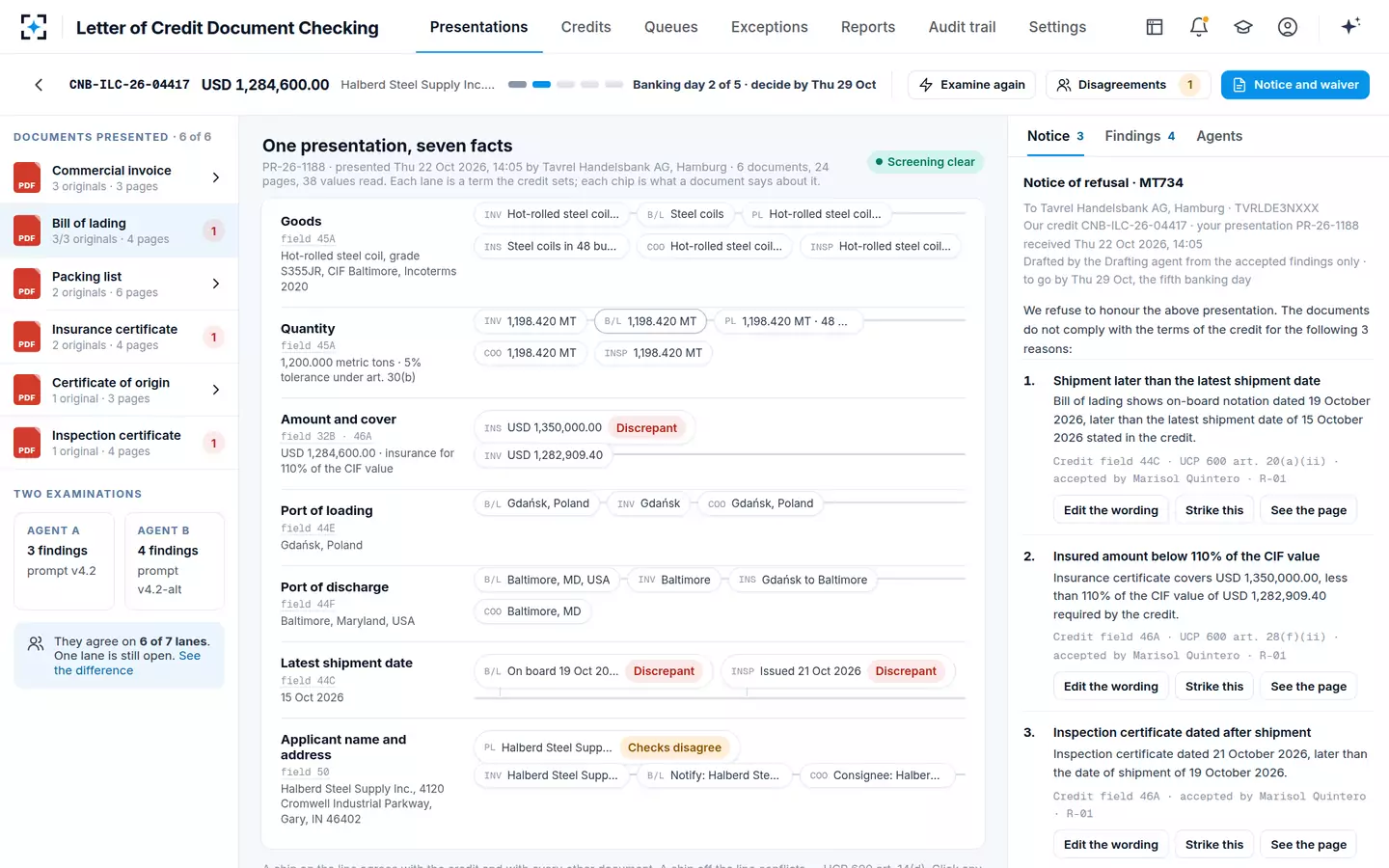
The examiner, Marisol Quintero in the sample, opens PR-26-1188: an import credit for USD 1,284,600.00, 1,200 metric tons of hot-rolled steel coil from Gdańsk to Baltimore, presented by a Hamburg bank on Thursday 22 October at 14:05. The day of presentation does not count. Friday was banking day 1, Monday is day 2, and the decision is due by the close of Thursday 29 October, the fifth banking day. By the time she opens it, the agents have already split the 24 scanned pages into six documents, counted the originals and read 38 values onto seven lanes, one for each term the credit sets.
One presentation on the sample desk, Monday, minute by minute
| Time | Who | What happened |
|---|---|---|
| 09:12 | Examiner | Opens PR-26-1188 on banking day 2 of 5. Four findings are waiting, each with its page. |
| 09:21–09:26 | Examiner | Accepts three discrepancies against the page each came from: a late on-board notation, an insurance amount below 110% of the CIF value, an inspection certificate dated after shipment. |
| 09:28 | Drafting agent | Writes the single notice of refusal and the waiver request to the applicant from the accepted findings only. |
| 09:33 | Examiner | Strikes the fourth finding, an abbreviated street name on the packing list, with a reason code and a note. |
| 13:48 | Client service officer | Sends the waiver request to the applicant, asking for an answer by Wednesday. |
| 14:36 | Applicant | Waives all three discrepancies in writing, 48 minutes later. |
| 14:52 | Senior checker | Reads the on-board notation herself and releases payment, value 27 October, on banking day 2 of 5. |
The table makes a point that holds well beyond the sample. The examiner's decisions took 21 minutes. The presentation took most of a working day to clear because a refusal or a waiver involves three other people: a client service officer who talks to the applicant, the applicant, and a senior checker who releases. A checker's day is not one long reading session; it is dozens of short decisions interleaved with waiting, and the reading is what fills the gaps when there are no agents to do it.
How long does it take to check an LC presentation?
No regulator or researcher publishes a time per presentation, so any figure is an estimate. Botminds' own estimate for a six-document presentation, shown at the top of this guide, is about 220 minutes by hand, of which 150 go on reading the documents and placing every value beside the credit. That is an estimate of where the time goes, not a benchmark, and banks that time their own desks will find their own mix.
What the estimate does show is the shape of the work. The 25 minutes of deciding are the expensive minutes, because they are the ones a regulator, a court or an applicant will question. The reading minutes are the error-prone ones: peer-reviewed research on letter of credit examination finds the work complex, labour-heavy and prone to error (Khalil et al., Decision Analytics Journal, 2025). A checker who reads 38 values across six documents for the fourth time in a morning is exactly where a late on-board date slips through.
How many presentations does an LC checker examine a day?
There is no public figure for presentations per checker per day, and anyone quoting one should say where it came from. The sample center handles about 31 presentations a banking day, roughly 640 a month, with a quarter-end peak of 60 a day, spread across several examiners. Those are the sample's volumes, chosen to look like a mid-sized US trade desk, not a measured industry rate.
The clock, the escalation and the peak across one trade processing center
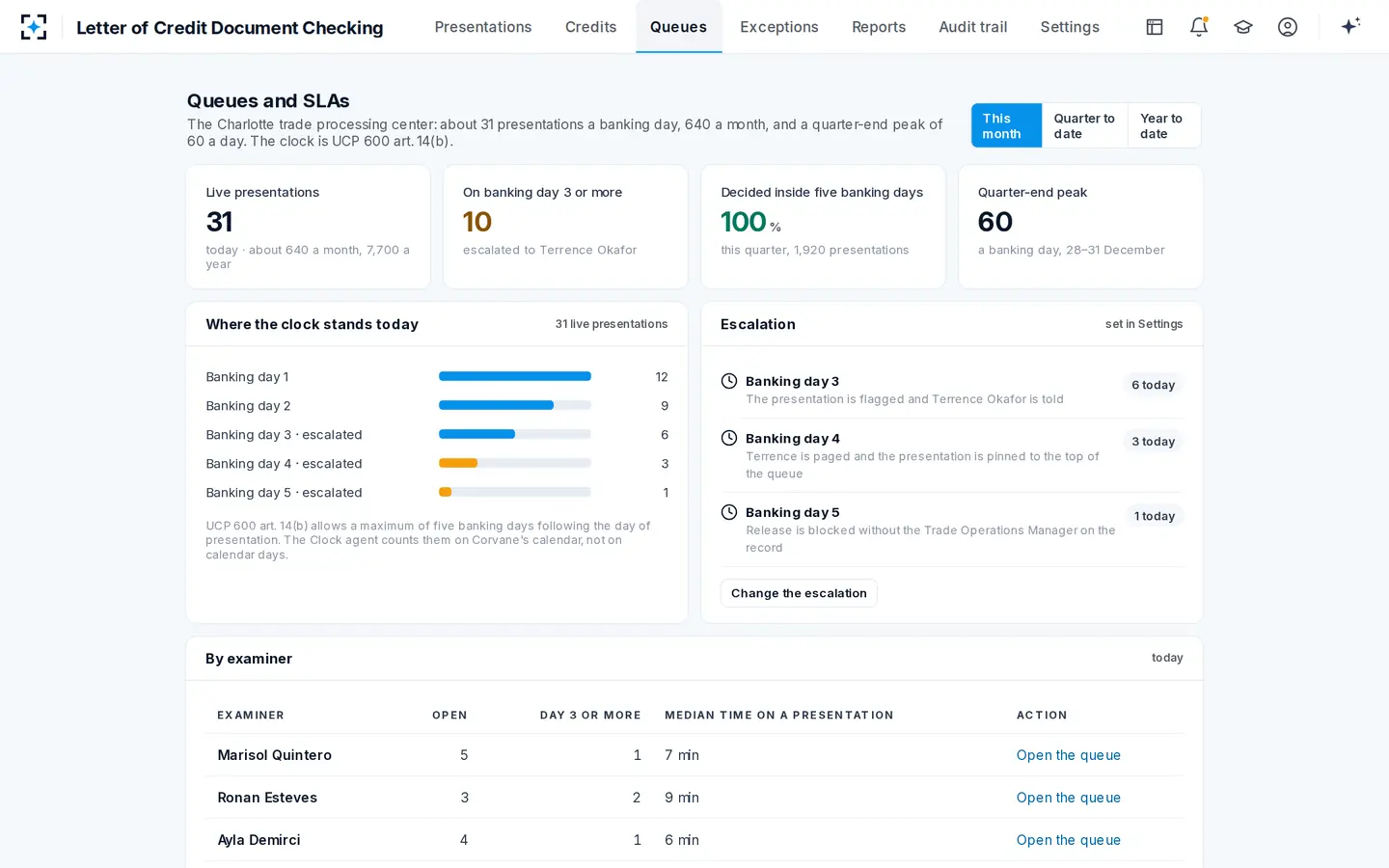
The peak is the planning number. UCP 600 gives each bank at most five banking days after the day of presentation to decide, and that period does not lengthen because the desk is busy. The US book is also concentrated: FDIC Call Report data put commercial letters of credit outstanding at about $24.5 billion at 30 June 2026, reported by 486 institutions, with the ten largest holding about 90% of it by our arithmetic. A desk at a bank outside that ten sees a fraction of the flow, with the same rules and the same clock.
The judgment part: deciding, not reading
The part of the day that cannot be handed to anyone else is the decision on a discrepancy. Two of the sample's four findings show why. The bill of lading carries an on-board notation dated 19 October against a latest shipment date of 15 October; under UCP 600 art. 20(a)(ii) the on-board date is the date of shipment, so the goods shipped late, and no examiner would argue otherwise. The packing list reads "Pkwy" where the credit reads "Parkway"; the two agents read it differently, and the decision falls to the examiner.
That second kind of call is the job. The examiner can strike it on more than one ground: an accepted abbreviation, or the plainer rule in art. 14(j) that an applicant's address on a document other than a transport document's consignee or notify field need not match the credit at all, provided it is in the same country. Getting it wrong in either direction costs something: refuse a good presentation and the bank has wrongly dishonored; pay a bad one and the bank may lose its right to reimbursement. How to check letter of credit documents against each other works through the cross-document rule in full.
Four seats around one presentation, and what each keeps
Today
Reads the same seven or eight facts out of every document, then writes the notice once, because the rules allow one.
With agents
Opens a presentation already laid out term by term, with each conflict citing its page and its article.
Still theirs: Every accept, strike and edit, with a reason code.
Today
Re-reads the whole presentation to trust one line, because the evidence sits in someone else's folder.
With agents
Opens the stamp on the page in one click and sees the checks behind the release.
Still theirs: The release of every notice, waiver and payment; never their own preparation.
Today
Finds out late, from a spreadsheet, which presentations are close to day five.
With agents
Sees every presentation by banking day, with day 3 escalated and day 5 blocked without a name on it.
Still theirs: The queue, the escalation and the settings.
Today
Argues with the applicant without being able to say which line of which page is wrong.
With agents
Sends a drafted waiver request with the page behind each discrepancy.
Still theirs: The conversation with the applicant and the presenting bank.
What a senior checker does that the examiner cannot
A senior checker is the second name on every refusal, waiver and payment, and the reason is control, not seniority. The OCC tells examiners to test whether segregation of duties and dual controls are in place for transaction processing (OCC, Trade Finance and Services; the procedure is quoted in fraud risk in trade finance). In a trade desk that means the person who prepared a finding is not the person who sends money or a refusal on it.
In the sample, the senior checker, Dana Whitfield, reads the on-board notation on page 1 of the bill of lading herself before releasing USD 1,282,909.40, the invoice value, to the presenting bank. The screen lists the five checks behind the release: two examinations completed, every finding carrying a reason code, screening clear on four parties, one vessel, two ports and the goods, inside the five banking days, and the waiver held in writing. The examiner's release button is unavailable on her own presentation, and the screen says why. Who may decide what, agent by agent, sets out the full split.
What skills does a documentary credit checker need?
A documentary credit checker needs the rules by article, the credit's message fields by heart, and the discipline to decide on the documents alone. The list below is what the work on a single presentation calls on; it is drawn from the rules themselves and from the OCC's procedures, not from any certification syllabus.
What one presentation asks of the person examining it
- Read the credit as amended, field by field
Goods and quantity in 45A, documents called for in 46A, additional conditions in 47A, latest shipment in 44C, the period for presentation in 48. An amendment the beneficiary accepted changes the lane.
- Know the article behind each document type
Art. 18 for the invoice, art. 20 for a bill of lading, art. 28 for insurance, art. 17 for what counts as an original.
- Count banking days, not calendar days
The day of presentation does not count; weekends and the bank's holidays do not either. The clock is a maximum, not a target.
- Tell a conflict from a difference
Art. 14(d): data need not be identical, but must not conflict. Most arguments with applicants are about this line.
- Spot a condition with no document
Art. 14(h): a condition the credit sets without saying which document shows it is disregarded, and should be shown as disregarded, not silently dropped.
- Write one notice that is complete
Each discrepancy, and what the bank is doing with the documents. There is no second notice to add one that was missed.
- Read for red flags as well as compliance
A port, vessel or price that does not fit goes to the financial crime team, and a checker never clears it alone.
- Leave a reason someone else can follow
Examiners ask for the volume and nature of discrepancies and their resolutions. A decision without a reason is hard to count and harder to defend.
What a training course rarely covers is the bank's own history. A credit on which shipment timing has gone wrong three times, an applicant that always waives within the hour, a presenting bank that sends incomplete sets: that knowledge lives in the checkers' heads unless something records it beside each presentation. The solution keeps every decision, with its reason and its page, on one trail an auditor can download.
One presentation on one screen: the credit's terms as lanes, every document's value on them
Is LC document checking a good job, and is it changing?
Document checking is a specialist job that the public labor data do not even name, which cuts both ways: there is no published wage benchmark, and there is real scarcity value in someone who knows the rules article by article. What is changing is the share of the day spent reading. The OCC's handbook already describes trade systems that take on discrepancy detection and list screening, and the same peer-reviewed work on AI in LC examination concludes that a person still has to verify what the machine proposes. LC document checking, traced step by step, shows where the line between reading and deciding falls on one presentation.
For the checker, the practical effect is that the morning starts with findings instead of a stack of paper, and the skill that matters most is the one that always mattered: knowing when a difference is a discrepancy. Botminds' Letter of Credit Document Checking is built around that division of labor.
Questions people ask
What is the difference between a document checker and a trade finance officer?
A document checker examines presentations under credits already issued and decides whether they comply. A trade finance officer usually works on the customer side, structuring and issuing credits and guarantees and handling amendments. In smaller banks one person may do both; in large processing centers they are separate teams.
Which rules does an LC checker apply?
Whatever the credit incorporates, which for commercial credits is usually UCP 600, with the ICC's International Standard Banking Practice (ISBP) as the companion on how documents are examined. Where a US credit does not incorporate the UCP, UCC Article 5 governs, and it gives an issuer a reasonable time but not beyond the seventh business day. An electronic presentation adds eUCP 2.1.
What systems do trade operations teams use?
A common stack, and the one the solution connects to, is a trade finance system holding the credit and its amendments, a SWIFT gateway for the MT700 family of messages, document imaging for the scanned presentation, a sanctions screening system and the general ledger. The OCC notes that trade systems may already do discrepancy detection and list screening; reading the documents against each other and writing the notice are the parts most often left to people.
Can a checker refuse a presentation alone?
The bank's own procedures decide, but the OCC tells examiners to test for segregation of duties and dual controls in trade processing, which makes a second name on a refusal or payment the defensible design. In the sample bank a maker cannot release their own presentation, and a refusal notice goes out only after a senior checker reads the evidence.
Is there a certification for LC checkers?
Commercial certifications exist and some banks ask for one in senior roles. The OCC's procedures do not name one; they tell examiners to assess whether the bank has a training program for trade personnel, its type, content and frequency, and the expertise, number and turnover of the staff.