A letter of credit training course should teach four layers, not one: the 39 articles of UCP 600, the international standard banking practice that article 2 of the rules folds into every examination, the ICC Banking Commission opinions that settle points the rules leave open, and the law that sits underneath, such as Article 5 of the Uniform Commercial Code in the United States. A course built around the articles does the first well and the others thinly, and no outside course can teach the fifth layer every examiner meets on day one: the bank's own procedures and past rulings. That gap is why rule questions still go to a senior checker by chat, or to a shelf of books. Botminds' UCP 600 & ICC Rules Search answers those questions with a cited verdict, labels rule, practice and bank procedure apart, and turns the bank's own rulings into material a course cannot carry.
The examples of the solution on this page come from a fictional sample bank, Corvane National Bank, and its sample data. The rules, the regulator's expectations and the occupational data come from ICC's own free texts, the OCC and the Department of Labor, linked where they appear.
Four seats that a letter of credit course trains, and what each still needs from a cited desk
Today
Finishes a course that walked through the 39 articles, then meets a bill of lading clause no article mentions and waits for a senior checker to say whether it is clean.
With agents
Asks the same question in plain words and reads the rule, the practice and the bank’s own ruling labelled apart, each cited, before deciding.
Still theirs: The decision, and a second examiner’s confirmation
Today
Is the training programme in practice: answers the same insurance-date and “about” questions by chat, several times a week, with the reasoning lost once the box is ticked.
With agents
Confirms discrepancies with the rule, the document check and the wording on one screen, and sees which questions keep coming back.
Still theirs: The confirmation, and the cases worth teaching
Today
Writes the bank’s position on a grey-area clause into an email that four processing centers may or may not read.
With agents
Approves a ruling once; every later answer names it, its version and its approver, and it becomes teaching material.
Still theirs: Approval of every ruling
Today
Buys a course, counts certificates, and cannot tell which rules the team still gets wrong.
With agents
Sees questions by topic and every override with its reason, and points the next course at the gaps.
Still theirs: The training plan and its budget
What should a letter of credit training course cover?
A letter of credit training course should cover the rules, the practice that interprets them, the opinions that settle disputes about both, and the law that governs where the rules are silent. Leave out any one and the examiner learns a version of the work that does not exist in a real presentation.
The rules are the obvious part. UCP 600 has 39 articles, from application (article 1) to assignment of proceeds (article 39), and it came into force on 1 July 2007, as the English High Court recorded in Fortis Bank v Indian Overseas Bank. The articles that carry the daily work are few: the definitions and interpretations in articles 2 and 3, the examination standard in article 14, refusal and notice in article 16, the transport documents in articles 19 to 27, insurance in article 28 and tolerances in article 30.
The practice is less obvious, and it is where most courses are thin. UCP 600 defines a complying presentation by three measures, the credit's terms, the rules and international standard banking practice (UCP 600, art. 2; article 14 explained quotes the definition). Standard practice is part of the test, not background reading, and ICC's own description of its International Standard Banking Practice tells readers to use it alongside UCP 600, never apart from it (ICC Academy).
Five layers behind every rules answer, and which of them a course can reach
| Layer | What it is | Who writes it | Free or paid | How a course usually treats it |
|---|---|---|---|---|
| Rules | UCP 600: 39 articles, in force since 1 July 2007 | ICC Banking Commission | Text served free on ICC’s Digital Library | Taught article by article |
| Practice | ISBP 821 (2023), replacing ISBP 745 | ICC Banking Commission | Sold by ICC | Summarised, rarely worked through |
| Interpretation | Banking Commission opinions, DOCDEX decisions | ICC experts, on practitioners’ questions | Sold in volumes | A few famous opinions, if any |
| Law | UCC Article 5 in the US; national law elsewhere | Legislatures and courts | Public | Often left to the legal team |
| Your bank | Examination procedures, wording library, rulings | The bank’s own rules desk | Internal | Cannot be taught by an outside course |
Is UCP 600 training enough to check documents?
No. UCP 600 training alone teaches what the rules say; examining documents also needs the standard practice the rules point to, and the judgement to read a document "in context", which article 14(d) makes part of the test. A trainee who knows every article can still call a presentation wrongly on the practice.
The drafters said so themselves. When they revised the rules, the Drafting Group wrote that ISBP "has evolved into a necessary companion to the UCP for determining compliance of documents with the terms of letters of credit", and that its principles would continue to apply while UCP 600 is in force (ICC, UCP 600 Introduction). They also reviewed some 500 Banking Commission opinions issued under the previous rules to decide what to change. The rules a course teaches were built on top of an interpretive layer most courses never open.
The courts add a second reason. The English Court of Appeal has said a court "must recognise the international nature of the UCP", that it is "intended to be a self-contained code", and that "a literalistic and national approach must be avoided" (Fortis v IOB [2011] EWCA Civ 58). A course that teaches the articles as a list of literal tests trains exactly the reading the court warned against.
Is there an official ICC certification for documentary credits?
ICC's own training arm, ICC Academy, lists online certifications in trade finance, among them a Certified UCP 600 Specialist and a Certified Documentary Credits Expert, alongside foundation certificates and introductory and advanced documentary credit courses (ICC Academy, trade finance). None of them is a licence. The OCC's trade finance handbook judges a bank's expertise and training programme; it does not name a qualification an examiner must hold.
The US labour statistics show how invisible the role is. A search of the Department of Labor's O*NET occupation database for "letters of credit" returns only general credit occupations, such as credit authorizers and credit analysts; no occupation title names documentary credit examination (O*NET OnLine). Any wage or headcount quoted for "LC examiners" in the US is a proxy.
No federal occupation code isolates the letter of credit examiner; the nearest proxies
0
O*NET occupations that name letter of credit or documentary credit examination
164,790
loan interviewers and clerks, the nearest clerical proxy; median wage $50,020
64,390
credit analysts, a partial proxy for senior trade specialists; median wage $83,510
How banks train trade finance examiners, and what the OCC asks about it
US bank examiners treat trade training as a control, not a perk. The OCC's Comptroller's Handbook on trade finance tells its examiners to assess the "Expertise, training, and number of staff members", the "Level of staff turnover", and to "Determine whether the bank has a training program to develop trade personnel", considering its "type, content, and frequency" and the "budget allocated to training" (OCC, Trade Finance and Services).
The same handbook expects competent managers and experienced staff to run trade operations safely, and its procedures test whether documents are reviewed in time after presentation and whether discrepancies are resolved or waived; a trade finance document checker's day quotes the passage and shows the work it describes. Training is judged by what the operation does five banking days after a presentation arrives, not by the certificates on a wall.
"Determine whether the bank has a training program to develop trade personnel."
OCC, Comptroller’s Handbook, Trade Finance and Services
That framing matters to a buyer. A course is one input to a training programme; the programme also needs a way to see which rules the team still gets wrong, a way to teach the bank's own positions, and a way to show an examiner how both are kept current. Those are the parts most banks run by habit, through the senior checker.
What a letter of credit course cannot teach: the bank's own rulings and the grey areas
A course cannot teach the bank's own answers to questions the rules leave open, because they are not published anywhere. Whether a bill of lading marked "packaging reused" is clean is a good example: article 27 defines a clean transport document as one with no clause or notation expressly declaring the goods or their packaging defective (UCP 600, art. 27), and the phrase declares nothing either way; ICC Banking Commission opinions follows that question to a ruling.
In the sample bank, that question produced a "Not settled" answer: the rule silent on the phrase, practice giving examples either way, two licensed opinions pointing in different directions. The Trade Rules Desk then drafted a ruling, a second person approved it, and the agents re-answered the four questions that had been waiting on it. No outside course could have taught that answer, because until that morning it did not exist.
A month of questions in UCP 600 & ICC Rules Search: where the team's rule knowledge runs out
Which UCP 600 questions do examiners actually ask? A sample month
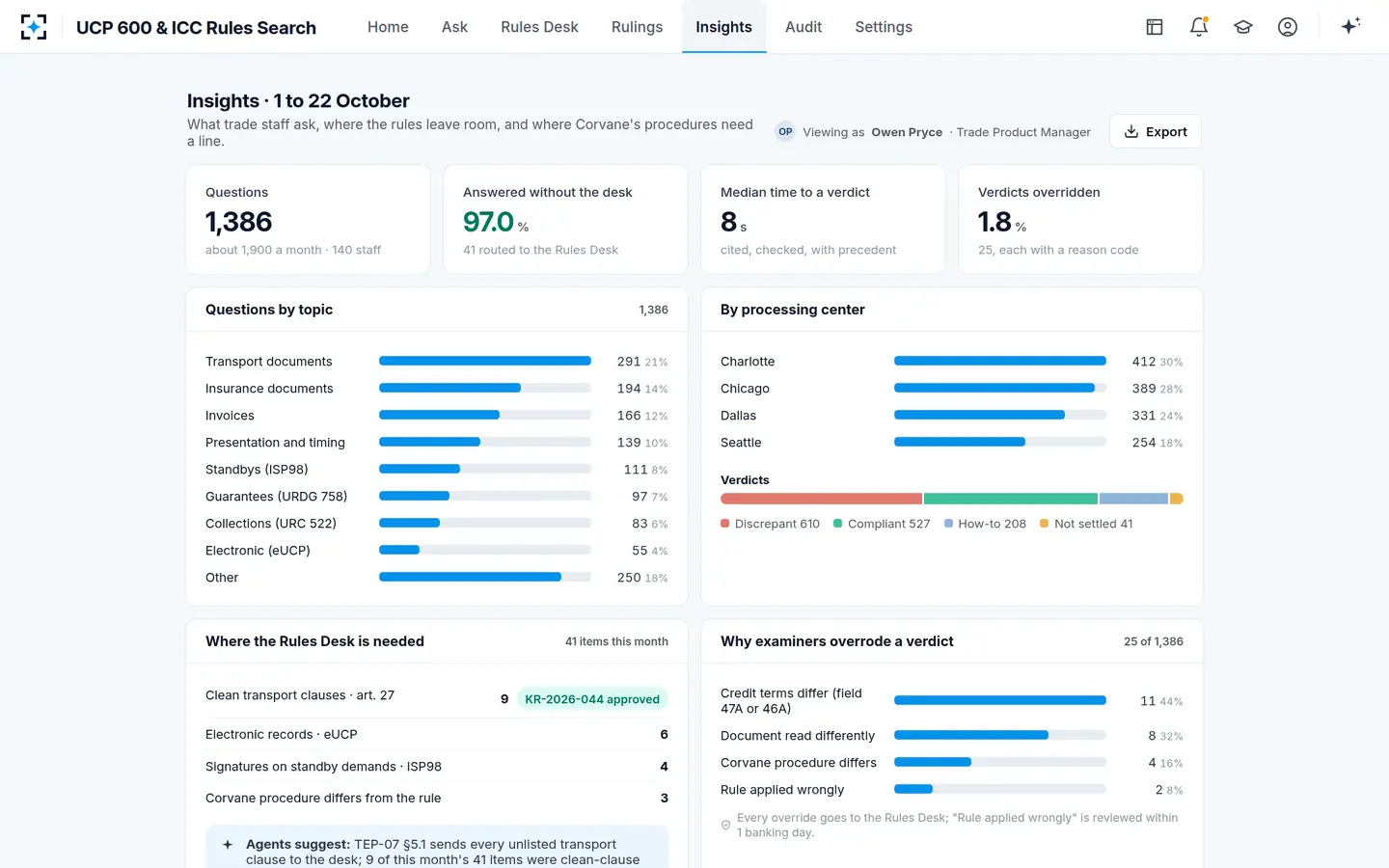
The questions an operation actually asks are the best syllabus a training manager will ever get. Take the sample bank's first three weeks of October as it runs through UCP 600 & ICC Rules Search: 1,386 questions from 140 trade staff, about 1,900 a month. Transport documents and insurance led; standbys, guarantees, collections and electronic presentation together made up a quarter.
Transport and insurance documents generate a third of the rule questions
Two other numbers in the same month are more useful to a trainer than the totals. Examiners overrode 25 verdicts, 1.8% of the total, and each override carries a reason: 11 because the credit's own terms differed, 8 because the document was read differently, 4 because the bank's procedure differed and 2 because a rule had been applied wrongly. And of the 41 questions the agents sent to the Rules Desk, 9 were about clean transport clauses under article 27. Those are the next two lessons, chosen by the work rather than by a course outline.
How to choose a letter of credit training course: eight checks
A desk head should choose a course by what it will change in the operation's answers, not by its length or its badge. The checks below can be put to any provider, including ICC's own, and to any in-house programme.
Eight checks before a bank buys a letter of credit training course
- It teaches from the current texts
UCP 600, ISBP 821 (not ISBP 745, which it replaced in July 2023) and eUCP 2.1. Ask the edition of every text in the course pack.
- It works article 2 and article 3 hard
Complying presentation, banking day, "on or about", "first half" of a month: the definitions decide more cases than the long articles.
- It teaches practice, not just rules
Exercises should turn on standard banking practice, since art. 2 makes it part of compliance.
- It shows how opinions change answers
At least a handful of worked opinions, so trainees learn that the rules leave room and who fills it.
- It covers the clock and the notice
Five banking days (art. 14(b)), a single notice listing each discrepancy (art. 16(c)) and what preclusion costs.
- It reaches the law the bank’s credits sit under
In the US, UCC Article 5 and its seven business days, which an incorporated UCP can displace (UCC § 5-116(c)).
- It tests on real documents
A trainee should examine a set of documents, not answer recall questions about articles.
- It leaves room for the bank’s own positions
The course will not know the bank’s rulings. Plan how trainees learn them, and how the desk keeps them current.
The last check is the one most buyers skip. A course teaches the market's answers; it cannot teach the bank's, and the questions that reach a senior checker are mostly the ones where the two differ or where nobody has answered yet. Our guide to UCP 600 questions and answers sets out the common ones and the three questions an examiner should ask before answering any of them.
Where UCP 600 & ICC Rules Search fits beside a course, and where it does not
The solution is not a course and does not award anything. It is the place an examiner takes a rule question during the working day, and the place a training manager sees which questions are being asked. Its Training coach writes certification-style practice questions from the rules and the bank's own rulings, each answer cited to its passage, with customer names and account details kept out.
A precedent trail: the bank's own decisions become teaching material
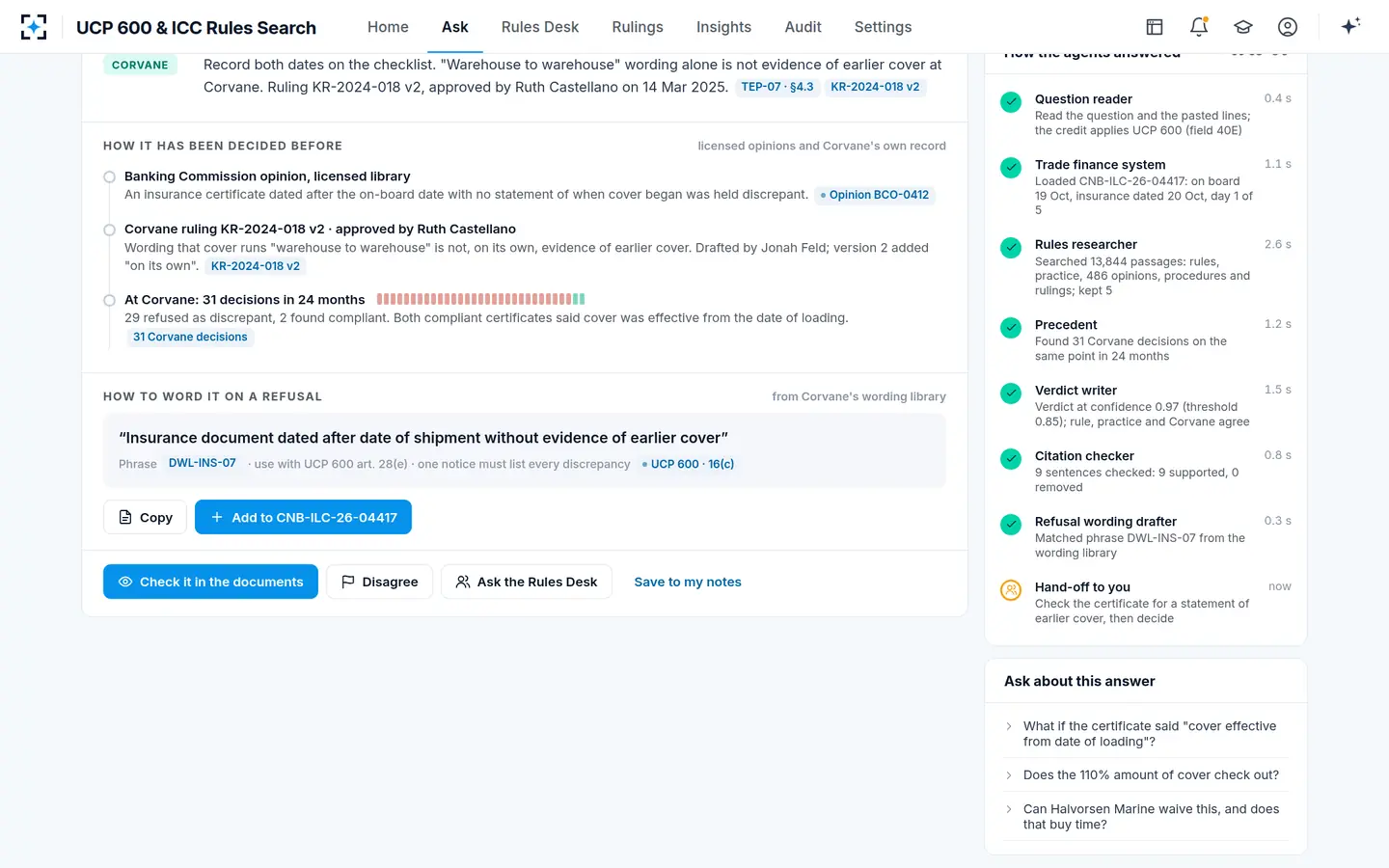
Where it fits: between courses, on live questions, with every answer showing which layer it rests on. An examiner who asks whether an insurance certificate dated the day after shipment is discrepant reads the rule (article 28(e)), the practice and the bank's own ruling labelled apart, each opening its passage. A trainee learns the structure of an answer every time they ask.
Where it does not: it will not teach the craft of reading a document set from scratch, it does not replace a qualification a bank asks its staff to hold, and it never decides. The agents research, write and check; an examiner decides, a second examiner confirms, and only the Rules Desk lead approves a ruling. Its licensed ICC text is shown only to entitled staff, within an excerpt limit, so it is not a way around buying ISBP 821 either; what is free and what must be licensed is set out separately.
Why the ICC's reported plan points at education
The ICC Digital Library reports that the Banking Commission chose a 2026–27 action plan instead of a revision of UCP 600, with one of four working groups focused on "education, strengthening practical understanding and application of ISBP 821 rather than revising the publication itself" (ICC Digital Library, August 2026). The article says it gives its author's views, not necessarily ICC's, so treat it as a report, not an announcement.
The same report gives a reason a training manager will recognise: the plan sets out to counter the inaccurate interpretations and unofficial guidance that circulate online and on social media, a worry testing an LLM's trade finance rules answers takes up. Trainees now learn from search results and chat assistants as much as from courses. A training programme that does not say which sources count, and how an answer shows its source, leaves them to work it out alone. Why there is still no UCP 700 covers what the plan means for the rules themselves.
Questions people ask
What is the best letter of credit training course?
The best course is the one that teaches from the current texts (UCP 600, ISBP 821 and eUCP 2.1), works the definitions in articles 2 and 3, and tests trainees on real document sets. ICC Academy lists online certifications including a Certified UCP 600 Specialist; other bodies run their own. Check the edition of every text in the course pack before buying.
How long does it take to train a letter of credit checker to sign alone?
No regulator or ICC text sets a period, so any figure a desk plans on is its own experience. The OCC asks its examiners to judge the team's expertise, training, numbers and turnover instead. In practice the senior checker is the person who has seen the bank's grey-area questions before.
Must examiners know ISBP 821 as well as UCP 600?
Yes. Article 2 of UCP 600 defines a complying presentation by reference to the credit, the rules and international standard banking practice, so practice is part of the test. ICC presents ISBP as a companion to be read with UCP 600, not apart from it. ISBP 821, published on 3 July 2023, replaced ISBP 745.
What do US bank examiners look for in trade finance training?
The OCC's trade finance handbook tells examiners to determine whether the bank has a training program to develop trade personnel, and to consider its type, content, frequency and budget. It also assesses expertise, staff numbers and turnover. Procedures then test whether documents are reviewed in time and discrepancies resolved or waived.
Can an AI tool replace letter of credit training?
No. A cited rules assistant can answer a live question and show which rule, practice and bank ruling the answer rests on, which reinforces training. It does not teach document examination from scratch, and the decision stays with an examiner and a second examiner. How to test such a tool is covered in our guide to five tests for an LLM in trade finance.
Should letter of credit training cover standbys and guarantees too?
If the desk handles them, yes, because they run on different rules and clocks. The OCC notes that practice for standbys is found in the UCP and in ISP98, whose rules are written for standbys alone; demand guarantees usually follow URDG 758. At the fictional sample bank, standby and guarantee questions were 15% of a month's rule questions.