eUCP version 2.1 is the ICC's supplement to UCP 600 "in order to accommodate presentation of electronic records alone or in combination with paper documents", published free on 29 June 2023 as ICC Publication 823E. It applies only when a credit says it is subject to the eUCP, and it then brings UCP 600 with it, prevailing wherever the two would give different results. Three changes matter most to an examiner: the examination period starts the banking day after a notice of completeness is received, not on delivery; one electronic record satisfies any requirement for originals or copies; and a hyperlink that cannot be opened at examination is a discrepancy. Version 2.1 itself was not a revision but an alignment with the UNCITRAL Model Law on Electronic Transferable Records. Electronic presentation raises rule questions the text does not always settle, and Botminds' UCP 600 & ICC Rules Search answers them from the eUCP text, cited to the article, with the bank's own procedure labelled apart.
eUCP text is quoted from ICC's free PDF; national law from official legislation and UNCITRAL. Examples of the solution come from a fictional sample bank, Corvane National Bank, and its sample data.
A paper presentation under UCP 600 and an electronic one under eUCP 2.1
Paper, UCP 600: Banking day following the day of presentation (art. 14(b)).
Electronic, eUCP 2.1: Banking day following receipt of the notice of completeness (art. e7(a)).
Paper, UCP 600: At least one original of each document; full sets where stated (art. 17).
Electronic, eUCP 2.1: One electronic record satisfies any requirement for originals or copies (art. e9).
Paper, UCP 600: Handwriting, stamp, symbol or any mechanical or electronic method (art. 3).
Electronic, eUCP 2.1: “Sign” includes an electronic signature (art. e3(a)(v)).
Paper, UCP 600: Documents examined on their face (art. 14(a)).
Electronic, eUCP 2.1: “Appear on their face” applies to the data content of the record (art. e3(a)(i)).
Paper, UCP 600: The place of the bank with which the credit is available (art. 6(d)).
Electronic, eUCP 2.1: An electronic address of a data processing system (art. e3(a)(iii)).
Paper, UCP 600: Not applicable.
Electronic, eUCP 2.1: A hyperlinked record is part of the record; if it cannot be reached at examination, that is a discrepancy (art. e7(b)).
Paper, UCP 600: Hold, return or follow instructions, as the notice states (art. 16).
Electronic, eUCP 2.1: Without instructions within 30 calendar days, paper is returned and electronic records may be disposed of (art. e8).
What is eUCP 2.1?
It is the current version of ICC's electronic supplement to UCP 600, published on 29 June 2023, which ICC describes as "a supplement and digital companion to the UCP 600 in purely digital form" (ICC, eUCP Version 2.1). It is free: ICC's July 2023 report says "eUCP and eURC are available for free" (ICC Documentary Credit World), unlike ISBP 821.
Version 2.1 changed very little, and ICC says so. Its introduction states: "It is very important to note that this was not a revision nor an update of the eUCP. It was solely an alignment with MLETR with respect to electronic transferable records" (eUCP 2.1, Introduction). The changes were a new definition of an "electronic transferable record", a renumbering of the definitions that followed, and an appendix of recommendations for the SWIFT MT700 fields of an eUCP credit.
The version matters anyway, because the credit must name it. Article e1(c) says "This version is Version 2.1. An eUCP credit must indicate the applicable version of the eUCP. If not indicated, it is subject to the latest version in effect on the date the eUCP credit is issued." Beware the copy you read: in October 2026, the eUCP page on ICC's free Digital Library still displayed the text of Version 1.1 (ICC Digital Library, eUCP), while the current text is the PDF.
How is eUCP different from UCP 600?
The eUCP does not replace UCP 600; it sits on top of it. "An eUCP credit is also subject to the UCP without express incorporation of the UCP", and "Where the eUCP applies, its provisions shall prevail to the extent that they would produce a result different from the application of the UCP" (eUCP 2.1, art. e2). Where the eUCP is silent, UCP 600 governs, and "Where not defined or modified in the eUCP, definitions given in UCP 600 will continue to apply".
It also switches itself off. If an eUCP credit lets the beneficiary choose paper or electronic and it presents only paper, "the UCP alone shall apply to that presentation", and the same if the credit permits only paper (art. e2(c)). An examiner's first question on any eUCP credit is therefore what was actually presented, not what the credit allowed.
When does the eUCP examination clock start?
On the banking day after the notice of completeness arrives. "The period for the examination of documents commences on the banking day following the day on which the notice of completeness is received by the nominated bank, confirming bank, if any, or by the issuing bank, where a presentation is made directly" (eUCP 2.1, art. e7(a)(i)). The five banking days of UCP 600 article 14(b) then run as usual.
Two provisions can move that start. If the bank is open but its system "is unable to receive a transmitted electronic record" on the expiry date or last day for presentation, the bank is "deemed to be closed" and the date is extended to the next banking day it can receive (art. e6(e)). And if a received record "appears to have been affected by a data corruption", the bank may ask for it to be re-presented; "the time for examination is suspended and resumes when the electronic record is re-presented", and if it is not re-presented within 30 calendar days, or by expiry if sooner, the bank "may treat the electronic record as not presented" (art. e12). How the paper clock is counted is covered in UCP 600's five banking days.
An eUCP presentation from first record to decision
A person decides
Beneficiary presents recordsElectronic records, separately and not necessarily at once (art. e6(b)), each identifying the eUCP credit (art. e6(d)).
A person decides
Notice of completenessThe presenter tells the bank the presentation is complete; without it, presentation is deemed not made (art. e6(c)).
Agent
Clock startsBanking day after the notice is received (art. e7(a)); suspended if a record must be re-presented after data corruption (art. e12).
A person decides
Examine the data contentIncluding any hyperlinked external record; a record that cannot be authenticated is deemed not presented (art. e6(f)).
A person decides
Decide and notifyHonour, or refuse under UCP 600 art. 16; without instructions in 30 days, records may be disposed of (art. e8).
What is a notice of completeness?
It is the presenter's statement that a presentation including electronic records is complete. "When one or more electronic records are presented alone or in combination with paper documents, the presenter is responsible for providing a notice of completeness", and "The receipt of the notice of completeness will act as notification that the presentation is complete and that the period for examination of the presentation is to commence" (eUCP 2.1, art. e6(c)).
The notice can itself be electronic or paper, and must identify the credit. Its absence is decisive: "Presentation is deemed not to have been made if the notice of completeness is not received" (art. e6(c)(iii)). One exception keeps the chain moving between banks: a nominated bank forwarding records to a confirming or issuing bank need not send one (art. e6(c)(iv)).
Originals, dates and hyperlinks: the rules that change examination
Four eUCP articles change what an examiner looks for. Originals stop being countable: "Any requirement for presentation of one or more originals or copies of an electronic record is satisfied by the presentation of one electronic record" (art. e9). Dates must be evidenced in the record: "An electronic record must provide evidence of its date of issuance" (art. e10), and a transport record's notation of the shipment date "need not be separately signed or otherwise authenticated" (art. e11).
The two hardest rules concern systems. A hyperlinked record, or a record to be examined by reference to an external system, makes that external record "an integral part of the electronic record to be examined", and "The failure of the external system to provide access to the required electronic record at the time of examination shall constitute a discrepancy" (art. e7(b)). Yet a bank's own inability to examine a record in the format the credit required "is not a basis for refusal" (art. e7(c)). The preliminary considerations warn banks accordingly: "Before agreeing to issue, advise, confirm, amend or transfer an eUCP credit, banks should satisfy themselves that they can examine the required electronic records".
Six checks before a bank issues, advises or confirms an eUCP credit
- The credit names the eUCP version
Art. e1(c): otherwise the latest version on the issue date applies.
- It states each record’s format
Art. e5: if a format is not indicated, the record may be presented in any format.
- It states the place for presentation
Art. e6(a): an electronic address for records, and a place for paper too if both are allowed.
- It states the banks’ physical locations
Art. e1(d): the issuing bank’s, and the nominated and confirming banks’ where known.
- Your systems can open every required format
Art. e7(c): inability to examine a required format is not a ground for refusal.
- You know the law that gives the records effect
ICC’s introduction: each applicable legal system must be considered.
Are electronic bills of lading accepted under eUCP?
The eUCP accommodates them; whether one carries the legal effect of a paper bill is a matter of national law. Version 2.1 defines an electronic transferable record as one "that contains the information that would be required in the equivalent paper document, such as a negotiable bill of lading or an assignable insurance document" (art. e3(b)(v)), and its introduction says "it is necessary to consider each applicable legal system with respect to usage of the eRules".
Some legal systems have answered. The UK's Electronic Trade Documents Act 2023, in force since 20 September 2023, says "An electronic trade document has the same effect as an equivalent paper trade document" (legislation.gov.uk), and its examples of paper trade documents include a bill of lading, a bill of exchange and a cargo insurance certificate. The effect depends on "a reliable system" meeting five tests.
The UK Act's five tests for an electronic trade document's reliable system
| The system must | Why it matters to an examiner |
|---|---|
| Identify the document so it can be distinguished from any copies | Replaces counting originals in a full set |
| Protect it against unauthorised alteration | What an examiner reads is what was issued |
| Ensure only one person can exercise control at a time | The electronic equivalent of holding the paper bill |
| Let the person in control demonstrate it | Shows who can present or endorse |
| Make a transfer deprive the previous holder of control | Stops two parties presenting the same title |
The fraud question these tests address, two sets of title documents for one cargo, is the territory of Botminds' Trade Finance Fraud Detection solution, whose guide to electronic bill of lading software asks whether e-documents end double financing; the rules question, whether a presentation under an eUCP credit complies, is this one's.
Has the US adopted MLETR?
No. MLETR is UNCITRAL's Model Law on Electronic Transferable Records (2017), a template for national law on electronic equivalents of documents such as bills of lading. UNCITRAL reports that legislation "based on or influenced by the Model Law has been adopted in 13 States and a total of 13 jurisdictions", and the United States is not among them (UNCITRAL, MLETR status).
MLETR-based laws by year of adoption: 13 jurisdictions, none in the US
US banking regulation has not caught up with the e-rules either. The OCC's rule on letters of credit lists the eUCP "v. 1.0, 1.1, & 2.0" among recognised rules of practice, as last amended in December 2020, and does not mention Version 2.1 (12 CFR 7.1016). A US bank can still issue an eUCP 2.1 credit; the rules apply because the credit incorporates them.
How UCP 600 & ICC Rules Search answers eUCP questions
It reads the credit first, because the eUCP applies only when the credit says so, and only to what was actually presented electronically. It then answers from the eUCP article, falls back to UCP 600 where the eUCP is silent, and labels the bank's own procedure apart. In the sample bank's first three weeks of October, 55 of 1,386 questions, 4%, were about electronic presentation, and 6 of the 41 sent to the Trade Rules Desk were eUCP questions: the second-largest group at the desk, from a topic that made up 4% of the questions.
An eUCP question waiting for a ruling: an on-board date in the record's data only
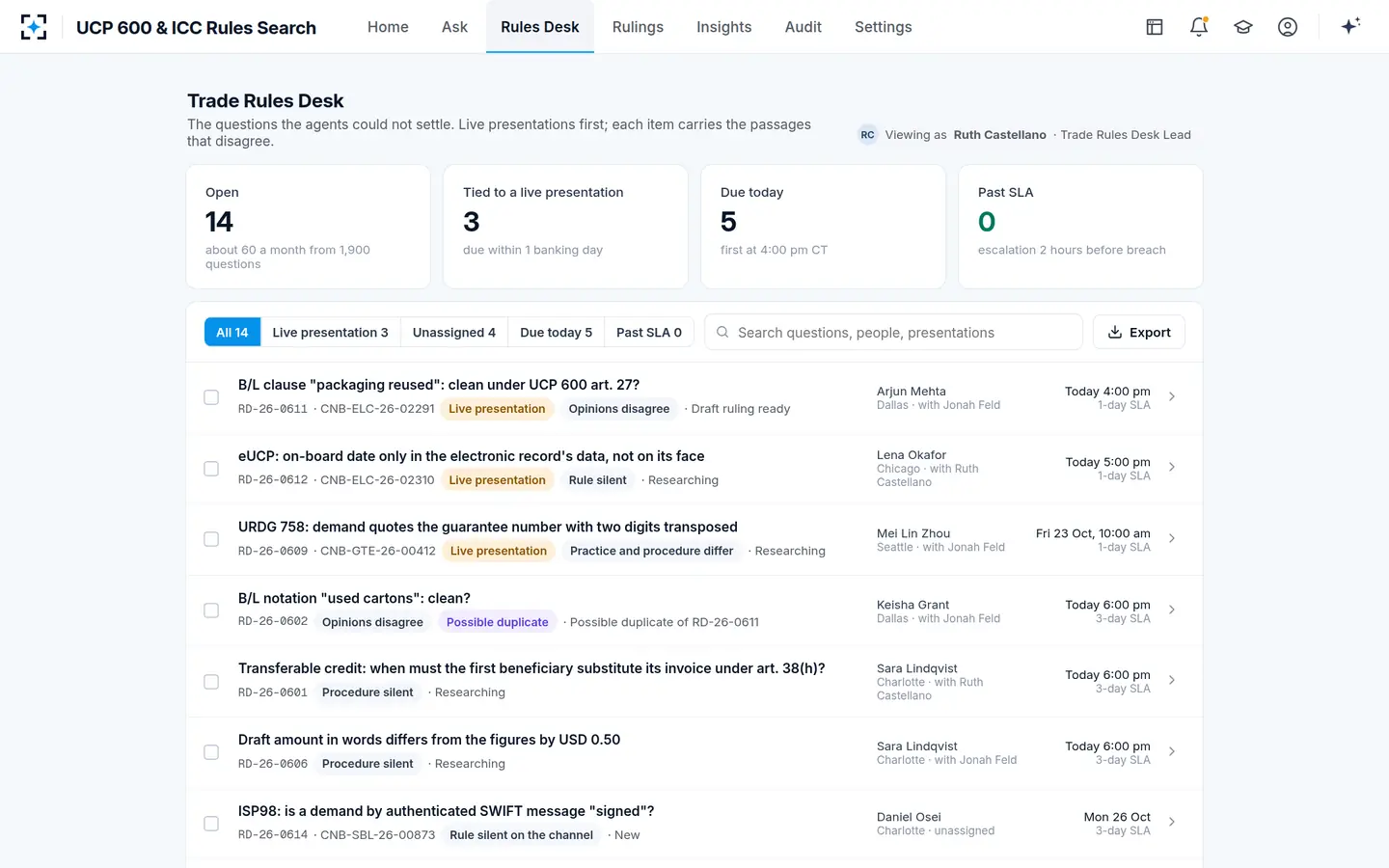
The question in that queue shows why. Article e3(a)(i) applies "appear on their face" to "the data content of an electronic record", and article e3(a)(vi) treats a notation as "data content whose supplementary character is apparent in an electronic record". Whether an on-board date held in a record's data but not displayed is such a notation is the kind of point the text leaves open; the agents say so, and a person rules. A report on the ICC Digital Library says how UCP 600, ISBP 821, ICC opinions and digital trade rules fit together will run through the Banking Commission's 2026–27 programme (ICC Digital Library, August 2026), though its author marks it as personal views.
Electronic presentation among a month's questions in UCP 600 & ICC Rules Search
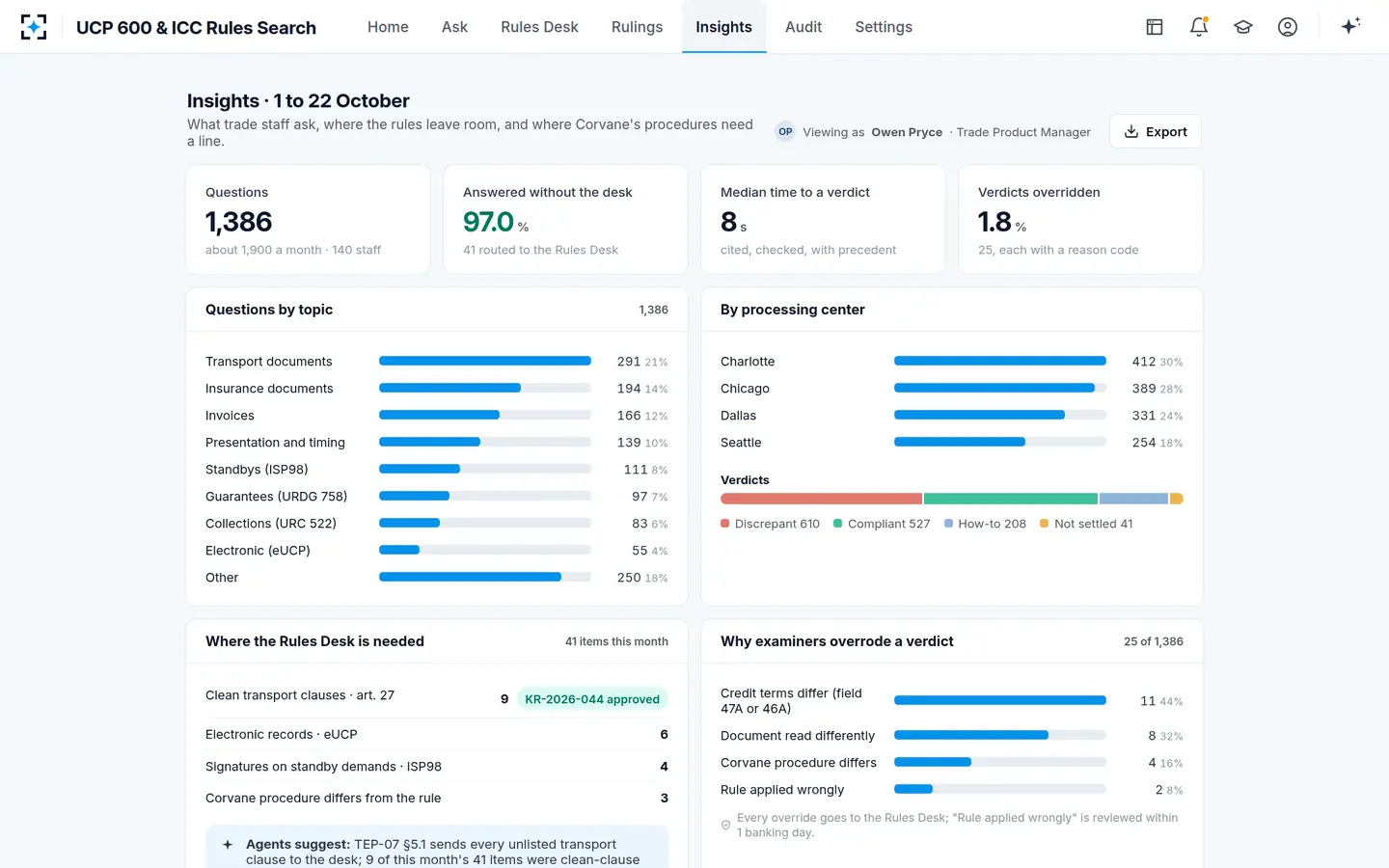
Questions about which eUCP version a credit applies are answered from article e1(c) and the credit; superseded versions stay searchable, marked as such, and are never the basis of a new answer. Why the UCP itself has not changed while the e-rules have is covered separately.
Questions people ask
Is eUCP 2.1 free?
Yes. ICC publishes eUCP Version 2.1 (ICC Publication 823E) as a free PDF on iccwbo.org, and its July 2023 report says the eUCP and eURC are available free. ICC's copyright notice still restricts reproducing or adapting the text without permission.
Does an eUCP credit need to mention UCP 600 as well?
No. Article e2(a) says an eUCP credit is also subject to the UCP without express incorporation of the UCP. Where the two would give different results, the eUCP prevails.
What happens if the notice of completeness never arrives?
The presentation is deemed not to have been made, under article e6(c)(iii), so the examination period never starts. If the only record left to present is the notice and the bank's system cannot receive records on the last day, it may be given by telecommunication or on paper and is deemed timely if sent before the bank can receive again.
How many originals are needed in an electronic presentation?
One. Article e9 says any requirement for presentation of one or more originals or copies of an electronic record is satisfied by presenting one electronic record. Paper documents in a mixed presentation still follow UCP 600's rules on originals.
What is the difference between eUCP and eURC?
The eUCP supplements UCP 600 for documentary credits; the eURC supplements URC 522 for documentary collections. Both were published in new versions on 29 June 2023, eUCP 2.1 and eURC 1.1, and both are free from ICC.