Electronic bill of lading software issues, transfers and surrenders bills of lading as electronic records on a system that lets only one party control a given bill at a time. That single feature is aimed squarely at double financing: a paper bill can be copied, printed twice or presented to two banks, while a properly built electronic bill can be held by only one controller, and its transfer strips the previous holder of control. The UK wrote the requirement into law in 2023, and 13 jurisdictions have legislated on the UN model. What electronic bills do not do is check that the cargo is real, that the receivable behind it has not been sold elsewhere, or that nobody is still circulating a paper set; more than 99% of bills were still paper in 2020. Botminds' Trade Finance Fraud Detection treats the electronic bill registry as one source among several before funding: it asks whether an electronic record exists, and checks the carrier, the ship and every other desk either way.
Bills of lading issued by ocean carriers in 2020: paper and electronic
About 16 million original bills
- Paper · 99%
- Electronic, at most · 1%
What is an electronic bill of lading?
It is a bill of lading that exists as an electronic record on a system rather than as signed paper, with the same functions: a receipt for the goods, evidence of the contract of carriage and a document of title that controls delivery. The legal question was always the third function. A paper bill works as a document of title because only its holder possesses it; an electronic file can be copied endlessly, so the law needed a substitute for possession.
That substitute is control. The UK Law Commission, whose 2022 report led to the Act, recommended that an electronic document "should be susceptible to exclusive control", explaining: "In order to prevent double spending, only one person (or persons acting jointly) must be able to exercise control of the document in electronic form at any one time" (Law Commission, Electronic trade documents). Double spending is the lawyers' name for what a lender calls double financing.
What is the UK Electronic Trade Documents Act?
The Electronic Trade Documents Act 2023 gives an electronic document the same legal effect as its paper equivalent, provided a reliable system is used to meet five conditions. It received Royal Assent on 20 July 2023 and came into force two months later, on 20 September 2023. The Act lists bills of lading and warehouse receipts among its examples of trade documents (ETDA 2023).
The five conditions are, in substance, the anti-fraud specification for electronic bill software. Section 2(2) requires a reliable system to identify the document so it can be distinguished from any copies; protect it against unauthorised alteration; "secure that it is not possible for more than one person to exercise control of the document at any one time"; allow whoever can control it to demonstrate that; and secure that a transfer deprives the previous controller of control. The Explanatory Notes call the last condition the answer to "the double spend problem": a document cannot be transferred twice by the same party (Explanatory Notes, paras 39–44).
What a reliable electronic bill system must do under the UK Act, section 2(2)
- Distinguish the document from any copies
A copy can be read but never used as the bill.
- Protect it against unauthorised alteration
A changed on-board date or container number must be detectable as unauthorised.
- Allow only one person to exercise control at a time
Persons acting jointly count as one. This is the double-spending condition.
- Let the controller demonstrate control
A bank asked to finance against the bill can verify who controls it.
- Divest the transferor on transfer
After transfer the previous holder cannot use the bill again.
What is MLETR, and where is it law?
MLETR is the UNCITRAL Model Law on Electronic Transferable Records, adopted in 2017, which gives countries a template for recognising electronic bills of lading, bills of exchange and similar documents on the basis of control. UNCITRAL's status page lists legislation based on or influenced by it in 13 states and 13 jurisdictions (UNCITRAL, MLETR status). The United States is not among them.
Where legislation based on or influenced by MLETR has been adopted
| State | Year | Note |
|---|---|---|
| Bahrain | 2018 | |
| Belize | 2021 | |
| Kiribati | 2021 | |
| Paraguay | 2021 | |
| Singapore | 2021 | |
| United Arab Emirates (Abu Dhabi Global Market) | 2021 | |
| Papua New Guinea | 2022 | |
| United Kingdom | 2023 | Influenced by the Model Law |
| France | 2024 | |
| Timor-Leste | 2024 | |
| China | 2025 | Influenced by the Model Law; bills of lading only |
| Marshall Islands | 2025 | Influenced by the Model Law |
| Mauritius | 2025 | Bills of exchange only |
Is an electronic bill of lading legal in the US?
Yes, under state commercial law, though not through MLETR. The Uniform Commercial Code counts a bill of lading as a "document of title" (UCC § 1-201) and its Article 7 recognises electronic documents of title through control. Under § 7-106, a system confers control if, among other things, "a single authoritative copy of the document exists which is unique, identifiable, and, except as otherwise provided in paragraphs (4), (5), and (6), unalterable", and each copy is "readily identifiable as a copy that is not the authoritative copy" (UCC § 7-106).
The concept is the same as the UK's: one authoritative record, one controller. What varies is the counterparty. A US bank financing an import from a country whose law, or whose carrier, does not support the electronic bill will still receive paper, and the governing law of each bill and platform rules matter when a dispute comes. For a lender, the practical question is not whether electronic bills are legal but whether the particular cargo in front of it has one.
Does an electronic bill of lading prevent fraud?
It prevents one fraud well and leaves the others. Exclusive control stops the same electronic bill being transferred to two financiers, and protection against alteration stops a date or container number being changed without trace. It does nothing about what was written into the bill when it was issued, about other documents that describe the same cargo, or about paper that circulates alongside.
What exclusive control stops, and what it does not
Stopped by a reliable electronic bill system: The same electronic bill cannot be controlled by two parties, or transferred twice by the same party.
Still needs a check before funding: A receivable, invoice or warehouse receipt on the same cargo financed at another desk or bank.
Stopped by a reliable electronic bill system: A changed on-board date or container number is detectable as unauthorised.
Still needs a check before funding: A false date or false description entered at issue, by a colluding issuer.
Stopped by a reliable electronic bill system: There is one authoritative record, not a set of three to print twice.
Still needs a check before funding: A paper set for the same cargo, issued or printed outside the system.
Stopped by a reliable electronic bill system: Nothing: the system records what its issuer states.
Still needs a check before funding: Whether the ship was at the loading port and the containers exist.
Stopped by a reliable electronic bill system: Nothing: the bill is not the sale contract.
Still needs a check before funding: Confirmation with the named buyer, as in the Hin Leong discounting.
The court records show why the right-hand column matters. The Hin Leong discounting applications rested on sale contracts that were "complete fabrications"; the appeal court noted they could be confirmed only by the purported buyers ([2026] SGHC 47). In ZenRock, the bill was genuine and the fraud was a doctored contract price and a receivable assigned to two banks ([2023] SGCA(I) 7). In the nickel case, bills described nickel and the containers held steel ([2026] EWHC 159 (Comm)). An electronic bill would have carried the same false description faithfully. And in Fimbank v Discover, the claimant's case was that cargo was delivered against forged bills while the originals sat with the collecting bank ([2020] EWHC 254 (Comm)), a fraud that a single electronic record, honoured by the carrier, is designed to prevent.
What should electronic bill of lading software do for a bank?
For a bank, the software is valuable to the extent it answers three questions before funding: does an electronic record exist for this bill, who controls it now, and has it ever been controlled by anyone else the bank should know about. Everything else in a provider's pitch is about efficiency for carriers and traders, which matters, but not to fraud.
Questions for electronic bill of lading software, from a lender's side
- Can a bank look up a bill by number and see whether an electronic record exists?
A "no record" answer is useful: it tells the bank to confirm a paper set with the carrier.
- Can the bank see who controls the bill now, and its transfer history?
This is the double-financing answer the system exists to give.
- Does the system meet the UK Act’s reliability factors, or an equivalent?
Rules, integrity, access control, security and independent audit, as section 2(5) lists.
- What happens when a bill moves between platforms?
A bill that leaves the system, or converts to paper, can reopen the duplication risk.
- Can the bank hold the bill as security, and release it, under clear rules?
Control for a pledge must be as exclusive as control for a sale.
- Does the carrier confirm what was issued?
An electronic bill is only as true as its issuer; the carrier’s own record still matters.
How Trade Finance Fraud Detection uses the electronic bill registry
As one source among several. For each financing, the Carrier and registry verifier asks the electronic bill registry the bank connects to whether a record exists for the bill number, and asks the carrier what it issued. Take a fictional sample case as it runs through the solution: for a copper cargo presented under a letter of credit on 2 October 2026, the registry holds no electronic record, and the carrier confirms one paper set of three originals. The bank, carrier and figures are invented.
No electronic record: the carrier confirms a paper set
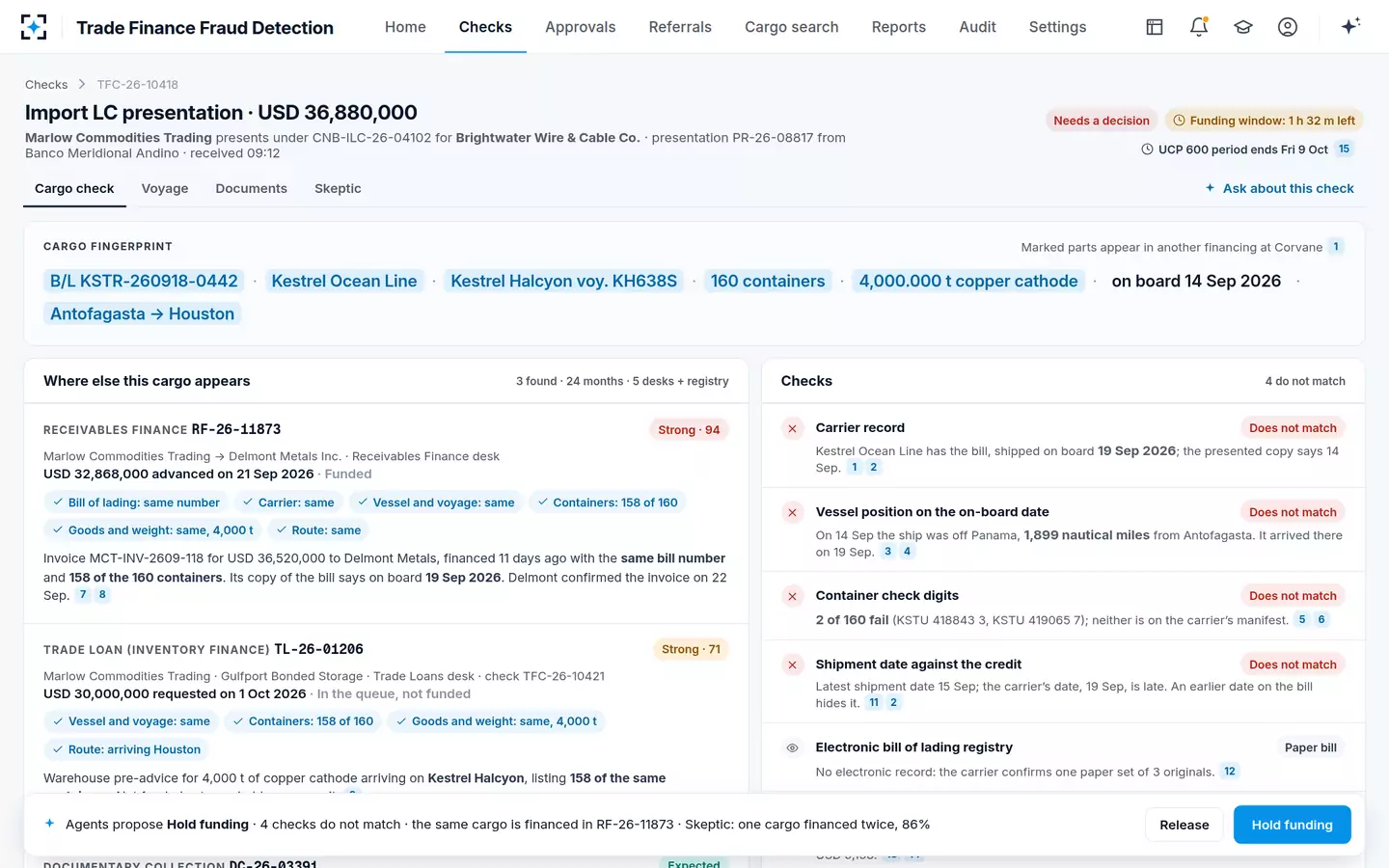
A paper answer changes what the other checks must do. With no electronic control to rely on, the duplicate question falls to the search across the bank's own desks, which in the sample found the same bill and 158 of 160 containers behind a receivable funded eleven days earlier. The carrier's record of three originals released to the shipper, set against the bill presented and the copy behind the receivable, is what exposes the date. The detail of that comparison is in who can confirm a bill of lading.
One bill, three versions: what an electronic record would have settled
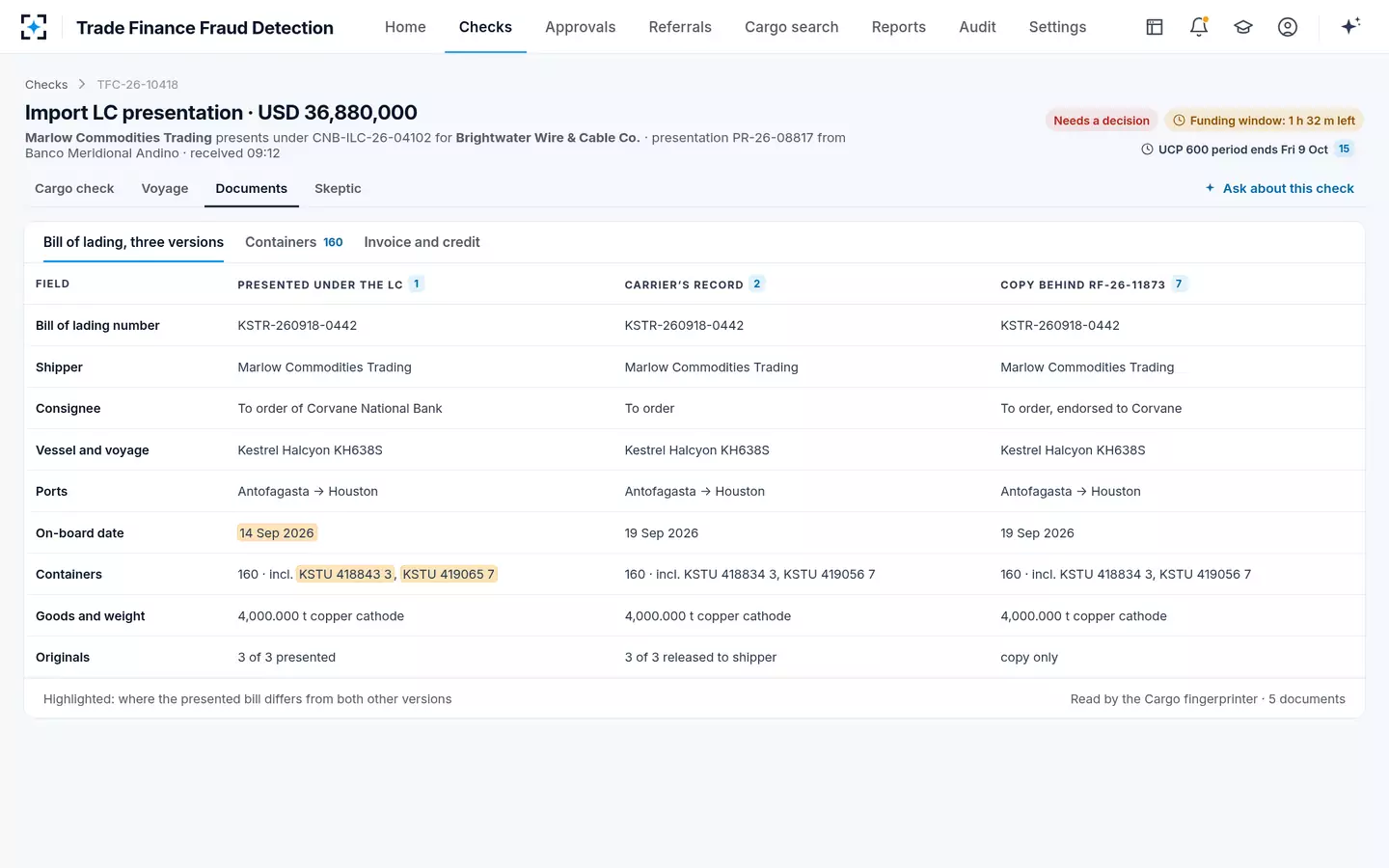
Where a bill is electronic, the solution records who controls it and checks the carrier and the voyage anyway, because a true record of a false shipment is still false. Electronic bills shrink one route to double financing; they do not replace looking at the cargo. The full set of schemes they leave open is laid out in types of trade finance fraud.
Questions people ask
Can a bill of lading be electronic?
Yes. In the UK the Electronic Trade Documents Act 2023, in force since 20 September 2023, gives an electronic bill the same effect as paper if a reliable system meets its control conditions; in the US, UCC Article 7 recognises electronic documents of title through control; and 13 states have legislated on the UN model law. Whether a given trade uses one depends on the carrier and the parties.
Do banks accept electronic bills of lading under letters of credit?
They can where the credit provides for electronic presentation, which ICC's supplement to UCP 600 for electronic presentations, the eUCP, is designed to govern, and where the bank can confirm control of the bill on the platform used. A credit that calls for paper originals still requires paper.
Does an electronic bill of lading stop duplicate financing completely?
No. It stops the same electronic bill being controlled or transferred twice. It does not stop the cargo being financed again through a receivable, an inventory loan or a warehouse receipt, a paper set issued outside the system, or a false description entered at issue.
Who controls an electronic bill of lading?
One person or group acting jointly at a time, as the system records: typically the shipper first, then the buyer or a bank after transfer. Under the UK Act, a person exercises control by using, transferring or disposing of the document, and merely reading it does not count.
What happens if an electronic bill is converted to paper?
The UK Act allows a document to change form, and its Explanatory Notes address documents converted between paper and electronic form. For a lender the risk is practical: once a paper version exists, the double-financing protection of exclusive control no longer covers it, so the carrier's record of what was issued becomes the key check again.