The types of trade finance fraud fall into eight recurring schemes: the phantom shipment, where no goods move; duplicate financing, where one cargo backs several financings; the forged or duplicated bill of lading; the ante-dated bill, where real goods carry a false date; the fabricated receivable or doctored contract; multiple pledging and forged warehouse receipts; misdescribed goods; and false accounts that open the credit lines in the first place. Each attacks a specific document, and each is exposed only by asking someone outside the presentation: the carrier, the ship's track, the warehouse, the buyer, the auditor or another desk. Botminds' Trade Finance Fraud Detection looks for the signs of the first seven on every trade financing before it is funded; the eighth needs the auditor's answer, which the solution does not seek.
Eight types of trade finance fraud: the document attacked and the check that exposes it
1
Phantom shipment
Document attacked
Bill of lading, shipping and customs documents
The check
Vessel position and port calls; the carrier’s record
Winson v OCBC (2024)
2
Duplicate financing
Document attacked
Invoice, bill of lading, the same cargo at two desks or banks
The check
Search every financing by each part of the cargo
Hin Leong cargoes sold to several buyers
3
Forged or duplicate bill
Document attacked
Bill of lading: never issued, or a second printed set
The check
Carrier confirms issue, originals and to whom released
Trafigura v Gupta (2026)
4
Ante-dated bill
Document attacked
On-board date on the bill of lading
The check
Carrier’s on-board date; ship’s position that day
Standard Chartered v PNSC (2002)
5
Fabricated receivable or contract
Document attacked
Sale contract, invoice, delivery evidence
The check
Confirm with the named buyer; price against prior shipments
Hin Leong discounting; ZenRock
6
Multiple pledging, forged receipts
Document attacked
Warehouse and port receipts
The check
Authenticate originals; count the stock
Qingdao (2014); Natixis v Marex
7
Misdescribed goods
Document attacked
Bill description, certificates of quality and analysis
The check
Weights, product codes, inspection
Trafigura v Gupta; Illinois plea (2013)
8
False accounts
Document attacked
Financial statements, audit opinion
The check
Confirm with the auditor; test the counterparties
Agritrade (2023)
What are the types of trade finance fraud?
The eight types above are a working taxonomy built from the court and prosecutor records on this page, not an official list: no regulator publishes one for fraud against banks. FATF's typologies come closest, but they are written for money laundering, where the bank is a conduit rather than a victim. The difference matters for controls, and is covered at the end of this page.
The OCC frames the common thread for examiners: a letter of credit "does not eliminate the risk of fraud or deception by an unscrupulous exporter against an importer, because the bank deals only in documents and does not inspect the goods themselves" (OCC Comptroller's Handbook, Trade Finance and Services). Every type below exploits the gap between the document and the goods.
A phantom shipment: documents for goods that never moved
A phantom shipment is a set of shipping documents for goods that were never shipped. FATF's 2006 typology describes an exporter who ships nothing and colludes with the importer so that the shipping and customs documents are processed as if goods had moved, and warns that banks can end up financing such shipments without knowing it (FATF, Trade Based Money Laundering, 2006). In the Hin Leong letters of credit, the High Court found, and the Court of Appeal upheld, that no cargo was shipped as Winson's letters of indemnity described ([2024] SGCA 31).
The documents can be flawless. What a phantom shipment cannot fake is the voyage: the named ship's position on the loading date, its port calls, and the carrier's own record. How a bank tests those is the subject of what a phantom shipment is and how a bank proves the ship was there.
What is duplicate financing?
Duplicate financing is one cargo, or one receivable, financed more than once: a letter of credit at one desk, a receivable at another, an inventory loan at a third, or the same documents presented to several banks. FATF described the mechanism in 2006 as multiple invoicing and noted that "Employing a number of different financial institutions to make these additional payments can further increase the level of complexity" (FATF, 2006).
The Hin Leong record shows the scale such multiplication can reach. Its interim judicial managers reported, as the Court of Appeal recounts, transactions in which the same cargo was sold multiple times using multiple bills of lading for financing, and that the cargo on one tanker had been sold to three buyers or more ([2024] SGCA 31; the full account is in examples of trade finance fraud). The check is a search across every financing by every part of the cargo, because the second financing rarely reuses the first one's reference: in practice the bill number, the container list, the vessel and voyage, the goods and weight, and the dates are what match.
Forged bills of lading and duplicate sets: how they differ
A forged bill of lading is one its named carrier never issued; a duplicate set is a second "original" set printed for a cargo that already has one. Both look genuine. In Winson, the liquidators of the shipping company whose stamp the bills bore said it had not issued them, and a Hin Leong employee explained that they were prepared from the details of one real shipment ([2024] SGCA 31; bill of lading verification follows the case to the carrier's answer).
The duplicate is subtler because the cargo and the voyage are real. In Trafigura v Gupta, Maersk concluded that only one set of bills had been issued but that the seller's forwarder had printed two, and another company presented apparently original bills for the same cargoes ([2026] EWHC 159 (Comm)). The check for both is the same question to the carrier: did you issue this bill, how many originals, and to whom were they released? Who else can confirm a bill is covered in bill of lading verification.
The ante-dated bill: true goods, false date
An ante-dated bill describes a real shipment but states an on-board date earlier than the true one, usually so a late shipment meets a letter of credit's latest shipment date. In the House of Lords case Standard Chartered v PNSC, bills dated 25 October 1993 were issued on 8 November for bitumen that had not yet been loaded, and the confirming bank paid US$1,155,772.77 on them ([2002] UKHL 43).
It is the type document examination is least able to catch, because the bill is regular on its face and the date satisfies the credit. The checks are the carrier's own on-board date and the ship's position on the stated day, which the guide to the ante-dated bill of lading works through.
Fabricated receivables and doctored contracts
Here the false document is the commercial one: a sale contract that does not exist, an invoice to a buyer who never ordered, or a genuine contract with its price altered. Hin Leong's founder was convicted of cheating HSBC over two discounting applications whose underlying sales were, in the Singapore Police Force's words, "complete fabrications". The appeal court agreed the offences were hard to detect because they concerned contracts "that only the purported counterparties could confirm", under a silent arrangement in which the buyer would not ordinarily know of the financing ([2026] SGHC 47).
In the ZenRock case, the contract was real and the price was not: ZenRock altered a copy of its sale contract with TOTSA, turning Brent minus US$3.60 a barrel into Brent plus US$3.60, so the letter of credit came out about half as much again as the market price ([2023] SGCA(I) 7; the court's words are in examples of trade finance fraud). The same receivable had been assigned to another bank. The checks: confirm with the buyer, compare the price with the parties' history and the market, and check for an existing assignment.
Double pledging: warehouse receipts pledged more than once
Double pledging, or multiple pledging, is using the same stored goods as security for more than one loan, usually through warehouse or port receipts; double pledging of collateral covers the same fraud in asset-based lending. In the Qingdao case of 2014 the court recorded the risk that one lot of metal had been used for several repo transactions or as security for several loans (Mercuria v Citibank [2015] EWHC 1481 (Comm)), the scheme warehouse receipt financing takes apart.
Its close relative is the forged receipt. In Natixis v Marex, sixteen warehouse receipts in the name of a real warehouse operator all turned out to be counterfeit, and the financier never acquired title to any nickel ([2019] EWHC 2549 (Comm)). The checks: authenticate original receipts with their issuer and confirm, or count, the stock. The lending side is set out in warehouse receipt financing.
Goods that are not what the papers say
Misdescription ships something, but not what was sold: cheap material in place of a valuable commodity, or less of it. Trafigura's containers, sold as LME-grade nickel, were found to hold carbon steel and other low-value material, while the bills, invoices and insurance certificates all said nickel; the judgment notes that the HS product codes "did not record this" ([2026] EWHC 159 (Comm)). In a 2013 US plea, a supplier admitted presenting bills of lading under letters of credit and that on various occasions "he shipped worthless scrap materials" (US Attorney, N.D. Illinois).
The bank's documents cannot settle contents, because a carrier usually vouches for sealed containers, not what is inside them. The checks are indirect, weights against declared quantity, product codes against the description, prices against prior shipments, and direct when the indirect ones disagree: an inspection.
False accounts that open the credit lines
The eighth type attacks the credit decision rather than the transaction. Agritrade's former chief financial officer misled 16 financial institutions into believing the group's financial statements were audited; they granted at least US$586.5 million of credit and lost about US$469.1 million, and much of the money went to purported suppliers connected to the company (Singapore Police Force, January 2023). Every trade transaction financed under those lines may have looked normal.
This is the type a pre-funding cargo check reaches least. It can show that the same "suppliers" are paid across many financings, but confirming an audit opinion is a credit-onboarding control, done by asking the auditor directly.
How one cargo can carry several types at once
Real schemes combine types, which is why a single check rarely suffices. Take a fictional sample case as it runs through Trade Finance Fraud Detection: on 2 October 2026 a bank receives a presentation under an import letter of credit for 4,000 tonnes of copper. The bill is ante-dated (on board 14 September, against the carrier's 19 September and a latest shipment date of 15 September), two of its 160 container numbers have been retyped, and a copy of the same bill already backs a funded receivable at the bank's receivables desk, while an inventory loan on the same cargo waits in a third queue. The bank, companies and figures are invented.
One sample cargo, three types of fraud
3
financings of one copper cargo across three desks
$99.7m
requested or advanced against a cargo worth about $36.9m
158of 160
containers shared with the earlier receivable
2
container numbers that fail their check digits
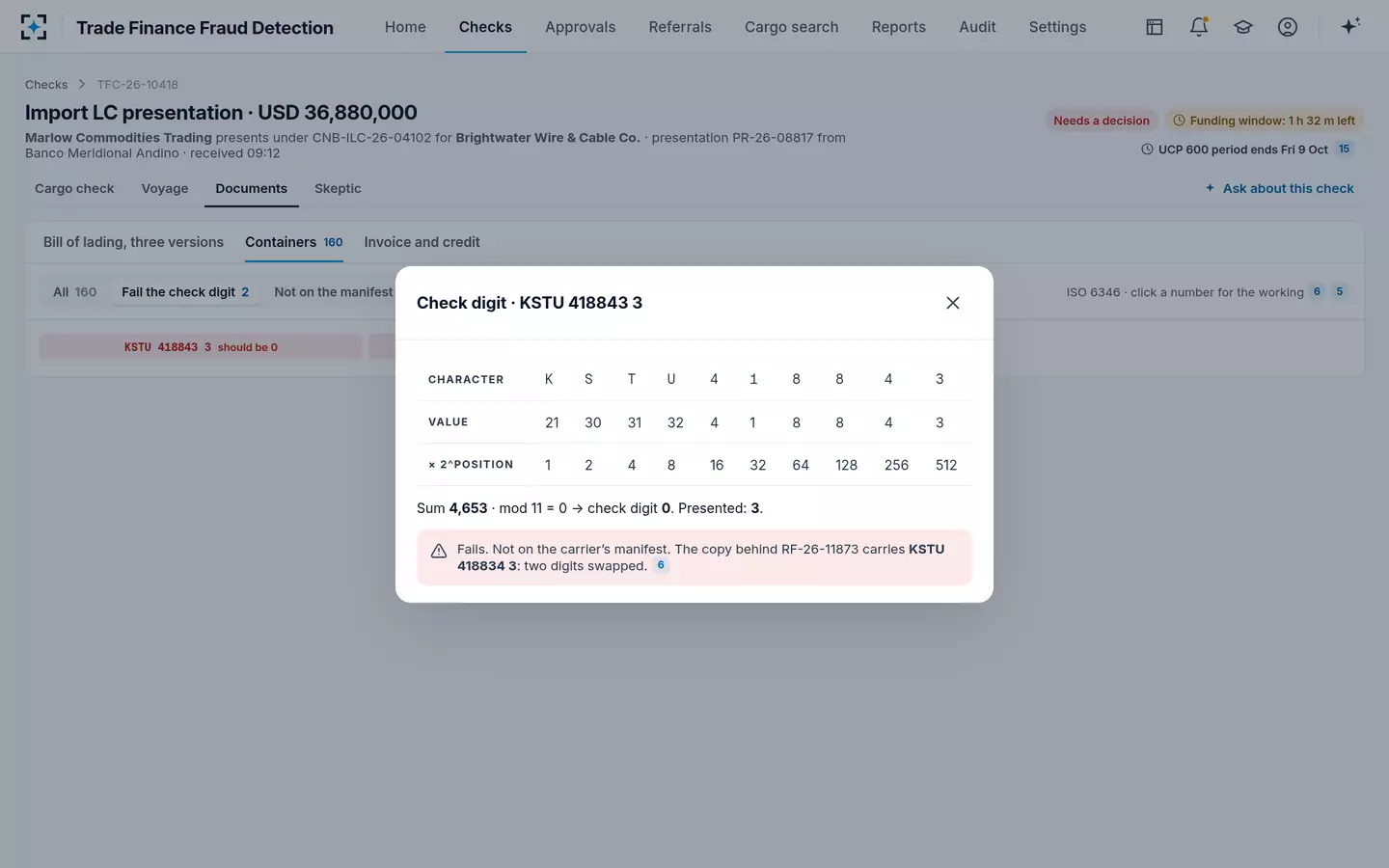
The retyped containers are a deliberate defence against duplicate searches: change two digits and an exact match on the container list fails. The container numbering standard includes a check digit computed from the other characters, so a retyped number usually fails its own arithmetic, and the solution shows the working.
A retyped container number fails its own check digit
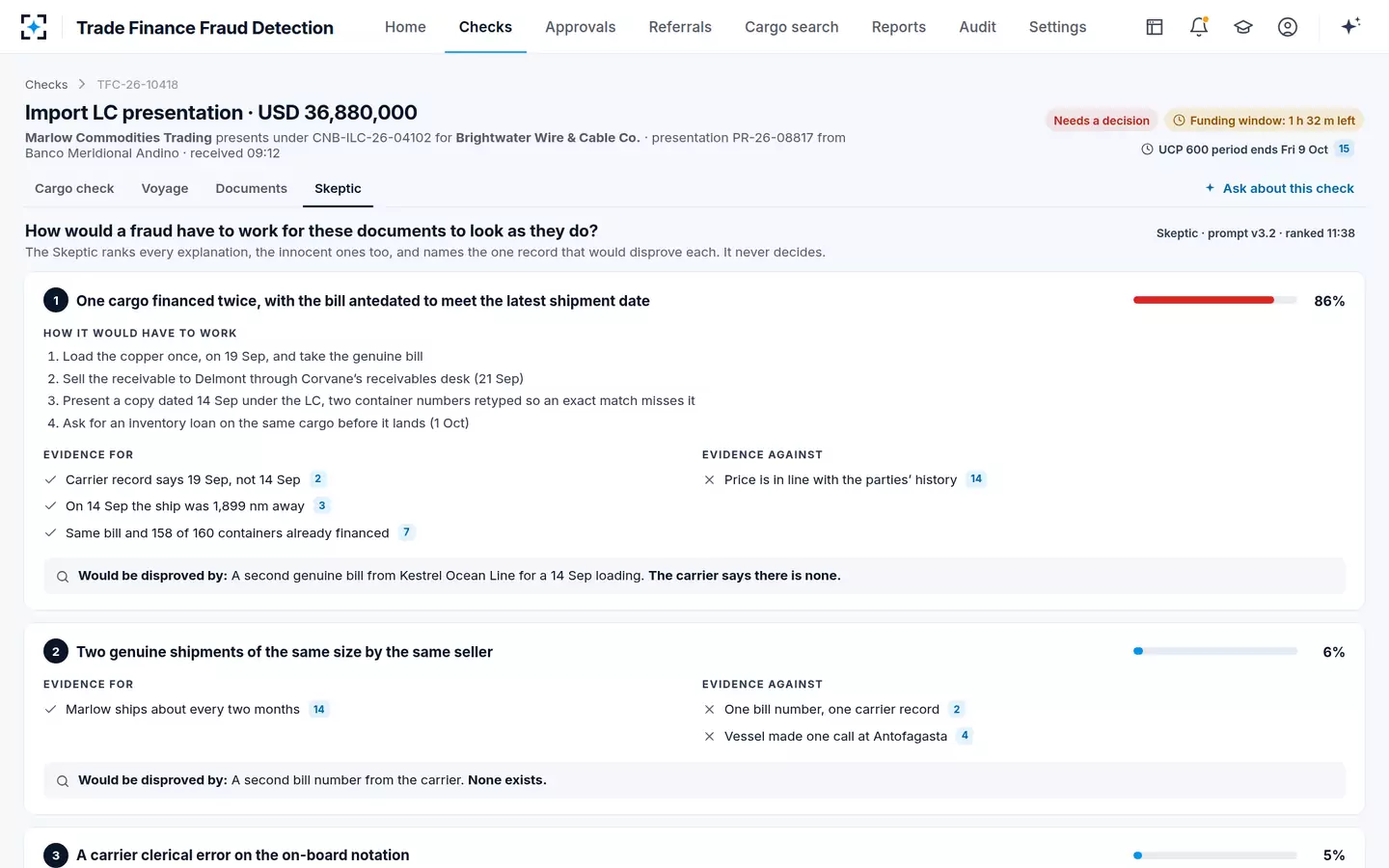
A good control also argues the other side. The solution's Skeptic agent ranks how a fraud would have to work for the documents to look as they do, and the innocent explanations too, each with the one record that would disprove it.
How would a fraud have to work? The innocent explanations ranked too
How is trade finance fraud different from trade-based money laundering?
The victim. In trade finance fraud the bank or financier is deceived and loses money; in trade-based money laundering the trade documents move value between parties who are often colluding, and the bank may be paid in full. Several techniques, phantom shipments and documents reused across banks among them, serve both purposes, which is why FATF's typologies are useful to fraud teams too.
Same documents, different victim
Trade finance fraud: The financier: a bank, a trade finance fund, an insurer.
Trade-based money laundering: Often no party to the trade; the harm is the value moved.
Trade finance fraud: Obtain funding that will not be repaid.
Trade-based money laundering: Move or disguise value across borders.
Trade finance fraud: Bills of lading, receipts, receivables, accounts.
Trade-based money laundering: Invoices and prices, routing, counterparties.
Trade finance fraud: Pre-funding checks of the cargo across desks and with outside parties.
Trade-based money laundering: Transaction monitoring and review for unusual pricing and patterns.
Trade finance fraud: Phantom shipments, duplicate documents, misdescribed goods.
Trade-based money laundering: The same techniques, used to justify payments.
Questions people ask
What is the most common type of trade finance fraud?
No dataset measures it. In the court and prosecutor records collected here, forged, false or duplicated bills of lading appear most often, in cases from Hin Leong to Trafigura to a 2013 US plea, because the bill is both the proof of shipment and, for many financings, the security.
What is multiple invoicing in trade finance?
Invoicing the same goods more than once to justify several payments or financings for one shipment. FATF described it in 2006 and noted that using several financial institutions for the extra payments makes the scheme harder to trace; it is the money-laundering name for what a lender experiences as duplicate financing.
Is double financing the same as double pledging?
They are close. Double financing is any second financing of the same goods or receivable; double pledging usually means the same stored goods given as security twice, often through warehouse receipts, as the Qingdao judgment describes. Both are found by searching for the same goods across every financing.
What is invoice fraud in trade finance?
An invoice that describes a sale that did not happen, at a price that is false, or to a buyer who has already paid or never ordered. The Hin Leong discounting applications rested on invented sale contracts, and the ZenRock credit on a contract whose price had been altered by US$7.20 a barrel.
Can one transaction involve several types of fraud?
Yes, and the larger cases usually do. The Trafigura judgment involves misdescribed goods and duplicate bills of lading; the Hin Leong record involves forged bills, cargoes sold to several buyers and fabricated contracts. A control that tests only one document will miss the rest.