Trade finance software providers sell three broad kinds of system: back-office platforms that issue and process letters of credit, collections, guarantees and trade loans; document-checking tools that compare a presentation with the credit; and financial-crime tools for sanctions, trade-based money laundering and fraud. When the purpose is fraud, the question that separates them is simple: does the system check the cargo, or only the instrument? A back office can process a perfect presentation for a cargo that was never shipped, or that already backs a receivable at the next desk. Botminds' Trade Finance Fraud Detection is built for that gap. It sits beside the bank's existing trade and loan systems, checks every financing's cargo against the bank's other desks and against carriers', vessel and container data before funding, and leaves each hold and release to named people.
Trade Finance Fraud Detection beside the trade back office: keep, add, connect
Keep: the systems of record
- Trade finance system: credits, collections, presentations, SWIFT messages
- Loan system: trade loans, receivables, supply chain and inventory finance
- Document imaging
- Case management, general ledger, payments hub
Add: the cargo check before funding
- Read each financing’s documents into one cargo fingerprint
- Search every desk for any part of the cargo
- Verify bill, voyage and containers with outside data
- Put each hold or release to named people, with the evidence
Connect: data the bank does not hold
- Carriers’ bill and shipment records
- Electronic bill of lading platforms
- Vessel positions and port calls
- Prior shipments between the same parties
Which trade finance software providers check cargo?
Ask each provider to show it on your own files, because processing the instrument and checking the cargo are different jobs. A trade back office is designed around the instrument: the credit's terms, the presentation, the examination period, the messages, the accounting. That is what it should do. Checking the cargo needs different inputs: carriers' records, vessel positions, container numbering and the bank's other lending systems.
The cases show what processing the instrument alone misses. In the 2023 Singapore case of Crédit Agricole v PPT Energy Trading, a trader obtained a letter of credit priced about 50% above the market by showing its bank a doctored copy of its on-sale contract, and, the trial judge found, did not want the bank to "see the whole chain" of related trades ([2023] SGCA(I) 7). Every instrument in that chain could have been processed correctly. The fraud lived in the relationships between them, which is exactly what a cargo and counterparty check across desks looks at.
Should we replace our trade finance system to add fraud checks?
No. Replacing a trade back office changes the processing of every instrument, and none of that is needed to check the cargo. The fraud check needs to read from the trade system and the loan systems, call outside data, and write back one thing: a hold, a release or a referral, each decided by a person.
The OCC's handbook is a reminder that adding a provider is itself an operational risk to manage. Discussing banks that have "outsourced trade operations to a third party", it warns that "a poorly written contract could lead to untimely processing and settlement of trade or breach of data security and confidentiality" (OCC Comptroller's Handbook, Trade Finance and Services). A narrow integration, read access plus a single write path for decided holds, is easier to contract for, test and exit than a replacement.
What the trade back office does, and what a cargo check adds
Trade back office: The instrument: one credit, one collection, one loan.
Cargo check before funding: The cargo: everything the bank has financed against it, at any desk.
Trade back office: The credit’s terms and the bank’s product rules.
Cargo check before funding: Carriers’ records, vessel positions, container numbering, prior shipments.
Trade back office: Visible only if the same reference is reused at the same desk.
Cargo check before funding: Searched by every part of the cargo, so a retyped number still matches.
Trade back office: Issue, examine, pay, account, message.
Cargo check before funding: Hold or release, decided by a person, with each source cited.
Trade back office: The documents and the processing history.
Cargo check before funding: The outside records that confirmed or contradicted the documents.
Can software find duplicate financing across desks?
Yes, inside one bank, if it searches by the parts of the cargo rather than by a reference number. The OCC's examination procedures already ask examiners to "check that procedures are in effect to preclude a customer from obtaining additional credit extensions on the same merchandise" (OCC, Trade Finance and Services, examination procedures). The practical obstacle is that the same cargo appears under different references at different desks: a bill number on a letter of credit, an invoice number on a receivable, a warehouse pre-advice on an inventory loan.
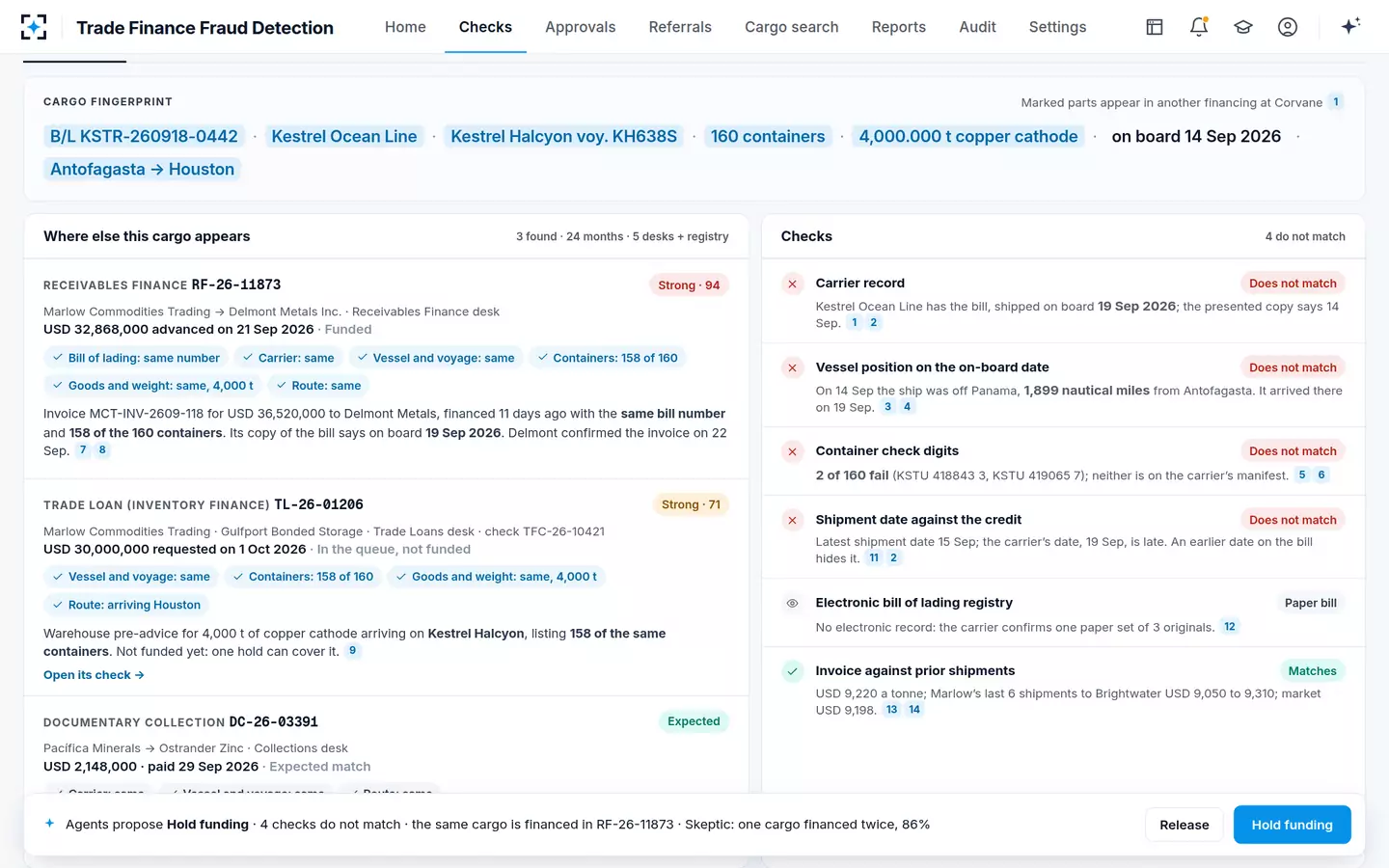
That is why matching on one key fails and matching on several parts works. Take a fictional sample case as it runs through Trade Finance Fraud Detection: a copper cargo presented under an import letter of credit on 2 October 2026 shares its bill number, carrier, vessel and voyage, goods and weight, route and 158 of its 160 containers with a receivables financing that the same bank's receivables desk had funded eleven days earlier. Two container numbers had been retyped, so an exact match on the container list would have missed it. The bank, companies and figures are invented.
Where else this cargo appears: three financings, one cargo
Across banks, no single bank's software can see another bank's files. FATF and the Egmont Group describe criminals reusing the same documents across several institutions, which makes the scheme difficult for any one institution to identify (FATF and Egmont Group, 2020). The outside answers that reach furthest are the carrier's record of how many original bills it released and to whom, and an electronic bill platform's record of who controls a bill, both covered in who can confirm a bill of lading.
How does trade finance software use vessel data?
To test the voyage the documents describe: was the named vessel at the port of loading on the on-board date, did it call where the route says, and is the transit time plausible. The Wolfsberg Group, ICC and BAFT note that sea transport can be checked against third-party vessel and voyage history databases (Trade Finance Principles, 2019 amendment). In the nickel fraud judged in 2026, a 95-day transit from Taiwan to China was noticed and financed anyway.
Ask a provider how its software treats a gap in the data. Transponder signals drop for legitimate reasons as well as illicit ones; a 2020 US Government maritime advisory notes that safety can prompt legitimate disabling of the Automatic Identification System while illicit operators disable or manipulate it to hide their movements (State, Treasury and US Coast Guard, May 2020). Software that reports a gap as a finding will flood the queue; software that ignores gaps will miss what they hide. The right behaviour is to show the gap, its length and the port calls around it, and let a person judge.
How much of a fraud check can software do on its own?
Parts of it, and the honest providers will say which. In their 2019 Trade Finance Principles the Wolfsberg Group, ICC and BAFT wrote that elements of the work, such as screening against sanctions lists, may be automated, but that the review of trade documents as a whole cannot be, and that pattern-based monitoring systems were then still under development and affordable mainly to larger banks (their words on automation are quoted in how technology can assist in combating TBML). Research has not settled the question since: a 2024 systematic review of trade-based money laundering studies found that what the literature can say about how best to combat it is limited (Tiwari, Ferrill and Allan, Journal of Accounting Literature, 2024).
The useful line runs between mechanical work and judgment. Reading every field, searching every desk, asking every carrier, placing every vessel and computing every check digit are mechanical and are exactly what people skip under time pressure. Deciding whether a cargo financed twice is fraud, an error or an expected pattern is judgment. The Wolfsberg Group's 2022 AI principles add that the bank stays responsible for decisions that rely on AI, whether built or bought, and that outputs must be explainable from their inputs (Wolfsberg Group, 2022). A provider that cannot show, for each finding, the record it relied on is asking you to take responsibility for something you cannot explain.
What integrations does trade finance fraud software need?
Read access to every system where a trade financing is requested or recorded, connections to the outside data that confirms a cargo, and one controlled write path for decisions. The table lists the connections the solution expects, with what flows in each direction.
Integrations for a pre-funding cargo check
| System | What it provides | What comes back |
|---|---|---|
| Trade finance system | Letters of credit, documentary collections and presentations | Hold or release status on the presentation |
| Loan system | Trade loans, receivables, supply chain and inventory finance | Hold or release status on the request |
| Document imaging | Bills of lading, invoices, packing lists, weight certificates | Nothing; documents are never edited |
| Carrier tracking and bill of lading registry | Carriers’ records of each bill; electronic bill lookups by number | Nothing |
| Vessel tracking data | Positions and port calls for the on-board date | Nothing |
| Case management | Existing fraud cases and referrals | Restricted referrals to investigations and the BSA Officer |
| General ledger and payments hub | Funding status | Holds posted to the suspense control; funding only after release |
The questions to ask any trade finance software provider about fraud
Ask for a demonstration on the bank's own past financings, and ask these questions of it. Each one maps to a failure that appears in a court record.
Questions for trade finance software providers about cargo checks
- Does it check every financing type at every desk before funding?
Fraud moves to the product nobody checks: receivables, inventory loans, supply chain finance.
- How does it match the same cargo when references differ?
By bill number, containers, vessel and voyage, goods and weight, dates and parties, with each match explained.
- Which outside sources does it query, and what happens when one is silent?
No answer should never become a pass.
- Can every finding be traced to the record behind it?
Examiners and courts will ask; so will the bank’s own model reviewers.
- Who can release funding, and can the same person confirm it?
The system, not policy, should enforce a second signature.
- How is a suspicious activity referral kept confidential?
Restricted to investigations and the BSA Officer; the customer side sees only that a presentation is under review.
- How is each new version tested before use?
Against past checks, with a named reviewer, and versioned so a decision can be traced to the version that informed it.
- What does the bank keep if it leaves?
Every decision, its evidence and its reasons, exportable, for the five years federal rules require.
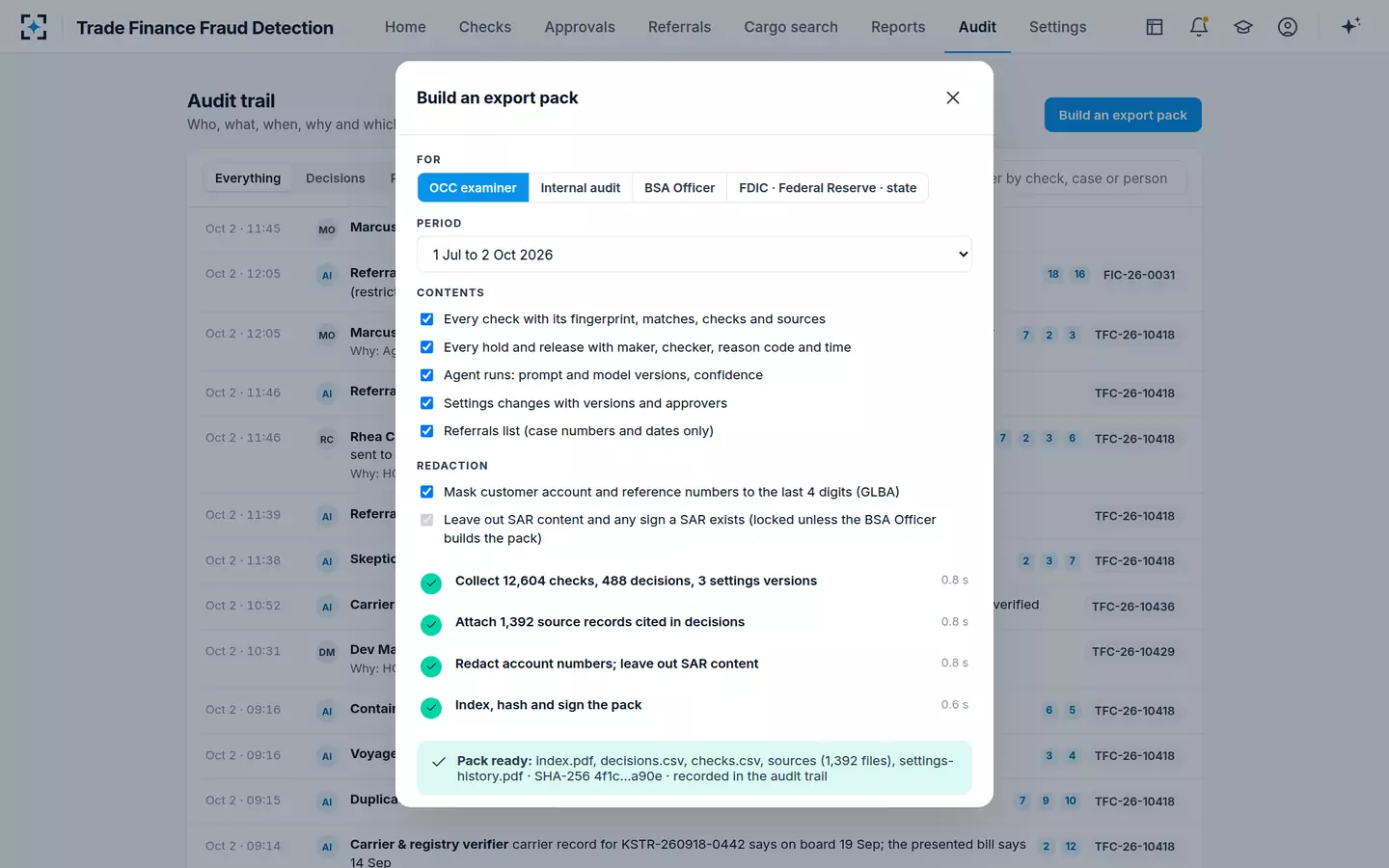
The last question is not academic. Records required under the Bank Secrecy Act rules must be kept for five years (31 CFR 1010.430), and the evidence behind a hold is often what a later SAR, insurance claim or lawsuit depends on. The solution builds an export pack for an examiner, internal audit or the BSA Officer, with account numbers masked and SAR content left out.
The evidence leaves with the bank: an export pack for the examiner
Where Trade Finance Fraud Detection fits, and where it does not
It fits beside the trade back office and the loan systems, as the pre-funding cargo check across all of them. Eight agents fingerprint each financing's cargo, search every desk and the registry, verify the bill with the carrier, place the vessel, check every container number, compare the invoice price with prior shipments, argue the innocent explanations and draft the referrals. A fraud analyst holds or releases; a credit risk officer signs every hold and every release above the bank's limit.
It does not replace the trade system, the document examiners or the sanctions screening. It does not value goods for credit; the price comparison only flags. It never contacts another bank, the customer or the presenter, so it cannot see financing of the same cargo at another bank except through the carrier's and the registry's answers. And it cannot see inside a sealed container: when the contents are the question, the answer is an inspection. How to measure whether it is working once live is set out in what the cases cost and how to measure controls.
Questions people ask
What is the best trade finance software?
There is no single best system, because the jobs differ: a back office processes instruments, a document checker compares presentations with credits, and a fraud check tests the cargo across desks and against outside data. Choose each for its job and test it on your own past files; for fraud, ask to see a duplicate caught when the references differ.
Do trade finance systems check bills of lading with carriers?
A back office generally records the bill as a document of the presentation and checks it against the credit's terms. Confirming it with the carrier, and placing the vessel on the on-board date, is a separate check that needs carrier and vessel data. Ask any provider to show which carriers it queries and what it does for the rest.
Is AI allowed to make trade finance funding decisions?
Software can propose; the bank remains responsible for the decision, and the Wolfsberg Group's 2022 principles say a bank is responsible for decisions that rely on AI whether it built or bought the system. Examiners test segregation of duties and dual controls over trade transaction processing, which is why the solution leaves every hold and release with two named people.
How long does it take to add a fraud check to an existing trade system?
That depends on how many systems hold trade financings and how quickly read access and the hold-and-release write path can be agreed and tested; no benchmark exists. A pilot on a sample of the bank's own past presentations, loans and receivables shows whether the matching and the outside checks work before any integration is built.
Can one bank's software see if a cargo is financed at another bank?
Not directly. FATF and the Egmont Group note that documents reused across several institutions are difficult for any one of them to identify. The carrier's record of how many original bills were released and to whom, and an electronic bill platform's record of control, are the outside checks that come closest.