Trade finance fraud is obtaining a letter of credit payment, a trade loan, a receivable purchase or an inventory advance against documents that misstate the goods, the shipment, the counterparties or the financing already in place. It rarely looks like fraud when it is funded: the documents are complete, consistent and regular on their face. No regulator or research body publishes a reliable aggregate of what it costs, but court and police records price individual schemes in the hundreds of millions of dollars, and recoveries are a small fraction. Botminds' Trade Finance Fraud Detection checks every trade financing before funding for the same cargo financed elsewhere at the bank and for bills, ships and containers that do not match the paper, with people deciding each hold. This page uses the public record to size the risk and sets out the measures that show whether a control like that is working.
The exposure is structural. The WTO estimates that "Up to 80 per cent of trade is financed by credit or credit insurance" (WTO, Trade finance and SMEs, 2016), and the OCC's examiners are told that in trade services "The potential for documentation fraud is high" (OCC Comptroller's Handbook, Trade Finance and Services). Every financing is a payment against paper someone else produced.
What single schemes cost, from court, police and prosecutor records
What is trade finance fraud?
It is deception aimed at a financier through the trade documents that justify a payment or a loan. The deception takes a handful of recurring forms: a bill of lading that was forged, altered, duplicated or ante-dated; goods that were never shipped, or are not what the papers describe; a receivable or sale contract that was invented or assigned twice; warehouse receipts pledged more than once or forged; and false financial statements that open the credit lines in the first place.
What separates it from ordinary credit loss is that the bank's own process approves it. In the Hin Leong case, Singapore's High Court accepted that the offences were difficult to detect because banks rely on information "often uniquely within the applicant's knowledge and difficult to independently verify". Each form, with the document it attacks, is laid out in the types of trade finance fraud.
How much does trade finance fraud cost banks?
No regulator or court has published a total. Figures that circulate for the losses after the 2020 commodity-trader collapses come from trade press and news reporting, not from regulators or courts, so they cannot be checked against an official record. What the official record does give is the cost of individual schemes, and those are large enough to make the case on their own.
The Singapore Police Force's account of Agritrade is the clearest single number: 16 financial institutions granted at least US$586.5 million of credit between January 2017 and November 2019, and the company defaulted, leaving a loss of about US$469.1 million (SPF, 17 January 2023). Its former finance chief was sentenced to 20 years. In England, the Serious Fraud Office's prosecution of Balli Steel ended with executives jailed for defrauding more than 20 banks of loans worth around half a billion dollars (SFO, December 2023; both cases are told in examples of trade finance fraud). And in the nickel case, Trafigura paid about US$500 million for cargoes that, on inspection, held low-value or worthless material ([2026] EWHC 159 (Comm)).
What is the biggest trade finance fraud on the public record?
Measured by what an official record states, the largest here are the nickel scheme in Trafigura v Gupta, at about US$500 million paid out, Balli Steel at around half a billion dollars of loans, and Agritrade at US$586.5 million of credit and US$469.1 million lost. The Qingdao metals affair of 2014 is the other name readers expect; the judgment that addresses it, Mercuria v Citibank, concerned metal invoiced at about US$272 million between two parties and decided who bore the risk, not the size of the whole loss.
Hin Leong, often named in this context, shows the limits of the record. The criminal case that reached judgment concerned two discounting applications to one bank, about US$111.7 million, among 130 charges brought; the sums owed to lenders more widely appear in reporting rather than in a court finding, and we leave them out. The cases are read in detail in examples of trade finance fraud from the court records.
Why recovery leaves most of the loss where it fell
Because the collateral was the deception. Trafigura sold the material it actually received for "just under US$10 million", around 2% of the roughly US$500 million it had paid, according to the judgment. Agritrade's lenders lost US$469.1 million of US$586.5 million in credit, about 80%. In Natixis v Marex, the financier "never acquired" title to any of the nickel it had paid for. A pre-funding control is valuable precisely because the post-funding remedies, from security to litigation, recover so little.
After the money moves, how little comes back
~2%
of what Trafigura paid, realised by selling the material it received
80%
of Agritrade’s US$586.5m in credit lost after default
our arithmetic: 469.1 ÷ 586.5
0
nickel the financier acquired title to, against 16 forged receipts
20yrs
sentence for Agritrade’s former CFO; recoveries are a separate matter
What KPIs matter before trade funding?
Measure coverage first, then speed, then outcomes. A pre-funding control that checks 60% of financings leaves the other 40% open to exactly the fraud it exists for, so the first number is the share of financings checked before funding. The second is whether checks finish inside the funding window, because a slow check gets skipped. Only then do holds, releases and confirmed frauds mean anything.
Measures for a pre-funding trade finance fraud control
| Measure | Definition | Why it matters | Sample month |
|---|---|---|---|
| Coverage | Financing events checked across every desk before funding, as a share of all events | Fraud moves to whatever is not checked | 1,047 events; target 100% |
| Decisions inside the window | Events decided within the bank’s pre-funding window | A check that misses the window gets bypassed | 98.6% (1,032 of 1,047) |
| Hold rate | Events held for a person’s decision, by reason | Shows where the risk sits and whether rules are tuned | 41 holds, 3.9% |
| Hold outcomes | Holds released with reasons and two signatures, against frauds confirmed | A hold rate with no outcomes is noise | 41 released; 0 confirmed in September |
| Cross-desk matches | Events sharing a part of the cargo with another financing, split by strength and explained matches | The duplicate-financing signal itself | 14 holds for cargo financed before |
| Checks by hand | Events where carrier or vessel data was missing and a person verified with a note | Measures the blind spots in data coverage | 3 holds for paper bills not verified |
| SAR decisions on time | Referrals decided by the BSA Officer within 30 days of detection | A federal deadline | Each referral carries its due date |
| Overrides | Releases against the agents’ proposal, with reason codes | The decision most worth reviewing later | Reported each month |
Coverage in practice: every event in one queue, with its window
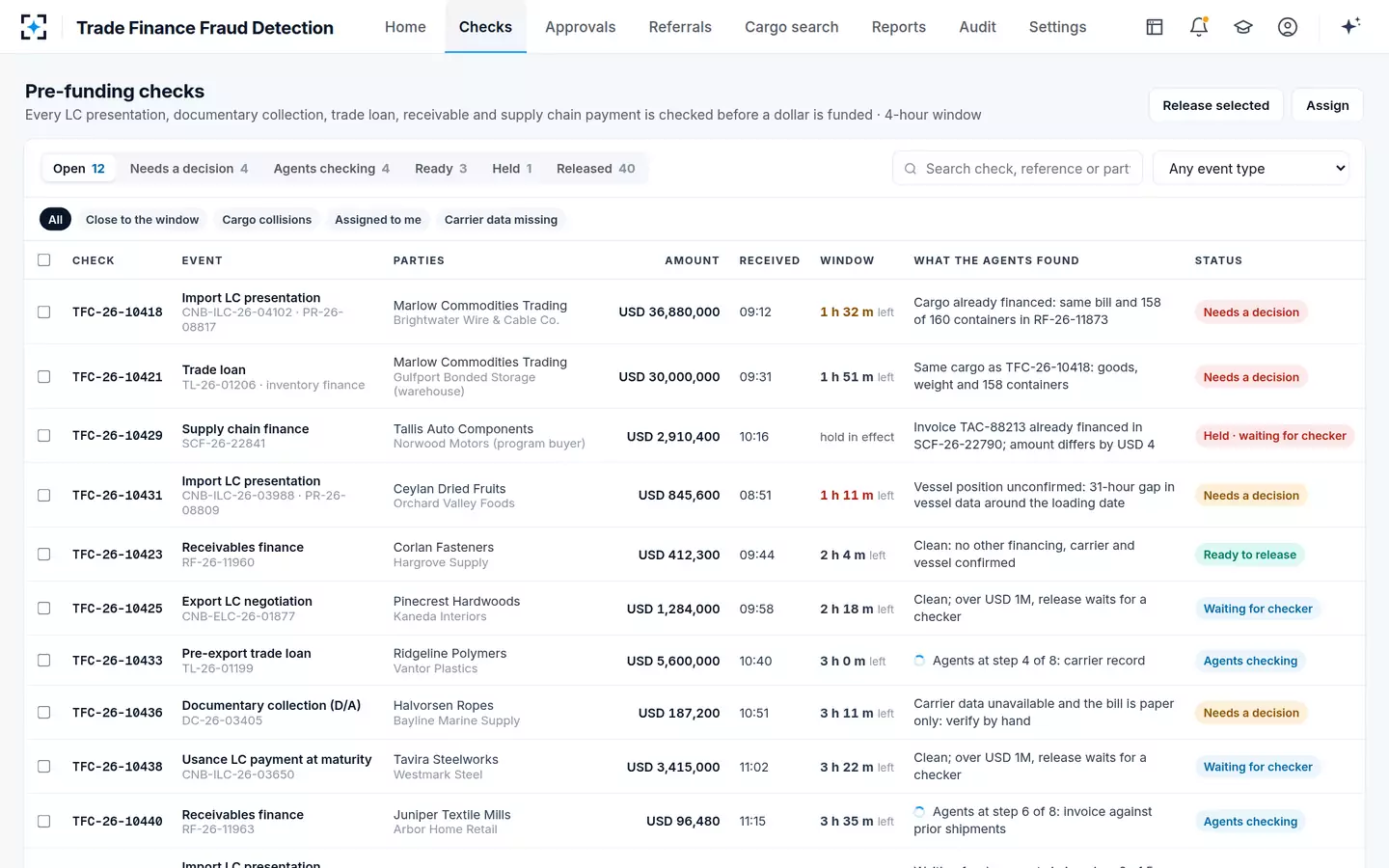
Two measures deserve particular care. A low hold rate is not good news on its own; it may mean the rules are blind. And "confirmed frauds" is a lagging, lumpy number: in the sample bank's year there were two confirmed cases, a phantom shipment in March and warehouse receipts for grain that had already left in July, and none in September. Report it, but run the programme on coverage, speed and the quality of each held decision.
How long should a pre-funding check take?
Long enough to ask the outside parties, short enough to run on every financing inside the funding window; no regulator sets a number. The solution's design target is a decision within four hours, with a warning to the analyst at three and an escalation to the head of trade operations at four. The clock that cannot move is the documentary credit's: UCP 600 gives the bank a maximum of five banking days after presentation to decide whether to honour.
Speed is a control, not a convenience. The forged warehouse receipts in Natixis v Marex were bought after managers dropped an agreed authentication step because the customer "wanted the deal done quickly" ([2019] EWHC 2549 (Comm)). A check that cannot keep pace with the business will be waived by the business.
Putting a value on the programme: a method with your own numbers
Because no regulator or independent study publishes the frequency of duplicate financing or an average loss, a credible business case is a method the bank fills in from its own book, not a borrowed percentage. The terms are four: the loss a pre-funding hold avoids, the cost of the people deciding, the cost of holding good financings, and the cost of the system.
The value of a pre-funding fraud control, term by term
Loss avoided
Exposure held on confirmed frauds × (1 − expected recovery)
Use your own confirmed cases; the public record suggests recoveries can be very low (about 2% in Trafigura).
Head of trade, CRO
Decision cost
Holds × minutes per decision × loaded hourly cost, for maker and checker
O*NET reports a 2025 median of $38.99 an hour for the occupation group that includes fraud examiners, a proxy only.
Head of trade operations
Holding good business
Released holds × hours held × funding cost and customer impact
Falls as rules are tuned; watch the hold rate and release reasons.
Relationship management
System and data
Licences, carrier and vessel data, integration and model review
Includes testing each agent version on past checks before release.
CIO, model risk
One input is often missing from these cases: the exposure that never reaches the books. In the solution's fictional sample case, a single hold on Friday 2 October 2026 stopped US$66,880,000 across an import letter of credit and a trade loan on one copper cargo worth about US$36.9 million, which was already backing a funded US$32,868,000 receivable at another desk. Requested or advanced, the cargo carried US$99,748,000 of financing. The bank, companies and figures are invented; the arithmetic is what a bank should be able to produce for each of its own holds.
What the monthly report should show the head of trade
It should show, on one page, how many financings were checked, how many were held and why, how many were decided inside the window, and how the trend has moved. The sample report below does that for September 2026.
The monthly report: events checked, holds by reason, inside the window
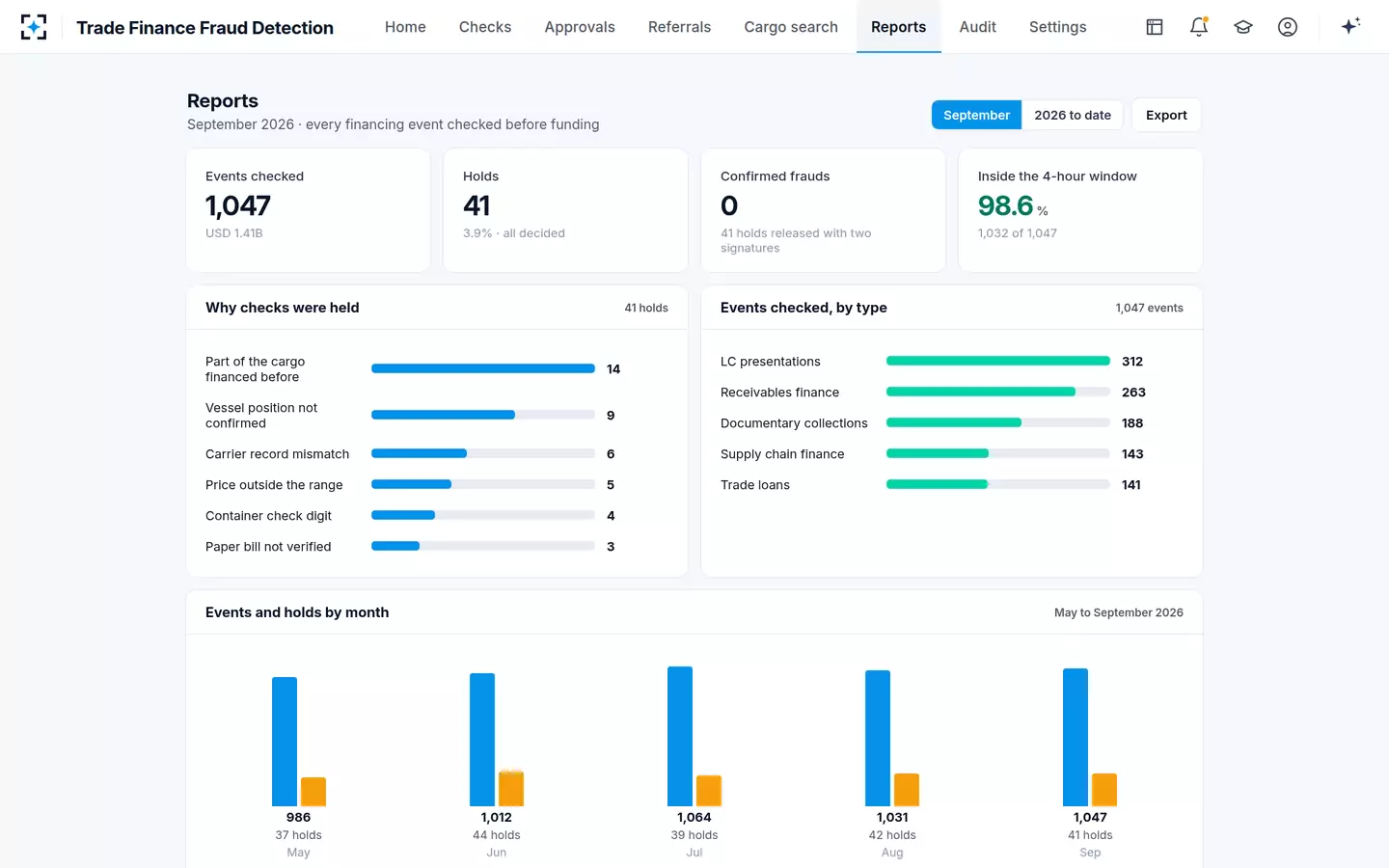
Reading it is a management exercise. Fourteen of 41 holds were cargo already financed somewhere in the bank, so the duplicate-financing search is earning its place. Nine were vessel positions that could not be confirmed, which points to data coverage rather than fraud. The 1.4% of decisions outside the window are the ones to read individually. The design choices behind those holds, including who may release one, are set out in why the maker never releases the funding.
What a board or risk committee should ask of the programme
- Is every financing type covered at every desk?
Letters of credit, collections, trade loans, receivables, supply chain and inventory finance.
- What share was decided inside the window, and what happened to the rest?
Late decisions are where controls get waived.
- Why were financings held, and how were holds resolved?
Reasons and outcomes, with two signatures on every release.
- Where is the data thin?
Carriers with no data, vessels with gaps, paper bills verified by hand.
- Were SAR decisions made inside 30 days?
Reported without revealing any individual SAR.
- How are the agents tested before a new version goes live?
Against past checks, with a named reviewer signing.
Questions people ask
What did Agritrade's lenders lose?
According to the Singapore Police Force, 16 financial institutions granted Agritrade International at least US$586.5 million of credit between January 2017 and November 2019; the company defaulted and their loss came to around US$469.1 million. The former CFO was convicted of deceiving the lenders about whether the group's financial statements were audited and was sentenced to 20 years in January 2023.
Is trade finance fraud increasing?
We found no regulator or research body that publishes a time series of trade finance fraud losses, so a trend claim cannot be supported from official data. A 2024 systematic review of research on trade-based money laundering, a neighbouring field, found the literature limited. Banks are better served by measuring their own holds and confirmed cases over time.
What is a good hold rate for pre-funding fraud checks?
There is no benchmark; it depends on the book and the rules. A rate that is very low may mean the rules are blind, and one that is high with no confirmed cases may mean they are badly tuned. In the solution's fictional sample month the rate was 3.9% of 1,047 events, with every hold decided and none confirmed as fraud.
Who should own trade finance fraud KPIs?
The head of trade operations owns the window, coverage and hold handling; the credit risk function owns the second signature; investigations and the BSA Officer own outcomes and SAR timeliness. Model risk owns the testing of any agent or model before a new version is used.
Do fraud losses in trade finance fall on the bank or the customer?
Often on the financier. Receivables, trade loans, repos and inventory advances are repaid from a sale or secured on goods that, in a fraud, may not exist: in Natixis v Marex the financier never acquired title to the nickel it paid for, and Agritrade's lenders lost about 80% of the credit they had granted.