A phantom shipment is a trade transaction in which the shipping documents describe goods that were never shipped: an exporter and importer, or a trader on its own, produce a bill of lading, an invoice and the supporting papers for a cargo that does not exist, and a bank finances or pays against them. FATF and the Egmont Group define it as a form of misrepresented quantity, "'phantom shipments' where no product is moved at all" (FATF and Egmont Group, 2020). The paper usually passes document examination, because it is copied from real voyages. What proves or disproves a phantom shipment is the physical record: whether the named ship was at the port of loading on the date stated, whether its carrier issued the bill, and whether the containers exist. Botminds' Trade Finance Fraud Detection gathers that evidence for every trade financing before it is funded, so a fraud analyst can hold the money before it moves.
What a phantom shipment's bill says, and what the record says
What the bill of lading says: Issued and signed by the named carrier or its agent.
What the outside record can show: The carrier has no such bill, or a different one for this number.
What the bill of lading says: Shipped on board the named vessel at the loading port on a stated date.
What the outside record can show: The vessel was elsewhere that day, or never called at the port.
What the bill of lading says: A list of container numbers, seals and weights.
What the outside record can show: Numbers that fail their check digits, or are not on the carrier’s manifest.
What the bill of lading says: Quantity and quality as described.
What the outside record can show: No inspector’s report, no certificates, no loading documents.
What the bill of lading says: A route from loading to discharge port.
What the outside record can show: A transit time no real voyage on that route would take.
What is a phantom shipment?
It is the extreme case of misstating how much was shipped: the quantity is zero. FATF's 2006 typology, the first official account, describes how "an exporter may not ship any goods at all, but simply collude with an importer" so that the documents for the "so-called 'phantom shipment'" are processed, and it warns that "Banks and other financial institutions may unknowingly be involved in the provision of trade financing for these phantom shipments" (FATF, Trade Based Money Laundering, 2006). People also call it a ghost shipment or a fictitious shipment.
FATF writes about it as a money-laundering technique, where buyer and seller collude to justify a payment. For a lender the same scheme is a fraud: a trader borrows against a cargo it never loaded, or sells a receivable on goods that never left the port. The documents are identical either way; what differs is who loses.
Why phantom shipment paperwork passes document examination
Because it is built from real voyages. FATF and the Egmont Group describe a criminal organisation that "may execute legitimate shipments of cosmetic goods, creating enough valid documentation to allow for subsequent phantom shipments and misuse of that previous documentation", and note that one real shipment may "create a veneer of legitimacy" for later invoices against shipments that never happen (FATF and Egmont Group, 2020).
A Singapore court record shows the method from the inside. In the Hin Leong letters of credit, a Hin Leong employee's statement, admitted in evidence, explained that the founder would "tell me to use the shipment details of a particular physical shipment to prepare the shipment documents with the different counterparties" (Winson Oil v OCBC [2024] SGCA 31). The vessels were real, the ports were real and the dates plausible. A bank examining those papers against the credit had nothing to refuse.
Phantom shipment examples from the court record
The clearest example is also a success. On 15 April 2020, OCBC rejected Winson's first presentation under a Hin Leong letter of credit "on the basis that there was no physical cargo that was shipped on the Ocean Voyager". Winson then presented documents for a different vessel, explaining the change as an internal mix-up. Both banks refused to pay; the court found no cargo had been shipped as described and the copy bills were forgeries, and Winson never received original bills or "any loading documents such as an independent inspector's report". Because the banks asked before paying, the loss stayed with the beneficiary.
Other examples show what happens when nobody asks. A US freight forwarder and others prepared documents "falsely stating that goods and equipment had been purchased and shipped to buyers in Mexico" for about 13 loans guaranteed by the Export-Import Bank of the United States; all defaulted, and the agency paid US$17.9 million in claims (DOJ, 27 May 2011). An Illinois supplier admitted presenting fraudulent bills of lading under letters of credit and, on various occasions, shipping "worthless scrap materials" instead of the goods sold (US Attorney, N.D. Illinois, 2013), the half-way house between a phantom shipment and misdescribed goods. The wider casebook is in examples of trade finance fraud.
Winson Oil: one afternoon, one circle, no cargo
2:54pm
Hin Leong sells gasoil to Trafigura, 27 March 2020
3:19pm
Trafigura sells the same quantity to Winson
5:10pm
Winson sells it back to Hin Leong, financed by two letters of credit
0
cargo shipped as the letters of indemnity described, the court found
How do banks detect phantom shipments?
By testing the voyage, not the documents. A bank cannot inspect cargo, but it can ask four outside sources whether the shipment happened: the carrier, which knows whether it issued the bill and loaded the goods; the vessel's position history, which shows whether the ship was at the loading port; the container numbering, which shows whether the boxes are real; and the loading evidence, an inspector's report or certificates, which a real shipment usually produces. The Wolfsberg Group, ICC and BAFT point to third-party vessel and voyage history databases as one way to verify sea transport (Trade Finance Principles, 2019 amendment).
The evidence ladder for a shipment, from weakest to strongest
- The documents agree with each other
Necessary and nearly worthless against a phantom shipment: forgers copy consistently.
- The transit time is plausible
In the nickel case, a 95-day transit from Taiwan to China was noticed and financed anyway.
- The containers exist
Owner code and check digit compute; the numbers are on the carrier’s manifest.
- The vessel was there
Position at the loading port on the on-board date, and a port call that fits.
- The carrier issued this bill
Same number, same shipper, same date, same containers, and how many originals went to whom.
- Someone saw the goods
An independent inspection at loading, or at the warehouse, for quantity and quality.
Can AIS data prove a shipment?
It can prove where a ship was, not what it carried. The Automatic Identification System, as a 2020 US Government advisory describes it, "is an internationally mandated system that transmits a vessel's identification and navigational positional data via high frequency radio waves", and the international safety convention requires certain vessels on international voyages to operate it "at all times with few exceptions" (State, Treasury and US Coast Guard, May 2020). The same advisory warns that vessels in illicit trade switch it off or manipulate it, broadcasting a different identity, which it calls spoofing, and that safety reasons can also justify disabling it.
So vessel data answers a precise question: was this ship at this port on this date? A ship that was 1,900 nautical miles away disproves a bill. A ship that was in port does not prove the cargo was loaded; that takes the carrier's record and, for contents, an inspection. And a gap in the signal proves nothing either way, which is why a check should show it to a person rather than score it.
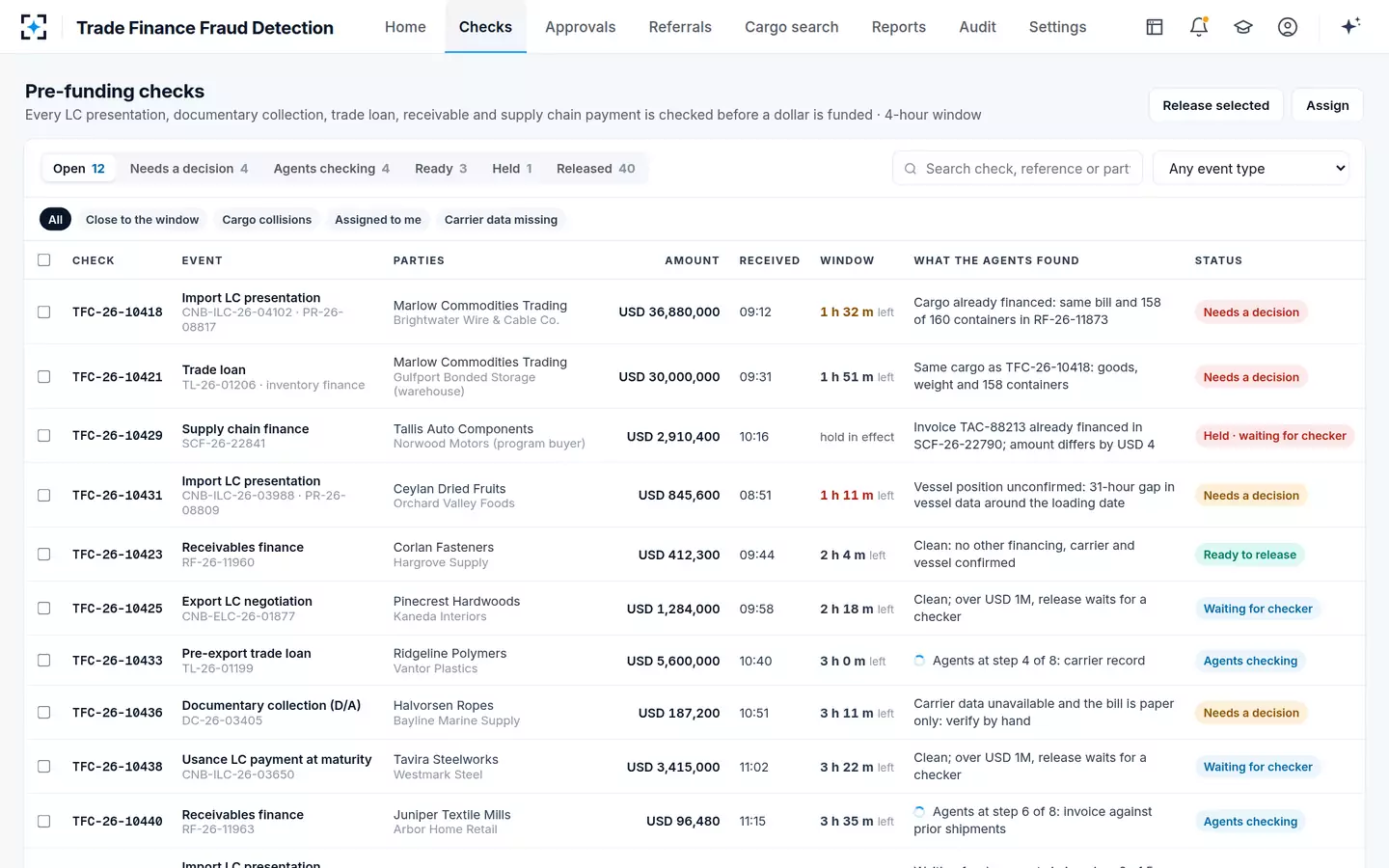
Take a fictional sample case as it runs through Trade Finance Fraud Detection. On 2 October 2026, a bank's pre-funding queue holds twelve open checks. One, a US$845,600 import letter of credit for dried fruit, shows a 31-hour gap in the vessel's data around the loading date: the agents mark the position unconfirmed and leave the decision to the analyst, with 1 hour 11 minutes left in the funding window. Another, a copper presentation, has a vessel position that contradicts its bill outright. The bank, companies and figures are invented.
A signal gap goes to a person; it is never scored as fraud
What is a container number check digit?
It is the eleventh character of a shipping container number, computed from the first ten, so that a mistyped or invented number usually fails the arithmetic. A container number is a three-letter owner code, an equipment category letter (U for freight containers), a six-digit serial number and the check digit. The method is set out in the international container identification standard, ISO 6346, which is sold rather than published free; the description below is our own.
Each letter takes a value from 10 upward, skipping 11, 22 and 33 (A is 10, B is 12, K is 21, S is 30, U is 32), and each digit keeps its own value. Each of the ten values is multiplied by 2 raised to its position, from 1 for the first character to 512 for the tenth. The products are added, the sum is divided by 11, and the remainder is the check digit, with a remainder of 10 written as 0.
Working one check digit: KSTU 418843 3
Sum 4,653 · remainder after dividing by 11: 0 · check digit should be 0 · presented: 3
A failed check digit is strong evidence of a typing error or an invented number, but a valid one proves only that the number is well formed. The next test is whether the number is on the carrier's manifest for that voyage. In the sample, the two failing numbers were also missing from the manifest, and a copy of the same bill behind an earlier financing carried the valid numbers, which is what turned a typing error into evidence that one bill had been altered.
What a phantom shipment costs, and why asking first is cheaper
When the bank asks before funding, a phantom shipment costs it a refusal and a court case it can win, as the banks did in Winson. When it does not, the record shows losses of the full amount: US$17.9 million of Export-Import Bank claims on the Alamo Freight Forwarding loans, all of which defaulted. The difference is a question put to the carrier and the ship's track on the day of the presentation.
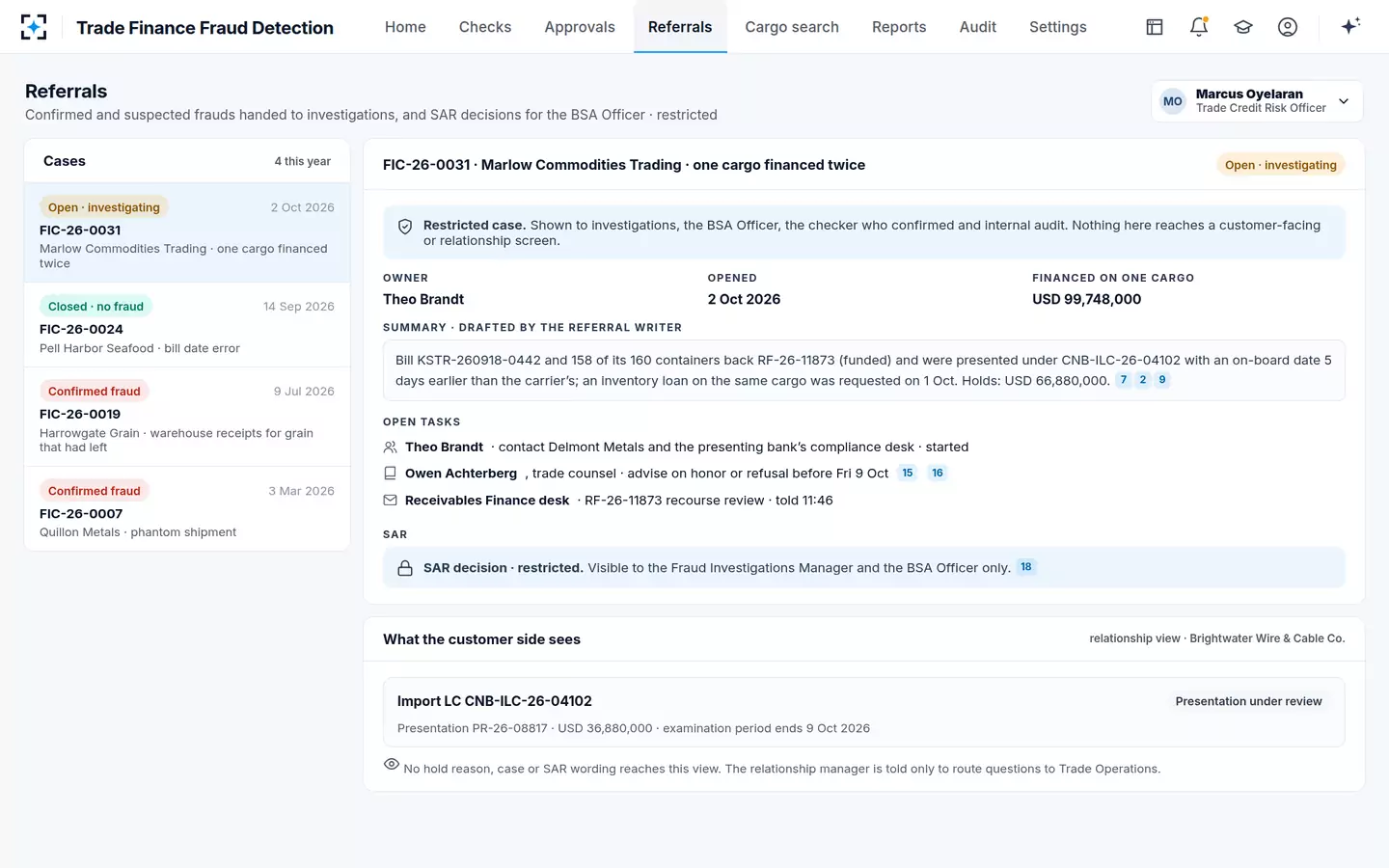
In Trade Finance Fraud Detection, those questions are asked for every financing: the Carrier and registry verifier compares the carrier's record, the Voyage checker places the vessel on the on-board date with its port calls cited, and the Container and number checker computes every check digit and compares the manifest. The fictional sample bank's referrals include a confirmed phantom shipment earlier in the year, opened as a restricted case for investigations. When the bill is real but its date is not, the questions change slightly; they are in the ante-dated bill of lading.
A confirmed phantom shipment, and a case restricted to investigations
Some things the agents cannot do. They cannot see inside a sealed container, so a shipment of scrap described as wood pulp passes every voyage check and needs an inspection; they flag when one is due. They cannot see a cargo financed at a different bank. And where a carrier has no data, they report the gap and ask a person to verify by hand; silence is never treated as proof that the ship sailed.
Questions people ask
What is a ghost shipment?
Another name for a phantom shipment: documents for a shipment that never took place. FATF uses "phantom shipment" in its 2006 and 2020 typologies.
What is FATF's definition of a phantom shipment?
FATF and the Egmont Group describe phantom shipments, in their 2020 report, as a form of over- or under-shipment "where no product is moved at all", relying on collusion between importer and exporter. FATF's 2006 typology describes an exporter that ships nothing and colludes with the importer so the shipping and customs documents are processed anyway.
Can a phantom shipment have a real bill of lading number?
Yes. Forgers copy real voyages, and a forged bill may reuse a real bill number from another shipment. That is why confirming that a number exists is not enough: the carrier's record has to match every field, including the shipper, date, containers and the number of originals released.
Is a phantom shipment the same as a short shipment?
No. A short shipment sends less than the documents state; a phantom shipment sends nothing. FATF groups both under the misrepresentation of quantity. A short shipment is caught by weights and inspection; a phantom shipment can also be caught by the carrier and vessel records, because there was no loading at all.
How do you check a container number?
Compute its check digit from the first ten characters, letters valued from 10 skipping multiples of 11, each value multiplied by 2 to the power of its position, the total divided by 11, and compare the remainder with the eleventh character. Then confirm the number appears on the carrier's manifest for that voyage.