Bill of lading verification means confirming, before money moves, that a bill of lading was issued by the carrier it names, for the vessel, voyage, on-board date and containers it states, and that the same bill is not already backing another financing. A bank cannot do this from the paper. The bank examining a presentation judges whether documents appear to comply with the credit and, under UCP 600, disclaims responsibility for whether they are genuine. The facts sit with other parties: the carrier or its agent, the vessel's own position history, the container records, an electronic bill platform where one exists, and the bank's other desks. Botminds' Trade Finance Fraud Detection is software that puts those questions to each source before a trade financing is funded; a fraud analyst then holds or releases, and a credit risk officer signs.
The volume is why it rarely happens by hand. A single trade finance transaction, the UK Government noted when it legislated for electronic trade documents, "typically involves 20 entities and between 10 and 20 paper documents, totalling over 100 pages" (Explanatory Notes to the Electronic Trade Documents Act 2023). A bank that wants to verify one bill of lading is asking parties it has no contract with, often in another time zone, while a funding window runs.
The paper a bank is asked to trust
16m
original bills of lading issued by ocean carriers in 2020
DCSA estimate
>99%
of those bills issued on paper, not electronically
30
parties a package of shipping documents can pass between
50
sheets of paper commonly found in one bill-of-lading package
What does bill of lading verification confirm?
It confirms four things the paper only asserts: that the named carrier issued this bill, that the details on the copy in front of you match the carrier's own record, that the vessel and containers named could have carried the goods on the date shown, and that this bill is not already pledged to someone else. Each claim fails in a different way, so each needs a different confirmer.
A bill of lading does three jobs at once. It is the carrier's receipt for goods shipped, it evidences the contract of carriage, and it is a document of title: the Uniform Commercial Code's definition of a document of title expressly includes a bill of lading, alongside a warehouse receipt. Fraud attacks each job separately. A forged bill was never issued by anyone. An altered bill is a genuine bill with a field changed, typically the on-board date or a container number. A duplicate set is a second "original" printed for a cargo that already has one. A genuine bill can also be true about the boxes and false about their contents.
That last case is the one carriers' wording anticipates. Under the US federal bills of lading law, a carrier is liable for goods it did not receive "by the date shown in the bill" or that do not match the bill's description, but not where the bill is qualified by words such as "said to contain" or "shipper's weight, load, and count" (49 U.S.C. § 80113). On a container bill those words are common. The carrier's record can confirm that 160 sealed containers went on board; it often cannot confirm what is inside them.
Why the bank examining the documents cannot verify the bill from the paper
Because documentary credit practice is built so that it does not have to. UCP 600, which governs a credit because the credit incorporates it, asks the examining bank whether a presentation appears on its face to comply, judged from the documents alone, within a maximum of five banking days. Article 34 then says that "A bank assumes no liability or responsibility for the form, sufficiency, accuracy, genuineness, falsification or legal effect of any document" (ICC, UCP 600). A forged bill that is regular on its face is a complying document.
The disclaimer protects the bank in its role under the credit. It does not protect the bank as a lender whose collateral is the cargo. The OCC states the consequence for examiners plainly: because the bank deals only in documents and never inspects the goods, a letter of credit leaves the importer exposed to a dishonest exporter (OCC Comptroller's Handbook, Trade Finance and Services; quoted in types of trade finance fraud). Document examination answers whether the paper matches the credit. Verification answers whether the paper matches the world, and that question has to be put to someone outside the presentation.
Who can confirm a bill of lading is genuine?
The party that created the underlying record: the carrier for the bill, the vessel's track for the voyage, the container operator's numbering for the boxes, the platform for an electronic bill and the warehouse for a receipt. Each can confirm some fields and none can confirm all of them. The table sets out who answers what, and the limit of each answer.
Who can confirm what about one bill of lading
| Who | Can confirm | Cannot confirm | How a bank asks |
|---|---|---|---|
| The carrier named on the bill | That it issued this bill number; shipper, vessel, voyage, ports, on-board date, container numbers; how many originals it released and to whom | What is inside sealed containers, where the bill is qualified "said to contain"; whether the cargo is financed elsewhere | The carrier’s tracking or bill lookup, or a written request to the carrier or its port agent |
| A forwarder or other issuer | Its own house bill and its booking with the ocean carrier | Anything independently: in Trafigura v Gupta a forwarder printed a second set | Only alongside the ocean carrier’s own record |
| Vessel position history | Where the named vessel was on the on-board date, and its port calls | Which cargo is aboard; a signal gap is not proof either way | Licensed vessel-tracking data with port-call history |
| Container numbering | That a number is well formed (owner code, check digit) and on the carrier’s manifest | Contents and weight | Compute the check digit; compare with the manifest |
| An electronic bill platform | Who controls an electronic bill now, and its transfer history | Paper bills; the truth of what the issuer wrote | A lookup on the platform the bill was issued on |
| The bank’s own other desks | Whether the same bill, containers or invoice already back a receivable, a loan or another credit | Financing at other banks | A search of every desk’s files by each part of the cargo, not by one reference |
The carrier's answer is the one that most often settles a forged bill, and the clearest example is in a Singapore judgment. In Winson Oil Trading v OCBC, two banks refused to pay under letters of credit for gasoil from a circular trade with Hin Leong. The liquidators of the shipping company whose stamp the bills bore wrote that it "did not issue the aforesaid BL", and a Hin Leong employee's statement, admitted in evidence, explained how such bills were made: the founder had staff copy the details of one real shipment onto documents for different counterparties (the statement is quoted in what is a phantom shipment), and the bills arrived already stamped, "I do not know where they get these stamps from" ([2024] SGCA 31). Every field on those bills described a real ship. Only the shipowner could say the bill was not its own.
Industry guidance points the same way for the voyage. The Wolfsberg Group, ICC and BAFT note that "sea transport can be verified through the use of a well-known third party vessel and voyage history database service" (Trade Finance Principles, 2019 amendment). That confirms the ship and the route, not the bill: a forger who copies a real voyage passes the vessel check and fails only at the carrier.
Can a freight forwarder issue a bill of lading? Yes, and one printed a second set
Yes. UCP 600 accepts a transport document issued by a party other than a carrier, owner, master or charterer, provided it meets the requirements of the transport-document articles, so a forwarder's bill can be a complying document. What a forwarder cannot be is an independent confirmer of a bill it printed itself.
The English Commercial Court's January 2026 judgment in Trafigura v Gupta shows why. Trafigura paid about US$500 million for containers sold as LME-grade nickel that held low-value or worthless material, and the judge found duplicate bills in several of the trades. Maersk's own investigation, quoted in the judgment, concluded that "only one set of Bills of Lading was issued. However, without Maersk's authorisation, [Techies] printed two sets of the Bills of Lading", Techies being the seller's Singapore agent and forwarder. Another company had meanwhile presented Maersk with "what appear to be original BLs in relation to these very Cargoes". For those three cargoes Trafigura had paid US$11,306,154.30, and the court valued what it received at zero, "because the goods were never delivered to it" ([2026] EWHC 159 (Comm)).
"Only one set of Bills of Lading was issued."
Maersk's investigation, quoted in Trafigura v Gupta [2026] EWHC 159 (Comm)
A bank holding one of those sets would have found the problem by asking the ocean carrier how many originals it released and to whom. It would not have found it by asking the forwarder, or by examining the paper, which was a complete and regular set.
Is there a bill of lading registry?
Not for paper bills, which made up more than 99% of the roughly 16 million originals issued in 2020: each carrier keeps the record of the bills it issued. Electronic bills are different: they live on platforms that track who controls each bill, and the UK's 2023 Act recognises an electronic trade document only where a reliable system ensures one person can control it at a time.
So a "registry check" means two different things. For an electronic bill, the platform can say whether the bill exists, who controls it now and whether it has been surrendered. For a paper bill, the carrier is the registry: it can say how many originals it issued and to whom it released them. A useful verification step treats a negative answer from an electronic platform as information, not clearance: if the platform holds no record, the next question goes to the carrier. The legal mechanics, and what electronic bills do and do not prevent, are set out in electronic bill of lading software and double financing.
How do you verify a bill of lading before funding? Eight checks in order
Start inside the bank, then go outside: search your own desks for the cargo, then confirm the bill with its issuer, then test the voyage and the containers. The order matters because the internal search is fast and decisive, while outside answers can take time and some never come.
Bill of lading verification before funding, in order
- Read the bill into its parts
Bill number, carrier, vessel and voyage, ports, on-board date, every container number, goods and weight, shipper and consignee. Every later check runs on these parts.
- Search every desk for any part, not only the bill number
Receivables, trade loans, inventory finance, supply chain finance and other credits. A retyped container number defeats an exact-match search.
- Ask the carrier whether it issued this bill
Compare its record field by field: on-board date, containers, consignee, number of originals and to whom they were released.
- If the bill is electronic, ask the platform who controls it
If it holds no record, the carrier confirms a paper set instead.
- Place the vessel on the on-board date
Position and port calls from vessel-tracking data. Show a gap in the signal; do not treat it as a finding.
- Check every container number
Owner code, check digit and presence on the carrier’s manifest.
- Compare count and weight
Containers against tonnage, invoice price against the parties’ prior shipments.
- Treat no answer as open, never as a pass
A carrier with no data means a documented check by hand, with a note, before release.
Take a fictional sample case as it runs through Trade Finance Fraud Detection: on Friday 2 October 2026 a fictional importer's bank receives documents under a letter of credit for 4,000 tonnes of copper cathode, US$36,880,000 at sight, shipped on the vessel Kestrel Halcyon from Antofagasta to Houston. The bank, people, carrier and vessel are invented. The presented bill says on board 14 September. The carrier's record has the same bill number and shipper, but shipped on board 19 September, four days after the credit's latest shipment date of 15 September. Two container numbers differ from the carrier's record by two swapped digits. And a copy of the same bill, with the carrier's dates, already backs a receivables financing of US$32,868,000 at the same bank's receivables desk, funded on 21 September.
One bill, three versions, side by side
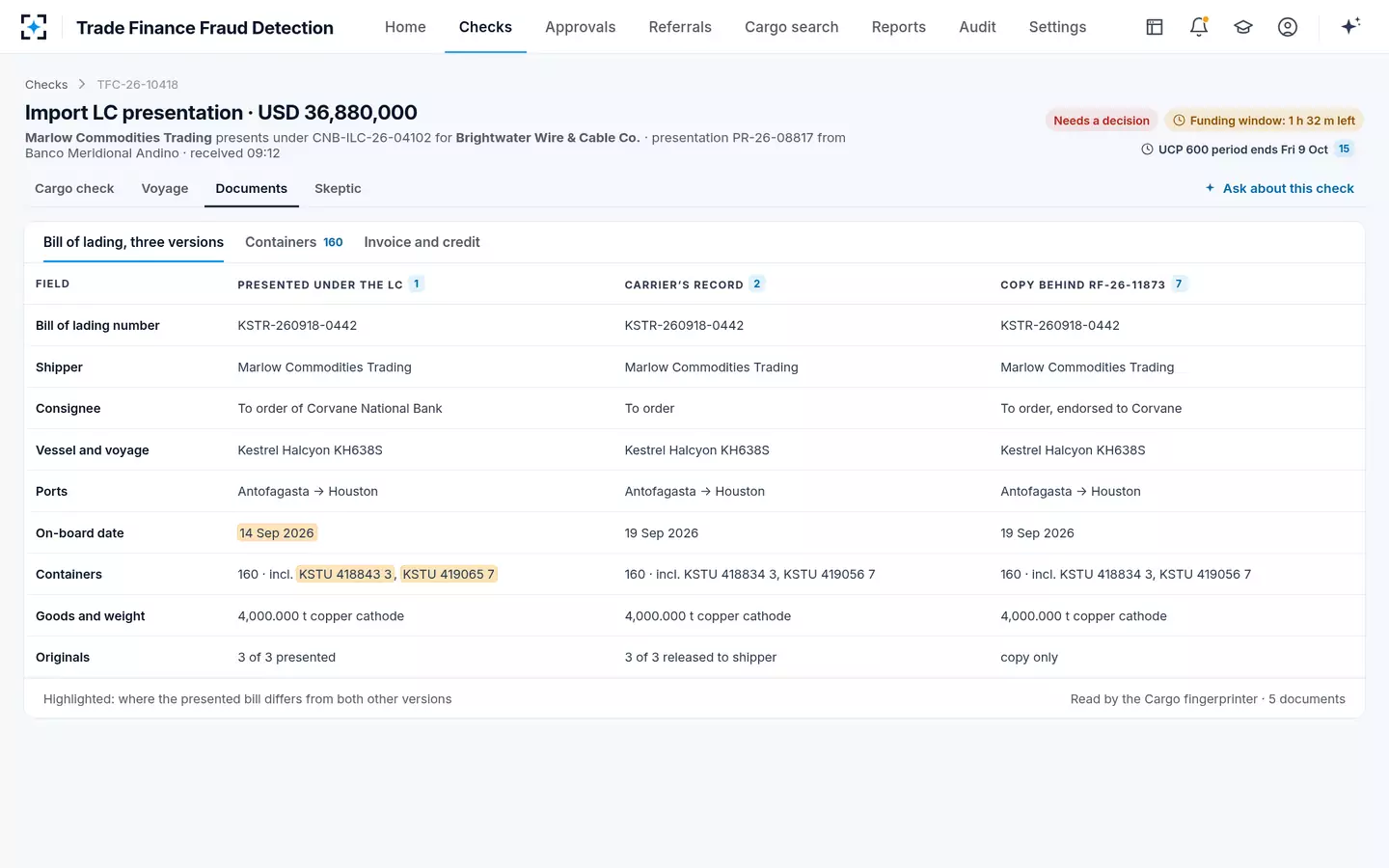
None of those three findings was visible in the presentation. The bill was regular on its face and, judged against the credit alone, its on-board date was inside the shipment period. The date and the containers were exposed by the carrier; the earlier financing by the bank's own receivables desk.
The sample morning: four minutes of checks, then people decide
What to look for in bill of lading verification software or a service
Judge any tool or service by whether it can say who confirmed each field and what it does when nobody answers. A bank can verify bills in three ways: an operations analyst who calls and emails carriers, a third-party verification service, or software connected to carriers' records, vessel data and the bank's own systems. Each can be good. They fail in the same places.
Questions to ask a bill of lading verification provider
- Which carriers can it query directly, and what happens for the rest?
A carrier with no data feed is common. The answer should be a documented check by hand, not a silent pass.
- Does it compare every field, or only confirm that the number exists?
A forged copy of a real bill carries a real number. In the sample, only the date and two containers differed.
- Does it ask how many originals were released, and to whom?
That is the question that finds a second printed set.
- Does it search your own desks by each part of the cargo?
Bill number, containers, vessel and voyage, goods and weight, so a retyped number still matches.
- How does it treat a gap in vessel data?
It should show the gap and its length, and leave the conclusion to a person.
- Who decides, and is the evidence kept?
A named person should hold or release, with each source cited and kept for the examiner.
Speed is the other test. Verification that cannot finish inside the funding window will be skipped, and the court records show what skipping looks like. In the forged warehouse receipts case decided in 2019, Marex's managers had agreed to courier original receipts to the warehouse for authentication, then emailed scans instead "as CHH wanted the deal done quickly", accepting that the main security feature could not be checked from a scan (Natixis v Marex [2019] EWHC 2549 (Comm)). All sixteen receipts the financier bought turned out to be forgeries. The same pressure applies to a bill of lading, which is why a check has to be fast enough to run on every financing, not only the suspicious ones. How a second person signs off on the result is covered in why the maker never releases the funding.
Where Trade Finance Fraud Detection fits, and where it stops
Trade Finance Fraud Detection runs bill of lading verification as part of a pre-funding check on every LC presentation, documentary collection, trade loan, receivable and supply chain finance request. A Cargo fingerprinter reads the bill, invoice, packing list and weight certificate into one line; a Duplicate financing finder searches every desk over 24 months and the electronic bill of lading registry the bank connects to; a Carrier and registry verifier compares the carrier's record; a Voyage checker places the ship; a Container and number checker computes every check digit. Each finding links to its source.
The cargo check: one fingerprint, every source, one decision
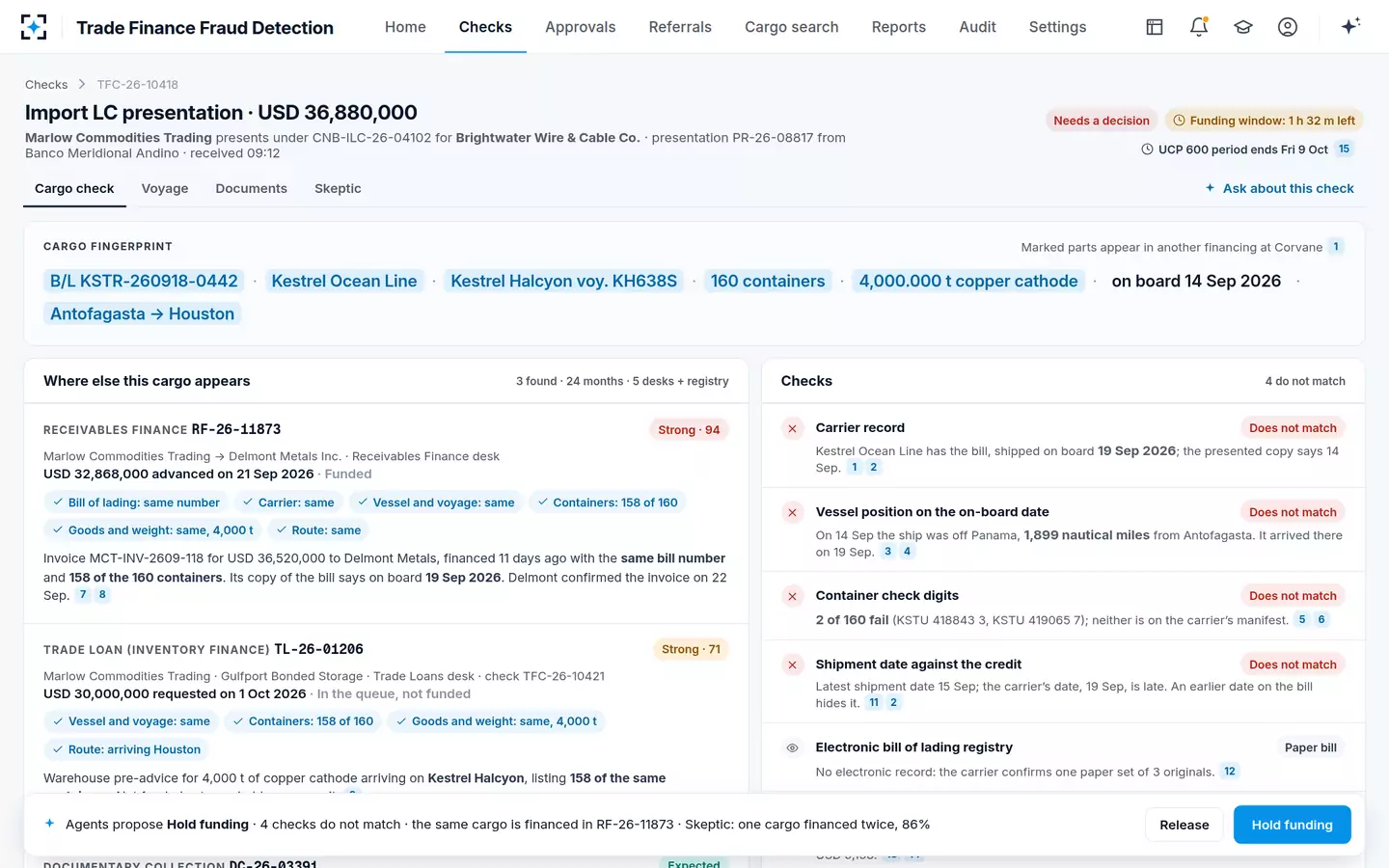
Its limits are deliberate. The agents read only the bank's own records, the registry and the carriers', vessel and container data the bank licenses; they never contact the customer, the presenter's contacts or another bank, so financing of the same cargo at a different bank stays out of view. They cannot see inside a sealed container: a bill that is true about the boxes and false about the goods, as in the nickel case, needs an inspection, and the solution can only flag that one is due. Where a carrier has no data, the check shows the error, retries and asks for a check by hand with a note; it never treats silence as a pass. And it does not replace document examination under UCP 600. The examiner still decides whether the presentation complies; this adds whether the cargo is real and unfinanced. When the carrier's date and the bill's disagree, the questions that follow are on the ante-dated bill of lading.
Questions people ask
How can I check if a bill of lading is genuine online?
Many carriers let you look up a bill or booking number online, which confirms that the number exists and shows the voyage. It does not confirm that the copy in your hand is unaltered, so compare every field with the carrier's record: on-board date, container numbers, consignee and number of originals. In Winson Oil, the bills copied a real ship's details and were exposed only when the shipowner said it had not issued them.
Does a copy bill of lading prove shipment?
No. In Winson Oil the seller's letters of indemnity rested on copy non-negotiable bills, front page only, and it never received the originals or any loading documents; the court found the bills were forgeries and that no cargo was shipped. A copy proves that someone holds a document, not that the carrier issued it or that the goods went on board.
Who issues a bill of lading?
A carrier, the master, or a named agent signing for either, and UCP 600 also accepts a transport document issued by another party, such as a forwarder, if it meets the transport-document articles. For verification, the party that matters is the ocean carrier whose vessel carries the goods, because its record is the one a forged or duplicated bill will not match.
What does "said to contain" mean on a bill of lading?
It means the carrier vouches for the packages it received, not for what is inside them. Under 49 U.S.C. § 80113, a US carrier is not liable for misdescription where the bill is qualified with words such as "said to contain" or "shipper's weight, load, and count" and it does not know whether the goods conform. For sealed containers, contents are confirmed by inspection, not by the bill.
How long does bill of lading verification take?
No regulator or research body publishes a benchmark, and a carrier's answer can be instant, where it offers an online lookup, or open-ended, where only a written request will do. In the fictional sample above, the agents' checks finished four minutes after the documents arrived, and the whole decision, including a second signature, inside the 4-hour target window.
Can bill of lading verification find the same cargo financed at another bank?
Not on its own. A bank sees only its own files, and FATF and the Egmont Group note that documents reused across several institutions are difficult for one institution to identify. An electronic bill platform can show who controls a bill, and the carrier can say to whom originals were released, which are the two outside answers that reach beyond one bank.