An ante-dated bill of lading, also written antedated or anti-dated, is a bill of lading that states a shipped-on-board date earlier than the day the goods were actually loaded, almost always so that a late shipment appears to meet a letter of credit's latest shipment date or the sale contract's shipment period. It passes document examination because nothing on its face is wrong: the date is plausible, the signatures are the carrier's or its agent's, and every field agrees with every other document. The falsehood is about the world, not the paper. That is why Botminds' Trade Finance Fraud Detection, software that checks trade financings for fraud before they are funded, does not test the date against the credit at all; it tests it against the carrier's own record and against where the named ship actually was that day.
Valid is not accurate: where an ante-dated bill sits
Complies with the credit · true about the cargo
A clean presentation
Shipped on time, dated as shipped. Pay.
Complies with the credit · false about the cargo
The ante-dated bill
Shipped late, dated early. Regular on its face, so it passes examination; only the voyage exposes it.
Discrepant · true about the cargo
An honest late shipment
Dated as shipped, after the latest shipment date. A discrepancy the applicant may waive or the bank refuses.
Discrepant · false about the cargo
A clumsy forgery
Wrong on its face and wrong in fact. Refused at examination; the fraud question comes second.
What is an ante-dated bill of lading?
It is a bill dated before the event it records. A bill of lading is the carrier's receipt for goods shipped, and its on-board date is meant to record when the goods went on board the named vessel at the port of loading. An ante-dated bill moves that date earlier; a post-dated bill moves it later. Both are false statements by whoever signs or issues the bill, and the ante-dated one is far more useful to a fraudster, because most deadlines in trade run to a latest date of shipment.
The false date can come from three places. A carrier or its agent can issue it knowingly at the shipper's request, as in the House of Lords case below. A shipper or forwarder can alter a genuine bill, changing only the date on a copy. Or a forger can produce the whole bill, copying a real vessel's name and voyage. Each leaves a different trail, and only the first is consistent with the carrier's own record.
Does a backdated bill of lading comply with the letter of credit?
Yes, if it is regular on its face. UCP 600, which governs a credit because the credit incorporates it, asks the bank to decide from the documents alone whether they appear to comply, and article 20 treats the on-board notation's date, or failing one the bill's issue date, as the date of shipment. An on-board date before the latest shipment date therefore satisfies the credit. Article 34 completes the picture: the bank assumes no liability for "the description, quantity, weight, quality, condition, packing, delivery, value or existence of the goods" a document represents (ICC, UCP 600).
The honest version of the same shipment would not have complied. A bill dated truthfully after the latest shipment date is a discrepancy, which the issuing bank can refuse and which the applicant may choose to waive. The ante-dated bill takes that choice away from the buyer and the bank. It is the clearest case in trade finance where a document can be valid for every examination purpose and still be false.
Why the on-board date is worth forging: shipment, presentation, price and payment
Because the date drives more than one deadline. In a documentary credit it decides whether shipment met the latest shipment date, and it starts the presentation clock: under UCP 600 article 14(c), a presentation including an original bill of lading must be made within 21 calendar days after the date of shipment, and in any event before the credit expires. Move the date and both tests change.
In commodity trades the date can also set the price and the payment date. The letter of credit at the centre of the 2023 Singapore case Crédit Agricole v PPT Energy Trading priced crude oil at the Brent average "on the bill of lading date plus a" premium, and payment "was due 60 days after the bill of lading date" ([2023] SGCA(I) 7). Where the price is struck on the bill's date, an ante-dated bill can also choose a more favourable market. The date on a bill of lading is not a formality; it is a term of the deal.
Is backdating a bill of lading fraud? The bitumen cargo a London bank paid for
Yes, when it is done to obtain payment, and the leading English authority shows how far the liability reaches. In Standard Chartered Bank v Pakistan National Shipping Corporation, a credit for Iranian bitumen sold to a Vietnamese buyer required: "Shipment must be effected not later than 25 October 1993". Loading was delayed. The shipping agents and shipowners agreed with the seller's managing director to issue bills of lading dated 25 October, and did so on 8 November, before the goods had been shipped; loading "was not in fact finished until 5 December". The bills were presented on 9 November and the confirming bank paid US$1,155,772.77 on 15 November (House of Lords, [2002] UKHL 43).
Standard Chartered v PNSC: the bill's date, the payment and the loading
- Loading delayed; no bill25 Oct to 8 Nov
- Bill issued, presented, paid8 Nov to 15 Nov
- Paid; still loading15 Nov to 5 Dec
The judgment is unsparing about what the false date meant. The covering letter claiming the documents were all those the credit required "was false to the knowledge of Mr Mehra because he had himself arranged for the backdating of the bill of lading", and it was agreed that "if there had been no bill of lading or SCB had known that it was falsely dated, payment would not have been made". The trial judge had found that Mr Mehra "dishonestly presented antedated and false bills of lading". The confirming bank sued the shipowners, the agents, the seller and its director in deceit; the shipowners settled for US$1.7 million before the hearing.
Who is liable for an antedated bill of lading?
Everyone who joined in the deceit, including the individuals who signed. The House of Lords restored judgment against the seller's managing director personally, rejecting the argument that he had acted only for his company: "No one can escape liability for his fraud by saying 'I wish to make it clear that I am committing this fraud on behalf of someone else and I am not to be personally liable.'" It also held that "there is no common law defence of contributory negligence" to deceit, so the bank's own failings, including a false statement its employee made to the issuing bank about the presentation date, did not reduce its claim.
In the United States the federal bills of lading statute, which covers among others bills issued by common carriers for shipments from a state to a foreign country (49 U.S.C. § 80102), reaches the same conduct from two directions. A carrier is liable to a holder who gave value in good faith relying on "the shipment being made on the date shown in the bill" (49 U.S.C. § 80113). And a person who, knowingly or with intent to defraud, "falsely makes, alters, or copies a bill of lading subject to this chapter" faces a fine and up to five years' imprisonment (49 U.S.C. § 80116). Liability after the fact is real; it is also slow, and the money has already moved.
Can a bank detect a false on-board date?
Yes, but not from the presentation. Two outside sources can contradict the date: the carrier's own record of when it shipped the goods, and the vessel's position history, which shows whether the named ship was at the port of loading on the date stated. Neither is part of document examination, and both have to be asked before funding to be of use.
Take a fictional sample case as it runs through Trade Finance Fraud Detection. A bill of lading presented under an import letter of credit on Friday 2 October 2026 states that 4,000 tonnes of copper cathode went on board the Kestrel Halcyon at Antofagasta on 14 September. The credit's latest shipment date is 15 September, so the presentation complies. The carrier's record has the same bill number and shipper, but shipped on board 19 September. Vessel-tracking data place the ship off Panama at noon on 14 September, 1,899 nautical miles from Antofagasta, heading south; it arrived there on 19 September. The bank, carrier, vessel and companies are invented.
Two outside facts against one date on the bill
14 Sep
on-board date on the presented bill
15 Sep
latest shipment date in the credit
19 Sep
on-board date in the carrier’s record
1,899nm
between the ship and the loading port on 14 Sep
The voyage check: the bill's date against the ship's position
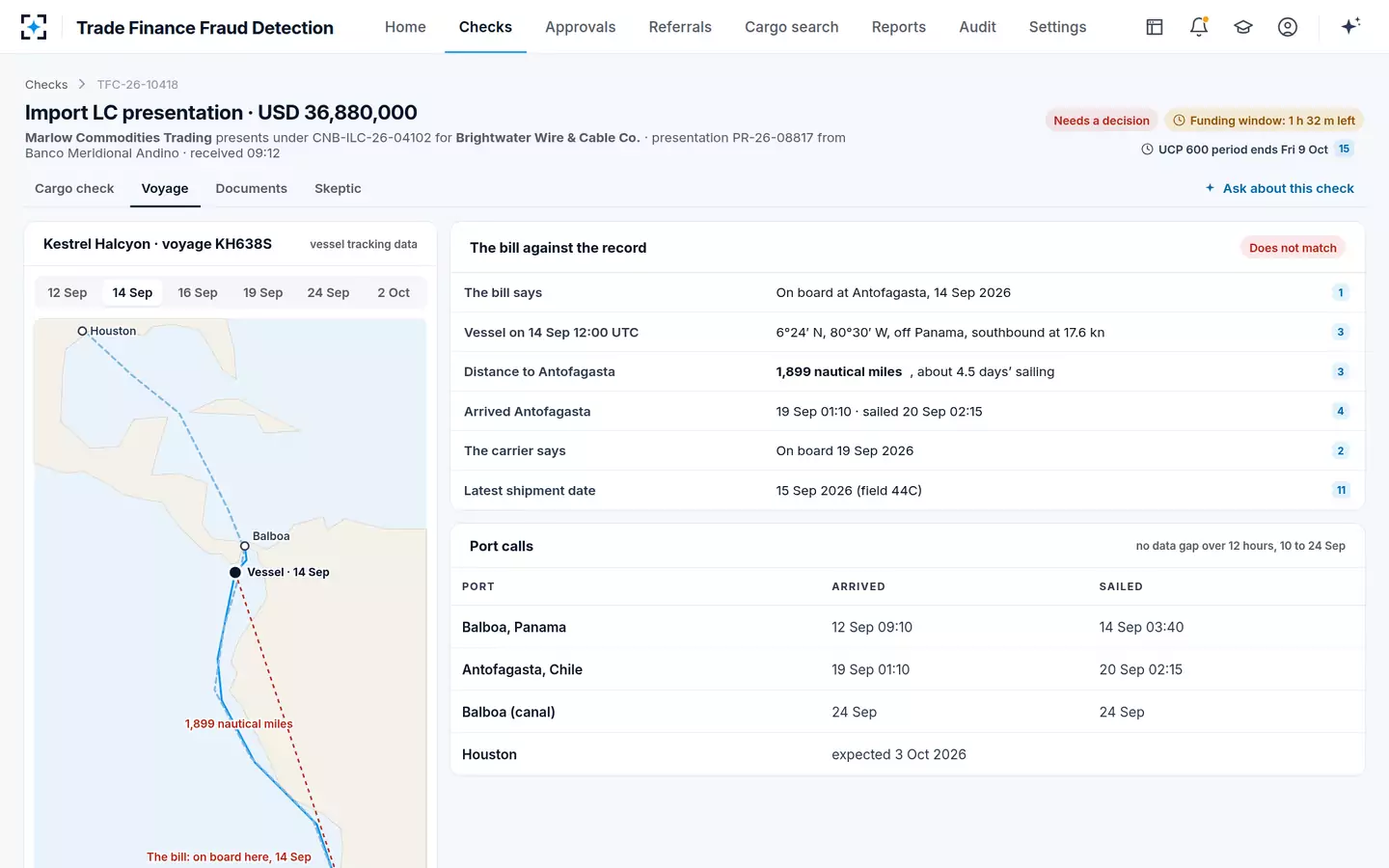
The position record matters as much for what it does not show. A ship's transponder signal can drop for legitimate reasons, and a 2020 US Government advisory notes that while "safety issues may at times prompt legitimate disablement" of the Automatic Identification System, vessels engaged in illicit activity may also disable or manipulate it (State, Treasury and US Coast Guard, May 2020). A gap is therefore something to show a person, never a finding on its own; the solution's Voyage checker is built not to conclude on a gap alone. Here there was no gap: the ship was simply somewhere else. How the same evidence proves or disproves that any voyage happened at all is the subject of what a phantom shipment is.
Valid is not accurate: the test runs against the voyage, not the credit
The examiner's question and the fraud question use the same document and different references. The examiner compares the bill with the credit and the other documents; the fraud check compares it with records the presenter does not control. A bank that measures its document checking only by how many discrepancies it catches will score an ante-dated bill as a clean pass.
Same bill, two questions
Document examination (UCP 600): The credit, the other documents and international standard banking practice.
The voyage check before funding: The carrier’s record, the vessel’s position history, the container manifest.
Document examination (UCP 600): Is it on or before the latest shipment date?
The voyage check before funding: Was the ship at the port of loading that day, and does the carrier record the same date?
Document examination (UCP 600): Do they appear to be the carrier’s, master’s or a named agent’s?
The voyage check before funding: Does the carrier confirm it issued this bill?
Document examination (UCP 600): Are they consistent with the other documents?
The voyage check before funding: Do their check digits compute, and are they on the carrier’s manifest?
Document examination (UCP 600): Complies.
The voyage check before funding: Contradicted by the carrier and the ship.
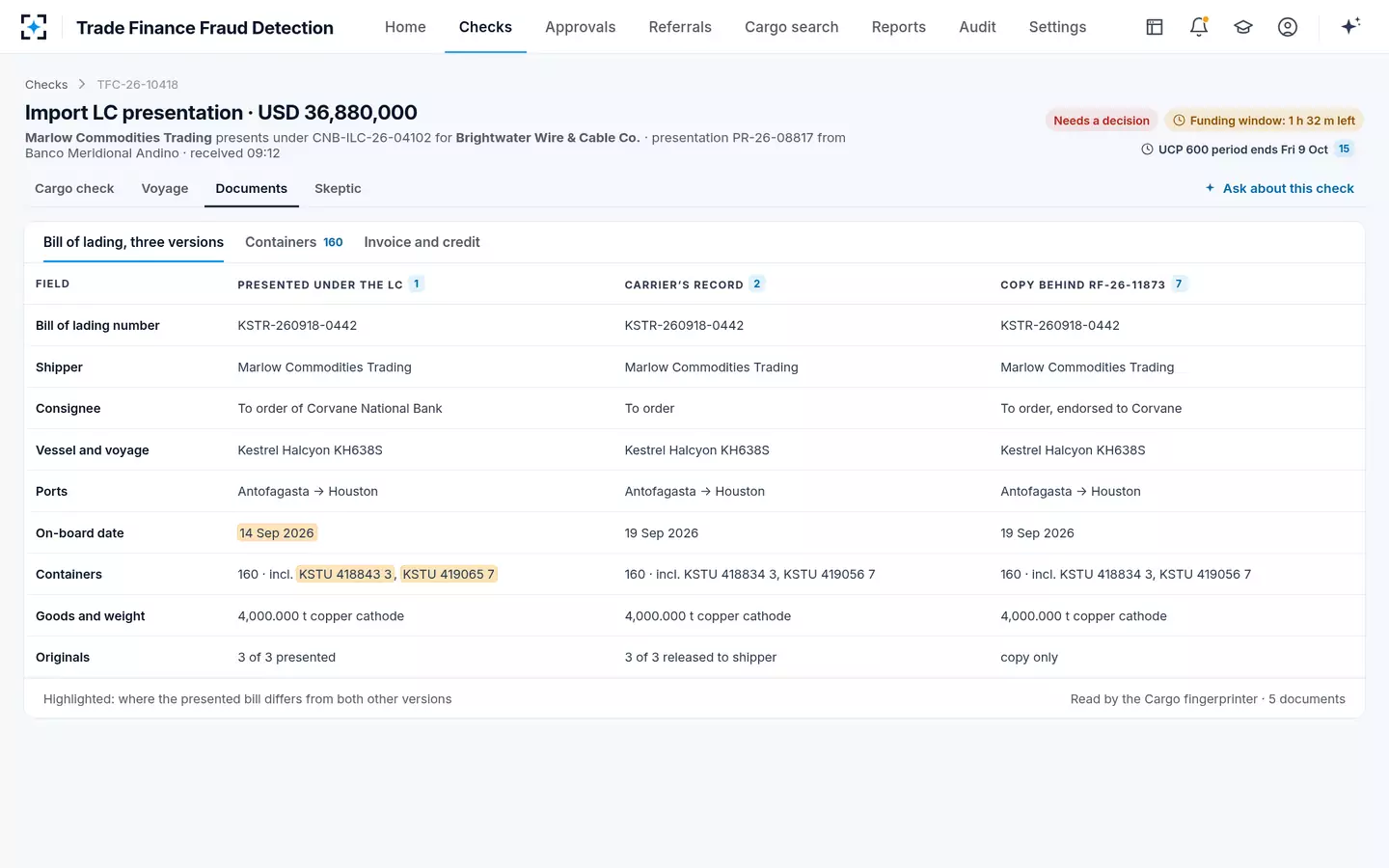
In the sample, the presented bill also disagrees with a copy of the same bill already financed as a receivable at the bank, which carries the carrier's 19 September date. That second financing is what turns a late shipment into something worse, one cargo financed twice, and it is covered in the types of trade finance fraud.
The presented bill against the carrier's record and an earlier copy
What a bank does when the dates disagree
It stops the money first, then establishes the facts, then takes legal advice on the credit. In the solution, the fraud analyst holds funding with reason codes, here a carrier record that does not match and a vessel not at the port on the on-board date, and a credit risk officer confirms. The Skeptic agent ranks the innocent explanations alongside the guilty ones. In the sample, a carrier clerical error on the on-board notation is ranked at 5%, and the one record that would disprove the fraud, a second genuine bill for a 14 September loading, does not exist: the carrier says there is none.
When the bill's date and the voyage disagree
- Hold funding before anything else
An ante-dated bill is a reason to stop; a release can follow if an innocent explanation is proved.
- Ask the carrier for its on-board date in writing
And whether it issued any other bill for the same goods.
- Check whether the ship could have been there
Position and port calls for the days around the stated date; note any signal gap separately.
- Rule out the innocent explanations explicitly
A carrier’s clerical error, a second genuine shipment of the same size, a corrected bill. Name the record that would prove each.
- Search every desk for the same cargo
In the sample, a copy carrying the true date already backed a receivable at another desk.
- Take counsel on honour or refusal inside the UCP 600 period
Fraud is a legal exception to the duty to pay, argued on evidence; the examination period does not stop for the investigation.
- Refer to investigations and the BSA Officer
A suspicious activity report decision is due within 30 days of detection, and stays confidential.
Speed is the reason to do this before funding. Once the bank has paid, its remedies are the ones the bitumen case illustrates: years of litigation against parties who may have no assets. What the agents found, and what the analyst decided, are recorded with each source, so the evidence for counsel and for any later claim exists from the morning it was found. How a second person reviews that hold is set out in why the maker never releases the funding.
Questions people ask
What is the difference between an ante-dated and a post-dated bill of lading?
An ante-dated bill states an on-board date earlier than the true loading date; a post-dated bill states a later one. Both misstate the date of shipment, which UCP 600 article 20 takes from the on-board notation or the issue date. Ante-dating is the common fraud because letter of credit and sale contract deadlines run to a latest shipment date.
Can a carrier be liable for issuing an antedated bill of lading?
Yes. In Standard Chartered v PNSC the shipowners and agents who issued bills dated 25 October 1993 for goods not yet shipped were held liable in deceit at trial and settled for US$1.7 million. Under US federal law, 49 U.S.C. § 80113 makes a carrier liable to a good-faith holder who relied on the shipment being made on the date shown in the bill.
Does a vessel tracking gap prove a bill of lading is false?
No. A US Government maritime advisory of May 2020 notes that the Automatic Identification System can be legitimately disabled for safety reasons, and poor transmission also occurs. A gap is a reason to ask the carrier and look at port calls; a position far from the loading port on the stated date, as in the sample above, is evidence.
Is an antedated bill of lading a discrepancy under UCP 600?
Not if it is regular on its face. The examining bank judges the documents alone, and a date before the latest shipment date complies. The falsehood is a fraud question, decided on evidence outside the documents, and a bank considering refusal on that ground takes legal advice within the five-banking-day examination period.
Can an on-board date be corrected legitimately?
Yes: a carrier can correct a genuine clerical error in its own record, and the correction should match the carrier's record and the vessel's movements. The test is consistency with independent evidence. In the solution's fictional sample book, an earlier case of a bill date error was investigated and closed as no fraud.