Fraud risk in trade finance is the risk that a bank funds a letter of credit, a collection, a trade loan or a receivable against documents describing goods that do not exist, were never shipped as stated, or already back another financing. The OCC calls it what it is for a bank: operational risk, "as trade activities remain heavily paper-based, leading to a significant potential for documentation errors and fraud" (OCC Comptroller's Handbook, Trade Finance and Services). The control that answers it is old and specific: one person prepares the decision, a different person approves it, and neither can do both. Botminds' Trade Finance Fraud Detection is built on that maker-checker line, with agents doing the searching and checking that people cannot fit into a funding window, and named people making every hold and release.
The control points in the solution's sample settings
$1m
release amount above which a second person must sign
and every hold, and every release of a hold
4h
pre-funding window, with a warning at 3 hours
design target
30days
to file a SAR after initial detection (31 CFR 1020.320)
5years
record retention for each decision (31 CFR 1010.430)
What are the fraud risks in trade finance?
Five risks account for the frauds in the public record: documents that are forged or altered, the same cargo financed twice, goods that were never shipped or are not what the papers say, receivables and contracts that were invented, and controls that existed on paper but were skipped under time pressure. The first four are schemes. The fifth is why the schemes worked.
The OCC's handbook puts the documentary risk bluntly: "The potential for documentation fraud is high in international trade transactions." The double-financing risk sits partly outside any one bank's view. FATF and the Egmont Group describe criminals reusing the same trade documents "across multiple FIs, making it difficult for one institution to identify it" (FATF and Egmont Group, Trade-Based Money Laundering: Trends and Developments, 2020). And the invented-receivable risk is the hardest of all to see: in the Hin Leong case, Singapore's High Court agreed that such offences were difficult to detect because the false representations "went towards the very existence of sales contracts", which was "something that only the purported counterparties could confirm" (Lim Oon Kuin v Public Prosecutor [2026] SGHC 47). The schemes themselves are catalogued in the types of trade finance fraud.
Why are letters of credit vulnerable to fraud?
Because a letter of credit pays against documents, and the bank that pays is not required, or equipped, to test whether the documents are true. Under UCP 600 the bank examines whether the presentation appears to comply on its face. That is the instrument's strength, a payment promise insulated from disputes about the goods, and its exposure: a forged bill of lading that is regular on its face is a complying document.
The OCC adds a second reason, volume: "Because a commercial letter of credit requires a great number of documents, even relative to most other areas of banking, it is more susceptible to documentary fraud". Every extra document is another place a value can be altered, and every document examined only against the credit is a document no one checked against the world. The narrow legal exit, the fraud exception, comes after the fact and is argued in court; a control has to work before the money moves.
What examiners test: segregation of duties, dual control and the same goods financed twice
The OCC's examination procedures for trade finance ask directly for the two controls this page is about. Examiners are told to evaluate whether "adequate controls (e.g., data security, physical access controls, customer authorization, authentication, segregation of duties, and dual controls) have been established for transaction processing". For bankers' acceptances they are told to check that procedures prevent a customer from obtaining further credit on the same merchandise, which is the duplicate-financing test in examiner's language.
Neither control is new; what has changed is what each person can see. A checker who signs a release on a summary cannot tell whether the cargo has already funded a receivable at another desk. A maker who has 50 presentations in a day cannot call every carrier. Dual control is only as good as the information the second person is given, and the cases below show the second look either missing or deciding without the facts.
What is maker-checker in trade operations?
Maker-checker means that the person who prepares and enters a decision cannot also approve it: a second, authorised person reviews the same evidence and confirms or returns it, and the system will not let one person play both parts. In trade operations the "decision" is usually a release of funds, a hold on a financing, an override of a discrepancy or a change to a limit.
Who does what around one held financing in Trade Finance Fraud Detection
Today
Works about 50 pre-funding checks a day; the documents comply, but she cannot see whether the cargo does.
With agents
Opens each check with the cargo fingerprint, every other financing of it and the carrier, vessel and container results cited, then holds or releases with reason codes.
Still theirs: The hold or release decision and its note
Today
Signs every hold and every release over $1 million, and has to rebuild the reasons before he can sign.
With agents
Sees the maker, the reason codes and the cited findings on one screen, and confirms or returns with a reason.
Still theirs: The second signature; can never be the maker
Today
Starts a fraud case from a phone call and rebuilds the evidence himself.
With agents
Receives the case with the evidence, the linked financings and the timeline, and can search any cargo across every desk.
Still theirs: The investigation and the customer contact
Today
Decides whether a SAR is filed within 30 days of detection, while no one outside the case may learn it exists.
With agents
Receives a restricted SAR decision referral with its due date, never visible on a customer-facing view.
Still theirs: The SAR decision
The cases where the second look did not happen
In the largest recent judgment, the red flags were seen and the funding went ahead anyway. In Trafigura v Gupta, decided by the English Commercial Court in January 2026, Trafigura paid about US$500 million for containers sold as nickel that held low-value or worthless material. The judgment quotes Trafigura's own operations staff raising concerns about voyage lengths and calling overdue buy-back payments "Red Flags". When a bill showed a 95-day transit from Taiwan to China, one employee wrote: "luckily Citi accepted this one, with little suspicion, but we might not get as lucky in the future" ([2026] EWHC 159 (Comm)). The judge found the scheme rested on a simple premise: it would work for as long as Trafigura took the shipping documents at their word and did not inspect the cargo (examples of trade finance fraud quotes the finding).
The observation was made; nobody with authority had to decide on it. That is the gap a maker-checker design closes, and it is a design question rather than a diligence one. A flag that lives in an email can be noted and forgotten. A flag that becomes a reason code on a held financing has to be released, with a written reason, by someone accountable, and then confirmed by someone else.
The Hin Leong case shows the other side of the same gap. The bank discounted invoices under a "silent" arrangement, so the named buyers would not ordinarily learn of the financing, and the documents behind two applications for about US$111.7 million were fabricated. Nobody inside the bank could have confirmed the contracts from the documents. Separation of duties does not create information; it only ensures someone independent judges the information there is. The full casebook, from Qingdao to the nickel containers, is in examples of trade finance fraud from the court records.
Can AI release trade funding?
It should not, and in Trade Finance Fraud Detection it cannot. The industry's own standard-setters have been explicit about the limits: in their 2019 Trade Finance Principles, the Wolfsberg Group, ICC and BAFT wrote that while parts of the work, such as screening names against sanctions lists, may be automated, the review of trade documents as a whole cannot be, and that banks will rely on a mix of automated and manual controls (Trade Finance Principles, 2019 amendment; see how technology can assist in combating TBML). The Wolfsberg Group's 2022 principles on AI and machine learning add that a bank remains responsible for decisions that rely on such systems, whether it built them or bought them, and that results must be explainable from their inputs (Wolfsberg Principles for Using AI and ML in Financial Crime Compliance).
The honest answer to the 2019 statement is to agree with it and divide the work accordingly. What can be automated is the mechanical part that people skip under time pressure: reading every field, searching every desk, asking every carrier, placing every vessel, computing every check digit. What cannot is the judgment on the result. The agents propose and cite; a person decides; a second person confirms.
What the agents do, and what stays with named people
The agents (propose and cite): Read the bill, invoice, packing list and weight certificate into one cargo fingerprint; a field they cannot read is marked "not read".
The people (decide and sign): The analyst sees every field with its source page and can correct the reading.
The agents (propose and cite): Search every desk over 24 months and the registry for any part of the cargo, and score each match.
The people (decide and sign): The analyst decides whether a match is the same cargo or an expected one.
The agents (propose and cite): Compare the carrier’s record, place the vessel, compute container check digits, compare the price with prior shipments.
The people (decide and sign): The analyst weighs the findings; a check by hand needs a note.
The agents (propose and cite): The Skeptic ranks how a fraud would have to work, argues the innocent case and names what would disprove each.
The people (decide and sign): The analyst can ask the Skeptic back, and decides.
The agents (propose and cite): Never. A finding below the 0.80 confidence threshold shows as “needs a person”.
The people (decide and sign): The analyst holds or releases; a credit risk officer confirms every hold, release of a hold and release over $1 million.
The agents (propose and cite): Draft the hold memo, the fraud referral, the SAR decision referral and the request to trade counsel; send nothing.
The people (decide and sign): Investigations and the BSA Officer decide what is filed and what anyone is told.
Who signs what in Trade Finance Fraud Detection
Every hold, every release of a hold and every release above the bank's limit carries two names, and the system refuses the same name twice. The flow below follows one financing from the documents arriving to the case opening; green steps are people.
One financing, from documents in to a confirmed hold
Agent
Fingerprinter, finder and verifiersWrite the cargo as one line, search every desk and the registry for any part of it, check the carrier, the vessel position and every container number, compare the price.
Never: Edit a document, guess a field, or contact the customer, another bank or the presenter’s contacts
Agent
SkepticRanks the explanations, innocent ones included, and names the record that would disprove each.
Never: Decides, or states a fraud as fact
A person decides
Fraud analyst (maker)Holds or releases with reason codes and a note the agents drafted.
Never: Confirms her own hold
A person decides
Credit risk officer (checker)Confirms or returns, seeing the maker, the reason codes and every cited finding.
Never: Acts as maker on the same financing
A person decides
Investigations and BSA OfficerRun the case and the SAR decision, restricted to them.
Never: Let a SAR appear on a customer-facing view
Take a fictional sample case as it runs through the solution. On Friday 2 October 2026, documents arrive at 09:12 under an import letter of credit for 4,000 tonnes of copper cathode worth US$36,880,000. By 09:16 the agents have found the same bill and 158 of its 160 containers behind a receivables financing funded eleven days earlier at the same bank, a carrier record showing a later on-board date, and two container numbers that fail their check digits. A trade loan on the same cargo is waiting in another queue. The bank, people and companies are invented.
The maker's hold: reason codes, the linked loan and a drafted note
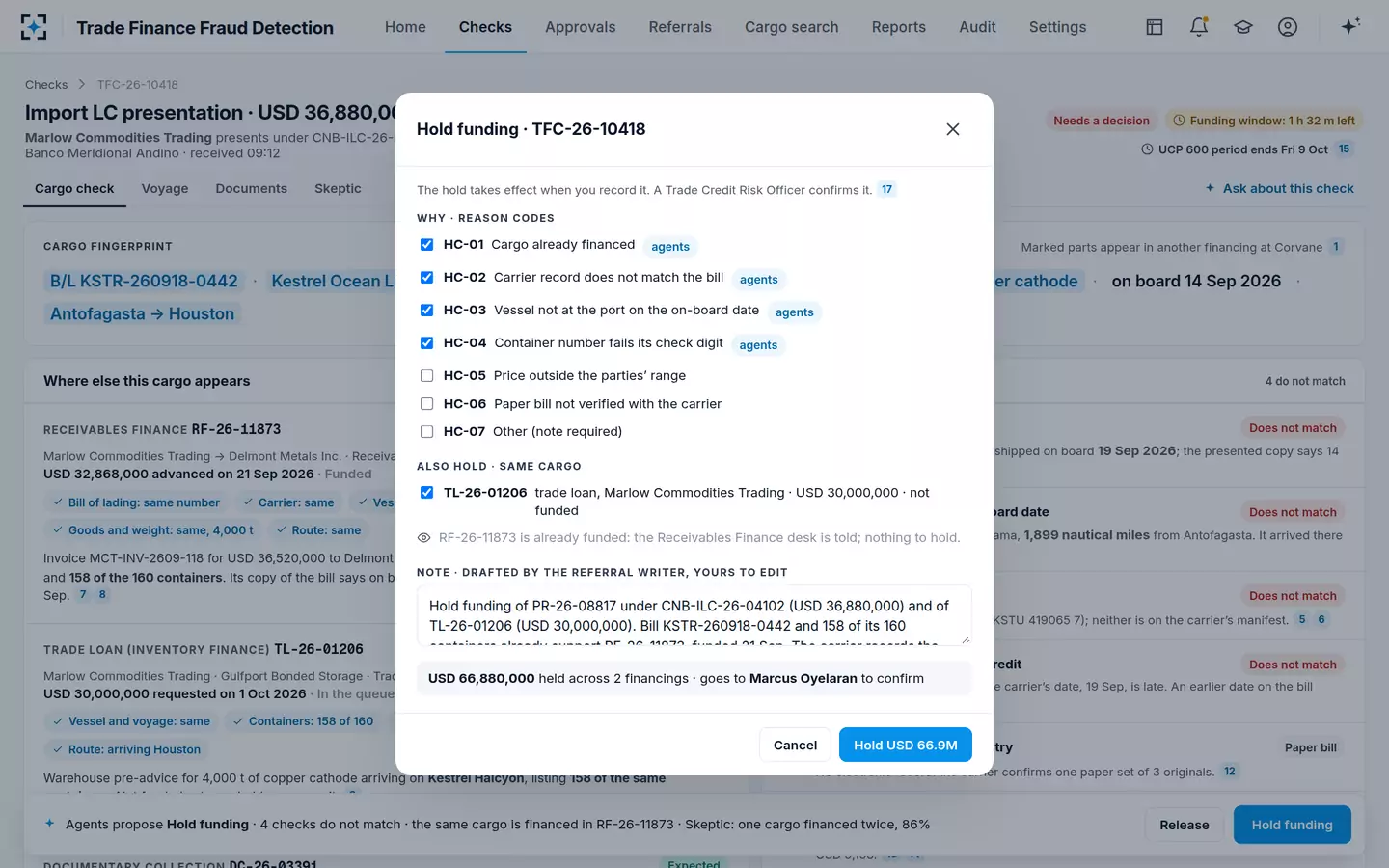
The analyst, Rhea Castellano in the sample, holds at 11:46. The hold stops US$66,880,000 across the presentation and the waiting trade loan in one decision, and the receivables desk, whose financing has already funded, is told rather than held. The design choice that matters is that the hold is immediate and the confirmation follows: money stops on one person's judgment, and starts again only on two.
The checker's screen: the maker, the reasons and the evidence on one page
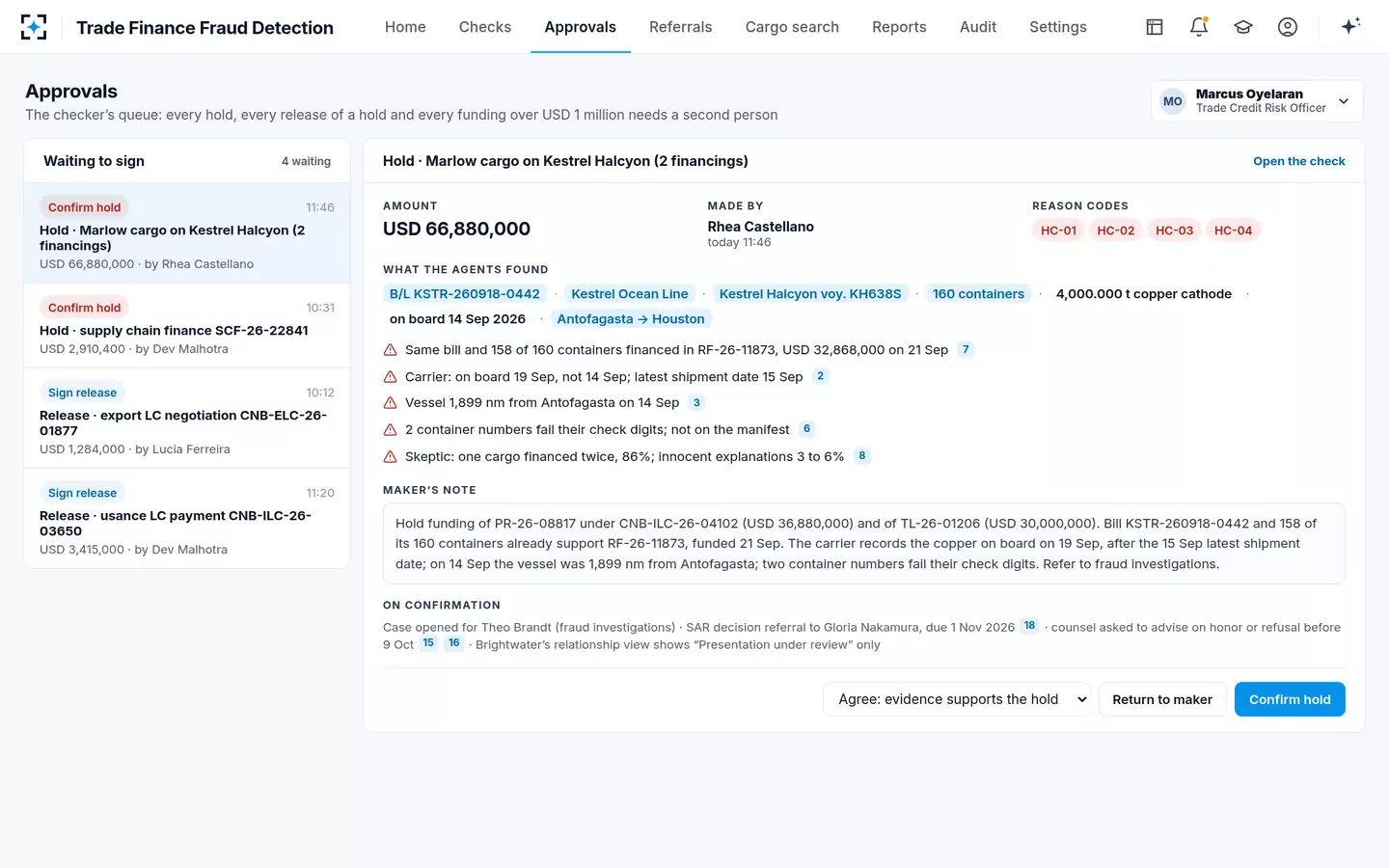
After a hold: investigations, the BSA Officer and a SAR nobody may mention
A confirmed hold on suspected fraud starts two federal clocks and one confidentiality duty. A bank must file a suspicious activity report within 30 calendar days of first detecting facts that may justify one, with up to 30 more days allowed to identify a suspect, and the rule makes a SAR, and any information that would reveal one exists, confidential (31 CFR 1020.320). Records must be kept for five years (31 CFR 1010.430).
Trade operations creates a particular leak risk here: the customer's relationship manager, the importer and the presenting bank all ask why a presentation has not been paid. In the solution, the confirmed hold opens a restricted case for the fraud investigations manager and a SAR decision referral for the BSA Officer, due 30 days from detection, and the customer-facing view of the letter of credit shows only "Presentation under review". Whether to honour or refuse a presentation on fraud grounds is a legal question with its own clock, five banking days under UCP 600, and goes to trade counsel. What a programme like this costs and returns, and how to report it, is on what trade finance fraud costs and how to measure controls.
Maker-checker rules for pre-funding fraud checks
- The hold is immediate; the release needs two people
Money stops on one judgment and starts again only on two.
- The system, not policy, stops the maker checking herself
A rule that relies on people remembering is not segregation of duties.
- The checker sees the evidence, not a summary
Each finding with its source, the reason codes and the maker’s note on one screen.
- Every override has a reason code and a note
A release against an agent’s proposal is the decision most worth reviewing later.
- No answer is never a pass
A missing carrier record or vessel gap leads to a documented check by hand, not a release.
- The administrator decides nothing on a financing
Settings change through a versioned rule with its own approval.
- The SAR stays in its own lane
Restricted to investigations and the BSA Officer; the customer side sees only "under review".
Questions people ask
Who approves trade financing at a bank?
A credit approval sets the limit; each drawing or release under it is then approved within delegated authorities, usually with a second signature above a set amount. The OCC's examination procedures ask examiners to confirm segregation of duties and dual controls over trade transaction processing. In the solution's sample settings a trade credit risk officer signs every hold and every release above US$1 million.
What does the OCC say about trade finance fraud?
Its Comptroller's Handbook names operational risk as the greatest risk in trade services because the work remains heavily paper-based, says a letter of credit does not eliminate the risk of fraud because banks deal only in documents, and calls letters of credit more susceptible to documentary fraud because of the number of documents they require. Its examination procedures test dual controls and whether a customer can obtain further credit on the same merchandise.
Is trade finance fraud the same as trade-based money laundering?
They overlap but differ in the victim. In trade finance fraud the bank or financier is deceived and loses money, as in the Trafigura and Hin Leong cases; in trade-based money laundering the trade documents are used to move value and the bank is often paid in full. Several techniques, such as phantom shipments and documents reused across banks, serve both.
What controls stop duplicate trade financing?
Inside one bank, a search of every desk's financings by each part of the cargo before funding: bill number, container numbers, vessel and voyage, goods and weight. Across banks, the carrier's answer on how many original bills it released and to whom, and an electronic bill platform's record of who controls a bill, are the main outside checks. FATF notes that documents reused across several institutions are hard for any one of them to identify.
How fast should a pre-funding fraud check be?
Fast enough to run on every financing inside the bank's funding window, or it will be skipped on the busy days. The solution's design target is a decision within four hours, with a warning at three; in its fictional sample month, 98.6% of 1,047 checked events were decided inside the window. Each bank should set and measure its own window.