Technology can assist in combating TBML, trade-based money laundering, by taking the mechanical part of every trade alert: reading the credit, its amendments and the shipping documents field by field, finding what the goods are usually worth, pulling the voyage behind the bill of lading, linking the parties across the bank's own payments, and drafting the case with its evidence. That part is most of the work, and it is why trade alerts take weeks. What technology cannot do is decide whether a trade is suspicious, and the industry's own standard said in 2019 that reviewing trade documents as a whole cannot be automated. Botminds' Trade-Based Money Laundering Detection takes that statement seriously: six agents do the reading, pricing, routing, linking and drafting, and a named investigator and BSA Officer make every decision.
Where this page shows the solution at work, the examples come from a fictional sample bank, Corvane National Bank, and its sample trade data. The time figures are the solution's design targets and our own estimates, labelled as such.
Why TBML resists the tools that work elsewhere in AML
80%
of international trade processed through financial institutions is open account, where the bank does not normally see the trade documents
<0.1%
of suspicious activity reports filed in 2016–2020 specifically indicated trade-based money laundering: 8,749 of almost 11 million
24%
of the SAR narratives FinCEN analysed for its 2010 advisory clearly identified the activity as TBML or the black market peso exchange
How can technology assist in combating TBML?
Technology assists in combating TBML where the work is reading, looking up and linking, and it does not assist where the work is deciding. An alert on a documentary trade turns on four questions: is this price plausible for these goods, does this route make commercial sense, do these parties keep paying each other in a circle, and do the documents agree with each other and with the credit. Each question needs evidence the bank has in scattered places: the trade finance system, the payments hub, public trade statistics, vessel records and the customer file.
Gathering that evidence is where the days go. At the sample bank the solution's designers estimated a median of 19 days from alert to a decided outcome when the work is done by hand, and the largest blocks are linking the parties across 18 months of trade and payments, finding what the goods are actually worth, and writing the case. Those are tasks a machine can do from the bank's own records and public data, with every finding pointing back at the document that produced it.
Where a trade alert's days go, by hand and with agents doing the gathering
By hand · 19 days (estimate)
- Parties · 26%
- Price · 21%
- Writing · 21%
- Route and reading · 21%
- Deciding · 11%
With agents · 4 days (target)
- Agents gather and draft · 25%
- People decide, sign, pack · 75%
The second bar is the argument of this page. Technology does not make the decision faster by making it for people. It makes the decision the main thing people spend time on: three days of a four-day alert are judgment, signature and the evidence pack, against two of nineteen when the investigator is also the researcher, the price analyst and the typist.
What can complicate the detection of TBML?
Four things complicate the detection of TBML, and only two of them are problems technology can work on. The first is that the bank sees paper, not cargo. FinCEN put it in its 2010 advisory: "financial institutions see only the documents related to a transaction and not the goods themselves," and those documents "may be created by the money launderers themselves with no neutral third party to verify the validity of the documents" (FinCEN FIN-2010-A001).
The second is that anything can be traded. GAO heard from banks, law enforcement and subject-matter experts that "criminal organizations can use any type of goods in TBML schemes," and that differences in price or quantity would be hard to establish in any given shipment "without thorough inspection of the contents of the container and commodity-specific expertise" (GAO-22-447). No bank can inspect containers.
The third is fragmentation. FATF and the Egmont Group report that most private-sector respondents, mainly financial institutions, "consider TBML as the hardest type of ML activity to detect," partly because schemes route money through several banks, so that "each of the involved FIs can see only a small part of the network" (FATF and Egmont, TBML: Trends and Developments, 2020). The fourth is the paper itself: the same report notes that documentation reaching banks "is often in different formats and languages, meaning that verification will likely be done manually."
The goods and the network are limits. A bank cannot see inside the container, and it cannot see the transactions at the other banks in the chain. The paper and the lookups are labour. Reading a bill of lading in another language against a commercial invoice, or finding the direct sailing time on a corridor, is exactly the kind of work that agents can take, and it is the kind that FATF says is being done by hand.
What the 2019 principles said cannot be automated
The Wolfsberg Group, ICC and BAFT, in the 2019 amendment of their Trade Finance Principles, said that the review of trade documents as a whole cannot be automated, and they were describing something real. The sentence in full is worth reading, because it also says what can be automated.
"Whilst certain elements of this process may be automated (e.g. screening of transactions against published lists of sanctioned entities and individuals), the overall process of reviewing trade documents by its nature cannot be successfully automated. A combination of automated and manual controls will be relevant in the context of AML and counter-terrorist financing (CTF) efforts."
The Wolfsberg Group, ICC and BAFT, Trade Finance Principles (2019 amendment)
An honest answer accepts the conclusion and splits the process. The overall review includes judgments no system should make: whether an explanation for an odd price is believable, whether a customer's new line of business is real, whether a pattern is suspicious enough to report. It also includes steps that are not judgment at all: transcribing a goods description, comparing it across six documents, converting a price per short ton to a price per kilogram, and finding the vessel's port calls. The principles name sanctions screening as one element that may be automated; the reading and matching steps are of the same kind.
The same document is cautious about pattern-based monitoring for documentary trade, which it called unproven in 2019. That caution is about scoring trades against learned patterns, and it is answered differently, on the bank's own closed alerts before go-live; a 10-week plan for trade-based money laundering solutions sets out how. On this page the point is narrower. Taking the clerical steps out of a review does not automate the review. It leaves the review to the person, with the evidence assembled.
The tasks, owner by owner
Dividing the tasks is the real design decision. A rule of thumb: a task belongs to an agent if its output can be checked against a document, and to a person if its output is a judgment about intent or a signature that the bank answers for.
Every task in a trade alert, and who owns it in the solution
| Task | Owner | Why there |
|---|---|---|
| Read the credit, amendments, invoice, bill of lading, packing list and certificate of origin | Document agent | Field-by-field comparison is checkable: each mismatch cites both passages |
| Decide whether the presentation complies with the credit | Trade operations | A separate decision on its own clock; the agent is barred from it |
| Normalise the price and place it on the market band for the goods code | Pricing agent | Arithmetic on public statistics and the customer’s history, with the observation count shown |
| Judge whether an unusual price has a commercial reason | Investigator | Needs judgment about the customer and the trade, not just a number |
| Pull the voyage and compare it with the direct service | Route agent | A lookup with a source; says “vessel data unavailable” rather than guess |
| Link applicant, beneficiary, shipper, notify party and payer | Party agent | Joins records the bank already holds; never infers ownership |
| Write the most likely innocent explanation and look for its proof | Challenger agent | Clears only when the proving document is in the file |
| Draft the case narrative with an exhibit on every sentence | Case writer | Drafting from cited findings; never marks a draft final |
| Close the alert, or propose escalation, with a reason code | Investigator | The decision the bank answers for |
| Approve the escalation and decide whether to file | BSA Officer | The checker; nobody approves their own |
What agents do on one trade alert
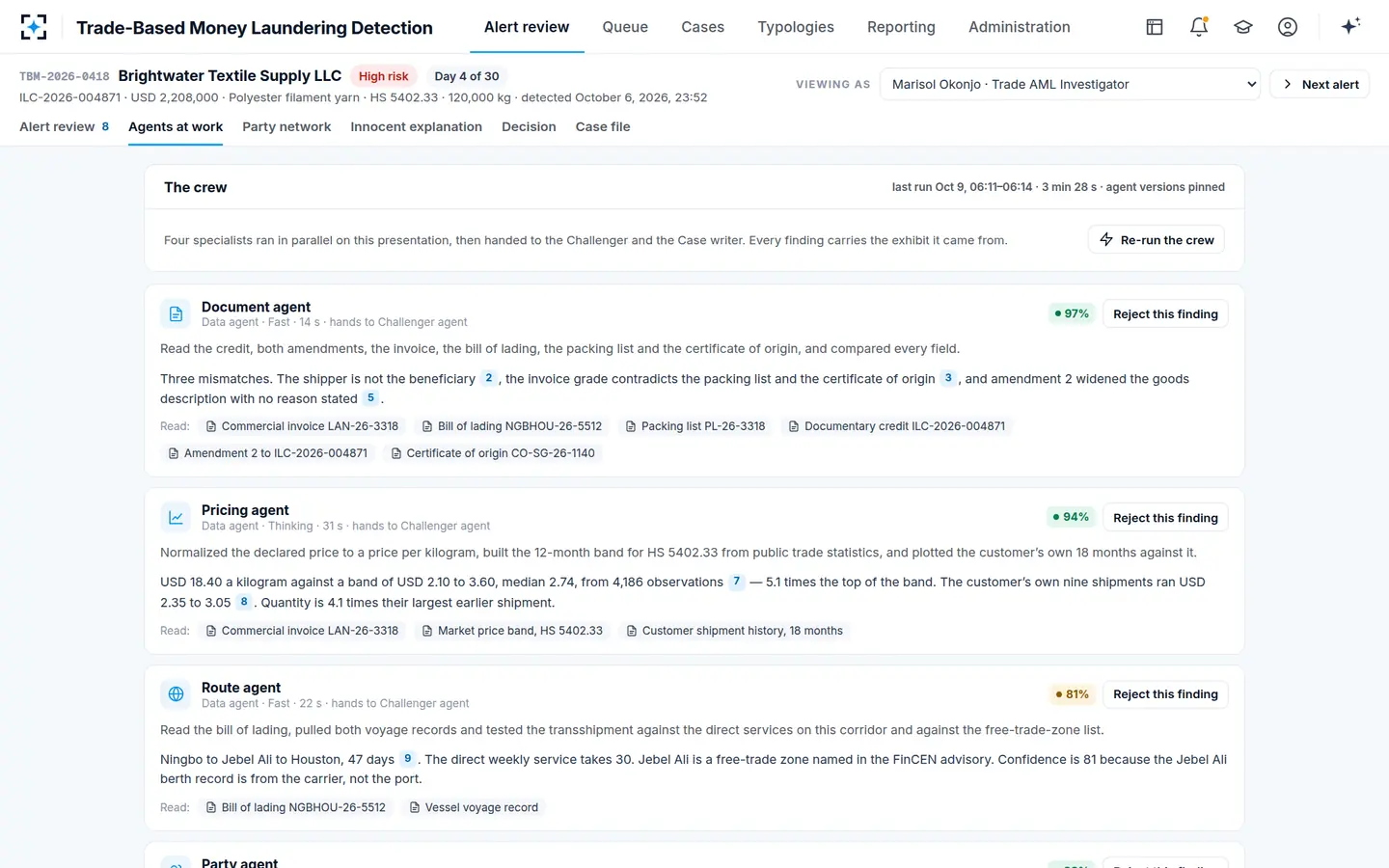
On the sample alert the agents ran in parallel and finished before the investigator arrived. Corvane National Bank holds an import credit for USD 2,208,000, 120,000 kg of polyester filament yarn at USD 18.40 a kilogram. The Document agent found three mismatches, the Pricing agent placed the price at 5.1 times the top of the 12-month band for the goods code, the Route agent found a transshipment through Jebel Ali that added 17 days to a 30-day direct service, and the Party agent found that the reimbursement came from a free-zone company the credit never names.
From overnight screening to a signed escalation: who does each step
Agent
Overnight screeningReads 44 presentations and collections and 61 reimbursements against 86 cited red flags; raises 10 alerts.
Agent
Four specialistsDocument, Pricing, Route and Party agents work the alert in parallel, each citing what it read.
Never: Re-examines the presentation under UCP 600
Agent
Challenger agentWrites the most likely innocent explanation for every flag and searches the file for the document that would prove it.
Never: Clears on the customer’s say-so
Agent
Case writerDrafts the narrative and the escalation memo, an exhibit on every sentence.
Never: Marks a draft final
A person decides
Trade AML investigatorReads the evidence, accepts or rejects each finding with a reason, decides to close or to propose escalation.
A person decides
BSA OfficerApproves or returns the escalation, decides whether to file, and files.
Four specialist agents on one alert, each showing what it read
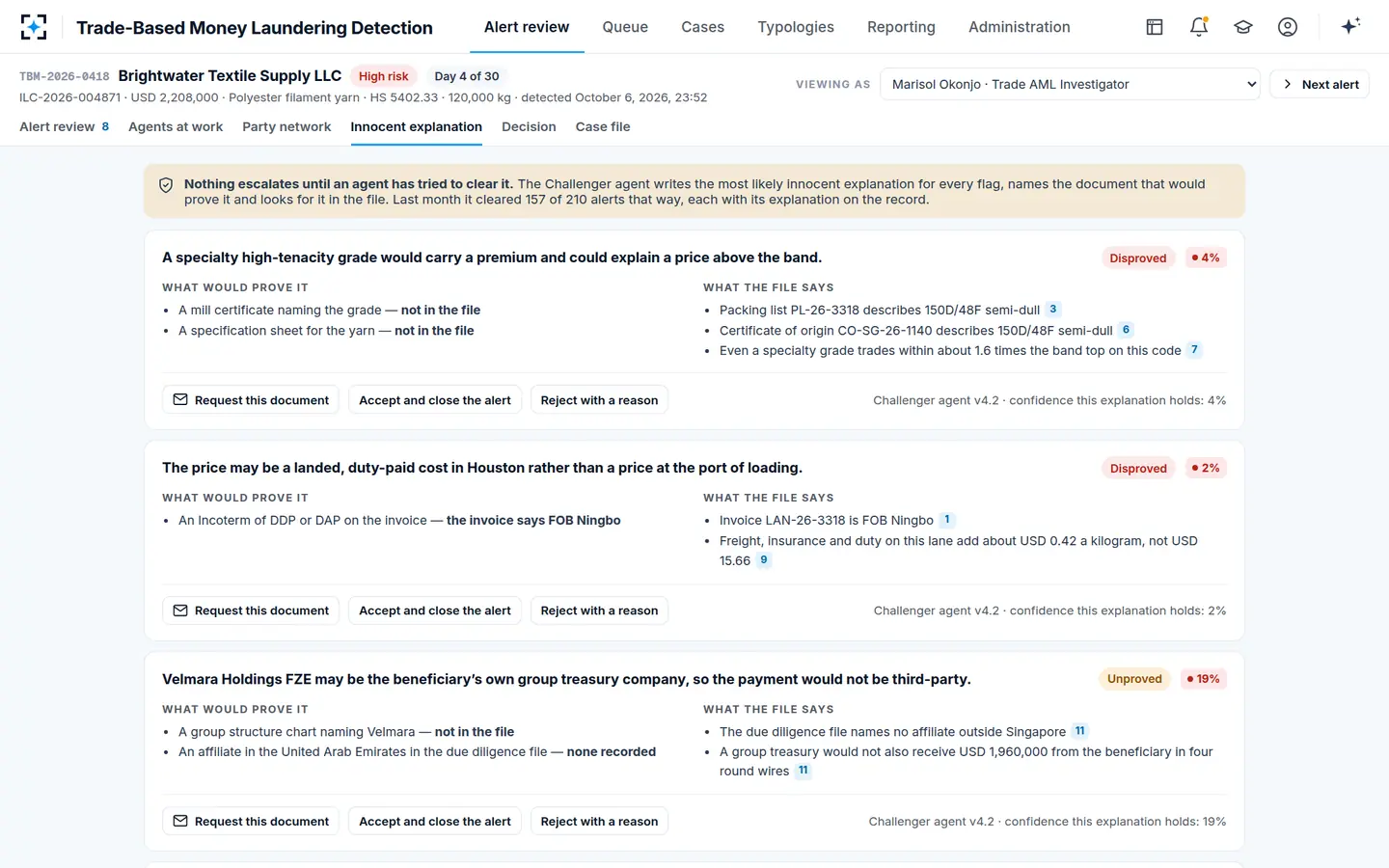
The Challenger agent is the step most systems leave out, and it does the most to save people's time. Its job is to clear the alert if the file allows it. On the sample alert it tested three explanations. A specialty high-tenacity grade would carry a premium, but the packing list and certificate of origin both describe the ordinary 150D/48F semi-dull grade. A landed, duty-paid price would explain part of the gap, but the invoice is FOB Ningbo. A group-treasury payer would explain the money, but no affiliate outside Singapore is recorded. Two were disproved and one stayed unproved, so the alert went to a person.
The agent that argues the other way, and what would prove it right
Can AI detect trade-based money laundering?
AI can surface trade-based money laundering indicators, but there is little public evidence on how well it detects TBML inside banks, and a buyer should know that before reading any vendor's figures. We found no regulator or peer-reviewed evaluation of AI for TBML detection at a bank. What exists is thinner and should be read for what it is.
GAO described one bank pilot in 2019. The bank scanned documents such as bills of lading, which were "processed by a character and noun recognition program to detect and classify reportable phrases based on Treasury and Department of Commerce guidelines, such as sanctions screening and export controls," and was "leveraging analytics, machine learning, and statistical transaction monitoring techniques to identify information, trends, connections, and anomalies indicative of TBML or other illicit finance schemes such as fraud" (GAO-20-314R). GAO reported what the bank said it was doing, not results.
FATF and Egmont wrote in 2020 that "innovative IT solutions, such as graph analytics and artificial intelligence (AI) and machine learning, can be particularly helpful in TBML-related analysis conducted by FIUs" (FATF and Egmont, 2020). That sentence is about financial intelligence units, which see reports from many banks and, in some countries, customs data; it is not a finding about banks. The academic picture is no fuller. The first systematic review of TBML research concluded that "Due to the limited number of studies, insights that can be drawn from the extant literature on the best way to combat TBML are also limited" (Tiwari, Ferrill and Allan, Journal of Accounting Literature, 2024). A December 2025 preprint that applied unsupervised machine learning to UN Comtrade data on aluminium trade found price deviation the strongest predictor of anomalies, but it is not peer reviewed and works on national trade statistics, not bank files (arXiv 2512.14410).
The honest reading for a bank is that AI's case in TBML rests on two things it can show on its own files: that the agents find what investigators found on alerts the bank already closed, and that every finding can be traced to a document. How the second line tests that is the subject of the model risk view of a TBML risk assessment tool.
Graph analytics and the view one bank cannot have
Graph analytics in TBML means treating parties and payments as a network and looking for shapes: value that returns to where it started, a payer that sits beside many unrelated trades, a notify party sharing an address with the company that pays. Inside one bank it works on the bank's own records, and that is both its power and its limit.
On the sample alert the Party agent linked five parties across 23 transactions in 18 months. The applicant paid the beneficiary USD 8,640,000 under 11 credits; the beneficiary sent USD 1,960,000 in four wires to the free-zone company that then reimbursed the bank for the applicant's credits; and the notify party on nine of eleven presentations shared that company's registered address. None of that is visible on one presentation. All of it is visible in records the bank already holds.
What a single bank cannot see is the rest of the network. The BIS Innovation Hub's Project Aurora, working on a synthetic dataset, found collaborative analysis across institutions more effective at detecting laundering networks than the siloed analysis banks run today (BIS Innovation Hub, Project Aurora, 2023). Until data-sharing of that kind exists for trade, a bank's graph stops at its own walls, and the Party agent is built to say so: it links only parties the bank holds a record for, and never infers ownership.
Where technology stops
Technology stops at five points in a trade alert, and a solution that does not stop there is a liability. It does not decide whether activity is suspicious. It does not approve its own work or anyone else's. It does not file a report, and it does not tell anyone outside the reporting chain that a case exists, because a SAR and any information that would reveal one are confidential. It does not price goods that have no market: the Pricing agent refuses any goods code with fewer than 40 observations in 12 months and asks for an analyst. And it does not decide whether a goods line needs an export licence, which is a separate question for the bank's export control screening.
Inside those limits the gain is concrete. In the solution's design, three in four alerts are cleared by the Challenger agent with a written explanation and the document that proved it, which is a target, not a measured result. The rest reach a person already priced, routed, linked and drafted. For the whole picture, from the overnight screening to the signed escalation, start at Trade-Based Money Laundering Detection.
Questions people ask
Can trade document review be automated?
Parts of it can. The Wolfsberg Group, ICC and BAFT said in 2019 that the overall review cannot be, by its nature, and that a combination of automated and manual controls is relevant. Transcribing, comparing fields across documents and screening names can be automated; judging whether a trade is suspicious cannot.
What tasks do trade AML analysts keep?
The judgments and the signatures: whether an unusual price or route has a commercial explanation, whether to close an alert or propose escalation, and, for the BSA Officer, whether to file. In the solution's design analysts also gather documents the agents cannot reach, such as a mill certificate requested from trade operations.
Does technology help with open account trade?
Less. In open account trade the bank usually sees only a payment, not the invoice or bill of lading, so document reading has nothing to read. Party links and payment patterns still work on the bank's own records, which is where the FATF and Egmont indicators on payments and accounts apply.
What is the difference between AI for FIUs and AI for banks in TBML?
Financial intelligence units receive reports from many banks and, in some countries, customs data, so network analysis can join the pieces. A bank sees only its own customers and payments. FATF's 2020 endorsement of graph analytics and AI was about FIU analysis; a bank's tools have to work inside its own records.
How long does a trade AML alert take without automation?
No public figure exists. The solution's designers estimated a median of 19 days from alert to decision at the fictional sample bank when the work is done by hand, against a design target of four days with agents doing the gathering. A bank should measure its own baseline before any pilot.