Over-invoicing in AML means invoicing goods above their fair market value so that the importer's payment moves more money to the exporter than the goods are worth; the excess is value transferred under cover of a trade. Under-invoicing is the reverse, moving value from exporter to importer. Both need the buyer and the seller to collude, and both leave one visible trace for a bank: a unit price that does not fit the goods. Banks look for that trace by converting the invoice price to a price per unit and placing it on a band built from trade statistics for the same goods code, then asking whether anything explains the gap. Botminds' Trade-Based Money Laundering Detection builds that band for every goods code a bank finances, with the customer's own history beside it, and treats a price outside it as a reason to ask, not a finding.
The worked example is a fictional sample bank, Corvane National Bank, and one sample alert in the solution. The arithmetic on it is ours.
A very old technique, measured only roughly
2006
FATF calls over- and under-invoicing one of the oldest methods of moving value across borders, and still common
$278bn
estimated moved out of the US in 2018 by under-valued exports and over-valued imports, in one researcher’s unit-price analysis
$435bn
estimated moved into the US the same year by over-valued exports and under-valued imports, by the same method
What is over-invoicing in AML?
Over-invoicing in AML is a trade-based money laundering technique in which the invoice states a price above what the goods are worth, so that the payment carries extra value from the importer's side to the exporter's. FATF's 2006 typology, still the reference text, calls over- and under-invoicing "one of the oldest methods of fraudulently transferring value across borders" and describes the key element as "the misrepresentation of the price of the good or service in order to transfer additional value between the importer and exporter" (FATF, Trade Based Money Laundering, 2006).
FATF's worked example uses widgets. An exporter ships a million widgets worth $2 each and invoices them at $3; the importer pays $3 million, the exporter pays its suppliers $2 million, and $1 million sits in a bank account to be paid out on the importer's instructions. The report draws the conclusion that matters for a bank: "neither of the above transactions would be undertaken unless the exporter and importer had agreed to collude." An unrelated buyer has no commercial reason to pay 50% over the market. A price that far out of line is a question about the relationship, not only about the goods.
Two directions of the same technique
Over-invoicing: The goods are worth more than they are
Under-invoicing: The goods are worth less than they are
Over-invoicing: From importer to exporter, inside the payment
Under-invoicing: From exporter to importer, inside the goods
Over-invoicing: An invoice priced far above the band for the goods code
Under-invoicing: An invoice priced far below the band for the goods code
Over-invoicing: An exporter may claim a larger export credit or VAT rebate
Under-invoicing: An importer may pay less duty
Over-invoicing: Specialty grade, delivered-duty pricing, a unit error
Under-invoicing: Off-grade or end-of-line stock, a unit error, an affiliate’s transfer price
What is under-invoicing?
Under-invoicing states a price below what the goods are worth, so the importer receives more value than it pays for and can sell the goods on at the real price. FATF's 2006 report notes that research suggests under-invoicing exports is among the most common of these techniques, because customs agencies, focused on stopping contraband and collecting import duty, generally watch exports less closely than imports.
The sample bank's queue holds one of each. The import credit on this page is priced 5.1 times the top of its band; an alert on milled rice is priced at 0.38 times the band floor. The second may be off-grade stock; at the sample bank another under-priced alert was cleared exactly that way, with the mill certificate that graded the goods.
How a unit-price band is built, step by step
A unit-price band is built by turning every comparable trade record for a goods code into a price per unit, taking a range of those prices over a window, and placing the invoice price on it. Each step has a choice in it, and each choice changes what gets flagged. The table follows the sample alert through the solution's method.
Building and reading a unit-price band, on one sample alert
| Step | What is done | On the sample alert |
|---|---|---|
| 1. Identify the goods | Take the goods code from the documents and check the description agrees | HS 5402.33, polyester filament yarn; the invoice says specialty high-tenacity, the packing list and certificate of origin say ordinary 150D/48F semi-dull |
| 2. Normalise the quantity | Convert to the unit the statistics use | 120,000 kg, already in kilograms |
| 3. Normalise the price terms | Put the invoice and the statistics on the same delivery basis | Invoice FOB Ningbo; freight, insurance and duty on the lane add about USD 0.42 a kilogram |
| 4. Build the band | Percentiles of unit values for the code over a window, with an observation minimum | 12 months to September 2026: 5th percentile USD 2.10, median 2.74, 95th percentile 3.60, from 4,186 observations |
| 5. Place the price | Declared unit price as a multiple of the band top and of the median | USD 2,208,000 ÷ 120,000 kg = USD 18.40; 5.1× the band top, 6.7× the median |
| 6. Compare the customer with itself | The customer’s own prices for the code over a look-back | Nine shipments in 18 months at USD 2.35 to 3.05; this one is 6.0× its highest |
| 7. Test the innocent explanations | Grade, unit, delivery terms, quality: find the document that would prove each | Specialty grade and landed price disproved by the file; mill certificate and specification sheet absent |
| 8. Decide what it means | A prompt for enquiry, decided by a person | Escalation proposed by the investigator, for the BSA Officer to approve |
Steps 2 and 3 are where most false alerts are born. At the sample bank an alert on kiln-grade alumina, flagged far above its band, turned out to be quoted per short ton rather than per kilogram; normalised, the price was USD 2.98 a kilogram and inside the band, and the invoice's unit note proved it. A band compared against an unconverted price will flag every trade quoted in tons, dozens or pieces.
The sample invoice price against the band and the customer's own history, USD per kilogram
Where do price benchmarks come from?
Price benchmarks for goods come from three places: public trade statistics, which record declared values and quantities by goods code; the bank's own history, which records what each customer has paid before; and, for traded commodities, published market prices. Each has a gap. Statistics are aggregated declarations, not verified prices, and GAO's review found that the Census Bureau edits a fifth of US trade records in a month before they are published. The bank's history knows only its own customers. Market prices exist for a small share of what moves in containers.
The Wolfsberg Group, ICC and BAFT make the point bluntly, and a bank should build its price check knowing it:
"Furthermore, it is not feasible to make such determinations on the basis of external data sources; most products are not traded in public markets and therefore there are no publicly available market prices. … However, there may be situations where unit pricing appears manifestly unusual, which may prompt appropriate enquiries to be made based on the FI's RBA."
The Wolfsberg Group, ICC and BAFT, Trade Finance Principles (2019 amendment)
The same principles add that even where goods are publicly traded, "the current prices may not reflect the agreed price used in any contract of sale or purchase," because contract terms, volume discounts and quality are commercially sensitive and rarely in the bank's file. FATF and Egmont agree from the other side: banks "often have only a vague description of the traded good, and establishing a 'fair price' can require significant resources and may be based solely on open source information" (FATF and Egmont, 2020). The band is a tool for the manifestly unusual, and it should be built and labelled as one.
How reliable is unit-price analysis?
Unit-price analysis is reliable at the extremes and unreliable in the middle, and its known weaknesses are worth stating on every alert. The FATF and Egmont indicator a band tests is prices that "do not seem to be in line with commercial considerations, are inconsistent with market value, or significantly fluctuate from previous comparable transactions" (FATF and Egmont, 2021). The last clause is the one the bank can test best, because it holds the previous transactions. The first two depend on a benchmark the bank does not own.
Criminals know where benchmarks fail. GAO heard from banks, agencies and experts that criminals "can, for example, also use obscure goods or part numbers, for which there are no available pricing data for banks to evaluate, on invoices in order to under- or over-invoice as part of TBML or related schemes" (GAO-22-447). That is why the solution refuses to score a goods code with fewer than 40 observations in a year and says so on the alert, and why it never values a specialty grade without a document that names it. A tool that scores every code, however rare, is most confident exactly where it should be least.
The research estimates carry the same caution at national scale. The $278 billion and $435 billion figures came from treating prices outside the upper or lower quartile for each commodity and country as suspicious, following a definition the researcher attributed to the Internal Revenue Service, and GAO noted that quartile cut-offs are somewhat arbitrary and the totals include tax evasion and other activity (GAO-20-333; Zdanowicz, Review of Law and Economics, 2009). The validation questions a second line asks of such a band are set out in the model risk view of a TBML risk assessment tool.
The band, opened at the passage the agents cited
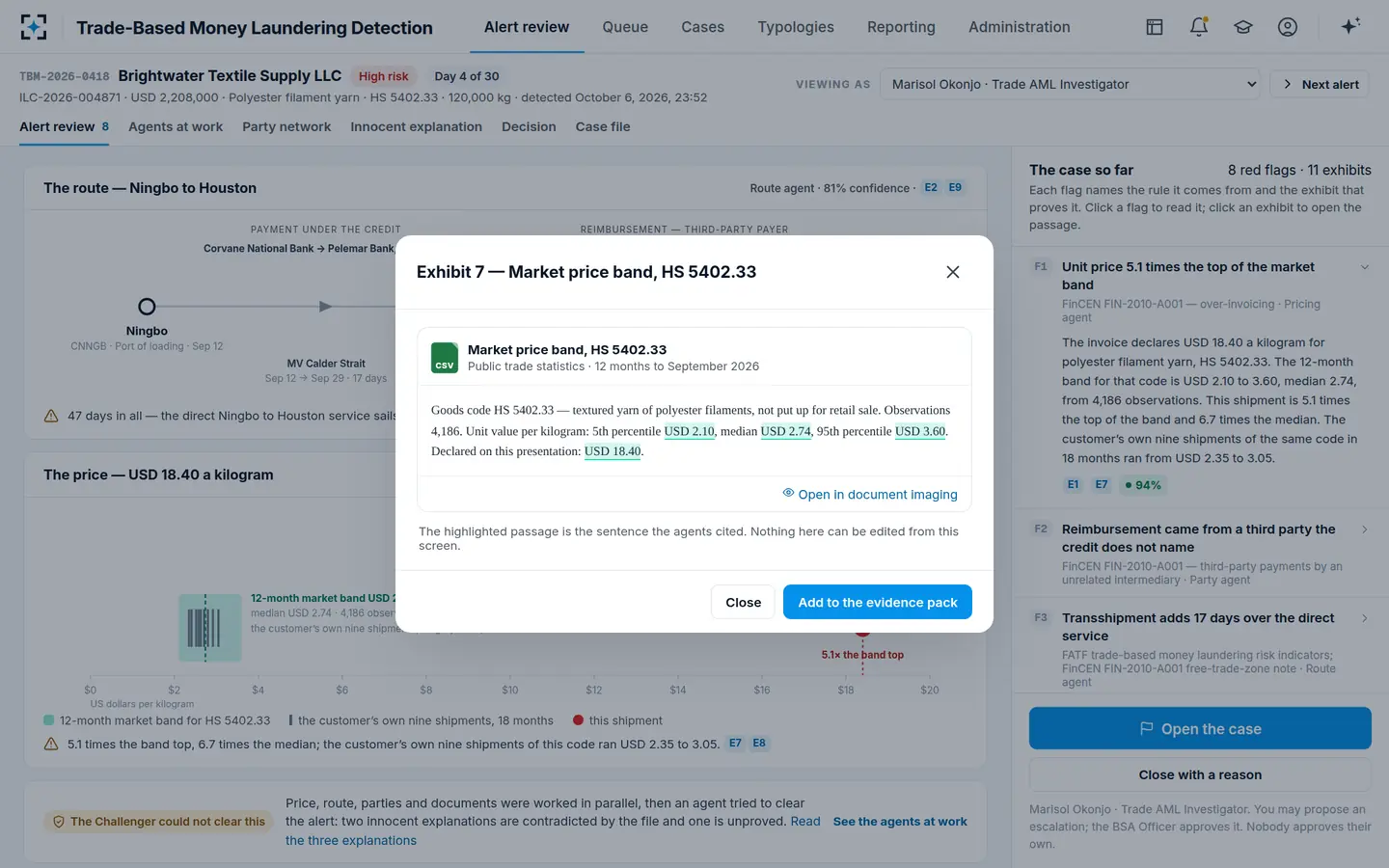
Reading the multiple: what 5.1 times the band top means
A multiple of the band top says how far outside the observed range a price is, not how much was laundered. On the sample alert USD 18.40 a kilogram is 5.1 times the 95th percentile and 6.7 times the median. If the yarn were worth the band top, the USD 2,208,000 invoice would carry about USD 1.78 million above it; if worth the median, about USD 1.88 million. Those are the sizes of the question, not of a crime.
The solution's settings at the sample bank turn the multiple into a workflow, not a verdict: a flag above 2.0 times the band top, and a recommendation to escalate above 5.0 times, both set by the bank and changed only with the BSA Officer's approval. Below the first, the price is inside what the bank has chosen to tolerate. Between the two, an investigator looks. Above the second, the case writer drafts an escalation for a person to accept or reject. The settings are the bank's policy, written down; the Wolfsberg principles expect staff training to cover how to analyse prices where reliable data exist, "how to identify where a unit price would be seen as obviously unusual and the escalation process that should be followed."
The innocent explanations, and the document that proves each
Most prices outside a band have an innocent explanation, and the explanation is only as good as the document behind it. Four account for most of them: the unit was different, the delivery terms were different, the quality was different, or the parties are related and the price is a transfer price. Each has a proving document: the invoice's unit note, the Incoterm on the invoice, a mill certificate or specification sheet, a group structure chart.
Seven price, route and party flags, each cleared with the document that proved it
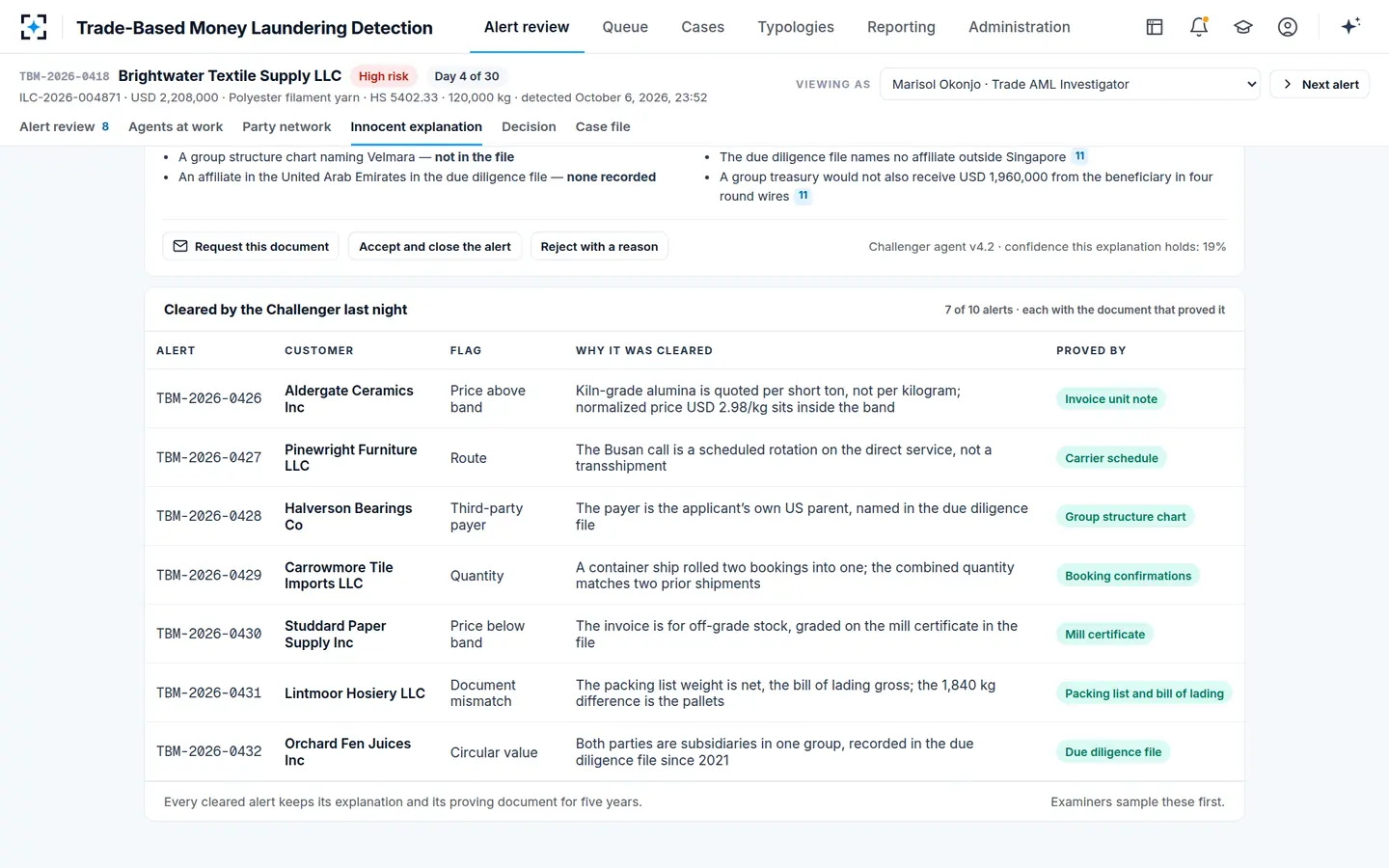
On the sample alert all three explanations failed or stayed open. The invoice called the yarn a specialty high-tenacity grade, but the packing list and the certificate of origin both describe the ordinary grade, and no mill certificate or specification sheet is in the file. A landed, duty-paid price would explain a little, but the invoice is FOB Ningbo and freight, insurance and duty on the lane add about USD 0.42 a kilogram, not USD 15.66. The payer could have been a group treasury company, but no affiliate is recorded. The price stayed unexplained, and with a third-party payer and a 17-day detour through a free-trade zone beside it, the investigator proposed escalation.
What is a trade transparency unit?
A trade transparency unit is a government team that compares trade and financial data across countries to find mispricing that no single bank can see. The US unit sits in Homeland Security Investigations and runs a system called DARTTS, which joins US import and export records, BSA reports filed with FinCEN and partner countries' trade data. One of its three analyses is the bank's price check at national scale: "Unit price analysis. Trade pricing data are analyzed to identify over- or under-valuation of goods, which may be indicative of TBML or other import-export crimes" (GAO-22-447).
The unit can do what a bank cannot: compare what one country recorded as exported with what the other recorded as imported. GAO reported that its analysis supported 258 investigations in fiscal 2018 and produced 17 leads referred in fiscal 2019, and that since 2004 it had helped set up 18 partner units abroad, mostly in the Western Hemisphere. GAO also recommended that DHS share the unit's data with other agencies; DHS did not concur. For a bank, the lesson is about division of labour: the bank's job is to notice the manifestly unusual price on its own trade and report it well, and the units with customs data on both sides do the rest. For a sample alert carried from the price flag to a signed escalation, see Trade-Based Money Laundering Detection; for the other red flags beside price, see trade-based money laundering red flags a bank can actually see.
Questions people ask
How do banks detect mispricing?
By normalising the invoice to a unit price, comparing it with a band for the goods code from trade statistics and with the customer's own past prices, and asking for the document that would explain any large gap. The Wolfsberg principles limit this to prices that look manifestly unusual, because banks rarely know the contract terms or quality behind a price.
Can a bank tell a fair price from an invoice?
Rarely with confidence. Most goods have no public market price, and even for traded commodities the contract price can differ for legitimate reasons. A bank can tell when a price is far outside what similar goods and the same customer usually cost, and that is enough to ask a question.
Is a high price always a red flag?
No. The FFIEC asks monitoring to give greater scrutiny to obvious over- or under-pricing, not to every price above average. At the fictional sample bank, 71% of the 612 flags its price-above-band rule raised in a year were cleared with a written explanation and the document that proved it.
What is the difference between over-invoicing and over-shipment?
Over-invoicing misstates the price; over- or under-shipment misstates the quantity, shipping more or less than the documents say, and at the extreme nothing at all, a phantom shipment. FATF lists them as separate basic techniques, and they are often combined.
Does over-invoicing show up in customs data?
Sometimes. Customs records the declared value, so a mispriced import may sit in the statistics a bank's band is built from. Mirror analysis, comparing one country's exports with the partner's imports, is how authorities and researchers look for the gaps; it needs data from both sides that a bank does not hold.