Is trade finance considered high risk? For sanctions and money laundering, the FFIEC's examination manual lists commercial letters of credit and other trade finance products among the products that may carry a higher level of OFAC risk, and describes trade finance as susceptible to documentary fraud linked to laundering; the industry's own trade principles call it a "higher risk" area in perception. As credit, trade finance is usually considered low risk: short-term, self-liquidating and given a low capital weight. The rules are more precise than either label. Risk in trade sits where the bank's view of the trade ends, so open account payments, which make up most trade banks process and come without documents, are harder to monitor than the letters of credit that carry the label. Botminds' Trade-Based Money Laundering Detection is built for the part a bank can see: it reads every credit, collection and reimbursement the bank holds for price, route, parties and documents, and leaves the decisions to people.
This page checks common claims about trade finance risk against the documents they come from. Where it shows the solution, the data are a fictional sample bank's.
Three facts behind the high-risk label
80%
of international trade processed through financial institutions is open account, according to the Wolfsberg Group as GAO reported it
20%
credit conversion factor for self-liquidating, trade-related contingent items of up to a year under US capital rules, against 100% for guarantees
$19tn
nearly, of merchandise trade in 2019, the volume GAO cites as a vulnerability in itself
Is trade finance considered high risk?
For money laundering and sanctions, trade finance is treated as higher risk in examination guidance and in industry practice, but the guidance is specific about why, and it does not make every trade transaction suspect. The industry standard frames it as a perception and draws a practical conclusion:
"There is a perception that Trade Finance is a "higher risk" area of business from a financial crime perspective, therefore, all FIs involved in Trade Finance should have risk policies and controls which are appropriate for their business."
The Wolfsberg Group, ICC and BAFT, Trade Finance Principles (2019 amendment)
The conclusion matters more than the label: controls appropriate to the business. A bank that issues a handful of import credits for long-standing customers and a global bank that confirms credits from hundreds of issuers both do trade finance, and their risk is not the same. The FFIEC says the same in its own terms, asking that documentation review and management information match the size and complexity of the trade portfolio and the bank's role in it.
What the FFIEC manual actually says
The FFIEC manual says three things about trade finance risk, in two different sections. Its OFAC section names commercial letters of credit and other trade finance products among its examples of products, services, customers and places that may carry a higher level of OFAC risk (FFIEC BSA/AML Manual, Office of Foreign Assets Control; the list is quoted in what deep ownership screening costs). Its trade finance section explains the money laundering risk: "because trade finance can be more document-based than other banking activities, it can be susceptible to documentary fraud, which can be linked to money laundering, terrorist financing, or the circumvention of OFAC sanctions or other restrictions (such as export prohibitions, licensing requirements, or controls)." And it adds the difficulty: "The involvement of multiple parties on both sides of any international trade transaction can make the process of due diligence more difficult" (FFIEC BSA/AML Manual, Trade Finance Activities).
The same section limits the burden. "Unless customer behavior or transaction documentation appears unusual, the bank should not be expected to spend undue time or effort reviewing all information," and banks with robust due diligence "may find that less focus is needed on individual transactions." The manual's view, read whole, is that trade finance carries particular risks that a bank must understand and monitor in proportion to its business, not that trade customers are presumed suspicious.
Are letters of credit higher risk than open account?
For money laundering, letters of credit are generally seen as less vulnerable than open account trade, because the bank sees more. FATF and the Egmont Group report that payment methods "like letters of credit or documentary collection, which require customers to provide the FI with more documentation than open-account trade, are often seen by the private sector as less vulnerable to TBML," and that launderers "may see open account trade as more attractive because the FI has more limited oversight of the transaction" (FATF and Egmont, TBML: Trends and Developments, 2020). Contributors to that report named open account and documentary collections as the most prominent methods in their TBML cases.
What the bank holds, and therefore what it can test
Letter of credit: Invoice, bill of lading, packing list, certificate of origin, the credit and its amendments
Open account: Usually none; a payment instruction and perhaps a reference
Letter of credit: Its applicant, and the beneficiary and other banks named in the credit
Open account: Its own customer and the counterparty named on the wire
Letter of credit: Price, description, route, quantity, amendments, payers
Open account: Payers, amounts, frequency, counterparties, account behaviour
Letter of credit: Examined by people against the credit, within the period the rules allow
Open account: Through automatic payment systems, often without human review
Letter of credit: Documents prepared by colluding parties can be consistent and false
Open account: No view of the trade behind the payment
The letter of credit's label comes from sanctions and fraud as much as from laundering. A credit names parties, vessels, ports and goods, all of which must be screened before the bank pays, and it moves money against paper that may be forged. Those risks are real, and different. Letter of credit money laundering risk sets out who decides what on a single credit.
Why is open account trade hard to monitor?
Open account trade is hard to monitor because the bank usually sees only the payment. GAO put the scale plainly: "According to the Wolfsberg Group, 80 percent of international trade that is processed through financial institutions is open-account trade," and the payment underpinning it "is usually processed through a bank's automatic payment systems, without human intervention" (GAO-20-314R). The Wolfsberg principles describe what is left: "As the FI has no visibility of the transaction, it is not able to carry out anything other than the standard anti-money laundering (AML) and sanctions screening on the clean or netting payment" (Wolfsberg Group, ICC and BAFT, 2019).
Where the documents are: most trade through banks comes without them
Trade processed through financial institutions
- Open account: payment only · 80%
- Everything else, including credits and collections · 20%
FATF and Egmont state the regulatory consequence: open account trading is "a fundamental part of the global trading process," so tighter regulation of it is not logistically or economically viable. Monitoring it means watching payments and counterparties: who pays for whose goods, whether money returns, whether an account passes funds through without a business behind them. The red flags that still work without documents are sorted out in trade-based money laundering red flags a bank can see.
What makes trade finance a target?
Four features make trade a target for laundering, and only one is about the bank. The volume is vast: GAO cites nearly $19 trillion of merchandise trade in 2019, against which any single mispriced invoice is hidden. The parties are many: GAO lists shipping companies, freight forwarders, warehouses, port authorities, terminal operators and insurers among those whose documents enter a trade, with varying oversight. The prices are opaque, because most goods have no public market. And the documents are produced by the parties to the trade, so collusion makes them consistent.
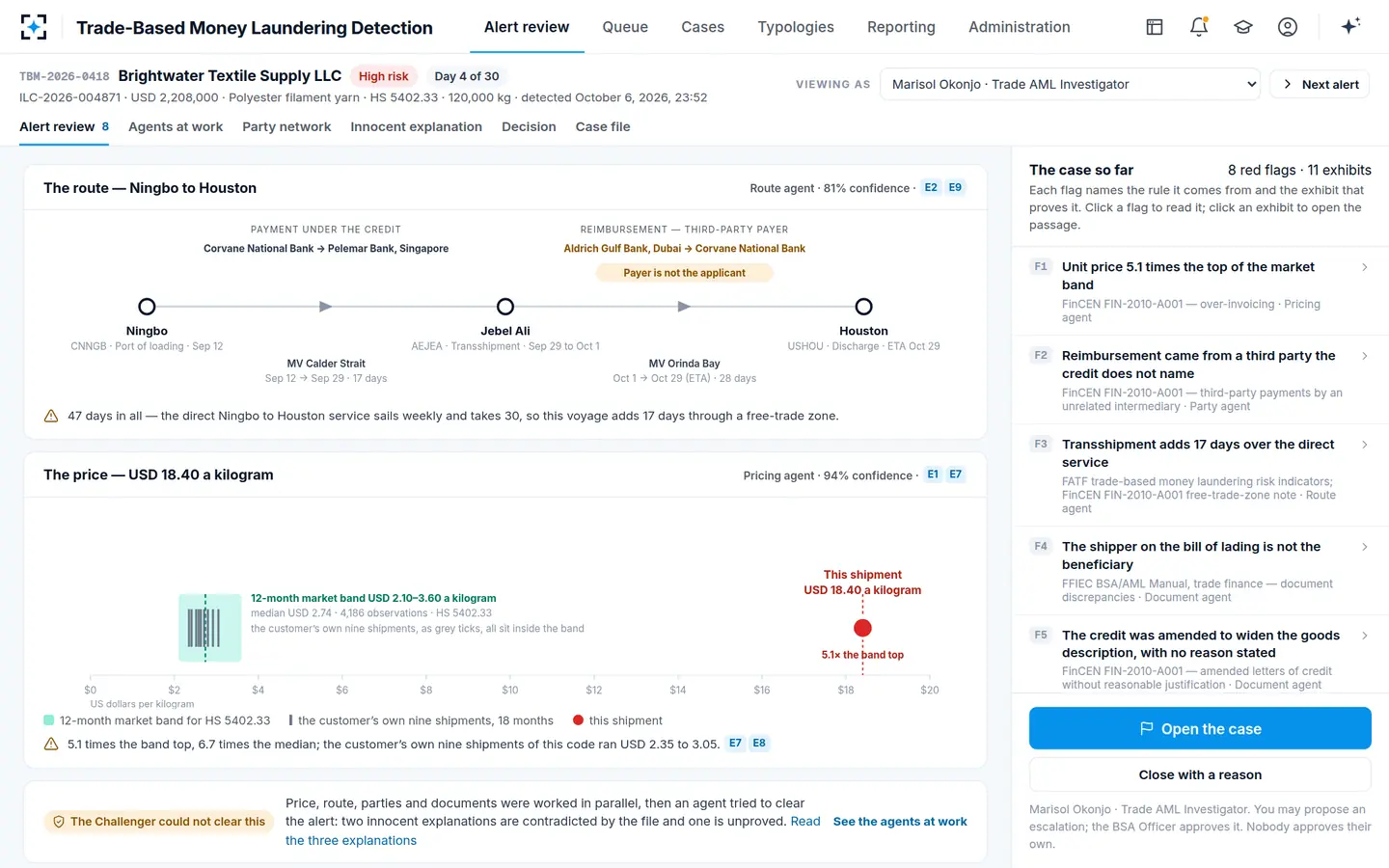
The bank's part is that it pays on those documents. GAO heard from banks that trade finance is "a very manual, resource-intensive business area because international trade is largely paper-driven, which exposes banks to fraud because the documents can be manipulated" (GAO-22-447). What protects the bank is not refusing the business but reading what it holds with the right questions, which is the work Trade-Based Money Laundering Detection's agents take on for the bank's investigators.
A letter of credit read for what the bank can see: route, price, payer, documents
Why is trade finance generally considered lower risk as credit?
As credit, trade finance is usually considered low risk because it is short, tied to goods and repaid from the trade itself. The FFIEC notes that "most trade financing is short-term and self-liquidating in nature." US capital rules reflect that: a self-liquidating, trade-related contingent item arising from the movement of goods, with an original maturity of a year or less, takes a 20% credit conversion factor, against 50% for performance standbys and 100% for guarantees and financial standbys (12 CFR 217.33).
The two views collide in practice. A product that is low risk as credit but labelled higher risk for financial crime carries compliance cost without much margin, and the World Trade Organization and IFC wrote in 2019 that "both compliance costs and potential regulatory risks have grown exponentially, making it more challenging to stay engaged," estimating unmet demand for trade finance at US$1.5 trillion a year (WTO and IFC, 2019). Those are dated estimates, but the direction is the point: a blanket high-risk label makes trade finance more expensive for exactly the small and developing-country businesses least able to pay for it.
Six claims about trade finance risk, checked
Common claims about trade finance risk, against the documents
| Claim | What the record says | Verdict |
|---|---|---|
| “Regulators say trade finance is high risk.” | The FFIEC lists commercial letters of credit and other trade finance products among products that may carry higher OFAC risk, and explains trade finance’s money laundering risks; the Wolfsberg principles call the high-risk view a perception | Partly true: higher-risk features, monitored in proportion |
| “Letters of credit are the riskiest way to pay.” | FATF and Egmont report the private sector sees letters of credit and collections as less vulnerable to TBML than open account | Not for laundering; sanctions and fraud are different questions |
| “A SAR means stopping the trade.” | The FFIEC says the bank is not expected to stop trade when a SAR is warranted, unless needed to avoid an OFAC violation | False |
| “Banks must verify every price.” | The FFIEC asks for scrutiny of obvious over- or under-pricing; the Wolfsberg principles say external price checks are not feasible except where prices are manifestly unusual | False |
| “Open account is low risk because the bank isn’t exposed.” | GAO and Wolfsberg: open account is most of trade, processed with limited visibility, and launderers may prefer it | False for money laundering |
| “Trade finance is low risk as credit.” | Short-term and self-liquidating, with a 20% credit conversion factor for qualifying items under US capital rules | Largely true, for qualifying items |
What do FFIEC examiners look at in trade finance?
FFIEC examiners look at four things in trade finance: the bank's policies and procedures for it, the due diligence in its customer files, whether its management information and risk ratings identify and monitor the trade portfolio for unusual activity, and whether its monitoring and reporting are adequate to its size, complexity, location and customers. Then they test a sample of trade finance accounts chosen from the bank's own risk assessment and check that the bank monitors for OFAC violations and unusual patterns and records what its due diligence found (FFIEC, Trade Finance Activities, Examination Procedures).
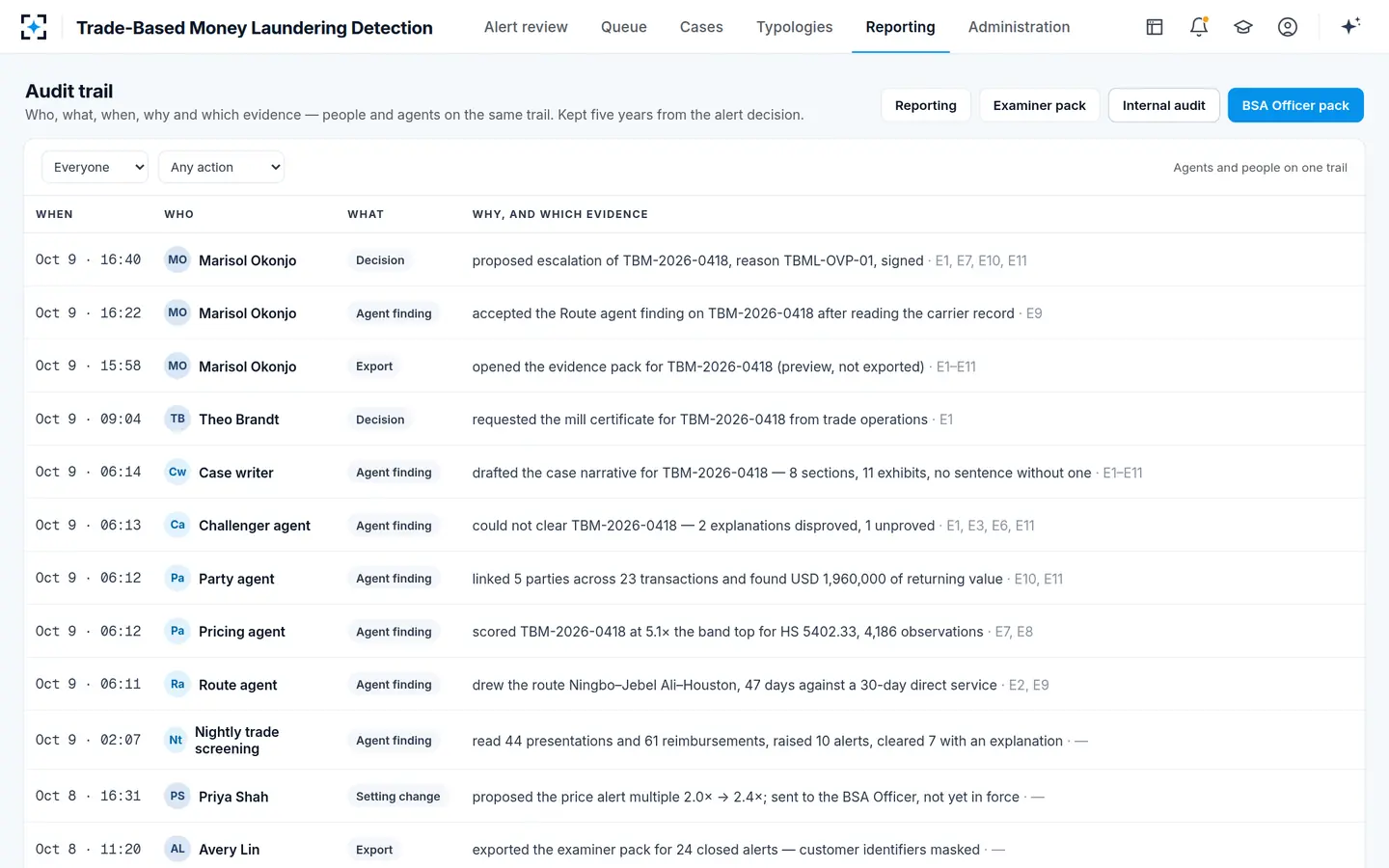
Nothing in those procedures asks the bank to treat trade finance as presumptively suspicious. They ask it to know where its trade risk is, watch it, and show its work. A bank that can open any closed trade alert and show the reason it was cleared and the document that proved it has answered most of the examiner's questions before they are asked; the measures that show this are in trade-based money laundering transaction monitoring KPIs.
Showing the work: one trail, and a pack for the examiner
For a bank that wants to monitor the trade it can see, with every decision recorded, start at Trade-Based Money Laundering Detection.
Questions people ask
Is trade finance higher risk for sanctions?
The FFIEC lists commercial letters of credit and other trade finance products among products that may carry higher OFAC risk, because they name many parties, goods, vessels and places, and letters of credit should be checked against OFAC lists before they are executed. Sanctions screening of trade is its own control, with its own blocking and reporting rules.
How much trade is open account?
About 80% of international trade processed through financial institutions, according to the Wolfsberg Group, as GAO reported in 2019 and FATF and Egmont repeated in 2020. No regulator publishes a current measured figure.
Does high risk mean a bank should avoid trade finance customers?
No guidance cited here says so. The Wolfsberg principles ask for controls appropriate to the business, and the FFIEC asks for monitoring proportionate to the bank's size, complexity and role. The WTO and IFC have described how rising compliance costs push banks away from trade finance in poorer markets.
Are documentary collections higher risk than letters of credit?
FATF and Egmont note that in a documentary collection the bank's role is limited and it does not necessarily verify the documents, and contributors to their 2020 report named collections, with open account, as the most prominent methods in their TBML cases. A letter of credit gives the bank more documents and more reason to examine them.
Why do people say trade finance is lower risk?
Usually they mean credit risk. Trade finance is short-term and self-liquidating, repaid from the sale of the goods, and qualifying trade items carry a 20% credit conversion factor under US capital rules. That says nothing about financial crime risk, which turns on what the bank can see of the trade.