FinCEN's trade-based money laundering advisory is FIN-2010-A001, issued on 18 February 2010: it gave banks red flags drawn from suspicious activity reports, reported that over 17,000 SARs had described potential TBML involving more than $276 billion, and asked filers to tick the right box and write "TBML" or "BMPE" in the narrative of every relevant report. The SAR data since suggest the request has not worked. GAO found that less than a tenth of one per cent of SARs filed from 2016 to 2020 specifically indicated TBML, and FinCEN's August 2025 advisory on Chinese money laundering networks asked again, this time for a new key term and the SAR form's TBML box. Botminds' Trade-Based Money Laundering Detection drafts every trade case under a typology and reason code, so that what the investigator found is named in the case the BSA Officer decides on.
Where the page shows a case, it is a fictional sample alert at a fictional sample bank, Corvane National Bank, in the solution.
What FinCEN found when it went looking in 2010
17,000+
SARs reported potential TBML on activity between January 2004 and May 2009
$276bn
in transactions those SARs described, in aggregate
24%
of the SAR narratives FinCEN analysed clearly identified the activity as TBML or BMPE; the rest took complex searches to find
What did FinCEN's TBML advisory say?
FinCEN's 2010 advisory said four things a bank still needs: what TBML is, what it looks like in a bank's records, how hard it is to see, and how to report it. It described the basic schemes as misrepresenting price and quantity, over- and under-invoicing, and invoicing the same goods more than once; it named the Colombian black market peso exchange as the complex case; and it gave red flags, the first four tied to trade documents and the rest to payments and deposits. It was candid about the limit: the activity is hard to identify because banks see the documents and not the goods (FinCEN FIN-2010-A001). The red flags are sorted by who can actually see them in trade-based money laundering red flags a bank can see.
It also set the tone for every list that followed: no single red flag, on its own, shows trade-based money laundering, the caution transaction monitoring scenario examples quotes in FinCEN's words. The 2010 advisory tied each flag to the customer in front of the analyst:
"Please keep in mind that this list of red flags identifies only possible signs of illicit activity and must be considered in conjunction with the normal transaction activity expected for the individual customer."
FinCEN Advisory FIN-2010-A001
The advisory was explicit about where its evidence came from: law enforcement experience with US trade with Mexico and Central and South America, though FinCEN advised institutions to apply the indicators more widely. It is still listed on FinCEN's advisories page in October 2026.
How many SARs report TBML?
Very few, on any count, and the counts measure different things. FinCEN's 2010 figure of over 17,000 came from searching narratives with trade terms drawn from its red flags. After FinCEN added a TBML and black market peso exchange option to the SAR form in 2012, GAO counted the reports that ticked it: 7,044 from 2014 to 2018, against more than 9.6 million SARs filed in the same years (GAO-20-314R). Two years later GAO reported the 2016 to 2020 figure: "Less than 1/10 of 1 percent of all SARs filed from 2016 through 2020 specifically indicated TBML activity (8,749 out of almost 11 million SARs)," with depository institutions filing about 79 percent of them (GAO-22-447).
Four counts of TBML reporting, each measuring something different
The first bar is larger than the others because it counted differently, not because filers labelled better in 2009. FinCEN found 76 percent of the reports it associated with TBML only through complex queries on trade terms. The middle bars count only the box, which is the narrowest definition. The last bar is a slice of one typology: of 137,153 reports FinCEN linked to Chinese money laundering networks from 2020 to 2024, 512 referenced the term TBML, totalling about $9.7 billion, while FinCEN found "multiple indicators of TBML-related activity in BSA reports in the dataset even where those reports did not expressly reference the term TBML" (FinCEN, Financial Trend Analysis, 2025).
Is TBML under-reported?
It is under-labelled, and probably under-detected, and the data cannot separate the two. FinCEN's 2010 analysis found a long lag as well as a missing label: "14 percent of the suspected TBML activity that occurred in 2004 was reported in 2004, while 30 percent of the 2004 activity was not reported until the first half of 2009, five years after the activity occurred." FinCEN suggested that institutions may first have learned of such activity from law enforcement inquiries or media reports.
The OCC gave GAO the other half of the explanation: banks may report the activity they can see without knowing it is trade-based. "Similarly, if the bank became aware that it was provided fraudulent documentation associated with a bank-financed trade transaction, it very well may have filed a SAR for fraudulent documentation rather than TBML" (GAO-22-447). GAO's 2019 report made the same point about information: banks "may not have enough information on the suspicious activity to determine whether it is related to TBML schemes" (GAO-20-314R).
The reporting lag FinCEN measured on 2004 activity
14%
of suspected TBML activity that occurred in 2004 was reported the same year
30%
of the 2004 activity was not reported until the first half of 2009
5years
between the activity and the report for that 30%
What keyword should a TBML SAR use?
Two, in different places. FinCEN's 2010 advisory asked financial institutions to "check the appropriate box in the Suspicious Activity Information section of the SAR form and include the abbreviation "TBML" or "BMPE" in the narrative portion of all relevant SARs filed," and to explain in the narrative why the institution suspects the activity. The current form's box is field 36(l), Trade Based Money Laundering/Black Market Peso Exchange, as FinCEN's 2025 advisory identifies it.
Later advisories add their own key terms on top. The 2014 advisory on funnel accounts asked for its own terms alongside TBML, set out with the funnel-account red flags in funnel account vs pass-through account. The August 2025 advisory on Chinese money laundering networks asks filers to put "CMLN-2025-A003" in SAR field 2, the filing institution's note to FinCEN, and in the narrative, and to select field 36(l) where TBML applies alongside the informal value transfer and unlicensed money transmitter fields (FinCEN FIN-2025-A003).
FinCEN's requests to label trade-based money laundering in a SAR
| Advisory | What it covers | What it asks filers to do |
|---|---|---|
| FIN-2010-A001, Feb 2010 | Trade-based money laundering and the black market peso exchange | Check the appropriate box; write TBML or BMPE in the narrative; explain why the activity is suspected |
| FIN-2014-A005, May 28, 2014 | Funnel accounts and TBML after Mexico’s US-dollar cash restrictions | Use the advisory’s key terms, including TBML, in the narrative and the suspicious activity section |
| FIN-2025-A003, Aug 2025 | Chinese money laundering networks used by Mexico-based cartels, including TBML | Write CMLN-2025-A003 in field 2 and the narrative; select field 36(l) and other applicable boxes |
Why FinCEN pairs TBML with BMPE
FinCEN pairs the two because the black market peso exchange is the trade-based scheme US law enforcement knows best, and the one in which the bank sees only ordinary-looking payments for goods. The 2010 advisory calls it "an example of a complex method of trade-based money laundering": drug dollars in the United States are sold to brokers, who use them to pay US suppliers for goods that importers in Colombia buy with pesos, so value crosses the border as goods and no cash moves. FinCEN's footnote calls it a "swap" of dollars owned by drug cartels in the United States for pesos already in Colombia.
The 2025 advisory describes a newer relative. Chinese money laundering networks buy US electronics and other goods with drug proceeds, using money mules and straw buyers, and export them to counterparties in Mexico, China, Hong Kong and the United Arab Emirates, or to cartel-owned companies in Mexico as an alternative to a mirror transfer. FinCEN calls those exports "a form of value exchange between CMLN operators that avoids cross-border money movements" (FinCEN FIN-2025-A003). The structure is the peso exchange's, with the broker's role taken by a network.
The advisory's payment indicators, which any bank can test
Most of the 2010 advisory's red flags are about money, not documents, which makes them the part of it that a bank without a trade finance desk can still use. FinCEN listed negotiable instruments in round denominations under $3,000, sequentially numbered or bought at several places, used to fund accounts; wires paying for goods where the ordering party does not live in the country the wire comes from; wires from jurisdictions it had linked to the peso exchange, among them Mexico, Guatemala, Argentina, Brazil, Paraguay, Uruguay and Venezuela; sudden starts and equally sudden stops in wire activity; and cash deposits under $1,000 several times a month followed by withdrawals at foreign ATMs.
One indicator describes the pass-through pattern that the FATF and Egmont list would later call a transit account: "Funds transferred into U.S. domestic accounts that are subsequently transferred out of the account in the same or nearly the same amounts. Origination and destination locations are frequently high risk jurisdictions" (FinCEN FIN-2010-A001). Every one of these can be tested on account and payment data alone, which is why they belong in the general monitoring system as well as in trade review. What they cannot do on their own is say that the money is moving through trade; for that the bank needs the goods, the invoice or at least the counterparty's line of business, which is where a trade case adds what a payment alert lacks.
What changed after the 2010 advisory?
The definitions changed little; the data, the typologies and the enforcement record did. FinCEN added the SAR form's TBML option in 2012. GAO's reports of 2019, 2020 and 2021 measured how rarely it was used and why banks struggle to see trade schemes. FATF and the Egmont Group published trends in 2020 and risk indicators in 2021. Treasury's 2026 National Money Laundering Risk Assessment widened the frame to illicit trade itself: "Trade-based money laundering (TBML) has long been viewed as a money laundering vulnerability, but trafficking in stolen goods, smuggling to avoid tariffs, and other illicit tactics also generate billions of dollars in illicit proceeds each year" (Treasury, 2026 NMLRA).
Enforcement moved too. In October 2026 the OCC fined American Express National Bank $350 million in part for failing to identify and report about $13 billion of suspected trade-based money laundering in a timely way, a card issuer rather than a trade finance bank. That case and others are read for the control each one tested in trade-based money laundering examples from public enforcement records.
What the numbers mean for a monitoring program
The numbers mean a bank cannot judge its trade program by how many TBML SARs it files, and it should make sure that the TBML it does find is labelled as such. A case that reaches the BSA Officer as "suspicious wires" when the investigator found a 5.1-times mispriced invoice and a free-zone payer has lost the information law enforcement most wants. The label has to be carried from the alert through the case to the report.
A trade case drafted under its typology, with an exhibit on every sentence
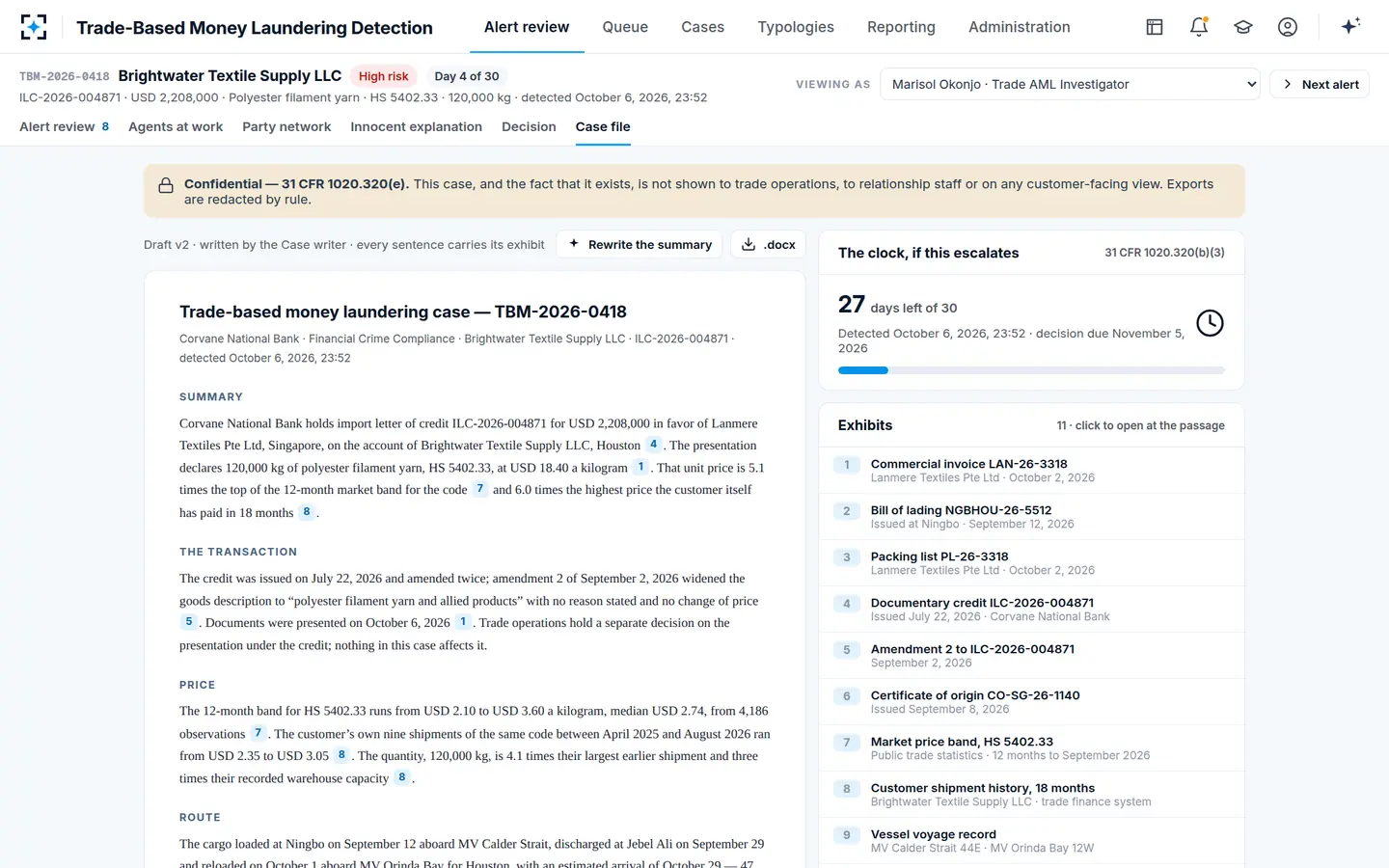
At the sample bank the investigator proposed escalation under reason code TBML-OVP-01, over-invoicing with a price outside the band and no document supporting it. The case the BSA Officer receives is titled as a trade-based money laundering case and walks through the transaction, price, route, parties and payment, documents and the explanations considered, each sentence tied to its exhibit. Whether to file, and how to complete the boxes and the narrative, stays with the BSA Officer; how to write a SAR narrative covers the narrative itself.
The typology travels with the case: a reason code on the decision
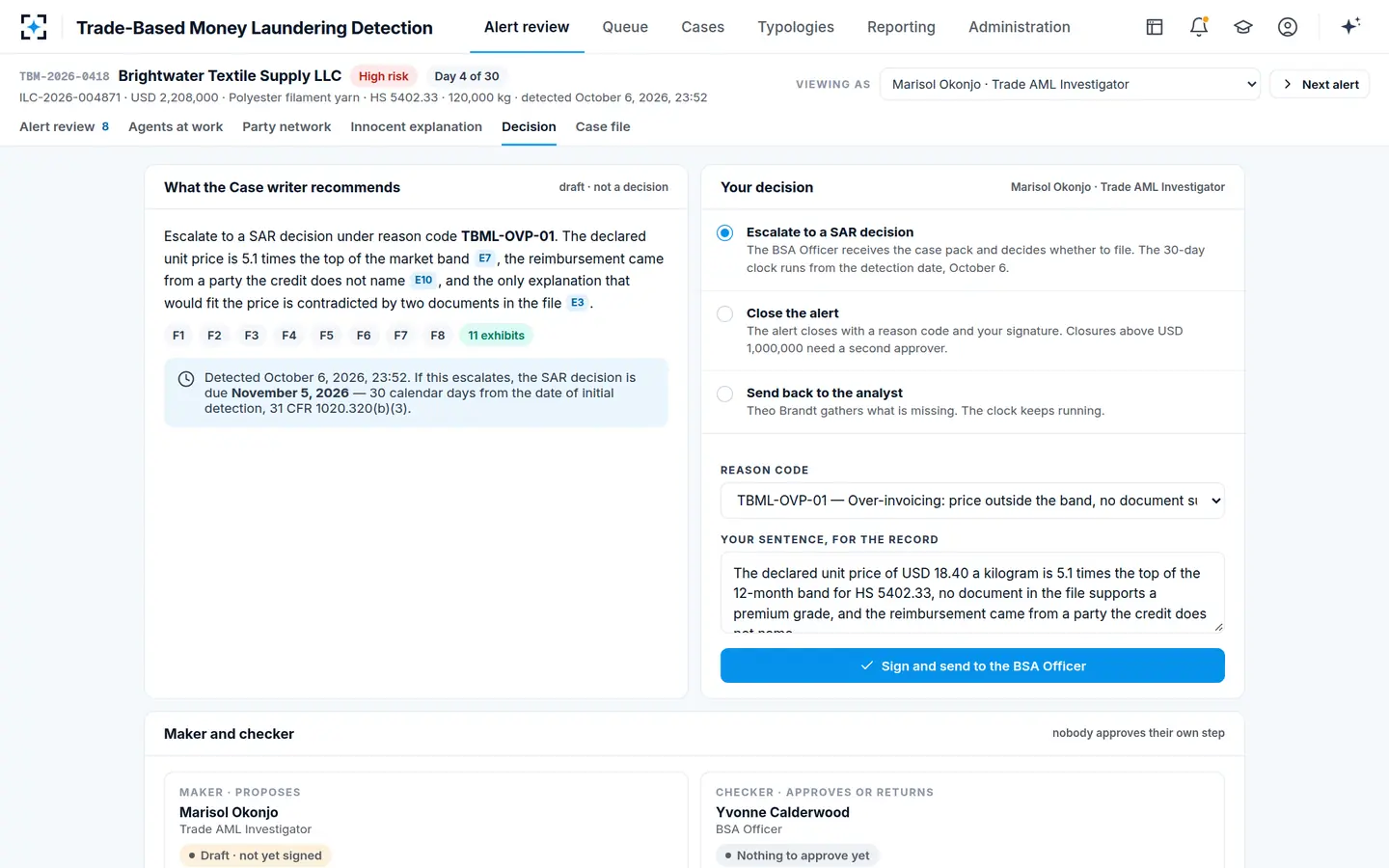
The rest of the numbers argue for patience with the evidence. FinCEN's lag figures show that trade schemes surface late, often after law enforcement has asked. A bank that keeps its cleared trade alerts with their written reasons can answer that later question; one that kept only a disposition code cannot. For the full sample case, start at Trade-Based Money Laundering Detection.
Questions people ask
Is the 2010 FinCEN TBML advisory still in effect?
FinCEN still lists FIN-2010-A001 on its advisories page in October 2026, and the FFIEC's trade finance section still cites it. Later advisories, including FIN-2014-A005 on funnel accounts and FIN-2025-A003 on Chinese money laundering networks, add to it rather than replace it.
Which SAR field covers trade-based money laundering?
Field 36(l), Trade Based Money Laundering/Black Market Peso Exchange, in the money laundering section of the SAR, as FinCEN's 2025 advisory identifies it. FinCEN asks filers to select it where it applies, together with any other relevant boxes, and to explain the suspicion in the narrative.
Who files most TBML SARs?
Banks. GAO reported that depository institutions filed about 79 percent of the SARs that specifically indicated TBML from 2016 to 2020; the rest came from other financial institutions covered by the reporting rules.
What red flags did the 2025 FinCEN advisory add for TBML?
Red flags for TBML run by Chinese money laundering networks, including businesses owned by Chinese nationals that receive marketplace deposits or export wires but rarely buy inventory, small electronics or real estate businesses receiving wires from Mexico, China, Hong Kong and the United Arab Emirates with no known nexus, and repeated credit card purchases of electronics paid down by unknown third parties.
Does FinCEN publish TBML statistics every year?
No. The public figures come from occasional analyses: FinCEN's 2010 advisory, GAO's reports in 2019 and 2021 using FinCEN data, and FinCEN's 2025 trend analysis of Chinese money laundering networks. A bank's own counts are the only regular series it will have.