Letter of credit money laundering risk is the chance that a documentary credit moves value for a launderer: an invoice priced at several times what the goods are worth, a voyage routed through a free-trade zone for no commercial reason, a reimbursement from a party the credit never names. The bank pays against paper, and the people who examine that paper are not the people who decide whether the trade is suspicious. The FFIEC asks banks to read the same documents twice, once for compliance with the credit and once for anomalies, and it says that a suspicious activity report does not oblige the bank to stop the trade. Botminds' Trade-Based Money Laundering Detection is built around that split: agents read every presentation for price, route, parties and documents, a trade AML investigator and the BSA Officer decide, and trade operations never see that a case exists.
The examples on this page come from a fictional sample bank, Corvane National Bank, as it runs through the solution. The rules and figures come from regulators and standard-setters, linked where they appear.
One instrument, two clocks, a book that is mostly in a few hands
$24.5bn
commercial letters of credit outstanding at FDIC-insured institutions on 30 June 2026, reported by 486 of them
5banking days
at most for each bank to decide whether a presentation complies, where the credit incorporates UCP 600
30days
to file a suspicious activity report from initial detection of facts that may warrant one, up to 60 if no suspect is identified
What is the money laundering risk in a letter of credit?
The risk is that the bank finances, or pays through, a trade whose documents misstate what moved and what it was worth. A letter of credit is a promise to pay against conforming documents, and the documents are produced by the parties who benefit from the payment. When the buyer and seller collude, a perfectly conforming presentation can carry an invoice inflated to move money from importer to exporter, a description that turns cheap goods into expensive ones, or a shipment that never sailed.
The FFIEC's examination manual puts the mechanism plainly: banks "need to be aware that goods may be over- or under-valued in an effort to evade anti-money laundering or customs regulations, or to move funds or value across national borders" (FFIEC BSA/AML Manual, Trade Finance Activities). The volume of paper adds to it. GAO, reporting the OCC's view, wrote that "trade finance products like letters of credit are more susceptible to documentary fraud because they require a large number of documents relative to other areas of banking" (GAO-22-447).
The instrument also has features of its own that launderers use. FATF and the Egmont Group list, among their trade activity indicators, the "use of letters of credit for unusually long or frequently extended periods without any apparent reason" (FATF and Egmont, TBML Risk Indicators, 2021). Amendments are the other one: an amendment that widens the goods description, changes the beneficiary or moves the place of payment can turn a clean credit into a vehicle for a different trade. The trade-based money laundering red flags a bank can actually see are sorted by role on a page of their own.
Which bank in the letter of credit sees what?
Each bank in the chain sees a different slice of the trade, and its duties follow its role. The FFIEC defines eleven roles in a credit, nine of them for banks, from issuing and confirming to reimbursing and paying, and asks the banks to do due diligence "commensurate with their roles in each transaction." GAO, citing the OCC, makes the same point about suspicious activity: "a bank may be the issuing bank, the confirming bank, or the receiving bank, and the responsibilities from a BSA perspective are different depending on the role that the bank plays" (GAO-22-447).
What each bank in a documentary credit holds, and what it owes
| Role | Whose customer | What it sees | What the AML read can reach |
|---|---|---|---|
| Issuing bank | The applicant (the buyer) | The application, the credit and every amendment, the presentation, the reimbursement claim | The applicant’s profile and history, the full document set, who pays and who is paid |
| Advising bank | Often the beneficiary | The credit and its amendments, before shipment | The credit’s terms and parties, not yet the shipping documents |
| Confirming or nominated bank | The beneficiary, or no customer at all | The presentation it examines, and its own payment to the beneficiary | Document anomalies; a beneficiary it may know little about |
| Reimbursing bank | The issuing bank | A claim and a payment instruction | Names for sanctions screening, almost nothing about the goods |
The issuing bank is the one that knows the customer. The manual is direct about what that means before the credit is opened: "Issuing Banks should conduct sufficient due diligence on a prospective customer before establishing the letter of credit," gathering information on applicants and beneficiaries, "including their identities, nature of business, and sources of funding." A bank that only confirms or reimburses sees the trade through a keyhole, which is why its controls look more like payment screening than like trade review.
Two decisions on one presentation
Every presentation under a letter of credit carries two decisions, made by different people on different clocks. Trade operations decides whether the documents comply with the credit, within the period the governing rules allow. Financial crime decides whether the trade is suspicious, and the reporting rule gives it far longer. The FFIEC asks for both reads on the same documents: "To the extent feasible, banks should review documentation, not only for compliance with the terms of the letter of credit, but also for anomalies or red flags that could indicate unusual or suspicious activity" (FFIEC BSA/AML Manual).
The same presentation, read twice for two different questions
The compliance decision: Do these documents comply with the terms of the credit and with each other?
The suspicion decision: Does this trade make commercial sense, and could it be moving value or proceeds?
The compliance decision: The document examiner in trade operations, with a checker for refusals
The suspicion decision: The trade AML investigator, with the BSA Officer approving any escalation
The compliance decision: At most five banking days after presentation under UCP 600 article 14(b), where the credit incorporates it
The suspicion decision: The bank’s own review period, then 30 days to file once the activity is determined to be suspicious
The compliance decision: The documents on their face; examining the goods is not the examiner’s job
The suspicion decision: Anything the bank holds: prices, voyages, payments, the customer’s history
The compliance decision: Paying against a discrepant presentation, or a refusal the bank cannot sustain
The suspicion decision: An unreported suspicion, or a report with no evidence behind it
The compliance decision: The presenter is told of every discrepancy in the refusal notice; that is part of the process
The suspicion decision: Nobody outside the reporting chain; a SAR and its existence are confidential
The two decisions draw on the same evidence but do not answer to each other. A presentation can be perfectly compliant and still be the most suspicious trade in the book, because the documents agree with one another about goods that were never worth the price. A discrepant presentation can be entirely innocent: a misspelt port, a late shipment date. Collapsing the two into one queue produces the worst of both, examiners who start refusing on suspicion and investigators who wait for a refusal that never comes.
Who is responsible for TBML in a bank?
Responsibility for trade-based money laundering sits with the BSA Officer and the financial crime function, not with trade operations, but trade operations is where the evidence is first seen. In practice five seats touch one trade alert, and each owns a different signature.
Five seats around one letter of credit, and what each signs
Today
Checks the presentation against the credit and the rules it incorporates, and notices odd things in passing with no structured place to put them.
With agents
Decides compliance on the same five-day clock, and receives document requests on the shipment without ever seeing the case behind them.
Still theirs: The compliance decision and the refusal notice
Today
Works a queue where most alerts turn out to be nothing, researching each one by hand to find out.
With agents
Reads alerts the agents have already priced, routed and linked, gathers what is missing and recommends; cannot close or escalate.
Still theirs: Triage and the request for evidence
Today
Looks up a trade statistic, scrolls a shipping site, searches the bank’s systems for the parties, then types the case.
With agents
Opens the shipment already drawn as a price and a route, tests the innocent explanations and decides.
Still theirs: The decision to close or to propose escalation, with a reason code
Today
Signs escalations whose reasoning lives in an investigator’s head and a paragraph of free text.
With agents
Receives a case with an exhibit on every sentence and both signatures on one trail.
Still theirs: Approval of every escalation, and the decision to file
Today
Samples closed alerts and asks why each was cleared, often with no written answer.
With agents
Reads every alert, the explanation that closed it and the document that proved it; can change nothing.
Still theirs: The independent test of the whole chain
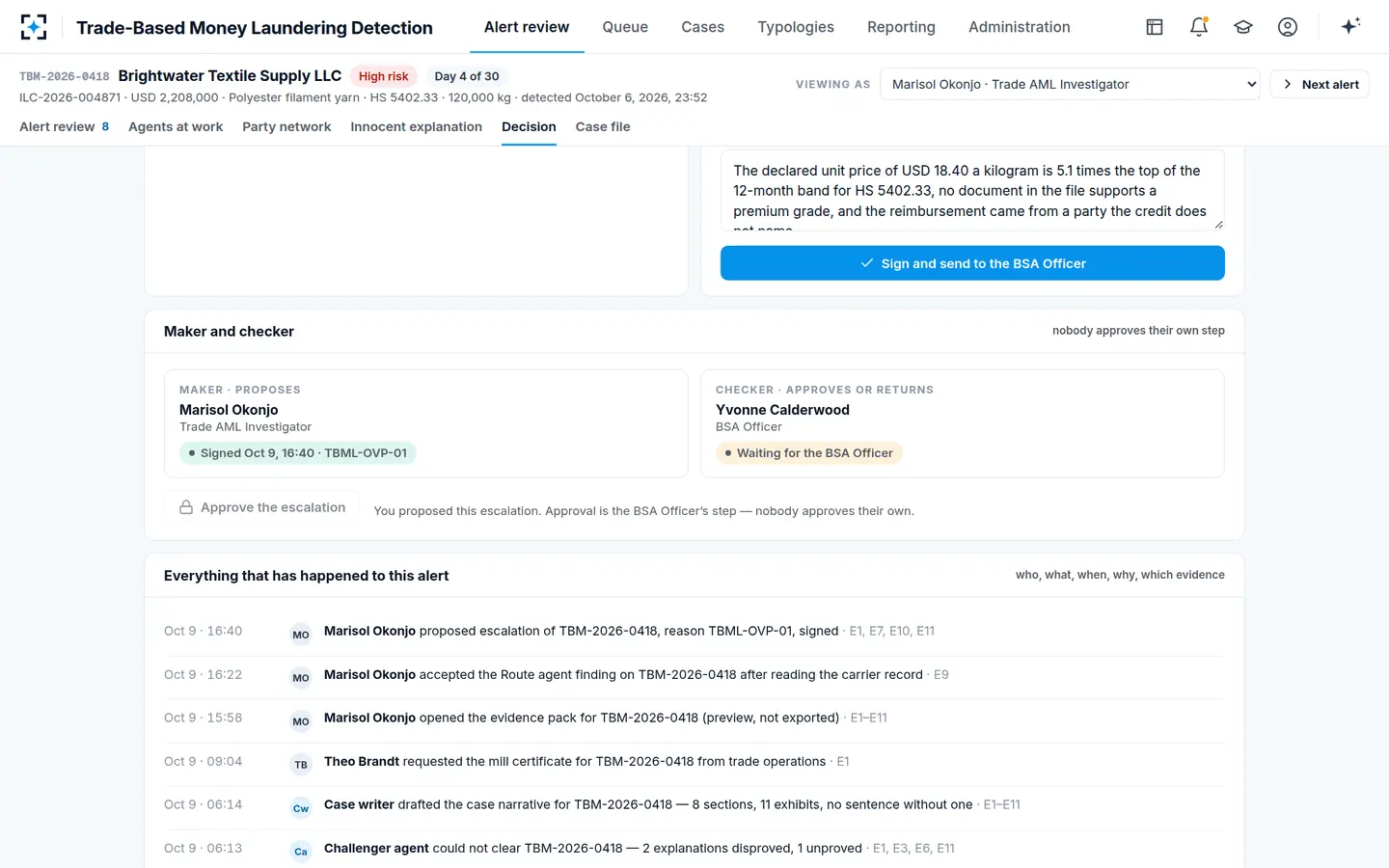
The investigator and the BSA Officer are a maker and a checker. The investigator proposes; the BSA Officer approves or returns. At the sample bank the solution also asks for a second signature on every closure above USD 1,000,000 and on every change to a threshold, because those are the decisions an examiner reads most closely after the fact.
Does a SAR stop a letter of credit payment?
No. A suspicious activity report does not oblige the bank to refuse the presentation or hold the payment, and the FFIEC says so in terms: "In circumstances where a SAR is warranted, the bank is not expected to stop trade or discontinue processing the transaction. However, stopping the trade may be required to avoid a potential violation of an OFAC sanction" (FFIEC BSA/AML Manual). The exception is sanctions: a sanctioned party, vessel or port in the documents is a blocking question, owned by the sanctions function, on its own rules.
That sentence is why the two decisions have to stay apart. If a suspicion could change the compliance decision, the examiner would need to know about the suspicion, and the refusal notice the beneficiary receives would carry its fingerprints. The reporting rule forbids that: a bank and its staff may not disclose a SAR or any information that would reveal one, and the SAR filing process sets out who may know what between alert and e-file.
The compliance clock ends long before the reporting clock starts
- Examine and decide≤ 5 d
- Review4 d target
- If suspicious: file within 30 days30 d
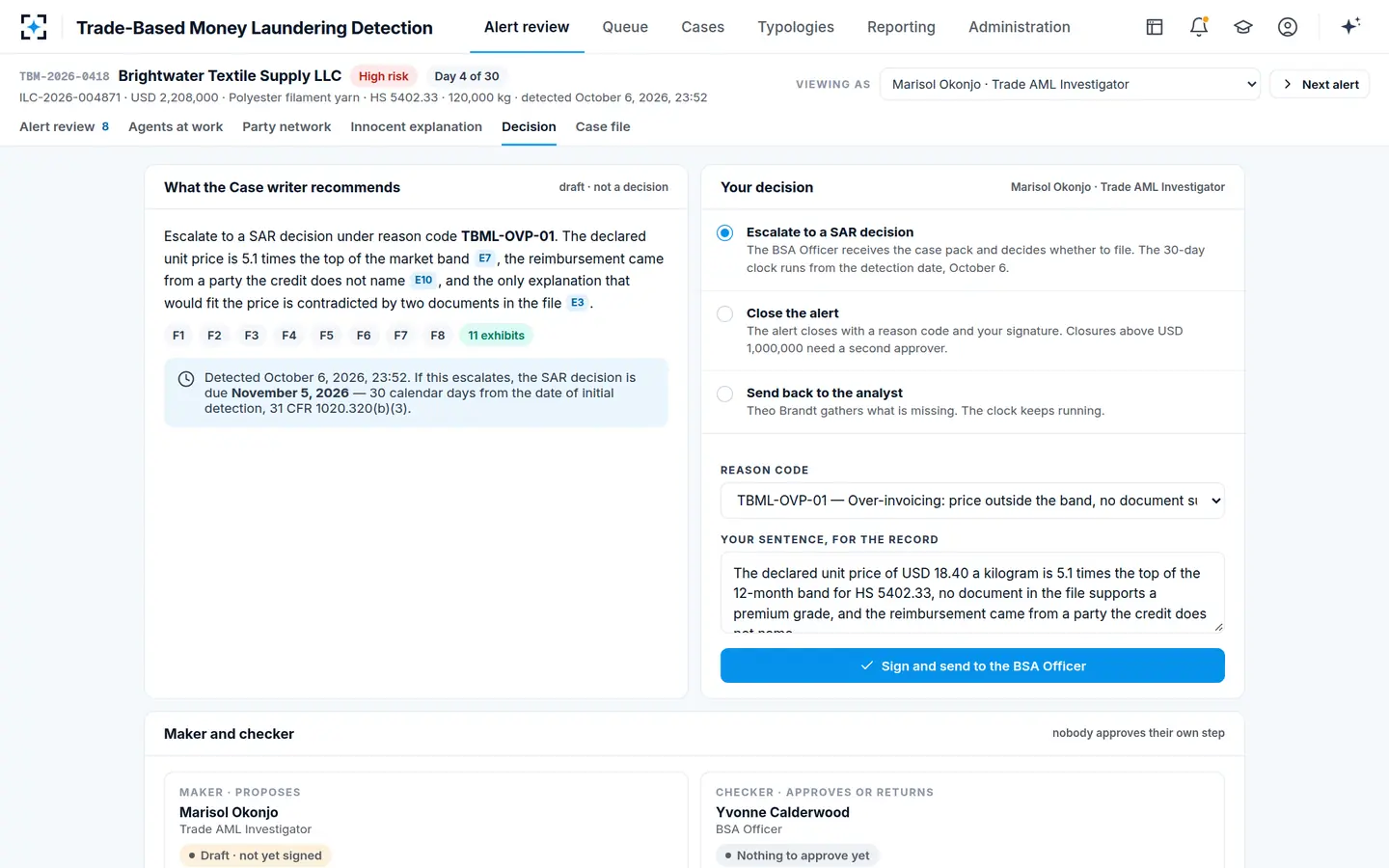
The sample alert shows the order of events. Corvane National Bank holds import letter of credit ILC-2026-004871 for USD 2,208,000, for 120,000 kg of polyester filament yarn at USD 18.40 a kilogram. Trade operations examined the presentation on its own clock. The financial crime case ran alongside: the agents found a price 5.1 times the top of the market band for the goods code, a reimbursement from a free-zone company the credit never names, and a transshipment that added 17 days to the voyage. None of that reached the examiner's screen.
The investigator's decision, with the reporting date in view and nothing on the compliance side
The red flags that sit inside the credit itself
Some trade-based money laundering red flags are visible only to a bank that holds the credit, because they live in its terms and its history rather than in the shipping documents. The FFIEC's list of what monitoring should give "greater scrutiny" includes two of them in its own words: "Shipment locations or description of goods not consistent with letter of credit" and "Significantly amended letters of credit without reasonable justification or changes to the beneficiary or location of payment." It adds that any change in the names of parties "also should prompt additional OFAC review" (FFIEC BSA/AML Manual).
At the sample bank the credit carried both. Amendment 2 widened the goods description from polyester filament yarn to "polyester filament yarn and allied products" with no reason stated and no change of price. The Document agent lists every amendment with the reason given, because an amendment that widens what may be shipped under the same price is precisely the change that lets an invoice describe goods the credit never priced. The examiner sees the same amendment for a different reason: whether the presentation complies with the credit as amended.
The third credit-level signal is time. A credit extended again and again, or held open far longer than the trade it finances, is a FATF and Egmont indicator in its own right. It is also easy to miss in a system that shows one presentation at a time, which is why the solution reads each credit's full life, every amendment and every extension, before it scores a presentation against it.
Keeping the two decisions apart in the system
Separation is easy to write in a policy and hard to keep in a system, because the two decisions use the same documents. The solution keeps them apart in three ways. The Document agent is barred from re-examining a presentation under UCP 600: it compares fields across documents to find anomalies and never states whether the presentation complies. Trade operations can open the same shipment and see the credit, the documents and its own clock, and nothing else. And no agent may contact a customer in any channel.
What crosses the line is a request, not a reason. When the investigator needs a mill certificate or a specification sheet to test whether a premium grade could explain the price, the request goes to trade operations as an ordinary document request on the shipment. The examiner sees which document is wanted; the case that wants it stays invisible.
Maker and checker: the investigator proposes, the BSA Officer decides
What examiners test in the letter of credit book
Examiners test whether the bank knows its trade customers, monitors the trade portfolio and writes down what its due diligence found. The FFIEC's examination procedures for trade finance ask the examiner to select a sample of trade finance accounts on the basis of the bank's own risk assessment and prior reports, to review the customer due diligence for each, and to verify that the bank monitors the portfolio for OFAC violations and unusual patterns (FFIEC, Trade Finance Activities, Examination Procedures). The sample is of accounts, which means an examiner sees an alert through the customer it belongs to.
The manual also scales its expectation to the book. Documentation review and management information should be "commensurate with the size and complexity of the bank's trade finance portfolio and its role in the letter of credit process." A bank that issues a few dozen import credits a year for long-standing customers is not expected to run the program of a global confirming bank. It is expected to show, for whatever it does, that both reads happened and that each decision has a name and a reason on it. Whether trade finance is considered high risk at all, and by whom, is a question the rules answer less simply than the shorthand suggests.
For a bank that wants both decisions on one record without either reaching into the other, Trade-Based Money Laundering Detection shows the full sample alert, from the overnight screening to the signed escalation.
Questions people ask
Does a letter of credit carry money laundering risk?
Yes. A letter of credit pays against documents prepared by the parties to the trade, so a colluding buyer and seller can use conforming documents to move value through mispricing, false descriptions or shipments that never happened. The FFIEC notes that because trade finance leans on documents more than most banking, it is open to documentary fraud tied to laundering.
What is the difference between trade operations and trade AML?
Trade operations decides whether a presentation complies with the credit, on the documents alone and within the period the governing rules allow, five banking days under UCP 600. Trade AML decides whether the trade is suspicious, using anything the bank holds. The two read the same documents for different questions and should not decide for each other.
Who signs the SAR on a trade case?
The bank's own procedures name who decides and signs; at the sample bank it is the BSA Officer, with the investigator proposing and unable to approve her own escalation. Trade operations and relationship staff are not in that chain, because a SAR and any information that would reveal it are confidential under 31 CFR 1020.320(e).
What due diligence does an issuing bank owe before opening a credit?
The FFIEC expects the issuing bank to gather information on applicants and beneficiaries, including their identities, nature of business and sources of funding, before establishing the credit, with background checks where the jurisdiction is higher risk. Banks in other roles do due diligence commensurate with their role in each transaction.
Does a confirming bank have to look for money laundering?
Yes, in proportion to its role. The FFIEC asks banks in roles other than issuing to complete due diligence commensurate with their roles in each transaction, and warns that "Issuing Banks may not always have correspondent relationships with the Advising or Confirming Bank," so a confirming bank may be dealing with an issuer it knows little about.