Trade-based money laundering examples in public records share one pattern: value moves under cover of a trade, through a price that does not fit the goods, goods that do not match the paperwork, or a payment that does not follow the shipment. The best-documented cases include the black market peso exchange, in which drug dollars in the United States pay for goods exported to Latin America; Chinese money laundering networks that buy phones and electronics with criminal proceeds and export them; European networks that moved drug money through trade in potatoes, onions and cars; and, in October 2026, a $350 million OCC penalty against American Express National Bank tied in part to about $13 billion of suspected TBML that was not reported in time. Read from the regulators' and investigators' own documents, each case points at a control a bank can run. Botminds' Trade-Based Money Laundering Detection is built around those controls, from price bands to party links, with a person deciding every alert.
The cases come from FATF and the Egmont Group, GAO, FinCEN, Treasury and the OCC, linked in each section; several describe charges or allegations, and we say so where they do. Where the page shows the solution, the data are a fictional sample bank's.
Three numbers from the public record
$13bn
of suspected trade-based money laundering at American Express National Bank not timely identified or reported, over about a decade
$6bn+
in credit card charges, over seven million of them, in one CMLN electronics scheme a single SAR filer reported for 2019–2024
€400m
suspected laundered over about four years by a professional network using trade in potatoes and onions, among other methods
What are examples of trade-based money laundering?
The textbook examples are FATF's 2006 techniques: over- and under-invoicing, multiple invoicing of the same goods, over- and under-shipment including shipments that never happen, and goods described as something more or less valuable than they are. The public cases show those techniques in combinations, and they show something the textbook does not: most schemes needed a bank to process ordinary-looking payments, and the trade documents, where they existed, were consistent with each other. The FFIEC manual describes the bluntest version in one line: "an importer may pay a large sum of money from the proceeds of an illegal activity for goods that are essentially worthless and are subsequently discarded" (FFIEC BSA/AML Manual).
Nine public TBML cases and typologies, and the control each one tests
| Case | Source | What happened | The control it tests |
|---|---|---|---|
| Black market peso exchange, US and Colombia (indicted January 2020) | FATF and Egmont 2020, Box 2.9 | Alleged brokers placed drug cash in US accounts and paid a merchant who exported electronics to Colombian importers, who paid pesos to the brokers | Who funds an exporter’s receipts, and whether payments come from the buyer |
| Phones and electronics, Australia (from 2017) | FATF and Egmont 2020, Box 2.8 | More than AUD 500 million through Australian accounts since 2014; exported devices under-valued to move value offshore | Price against the market, and mirror data held by customs |
| Potatoes and onions, France, Belgium and the Netherlands (2016–2019) | FATF and Egmont 2020, Box 2.7 | A network suspected of laundering about €400 million; North African buyers told to pay invoices into accounts the traffickers controlled | Payments for goods to parties other than the seller |
| Luxury vehicles, Spain and Italy (2017–2018) | FATF and Egmont 2020, Box 2.6 | Cars bought with criminal cash, fake sales chains, and imports of watches, shoes and fabric; EUR 8 million of assets identified, then property, vehicles and 32 bank accounts seized | Goods inconsistent with the line of business |
| Damaged cars at transshipment (2020 report) | FATF and Egmont 2020 | Right price declared at export, a much lower one at transshipment, payments routed through other companies | Value consistency along the route |
| Chinese money laundering networks, US (2020–2024 data) | FinCEN advisory and trend analysis, 2025 | Phones and luxury goods bought with card credit paid down by unknown parties, then exported | Card and account patterns that fund exports |
| MUFG Bank federal branches (2019) | OCC order, as GAO described it | Alleged weaknesses in trade finance monitoring, among others; no finding of TBML | The trade finance monitoring program itself |
| American Express National Bank (2026) | OCC news release | About $13 billion of suspected TBML not timely identified or reported; risk assessment not tailored to the card business | A risk assessment that sees every product TBML can use |
| Jewellery via Jordan, US (charged 2025) | Treasury, 2026 NMLRA | Alleged false claims of Jordanian origin to avoid more than $86 million in duties on over $1.2 billion of jewellery imports | Origin and route against the documents |
The widget arithmetic: over- and under-invoicing in one example
FATF's 2006 report explains price manipulation with two invoices for a million widgets worth $2 each. Invoiced at $1, the importer pays $1 million, sells the widgets for $2 million and holds the extra $1 million for the exporter's side; invoiced at $3, the importer pays $3 million and the exporter, after paying $2 million to its suppliers, holds $1 million for the importer's side (FATF, 2006). The report adds that the two companies may belong to the same organisation, and that a parent can sell at a fair price to an affiliate in a weaker jurisdiction, which then re-invoices at a false one, moving the mispricing offshore.
The arithmetic matters because it shows what a bank can test. It cannot know what each widget is worth, but it can see when a price is many times what similar goods cost and what the same customer paid last year. How a unit-price band is built, and its limits works through that test on a sample letter of credit.
What is the black market peso exchange?
The black market peso exchange is a scheme in which drug dollars in the United States are swapped for pesos in Colombia through trade, so that no cash crosses the border. A broker takes the cartel's dollars in the United States and uses them to pay US suppliers for goods that Colombian importers want; the importers pay the broker in pesos at home, and the broker pays the cartel, minus commission. FATF and Egmont's 2020 case study describes a January 2020 US indictment of six Colombian nationals who allegedly worked with an Indian national, an alleged complicit merchant whose business exported consumer electronics to buyers that included importers in Colombia (FATF and Egmont, 2020).
The bank's view of such a scheme is a US exporter receiving payment for real goods. The goods ship, the documents agree and the price may be fair. What is wrong is who pays: cash deposits and wires from parties with no connection to the buyer, which is why third-party payment is the first red flag on FinCEN's 2010 list. What FinCEN asks filers to call these cases is covered in the FinCEN advisory and what the SAR data say.
What was the Amex TBML case?
On 8 October 2026 the OCC announced a cease-and-desist order and a $350 million civil money penalty against American Express National Bank for deficiencies in its BSA/AML program, and found that systemic breakdowns in suspicious activity monitoring and reporting led to a failure to identify, evaluate and sufficiently report, in a timely way, about $13 billion of suspected trade-based money laundering over the past decade. The OCC also found that the bank's risk assessment had focused on its relatively narrow deposit products and too little on its dominant credit and charge card business. The Federal Reserve issued a concurrent order against the parent companies (OCC news release 2026-87).
The case matters for trade finance teams precisely because it is not a trade finance case. TBML ran through card products, which the bank's risk assessment under-weighted, and the FinCEN data on Chinese money laundering networks describe the same route: cards used to buy phones and electronics in volume, paid off by third parties, with the goods exported. A bank whose TBML monitoring covers only its letters of credit is watching the part of the business that holds the documents, and possibly not the part that carries the money. How the Amex order bears on risk assessment categories is examined in BSA risk assessment categories.
What did MUFG's order say about trade finance?
The 2019 OCC order against three US federal branches of MUFG Bank is known to the public mainly through GAO, which described it as highlighting alleged weaknesses in monitoring of international funds transfers, in due diligence for foreign correspondent accounts, and in the branches' "processes and procedures for trade finance monitoring." GAO was careful about what the order did not find: "The cease and desist order did not find that the banks engaged in, or were party to, TBML-related schemes, but that their processes and procedures had alleged weaknesses that could be exploited" (GAO-22-447).
That is the most common shape of trade finance enforcement: a finding about the program, not about a laundered shipment. Examiners test whether the bank monitors its trade portfolio and records what its due diligence found, and a program that cannot show both is a finding whether or not any laundering is proved. The monitoring measures that show it are set out in trade-based money laundering transaction monitoring KPIs.
What are circular trades?
A circular trade, or round-tripping, is a payment flow that leaves a country and comes back after passing through others, so that value returns to where it started with a trade to explain each leg. FATF and Egmont list it among their account indicators: "Payments are routed in a circle – funds are sent out from one country and received in the same country, after passing through another country or countries" (FATF and Egmont, TBML Risk Indicators, 2021). A circle is hard for any one bank to see whole, because each leg can sit at a different bank.
What a bank's own records show in each case
A trade that pays for goods: The applicant, from its own account
A circle that pays for itself: A free-zone company the credit never names
A trade that pays for goods: To its suppliers and costs
A circle that pays for itself: USD 1,960,000 in four wires to that same free-zone company
A trade that pays for goods: The buyer or its agent
A circle that pays for itself: A Hong Kong company at the payer’s registered address
A trade that pays for goods: Purchase order, supplier invoices
A circle that pays for itself: None: no group chart, no affiliate recorded
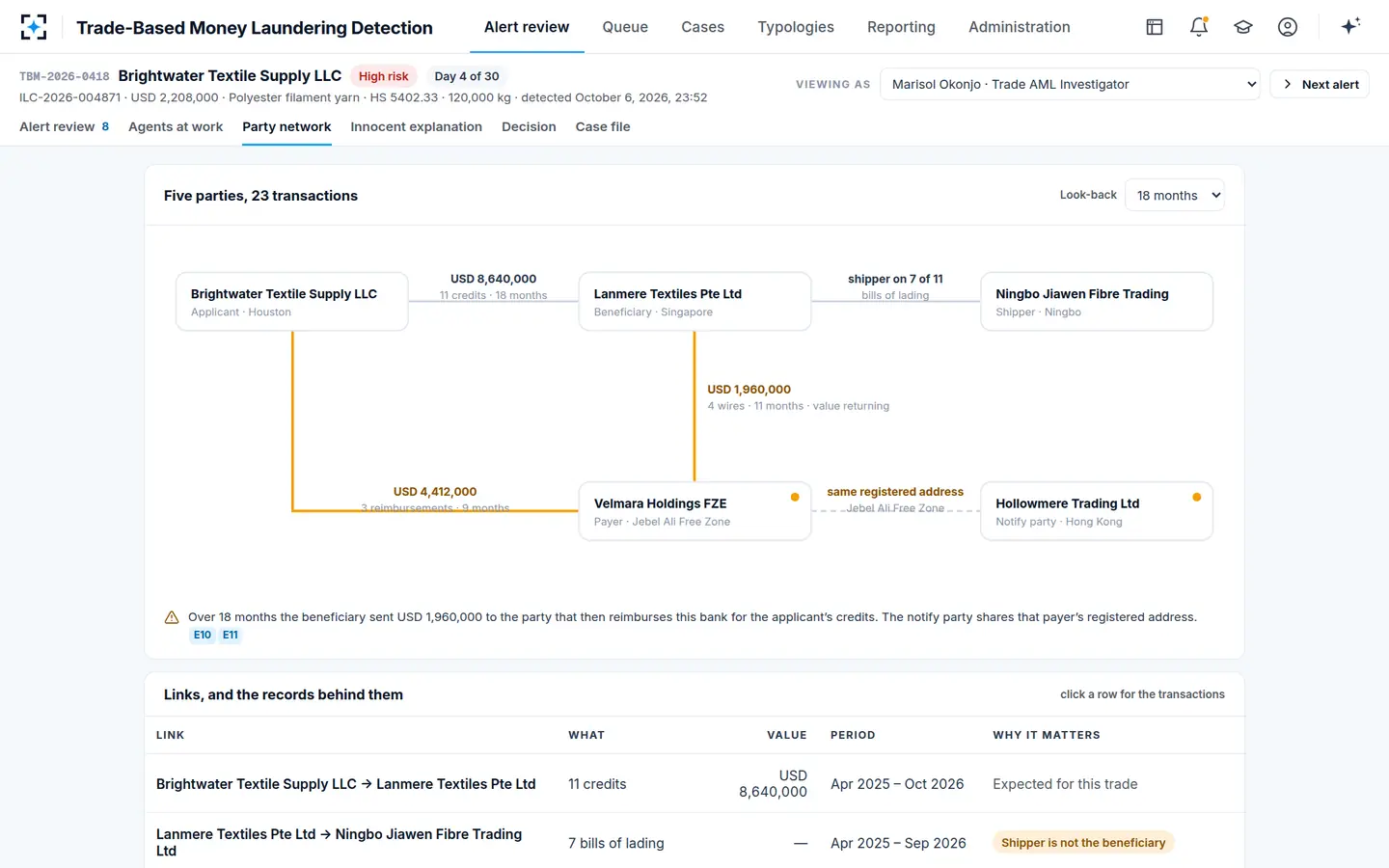
Inside one bank, part of the circle is often visible. On the sample alert the bank paid USD 8,640,000 under 11 credits for its applicant over 18 months, received USD 4,412,000 of reimbursements from a free-zone company the credits never name, and its own records show the beneficiary paying that company USD 1,960,000. The sample bank's queue holds another: USD 2.7 million returned between two parties in nine months. Not every circle is laundering; one the sample bank cleared involved two subsidiaries of one group, recorded in the due diligence file since 2021.
Part of a circle, from the records one bank holds
Phones, potatoes and cars: what the FATF and Egmont cases show
The 2020 FATF and Egmont report's case studies show that TBML uses whatever trade is convenient, not only high-value goods. In the Australian case, the Australian Border Force found more than AUD 500 million had passed through Australian bank accounts since 2014; proceeds of drug sales in North America were layered through many accounts and used to buy small, high-end electronic devices for export to South East Asia and the Middle East, and under-valuing the exports exaggerated the value moved. The investigators caught the mismatch by comparing export declarations with the partner country's import declarations, data no bank holds.
In the French, Belgian and Dutch case, a professional laundering network suspected of handling about €400 million over four years used, among other methods, an underground banker in the Netherlands who exported potatoes and onions to North Africa; the buyers were directed to pay the invoices into accounts controlled by the traffickers. Sentences were handed down in 2019, with €4.8 million of assets and more than €7 million in cash seized. In the Spanish and Italian case, criminal cash bought luxury vehicles in Germany, fake sales chains generated tax fraud, and import companies bought watches, shoes and fabric for onward sale.
"They do not use any of the common TBML techniques, instead they exploit these legitimate supply chains to move their criminal proceeds to different jurisdictions."
FATF and Egmont Group, TBML: Trends and Developments (2020)
The vegetable case is the uncomfortable one for a price-based program. On FATF's account, no common technique was used, mispricing included. The control that would have seen it was the payment: a buyer told to pay the seller's invoice into an account that is not the seller's.
Illicit trade in the 2026 risk assessment
Treasury's 2026 National Money Laundering Risk Assessment widened the picture from laundering through trade to proceeds from illicit trade, and its examples are close to the documents a trade bank handles. In one, an Indonesian jewellery company and three individuals were charged with evading more than $86 million in duties on more than $1.2 billion of jewellery imports, partly by shipping jewellery made in Indonesia through Jordan and falsely claiming Jordanian manufacture. In another, three individuals were indicted for receiving packages from a Colombian company that purported to contain metal widgets, half of which held gold cylinders painted over to avoid detection. Mexico-based cartels' stolen crude, the assessment notes, is often mislabelled as "waste oil" or another supposedly hazardous material (Treasury, 2026 NMLRA). These are charges, not convictions.
Each example is a document that says something false about origin, contents or description. A bank financing such a trade would see a certificate of origin, a packing list or a commercial description, consistent with each other and false about the goods. The checks that sometimes catch them are outside the documents: the route against the claimed origin, the customer's history against its new goods, the price against what the description implies.
What each case teaches the monitoring program
Read together, the cases point at five controls, and only one of them is a price check. Price against the market and the customer's own history catches the electronics under-valued for export. Payments against the trade catch the peso exchange and the vegetable buyers paying the wrong account. Party links across months catch the circle. Route and origin against the documents catch the transshipment and false-origin cases. And a risk assessment that covers every product TBML can use, cards and open account included, catches the gap the Amex order exposed.
One queue, several typologies: over-invoicing, third-party payer, circular value, duplicate invoice
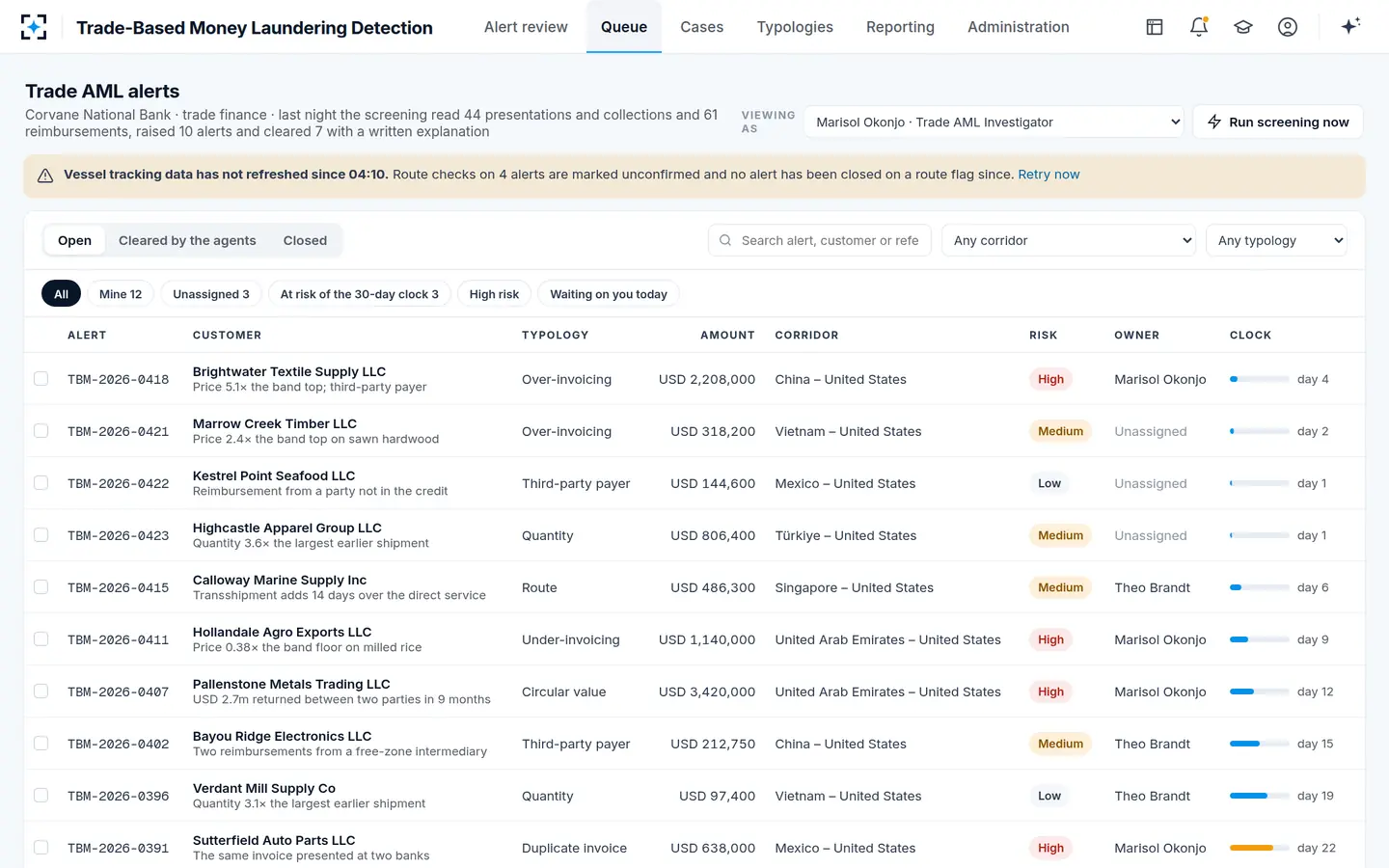
The solution runs all five on the trade a bank handles and lets a person decide each alert, with the evidence assembled. For the full sample case, start at Trade-Based Money Laundering Detection.
Questions people ask
How does trade-based money laundering work?
Criminals move value by misstating a trade: the price, the quantity, the description or the fact of shipment, or by paying for real goods with criminal money through third parties. FATF defines TBML as disguising the proceeds of crime and moving value through trade transactions to legitimise their illicit origin.
What are phantom shipments?
Shipments that exist only on paper: the exporter and importer collude so that documents for goods never shipped are processed, and payment moves value. FATF lists them under over- and under-shipment, its extreme case, and notes that schemes may mix real shipments with phantom ones to look legitimate.
Was Amex fined for trade-based money laundering?
The OCC's $350 million penalty in October 2026 was for deficiencies in the bank's BSA/AML compliance program. Among the findings was a failure to identify and report, in a timely way, about $13 billion of suspected trade-based money laundering; the findings the OCC describes concern the bank's compliance program, its monitoring and its reporting.
What goods are most used in TBML?
No single category. FATF and Egmont's 2020 cases include electronics, vehicles, textiles, potatoes and onions, and list lumber, plant machinery, scrap metal, fuel and drinks among other sectors exploited. FinCEN's 2010 red flags were tied to high-value goods such as electronics, auto parts and precious metals and gems.
Are trade-based money laundering cases usually prosecuted as TBML?
Often not under that name. Public records describe them as money laundering, smuggling, customs or tax fraud, sanctions evasion or program failures at a bank, which is one reason TBML is hard to count.