Examples of trade finance fraud on the official record include metal pledged several times over in Qingdao's bonded warehouses, forged warehouse receipts for nickel, forged copy bills of lading and a cargo that was never shipped behind two Hin Leong letters of credit, invented sale contracts discounted at a bank, falsified audited accounts that opened credit at 16 lenders, one receivable assigned to two banks, and containers of steel sold and financed as nickel. Every one of them passed through a bank's ordinary process, because the documents were complete and regular on their face. This casebook reads each example in the court judgment or the prosecutor's release, sets out what was false and which document carried it, and names the single check that would have asked the right question before funding. Botminds' Trade Finance Fraud Detection, which checks each trade financing's cargo across the bank's desks and against carriers', vessel and container data before funding, is built around those checks.
Figures here come only from judgments, police and prosecutors. Totals that circulate in the press for the 2020 commodity-trader collapses do not appear in those records, so they are left out.
From the money moving to a final judgment: years, not days
- Found to judgment12 months
- Found to judgment32 months
- Found to judgment39 months
- Investigation to sentence36 months
- Credit to appeal43 months
- Refusal to final ruling52 months
- Discounting to conviction50 months
- Appeal22 months
What was the Qingdao metals fraud?
In 2014 banks found that metal they had financed in bonded warehouses at the Chinese ports of Qingdao and Penglai was missing or had been pledged several times. The English Commercial Court's judgment in Mercuria Energy Trading v Citibank records the scale as the banks first saw it: Standard Chartered was told by the port authority that there were "approximately 60,000 to 70,000 tonnes of aluminium inside the port: Citi alone was supposed to have 73,000 tonnes stored there". At Penglai, where Citi's receipts covered about 20,000 tonnes, a stock check found 16,000 ([2015] EWHC 1481 (Comm)).
The mechanism, as reported to Citi, was a trader colluding with a port company to issue fraudulent port receipts to the warehouse operators, who then issued warehouse receipts to Citi; the port receipts behind the Penglai metal had not been signed by anyone with authority (warehouse receipt financing quotes the record). The court's holding turned on what a receipt is: Citi accepted the warehouse receipts it had tendered "were not documents of title", so handing them over did not deliver any metal. The check that asks the right question: count the stock and confirm with the warehouse that it holds the goods for you, rather than relying on the receipt. The full lending angle is in warehouse receipt financing.
Sixteen forged receipts: Natixis v Marex
Between November 2016 and January 2017 Natixis bought nickel from Marex in repo-style trades, paying against warehouse receipts in the name of the warehouse operator Access World. In February 2017 Access World inspected them and reported that not one of the sixteen receipts was genuine, including fourteen it had earlier confirmed as authentic. Natixis claimed US$32,114,093; the court found it never acquired title to any nickel ([2019] EWHC 2549 (Comm)).
The judgment also records the decision that let the first receipts through: Marex's managers had agreed to courier originals to the warehouse for authentication, then accepted emailed scans because the customer wanted speed, knowing the main security feature could not be checked on a scan. The check: authenticate the original with its issuer before paying, every time, including when a deal is in a hurry.
What happened at Hin Leong?
Hin Leong Trading, a Singapore oil trader later placed under interim judicial management, left two lines of court record. The first is about letters of credit. On the afternoon of 27 March 2020 a circular trade was struck: Hin Leong sold gasoil to Trafigura at 2.54pm, Trafigura sold the same quantity to Winson at 3.19pm, and Winson sold it back to Hin Leong at 5.10pm, with Hin Leong's banks issuing letters of credit for the last leg. Both banks refused to pay, saying no cargo had been shipped and that the copy non-negotiable bills of lading behind Winson's presentations were forgeries. Hin Leong's interim judicial managers reported, as the Court of Appeal recounts, that "the cargo onboard the Ocean Voyager was sold to at least three buyers, and the cargo onboard the Ocean Taipan was sold to at least two buyers". The Court of Appeal upheld the banks on the fraud exception in August 2024 (Winson Oil v OCBC [2024] SGCA 31).
The second line is criminal. Hin Leong's founder was convicted in May 2024 of cheating HSBC over two discounting applications, for which the bank disbursed US$111,683,939; the Singapore Police Force said "the two transactions were complete fabrications" supported by forged or fabricated documents, and 130 charges had been brought in all (SPF, 10 May 2024). On appeal in March 2026 the High Court upheld the conviction and reduced the sentence to 13 years and six months, agreeing the offences were hard to detect because they concerned contracts "that only the purported counterparties could confirm" ([2026] SGHC 47). The checks: ask the carrier whether it issued the bill, and look for the same cargo in other financings; for silent receivable discounting, the only independent confirmation is from the named buyer.
What is the Agritrade case?
Agritrade International, a Singapore coal and palm-oil trader, defaulted on credit that financial institutions had granted against falsified accounts. The Singapore Police Force reported that its former chief financial officer "deceived 16 financial institutions" into believing the group's financial statements were audited, that they granted "at least USD 586.5 million in credit facilities" between January 2017 and November 2019, and that their loss came to "around USD 469.1 million". Most of the money drawn went to purported suppliers that were "actually connected to AIPL in a material fashion" (SPF, 17 January 2023). She was sentenced to 20 years.
A separate charge in 2021 alleged that she cheated one bank into believing that "19 bills of lading had been legally and validly pledged" in its favour, so that it disbursed US$19.9 million to a supplier (SPF, 20 September 2021); the 2023 conviction listed 11 counts of cheating and one of falsifying accounts. The checks: confirm audited accounts with the auditor, and test whether the "suppliers" being paid are independent of the borrower.
One receivable, two banks: the ZenRock case
In April 2020 ZenRock Commodities Trading induced Crédit Agricole CIB to issue a letter of credit for a cargo of Congolese crude by showing it a doctored copy of its on-sale contract. As the Singapore International Commercial Court of Appeal put it, "Zenrock simply doctored a copy of its sale contract with TOTSA" to show a price of Brent plus US$3.60 a barrel instead of Brent minus US$3.60. The credit came to US$23,662,732.50 against a true invoice of US$16,517,443.06, "about 50% higher than the market price". ZenRock had also assigned "to ING its receivable under its contract with TOTSA", then told the buyer that the receivable had in fact been assigned to Crédit Agricole ([2023] SGCA(I) 7). The bank was awarded US$10,319,470.81 against the credit's beneficiary for breach of a warranty of title, not on the fraud itself.
The checks: confirm the price with the buyer or against the market, and check whether the receivable is already assigned. One bank cannot see another's assignment, which is why a notice of assignment acknowledged by the buyer is a control, not paperwork.
What was the Trafigura nickel fraud?
Between January and October 2022, Trafigura bought 107 containerised cargoes sold as LME-grade nickel from companies controlled by Prateek Gupta, paying about US$500 million. The shipping documents all described nickel; the containers, when inspected in Rotterdam in November 2022, held "what appeared to be carbon steel, rather than Nickel cathodes as the BL had specified". The English Commercial Court found "fraud on a grand scale" in January 2026, and that Trafigura had sold the material it received for just under US$10 million, about 2% of what it paid ([2026] EWHC 159 (Comm)).
The scheme worked "as long as Trafigura did not carry out inspections and accepted the truth of what was stated in the shipping documents".
Saini J, Trafigura v Gupta [2026] EWHC 159 (Comm)
Two details make it a case about checks, not only about inspection. A forwarder printed a second set of bills for three cargoes without the carrier's authority, so another company presented Maersk with apparently original bills for the same goods. And Trafigura's own staff had flagged voyage times, including a 95-day transit from Taiwan to China, without that becoming a decision. The checks: ask the carrier how many originals it released and to whom, test the voyage time, and inspect when the documents and the trading pattern stop making sense.
What was the Balli Steel fraud?
The Serious Fraud Office prosecuted the former chief executive and two senior executives of Balli Steel Plc, who were jailed in March 2023 "for defrauding over 20 banks and securing loans for around half a billion dollars" (SFO, 1 December 2023). The SFO's release does not describe the documents used, and accounts of the mechanism appear only in press reporting, so this casebook records the scale and the number of banks and leaves the method open. Its lesson stands on those facts alone: twenty banks each saw part of the borrowing.
The US record: forged bills under letters of credit
US prosecutions show the same document at a smaller scale. In 2013 an Illinois business owner admitted that he "caused payments to be disbursed under these Letters of Credit" by "creating and presenting fraudulent Bills of Lading, Certificates of Origin, and packing lists", and that on some occasions "he shipped worthless scrap materials" instead of wood pulp (US Attorney, N.D. Illinois, 13 May 2013). In 2011 the owner of an El Paso freight forwarder was sentenced to 70 months after he and others prepared "false commercial invoices, bills of sale, bills of lading" for about 13 Export-Import Bank-backed loans totalling some US$17.9 million, all of which defaulted (DOJ, 27 May 2011).
And forged bills harm the bank that holds the genuine ones too. In Fimbank v Discover Investment, the claimant's case was that the cargo "was delivered away out of the warehouse against production of forgeries of the bills of lading in circumstances where the originals were with Blom Bank in Egypt, acting as collecting bank for the claimant on a documents against payment basis" ([2020] EWHC 254 (Comm)). Holding the originals is security only if nobody releases the goods without them.
Ten cases, the false document and the check that would have asked
| Case | What was false | Document attacked | The check before funding |
|---|---|---|---|
| Qingdao (2014) | Metal missing or pledged several times | Port and warehouse receipts | Count the stock; confirm the warehouse holds it for you |
| Natixis v Marex (2016–17) | Sixteen counterfeit receipts | Warehouse receipts | Authenticate originals with the issuer |
| Winson / Hin Leong (2020) | No cargo; forged copy bills | Bills of lading, letters of indemnity | Ask the carrier; search for the same cargo |
| Hin Leong discounting (2020) | Sale contracts invented | Contracts, invoices, delivery documents | Confirm with the named buyer |
| Agritrade (2017–19) | Accounts not audited; related "suppliers" | Financial statements | Confirm with the auditor; test supplier independence |
| ZenRock (2020) | Contract price doctored; receivable assigned twice | Sale contract, assignment | Confirm price and assignment with the buyer |
| Trafigura v Gupta (2022) | Steel sold as nickel; duplicate bills | Bills of lading, certificates | Ask the carrier about originals; test voyage time; inspect |
| Balli Steel (to 2023) | Not stated by the SFO | Not stated | See every desk’s exposure to the borrower |
| Illinois, 2013 | Goods not shipped as stated | Bills of lading, certificates of origin, packing lists | Ask the carrier; compare weights |
| Fimbank (2018 cargo) | Forged bills used to take delivery | Bills of lading | Carrier releases only against originals |
What the cases have in common
Three things recur. The documents were regular, so document examination passed them. The facts that would have exposed them sat with someone else: a carrier, a warehouse, an auditor, a buyer or another desk. And the time to ask was before funding, because afterwards the recoveries were small and the litigation long; the shortest path above, from the Qingdao discovery to judgment, took a year.
The casebook in four numbers
16
institutions that lent to Agritrade against falsified accounts
20+
banks the SFO says Balli Steel defrauded
3+
buyers the Ocean Voyager’s one cargo was sold to, per Hin Leong’s interim judicial managers
~2%
of the price Trafigura recovered by selling what it received
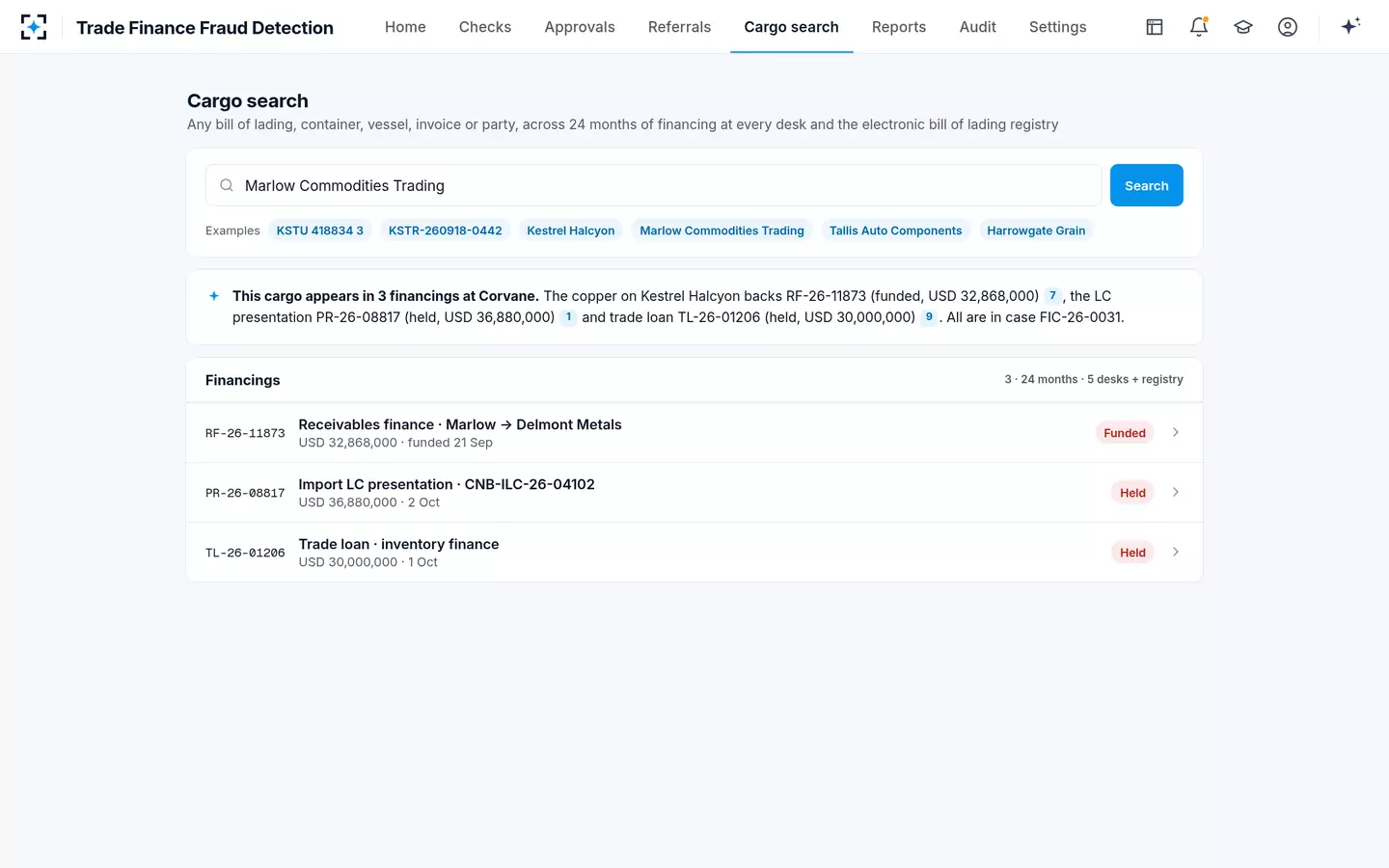
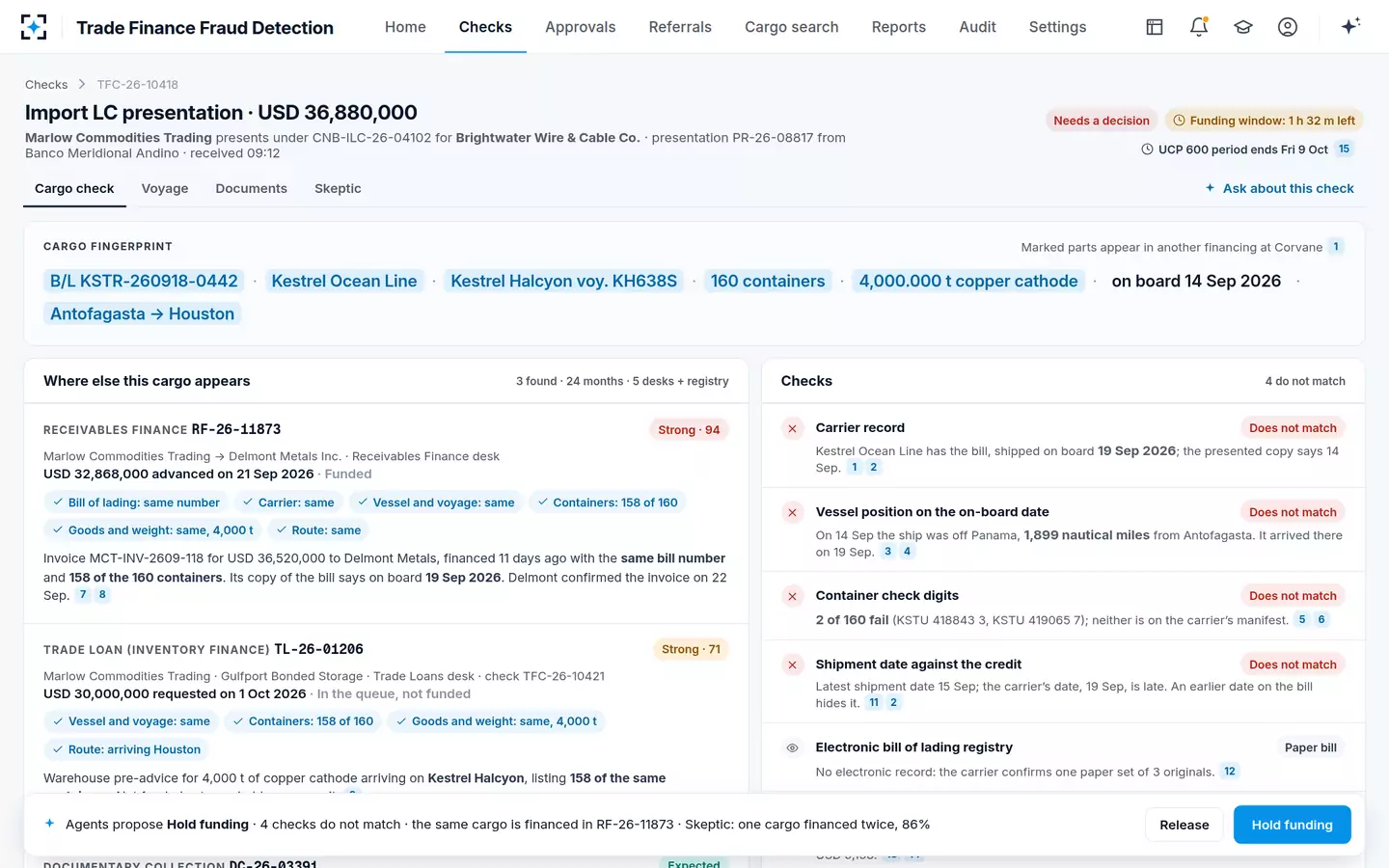
The checks that recur are the ones Trade Finance Fraud Detection runs on every financing: search every desk for the same cargo, confirm the bill with the carrier, place the vessel, test the containers, compare the price with the parties' history. They cannot reach everything. A falsified audit opinion, a contract only a buyer can confirm and financing at another bank need outside confirmation the agents do not perform, and the solution's referral writer drafts that request for a person to send. Take a fictional sample case as it runs through the solution: a search on one trader's name returns every financing of its copper cargo across the bank's desks in one answer.
Cargo search: every financing of one cargo, across every desk
The checks the casebook calls for, on one sample presentation
The patterns behind these examples, and the document each one attacks, are set out as a taxonomy in types of trade finance fraud, and what they cost in what the cases cost and how to measure controls.
Questions people ask
What did the Singapore court decide in Winson Oil?
In August 2024 the Court of Appeal dismissed Winson's claims against OCBC and Standard Chartered for payment under letters of credit, holding that the fraud exception was made out. It also held that the fraud exception for letters of credit is not narrower than for performance bonds and guarantees, so a beneficiary who presents documents recklessly, careless whether they are true, is also caught.
Was Hin Leong's founder convicted?
Yes. Lim Oon Kuin was convicted in May 2024 on three charges of cheating HSBC and instigating forgery over two discounting applications worth about US$111.7 million, and sentenced to 17.5 years in November 2024. In March 2026 the High Court dismissed his appeal against conviction and reduced the aggregate sentence to 13 years and six months.
What was the Trafigura nickel fraud case about?
Trafigura sued Prateek Gupta and companies he controlled in England over about US$500 million paid in 2022 for containers described as LME-grade nickel that held low-value or worthless material. In January 2026 the Commercial Court found for Trafigura, held Mr Gupta personally liable for around US$500 million, and found that duplicate bills of lading had been issued for some cargoes.
Are there trade finance fraud cases in the United States?
Yes, mostly smaller and prosecuted as wire fraud or fraud on a government lender. Examples include a 2013 guilty plea for presenting fraudulent bills of lading under letters of credit and a 2011 sentence of 70 months for false bills of lading behind Export-Import Bank-backed loans of about US$17.9 million.
Which document is most often falsified in these cases?
No dataset counts it, but in this casebook bills of lading are forged, false or duplicated in four of the ten cases, warehouse receipts in two, contracts or accounts in three, and the SFO does not say for Balli Steel. The bill of lading carries the most weight because it is both the proof of shipment and, for many financings, the security.