Warehouse receipt financing is lending, or buying and repurchasing, against commodities held in a warehouse, with the warehouse's receipt as the evidence that the goods are there and as the means of controlling them. A trader deposits metal, grain or oil; the warehouse issues a receipt; the bank advances money against the receipt and holds it until repaid. The structure is only as good as three things the receipt asserts: that the issuer is who it says, that the goods are in the warehouse in the stated quantity, and that nobody else holds a claim to the same goods. The 2014 Qingdao affair and the forged nickel receipts of 2017 broke all three. Botminds' Trade Finance Fraud Detection, which checks every trade financing before it is funded, treats an inventory or warehouse-backed loan as one more financing of a cargo, and searches every desk for the same goods.
Qingdao and Penglai, 2014: the receipts against the stock
73,000t
aluminium Citi alone was supposed to have stored at Qingdao
60–70kt
aluminium the port authority said was inside the whole port
20,000t
aluminium covered by Citi’s receipts at Penglai
16,000t
found when the warehouse operator counted the stock there
What is warehouse receipt financing?
It is secured lending in which the security is stored goods, represented by a receipt the warehouse issues. The OCC's glossary describes a warehouse receipt as "An instrument that lists and is a receipt for goods or commodities deposited in the warehouse that issues the receipt", which may be negotiable or nonnegotiable, and sets the standard a bank should meet: banks accept a receipt as collateral only if its issuer is a bonded warehouse manager, and "The bank must have protected assurances for the authenticity of the receipt and the fact that the commodities pledged are fully available as listed on the warehouse receipt" (OCC Comptroller's Handbook, Trade Finance and Services).
The same receipts appear inside trade finance products. A green clause letter of credit, in the OCC's definition, is one where "advance payment is made, generally upon presentation of warehouse receipts evidencing storage of the goods". Commodity traders also use repurchase agreements, in which a bank buys metal on warehouse receipts and sells it back later at a higher price: a true sale in law, a secured loan in effect, as the courts in both cases below describe.
Is a warehouse receipt a document of title?
It depends on the law that governs it, and the answer decides whether handing over the receipt hands over the goods. Under the Uniform Commercial Code, a "document of title" expressly includes a warehouse receipt (UCC § 1-201), and a receipt is negotiable "if by its terms the goods are to be delivered to bearer or to the order of a named person" (UCC § 7-104). The UK's Electronic Trade Documents Act 2023 lists warehouse receipts among its examples of trade documents (ETDA 2023).
In Mercuria v Citibank the receipts were not documents of title. Citi accepted that the warehouse receipts it tendered "were not documents of title" under the Sale of Goods Act, so the court held that tendering them did not deliver the metal; only the warehouse operator acknowledging that it held the goods for the buyer, an attornment, would have done so ([2015] EWHC 1481 (Comm)). For a lender the lesson is the same either way: the receipt is a claim on the warehouse, and it is worth exactly what the warehouse will deliver.
What was the Qingdao warehouse fraud?
In May 2014, banks with metal financed in bonded warehouses at the Chinese ports of Qingdao and Penglai found that much of it could not be found. Citi held 27 sets of warehouse receipts for aluminium and copper bought from Mercuria in repo transactions. The suggestion reported to Citi was that a Chinese trader had colluded with a port company "to issue fraudulent rukudans (port receipts)" to the warehouse operators, who then issued their own receipts to Citi on the strength of them. At Penglai, Citi was told the port receipts behind its metal "were not signed by an authorised person".
Once the fraud surfaced, the receipts gave no access to anything. The port was "out of bounds to all" while the authorities counted, Citi's inspector could not get in, and banks were, in one employee's words recorded in the judgment, "flying in" to place claims on metal. The court described the risk in terms every warehouse lender should know: metal "may be the subject of 'multiple pledging' whereby the same lot of metal has been used as the subject matter for multiple repo transactions and/or as security for multiple loans". Each lender's receipts were regular; together they described more metal than existed.
What is multiple pledging of warehouse receipts?
Multiple pledging is using one lot of stored goods as security for more than one financing, by obtaining several receipts for it, by layering receipts on top of upstream receipts as at Qingdao, or by pledging the same receipt to more than one lender. It works because each lender sees only its own receipt and, often, only paper.
The check is a search, not a reading. A lender can find a second pledge of the same goods only by looking across every financing that could describe them: other loans against the warehouse, receivables against the sale of the goods, letters of credit for their purchase. The OCC's examination procedures ask examiners to "compare collateral, e.g., trust receipts and warehouse receipts, with the description on the collateral records", and to check that procedures prevent a customer from obtaining further credit on the same merchandise (OCC, examination procedures). Outside the bank, only the warehouse operator, counting its own stock and its own receipts, can say how many claims exist against a lot.
Sixteen forged receipts and the authentication that was skipped
Forgery is the other route. In Natixis v Marex, Natixis bought nickel from Marex in five purchases between November 2016 and January 2017, paying against warehouse receipts in the name of the operator Access World. In February 2017 Access World inspected them and found that "none of the sixteen purported warehouse receipts" was genuine; Marex later conceded they were forgeries. Natixis claimed US$32,114,093 ([2019] EWHC 2549 (Comm)).
The judgment is a manual of what authentication can and cannot do. The court recorded as common ground that an "off-warrant" transfer of warehouse receipts "has an inherently higher risk of fraud" than trading exchange warrants, and that "This risk can be partially mitigated, though not eliminated, by sending the original warehouse receipts to the issuing warehouse for authentication using the confidential security features embedded by the warehouse in the receipts". For the first three purchases, Marex's managers chose to email scans instead of couriering originals because the customer wanted the deal done quickly. The warehouse's reply to a scan was explicit: "We however cannot confirm the authenticity and/or validity of the photocopy document until we are in possession of the original Warehouse Receipt and have verified same to our satisfaction."
For the last two purchases the warehouse confirmed fourteen of the forged receipts as authentic. The court found it negligent, held that it bore "the lion's share of the blame", and reduced Marex's recovery from it by 25% for Marex's own contributory negligence. Authentication by the issuer is necessary; it is not sufficient, and it is only as good as the issuer's own checks.
Who is liable for a forged or false warehouse receipt?
It depends on whether the warehouse issued it. For a receipt the warehouse did issue that misdescribes the goods, the UCC lets a good-faith purchaser for value who relied on the description "recover from the issuer damages caused by the nonreceipt or misdescription of the goods", subject to qualifications such as "said to contain" (UCC § 7-203). A forged receipt is not the warehouse's document at all, so the lender's claims run against whoever sold or pledged it, and against the warehouse only if it negligently confirmed a forgery, as in Natixis.
Who answers for a bad warehouse receipt
| What went wrong | Who the lender looks to | From the record |
|---|---|---|
| Genuine receipt, goods missing or misdescribed | The issuing warehouse, under its liability for nonreceipt or misdescription | UCC § 7-203, subject to "said to contain" and similar qualifications |
| Forged receipt in a real warehouse’s name | The seller or borrower who delivered it; the warehouse only if it confirmed it negligently | Natixis v Marex (2019): Access World negligent in authenticating 14 receipts |
| Receipt that is not a document of title | The counterparty’s delivery obligation; the receipt alone delivers nothing | Mercuria v Citibank (2015) |
| Same goods pledged to several lenders | Competing claims among lenders, and the borrower if solvent | Qingdao: banks "flying in" to place claims (2014) |
How do lenders verify warehouse stock?
By confirming the goods with the people who hold them and searching for every other claim on them, before funding and again during the loan. The receipt starts the inquiry; it does not end it. The flow below sets out the checks in the order a lender can run them, with green steps for people.
Warehouse receipt financing: the checks before an advance
Agent
Read the receipt into its partsIssuer, receipt number, goods, grade, quantity and weight, location, lot and any container or vessel references.
Never: Guess a field that cannot be read
Agent
Search every financingLook for the same goods, lot, containers, vessel or invoice across loans, receivables and letters of credit.
Never: Contact the borrower or another bank
A person decides
Authenticate the originalAccept receipts only from an approved, bonded operator, have it verify the original receipt, not a scan, and confirm it holds the goods for you.
Never: Accept a photocopy confirmation
A person decides
Count or inspectAn independent inspection of the stock against the receipt, repeated during the loan.
Never: Rely on the warehouse’s word alone for large lots
A person decides
Decide and recordAdvance, hold or decline, with a second signature and the evidence kept.
Never: Let the person who prepared it approve it
When a warehouse loan and a bill of lading describe the same goods
Inventory finance on goods still at sea is where warehouse and shipping fraud meet. Take a fictional sample case as it runs through Trade Finance Fraud Detection. On 1 October 2026 a trader asks a bank's trade loans desk for a US$30,000,000 inventory loan against a bonded warehouse's pre-advice for 4,000 tonnes of copper cathode arriving on the vessel Kestrel Halcyon, listing its containers. The next morning the same trader presents documents under a letter of credit for the same cargo, and the bank's receivables desk had already funded US$32,868,000 against an invoice for it eleven days earlier. The bank, warehouse, companies and figures are invented.
One cargo, three desks: an inventory loan on goods still at sea
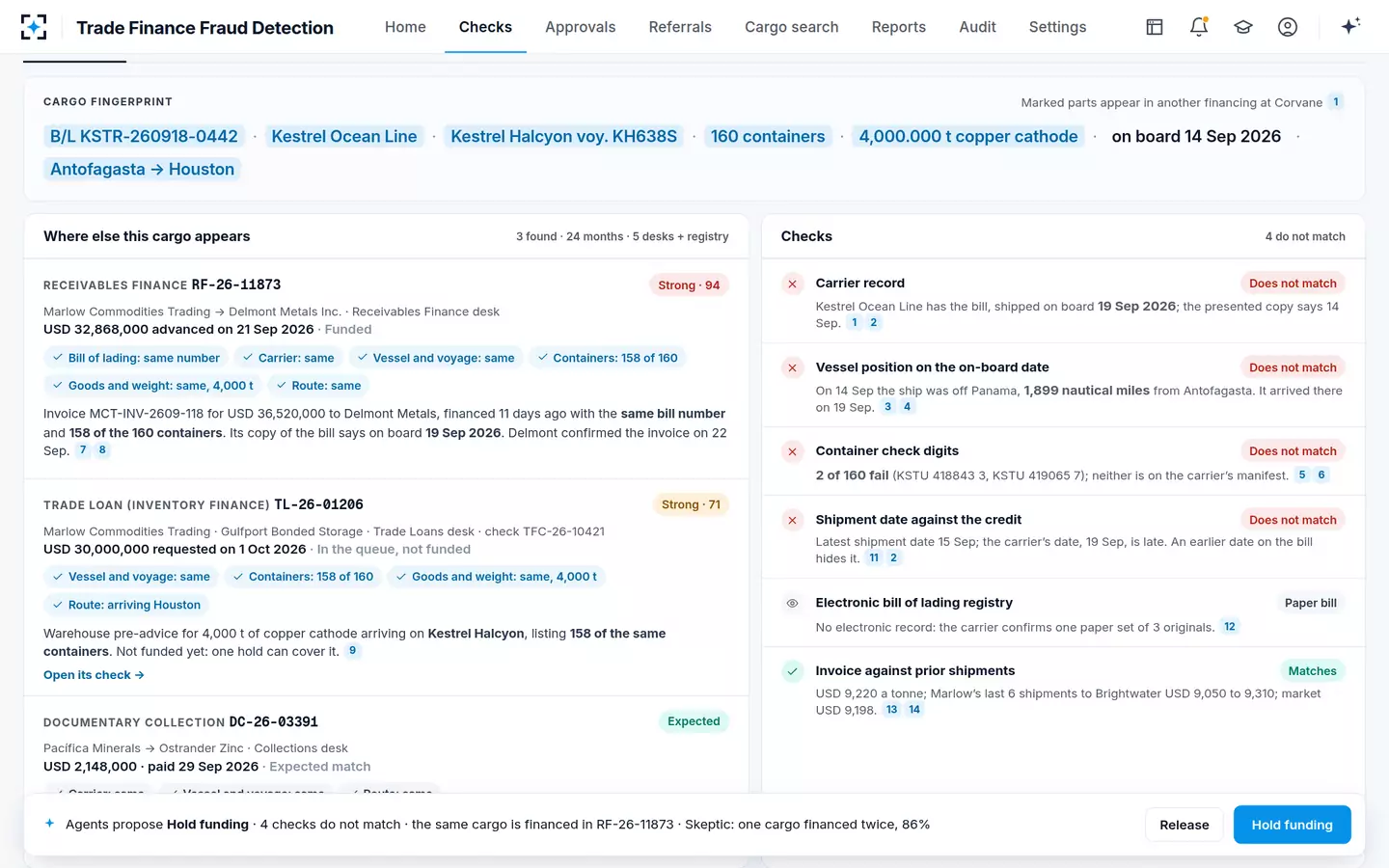
Nothing about the inventory loan request was irregular on its own desk. The warehouse pre-advice was plausible, the loan was within the trader's line, and the goods were genuinely on the water. What made it the third financing of one cargo was visible only from the containers, which the agents matched across the three desks. The analyst's single hold stopped the letter of credit and the inventory loan together, and the receivables desk was told about the advance it had already made. The same cargo search answers the question an inventory lender should ask before every advance: what else in this bank is secured on these goods?
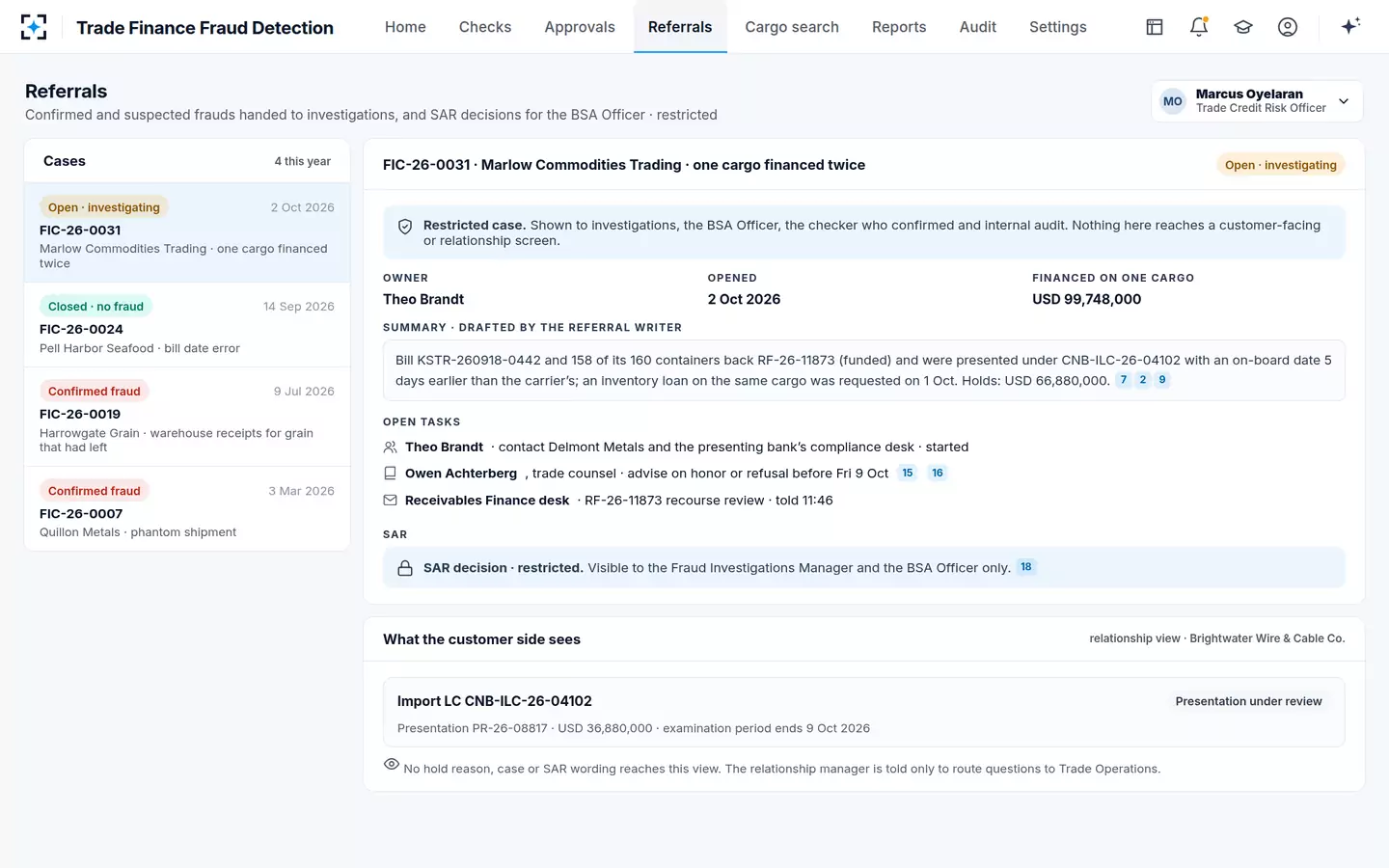
The fictional sample bank's referral list also records an earlier confirmed case of warehouse receipts issued for grain that had already left the warehouse, opened as a restricted case for investigations.
Warehouse receipts for grain that had left: a confirmed case in the sample book
Where Trade Finance Fraud Detection fits, and what still needs a person in the warehouse
The solution reads the receipt, the pre-advice and the shipping documents into one fingerprint and searches every desk for the same goods before an advance, which is the multiple-pledging check inside one bank. It does not authenticate a receipt's security features, count stock or see other banks' pledges: those need the issuing warehouse, an inspector and, for other banks, information the bank does not hold. In Singapore, a former finance chief was charged in 2021 with cheating a bank into believing that 19 bills of lading had been validly pledged to it (Singapore Police Force, September 2021), a reminder that a pledge on paper is only as good as the goods and the issuer behind it. The wider set of schemes is in types of trade finance fraud, and the full Qingdao and Natixis stories sit with the other cases in examples of trade finance fraud.
Before an advance against warehouse receipts
- Is the issuer an approved, bonded operator?
The OCC glossary’s condition for accepting a receipt as collateral.
- Has the issuer verified the original, not a scan?
Natixis: a scan cannot be authenticated, and the warehouse said so.
- Has the warehouse acknowledged it holds the goods for you?
Mercuria: without that acknowledgment the receipt delivered nothing.
- Has anyone counted the stock?
Penglai: receipts for about 20,000 tonnes, 16,000 found.
- Is the same lot financed anywhere else in the bank?
Search loans, receivables and letters of credit by goods, lot, containers and vessel.
- Is the advance re-tested during the loan?
Stock can leave after the receipt is issued, as in the sample case of grain that had left.
Questions people ask
What is the warehouse receipt financing process?
The borrower deposits goods in an approved warehouse, which issues a receipt; the lender verifies the receipt and the goods, takes control of the receipt or an acknowledgment from the warehouse that it holds the goods for the lender, and advances a percentage of their value. Goods are released against repayment or substitute collateral, and the lender monitors the stock until the loan is repaid.
What is the difference between a warehouse receipt and an exchange warrant?
An exchange warrant is issued under an exchange's rules and held in its central system; a warehouse receipt is issued by an individual warehouse under its own terms. In Natixis v Marex it was common ground that receipts are less secure than LME warrants, which are held in a secure central depository, and that an off-warrant transfer of receipts carries an inherently higher risk of fraud.
Can a warehouse receipt be electronic?
Yes. The UK's Electronic Trade Documents Act 2023 lists warehouse receipts among the trade documents that can exist electronically if a reliable system ensures one person controls them at a time, and the UCC recognises electronic documents of title through control. Exclusive control helps against duplicate receipts; it does not show that the goods are in the warehouse.
What happened to the banks in the Qingdao fraud?
The Mercuria v Citibank judgment records that once the fraud surfaced the ports were closed to inspection and banks rushed to place claims; Citi's attempt to pass the risk back to Mercuria by tendering the endorsed receipts failed, because they were not documents of title and did not deliver the metal. Losses across all banks are not stated in that judgment.
How often should a lender inspect warehouse stock?
None of the sources on this page sets a frequency; it depends on the goods, the warehouse and the size of the advance. The OCC asks examiners to compare collateral such as warehouse receipts with the bank's collateral records, and the cases show the cost of not counting: at Penglai a stock check found 16,000 tonnes against receipts for about 20,000.