The doctrine of strict compliance is the rule that a bank must pay a letter of credit against documents that comply with its terms, and may refuse documents that do not, judging only what the documents show. US law states it in UCC § 5-108(a): an issuer shall honor a presentation that, "as determined by the standard practice", "appears on its face strictly to comply with the terms and conditions of the letter of credit". UCP 600 says the same in its own words: a complying presentation is one in accordance with the credit, the rules and international standard banking practice, and data in one document may differ from the others in wording but must not contradict them. Strict compliance is therefore neither mirror-image matching nor a search for any flaw, and the myths that treat it as either cause wrong refusals and wrong payments. Each is a question examiners take to a senior checker. Botminds' UCP 600 & ICC Rules Search answers such questions with the rule, the practice and the bank's own rulings labelled apart, each cited, so the examiner sees where the line is.
Rule text is quoted from ICC's free Digital Library, and courts from their official reports. Examples of the solution come from a fictional sample bank, Corvane National Bank, and its sample data.
Five myths about strict compliance, and what the rules and courts actually hold
The myth: Every document must repeat the credit word for word.
What the rules and the courts hold: Data may be worded differently from the credit and the other documents but must not contradict them (UCP 600 art. 14(d)); goods may be described in general terms outside the invoice (14(e)).
The myth: Any spelling slip justifies refusal.
What the rules and the courts hold: US courts allow a very narrow exception for minor variations, such as an unmistakable typing error; but one word that changes meaning is a real discrepancy (Fortis v IOB, 2011).
The myth: Strictness lets the bank refuse for anything it finds, whenever it finds it.
What the rules and the courts hold: One notice, listing each discrepancy, by the close of the fifth banking day, or the bank is precluded (UCP 600 art. 16(c), (d), (f)).
The myth: If the goods arrived as ordered, small document flaws do not matter.
What the rules and the courts hold: Banks deal with documents, not goods (art. 5); omitting documents or presenting the wrong transport document is not a minor variance (MAM Apparel, 2020).
The myth: Strict means whatever a careful examiner thinks it means.
What the rules and the courts hold: Compliance is judged by standard practice: UCC § 5-108(e) makes it a matter for the court, and UCP 600 art. 2 builds it into the definition.
What is the doctrine of strict compliance?
It is the bargain that makes a letter of credit work: the bank promises to pay against specified documents, so it must pay when they comply and may refuse when they do not, without looking past them. The Second Circuit, quoting its earlier cases, put it this way: the issuing or confirming bank "takes on an absolute duty to pay", but "In order to protect the issuing or confirming bank, this absolute duty does not arise unless the terms of the letter have been complied with strictly" (Mago v LHB, 2d Cir. 2016).
The reason is speed and certainty for the bank. The same opinion explains that adherence to the rule "ensures that banks, dealing only in documents, will be able to act quickly", and that compliance is "essential so as not to impose an obligation upon the bank that it did not undertake and so as not to jeopardize the bank's right to indemnity from its customer". US banking regulation fixes the same principle for national banks, whose obligation to honour turns on the documents specified, not on conditions outside them (12 CFR 7.1016).
"The corollary to the rule of strict compliance is that the requirements in letters of credit must be explicit and that all ambiguities are construed against the bank."
Second Circuit in Mago v LHB (2016), quoting Marino Industries v Chase Manhattan Bank (1982)
Myth 1: does strict compliance mean identical documents?
No. Under article 14(d), data in a document, read in context with the credit, the document itself and standard practice, may be worded differently from the rest of the presentation but must not contradict it, and under 14(e) documents other than the commercial invoice may describe the goods in general terms (UCP 600, art. 14(d)–(e)). UCP 600 article 14, paragraph by paragraph quotes both paragraphs and the cases that applied them.
The English courts reached the same place before UCP 600 wrote it down. In the Kredietbank case, which the Court of Appeal discussed in Fortis v IOB, a survey report from a company whose name differed slightly from the one the credit named was held compliant as an obvious misnomer, because strict compliance does not demand exact literal compliance in every case. US courts state the doctrine in harder words, quoting "Literal compliance with the credit" as "essential" (Mago), but they too accept documents that vary in ways the documents themselves resolve.
What survives everywhere is the invoice rule. Article 18(c) requires the invoice to describe the goods as the credit does, so the one document where near-identity is expected is the one most myths ignore.
Myth 2: can a typo justify refusal of a letter of credit?
Sometimes, but not because it is a typo. A typing error that leaves the meaning "unmistakably clear" falls within the narrow minor-variance exception US courts recognise, and the Eastern District of New York listed, as an example of a variance that did not amount to noncompliance, the presentation of five copies of required documents instead of six (MAM Apparel v NCL, E.D.N.Y. 2020, citing Bank of Cochin).
A single word that changes the meaning is a different matter. In Fortis v IOB a certificate required to state "our" cost said the issuing bank's cost instead, and the Court of Appeal held that this was a real discrepancy, not a trivial one, even though the beneficiary had in fact paid ([2011] EWCA Civ 58). The test is not the size of the error but whether, read in context, the document still says what the credit requires.
Five cases on where strict compliance draws the line
| Case | Court and year | What was presented | Result |
|---|---|---|---|
| Mago v LHB | 2d Cir., 2016 | Unsigned copies of bills of lading, where the standby required a copy “evidencing shipment” | Not compliant |
| MAM Apparel v NCL | E.D.N.Y., 2020 | An air waybill where an ocean bill of lading was required; required documents missing | Not compliant; “not ‘minor variances’” |
| Bank of Cochin (as cited in MAM) | S.D.N.Y., 1985 | Five copies of required documents instead of six | Not noncompliance |
| Fortis v IOB | Court of Appeal (England), 2011 | A certificate naming the issuing bank’s cost where the credit said “our” cost | A real discrepancy, but the bank was precluded by delay |
| Kredietbank (as discussed in Fortis) | English courts | A survey report from a company with a slightly different name | Compliant: an obvious misnomer |
Myth 3: strictness lets the bank refuse whenever it likes
Strictness cuts both ways: the bank must also comply strictly with its own duties. A bank that refuses must send one notice, listing every discrepancy it refuses for, by the close of the fifth banking day after presentation; a bank that does not can no longer claim the presentation failed to comply (UCP 600, art. 16(c), (d), (f)). US law says the same in UCC § 5-108(c): an issuer that gives no timely notice is precluded from asserting "any discrepancy", and from any discrepancy "not stated in the notice".
Fortis v IOB shows what that costs. The discrepancy in the certificate was real, but the bank had said it was returning the documents and then held them for months; it was precluded from relying on the discrepancy at all. How the five days are counted, and what eats into them, is in UCP 600's five banking days.
Myth 4: strict compliance vs substantial compliance
Under UCP 600 and US law the standard is strict, not substantial: "Banks deal with documents and not with goods, services or performance to which the documents may relate" (UCP 600, art. 5), and the examination looks at the documents and nothing else (art. 14(a)). That the goods arrived in good order does not cure a missing document. In MAM Apparel the court held that "Completely omitting documents and providing nonconforming shipping documents are likewise not 'minor variances'" (E.D.N.Y. 2020).
The commercial reality softens the rule in a different way: by waiver, not by doctrine. In Ronald Mann's study of 500 credit files from five US banks in 1999, under UCP 500, most discrepancies did not signal a problem with the underlying deal, and applicants waived the discrepancies in all but one of the 365 discrepant files (Mann, Michigan Law Review, 2000). Strict compliance gives the applicant the choice; it does not stop the applicant from choosing to pay.
What Mann's 500 files showed about strict compliance in practice
27%
of presentations conformed to the credit on first presentation, 17% to 36% by bank
59%
of examined discrepant files showed defects that did not suggest a default by the beneficiary
364of 365
discrepant files in which applicants waived the discrepancies and permitted payment
Myth 5: strict compliance is whatever a careful examiner thinks
No; it is measured against standard practice, and in the end by a court. UCC § 5-108(e) says "An issuer shall observe standard practice of financial institutions that regularly issue letters of credit", that "Determination of the issuer's observance of the standard practice is a matter of interpretation for the court", and that the court "shall offer the parties a reasonable opportunity to present evidence of the standard practice" (UCC § 5-108). Under UCP 600 the same practice is part of the definition of a complying presentation (art. 2).
That is why examiners in different processing centers of one bank can disagree and still each be careful. A bank that wants one answer needs a written position where the rules and practice leave room, approved by someone accountable, and applied the same way everywhere. The OCC's handbook makes the stakes plain: a discrepancy left unresolved can cost the bank its protection, its rights and money (OCC, Trade Finance and Services). Where ICC's own experts weigh in, the opinion layer explains how much their views count.
How do courts apply UCP 600 strict compliance?
They read the credit first, then the rules, then practice, and they construe ambiguity in the credit against the bank that wrote it. In Mago, the beneficiary argued that under the UCP and ICC guidance, copies of bills of lading need not be signed. The Second Circuit assumed that was right and held against it anyway, because the credit required a copy "evidencing shipment", and an unsigned copy did not evidence it; the court quoted the function test of article 14 and cited ISBP on the general point.
English courts add a method. The Court of Appeal in Fortis said the UCP must be construed internationally and purposively, in light of the practice of international bankers and traders, rather than by national canons of construction, and it heard ICC Banking Commission members as expert witnesses on that practice. Strict compliance, on that view, is strict adherence to what the credit and international practice require, not to the narrowest reading of the words. Article 14, paragraph by paragraph, covers the examination standard the doctrine runs through.
Six checks that keep a compliance call on the right side of the doctrine
- Read the credit before the rules
Art. 1 lets the credit modify any article; Mago turned on the credit’s own words.
- Ask whether the data conflict, not whether they match
Art. 14(d); hold the invoice to art. 18(c)’s “correspond”.
- Test meaning, not spelling
An unmistakable typing error is a minor variance; a word that changes meaning is not.
- Disregard conditions with no document
Art. 14(h): deemed not stated.
- List every discrepancy once, by day five
Art. 16(c), (d), (f): a ground found later cannot be added.
- Use your bank’s written position on grey areas
And name who approved it, so four centers decide alike.
How UCP 600 & ICC Rules Search answers compliance questions
It answers the question in front of the examiner, verdict first, and shows its working in three labelled layers: the rule, standard practice and the bank's own procedure or ruling, each cited to its passage. When the presentation is named, the agents read the credit's terms first, so a credit that modifies an article changes the answer. When the rule, practice and opinions do not settle the point, the answer is "not settled", and the question goes to the Trade Rules Desk.
A compliance verdict in UCP 600 & ICC Rules Search, with the condition that would reverse it
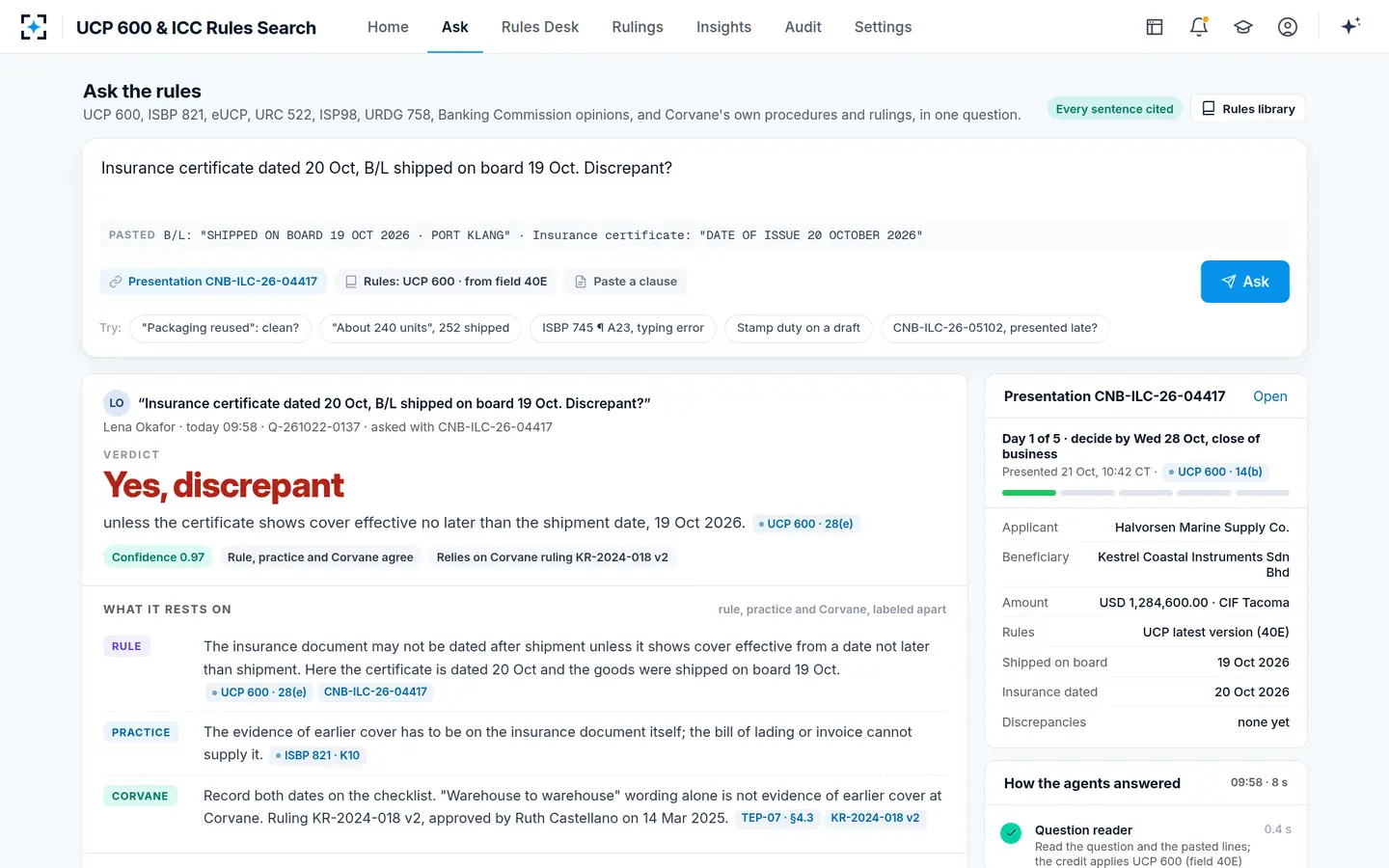
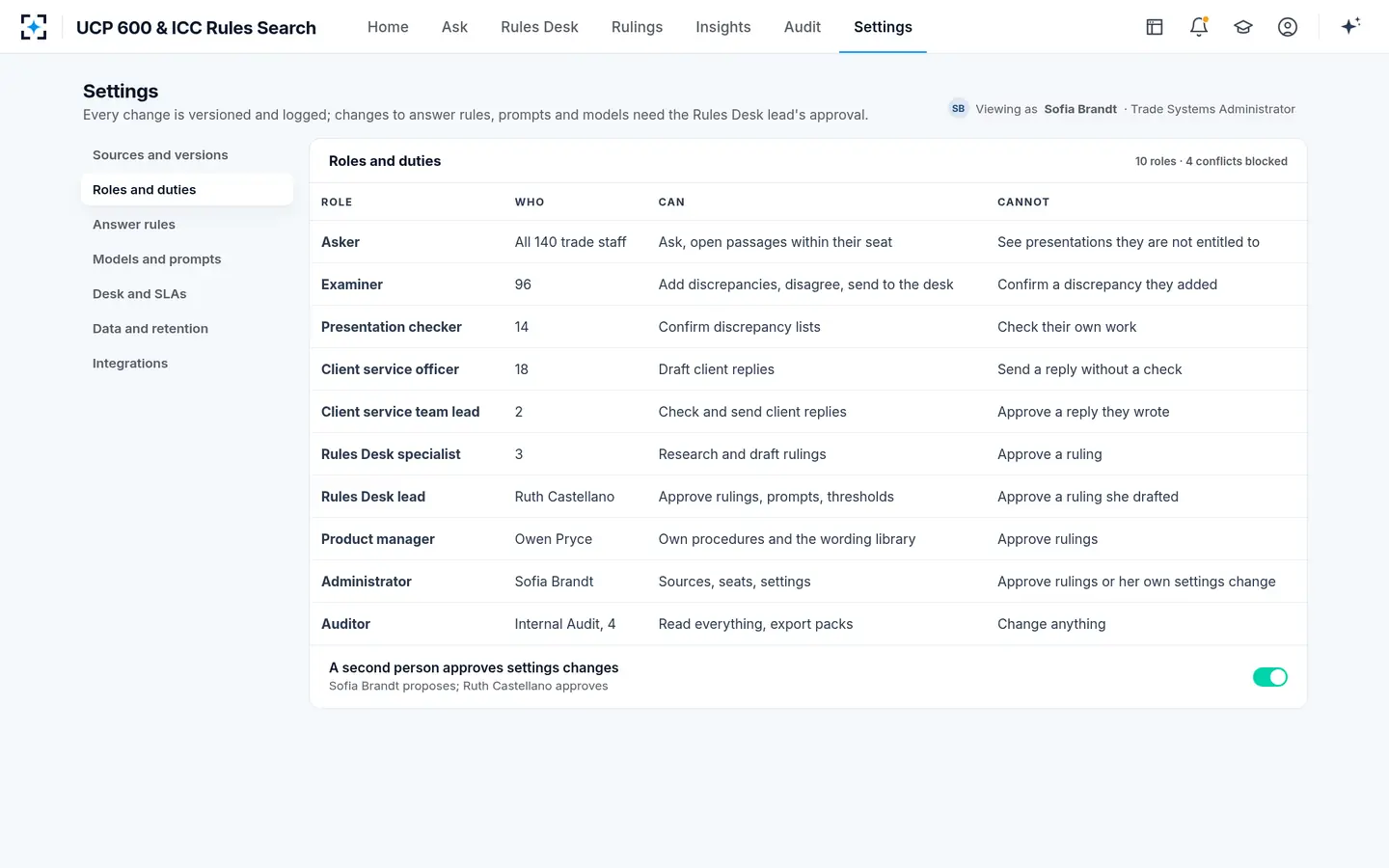
The decision stays with people, and so does the second look strict compliance demands. An examiner adds a discrepancy; a different examiner confirms it before it reaches the system that assembles the refusal notice; the agents never pay, refuse or send a notice. In the sample bank's first three weeks of October, examiners overrode 1.8% of verdicts, each with a reason code, and the largest reason was a credit whose terms differed from the general rule.
Separation of duties: who may add, confirm and approve
Questions people ask
Where does the doctrine of strict compliance come from?
US courts applied it in cases such as Marino (1982) and Voest-Alpine (1983), which the Second Circuit still quotes, and it is now written into US statute: UCC § 5-108(a) requires an issuer to honor a presentation that appears on its face strictly to comply with the credit, as determined by standard practice. UCP 600 does not use the phrase, but its definition of a complying presentation and its examination standard in article 14 do the same work.
What is the minor variance exception?
It is a narrow exception US courts recognise for variations that do not affect meaning, such as a word that is unmistakably clear despite a typing error. The Eastern District of New York has stressed how narrow it is, and held that omitting required documents or presenting the wrong transport document is not a minor variance.
Does strict compliance apply to standby letters of credit?
Yes. Mago v LHB was a standby case, decided under UCP 600, and the Second Circuit applied strict compliance to its documentary requirements. Standbys issued under ISP98 follow ISP98's own examination rules, which Botminds' Bank Guarantee & Standby LC Issuance solution covers.
Who decides whether documents strictly comply?
Each examining bank decides within five banking days, under UCP 600 article 14(b); if the parties dispute it, a court decides, judging the bank against standard practice under UCC § 5-108(e). The applicant cannot force the bank to accept discrepant documents, but may waive the discrepancies, and the bank may then choose to pay.
Can the applicant insist on stricter compliance than the rules require?
Only by writing it into the credit. Article 1 lets the credit modify UCP 600, and US courts construe ambiguous credit terms against the bank, so a requirement the applicant wants enforced has to be explicit and documentary. A condition with no document attached is disregarded under article 14(h).