The latest version of the UCP is UCP 600, the 2007 Revision, ICC Publication No. 600, which came into force on 1 July 2007 and has not been revised since; there is no UCP 700. ICC's foreword calls it "the sixth revision of the rules since they were first promulgated in 1933". What has changed since 2007 is the layer around the rules: International Standard Banking Practice moved from ISBP 745 to ISBP 821 in July 2023, the electronic supplement moved to eUCP Version 2.1 in June 2023, and ICC's Banking Commission keeps issuing opinions. For a trade operation, the real versioning risk is not a new UCP but an answer built on a superseded edition of something else. Botminds' UCP 600 & ICC Rules Search cites every answer to its source version and never uses superseded text for a new answer.
Rule texts and ICC publications are linked where they appear. Examples of the solution come from a fictional sample bank, Corvane National Bank, and its sample data.
The UCP has stood still since 2007; standard practice has moved twice
- UCP 500to 2007
- UCP 600 in force, unrevised2007 → 2026
- ISBP 645 and its UCP 600 update2002 → c.2013
- ISBP 745c.2013 → 2023
- ISBP 8212023 →
What is the latest version of UCP?
UCP 600. Article 1 names it as "The Uniform Customs and Practice for Documentary Credits, 2007 Revision, ICC Publication no. 600" (ICC Digital Library, UCP 600), and it came into force on 1 July 2007, as the English High Court noted in Fortis v IOB [2010] EWHC 84 (Comm). It has 39 articles, served free on ICC's Digital Library.
The revision took more than three years. ICC authorised it in May 2003, the Drafting Group reviewed some 500 Banking Commission opinions issued under UCP 500, and the foreword records that it "sifted through more than 5000 individual comments" (ICC, UCP 600 Foreword). One reason for the work was the failure rate of the time: ICC's introduction cites surveys from when the revision began, around 2003, finding that about 70% of documents presented under credits were refused on first presentation (ICC, UCP 600 Introduction; common discrepancies in letters of credit quotes it and asks what it measured), a dated figure that a 1999 study of 500 US files broadly matched at 73% discrepant (Mann, 2000).
UCP 600 in four numbers
39
articles, from application (art. 1) to assignment of proceeds (art. 39)
6th
revision since the rules were first published in 1933
5,000+
individual comments the Drafting Group sifted through
19years
in force without revision, since 1 July 2007
Is there a UCP 700?
No. There is no UCP 700 and no published draft of one. In July 2023 ICC's Documentary Credit World noted that "it is premature to suggest that a revision of UCP 600 will follow" until a decision on the future of ISBP was taken (ICC Digital Library, July 2023), while two experts set out ISBP paragraphs they considered "much closer to a rule than a practice".
The vote that would have driven a revision did not produce a mandate. When ICC national committees were asked about the future of ISBP in 2023, 6 favoured no further work, 6 a full review within its current scope, 8 extending its scope beyond the examination of documents, and 2 separate guidance on issuance, advising, confirmation and amendment. The report observed that "the tallied votes do not provide a strong mandate to do anything", and that just 22 national committees voted (ICC Documentary Credit World, July 2023).
When ICC asked about the future of ISBP in 2023, no option won a majority
Is the ICC revising UCP 600? What the 2026–27 plan reportedly does
Not according to the latest report. The ICC Digital Library reported in August 2026 that "Rather than embarking on a formal revision of UCP 600, the Commission has chosen a different path", a UCP/ISBP action plan for 2026–2027 with "four dedicated working groups": clarification and interpretation of UCP 600, transport and document practice, standbys and the use of UCP 600 alongside ISP98, and education on ISBP 821 (ICC Digital Library, 4 August 2026).
Read that report with its own caveat. It cites an overview presentation as its source, and it states that it "represents the views of the author and not necessarily those of ICC". We found no separate ICC announcement of the plan. What a desk can take from it with confidence is the direction, not the detail: the rules are not about to change, while interpretation, practice and guidance are where the movement is.
"The UCP remain the most successful set of private rules for trade ever developed."
ICC, Foreword to UCP 600
What replaced ISBP 745?
ISBP 821, published on 3 July 2023. ICC's report of the Banking Commission meeting that July says "ISBP 821, which replaces ISBP 745 formulated ten years ago, ensures alignment of ISBP with ICC Official Opinions approved from October 2013 to January 2023", and that "nine ICC Opinions were identified as containing content appropriate for incorporation" (ICC Documentary Credit World, July 2023). It is sold by ICC Publishing, not served free.
The pattern is the point. Opinions answer practitioners' questions as they arise, and every ten years or so the ones that stood the test are folded into ISBP. Between those moments, the opinion is the current practice and the ISBP paragraph it will eventually change is the older one. How the opinion layer works, and how much weight courts give it, has its own guide.
What changed in practice between ISBP 745 and ISBP 821 can only be described here, because the text is sold. ICC's own account gives the shape: an alignment with opinions approved over almost a decade, nine of them judged suitable for incorporation, rather than a rewrite. Some issues missed the cut. The point raised in Draft Opinion TA927, on "free of charge goods" under a paragraph of ISBP 745, failed to become an opinion in 2023 and was set aside "for a future ISBP update" (ICC Documentary Credit World, July 2023).
Practitioners also argue about where the line between rule and practice should sit. Two technical advisers to the ICC Banking Commission, David Meynell and Gary Collyer, identified ISBP 821 paragraphs they considered "much closer to a rule than a practice", and definitions that could merit inclusion in the UCP itself (ICC Digital Library, July 2023). That debate is the closest thing to a UCP 700 on the table, and on the latest report it has turned towards clarification and education rather than redrafting. For an examiner, the consequence is unchanged: the practice that decides most cases moves between rule revisions, so a desk that tracks only the rules is always a decade behind.
What has changed around UCP 600 since 2007, and what has not
| Text | Current version | Since | Free or sold | What it replaced |
|---|---|---|---|---|
| UCP 600 | ICC Publication No. 600 | 1 July 2007 | Free on ICC’s Digital Library | UCP 500 |
| ISBP | ISBP 821 | 3 July 2023 | Sold by ICC | ISBP 745 |
| eUCP | Version 2.1 | 29 June 2023 | Free PDF from ICC | Earlier versions 1.0, 1.1 and 2.0 |
| eURC | Version 1.1 | 29 June 2023 | Free from ICC | Version 1.0 |
| Banking Commission opinions | Issued continuously | — | Sold in volumes | Some cancelled by later opinions |
| US regulation, 12 CFR 7.1016 | Lists UCP 600 and eUCP to Version 2.0 | Last amended Dec 2020 | Public | — |
Is UCP 500 still used?
It can be, because the UCP applies only by incorporation and a credit may name an earlier revision. US regulation allows for it: the OCC's rule on letters of credit lists "the Uniform Customs and Practice for Documentary Credits (International Chamber of Commerce (ICC) Publication No. 600 or any applicable prior version)" among recognised rules (12 CFR 7.1016).
We know of no published count of credits still issued under UCP 500, so this guide gives none. The practical check is the credit itself: what it names, and when it was issued. The same regulation shows how slowly formal references move: as last amended in December 2020, it lists the eUCP "v. 1.0, 1.1, & 2.0", not Version 2.1, which came in 2023.
UCP latest version in a credit: which revision it points to
"UCP latest version" in a credit's applicable-rules field points to the revision in force when the credit was issued, which for every credit issued since 1 July 2007 is UCP 600. A US court treated a credit naming the "UCP latest version" and "subject to ICC Pub. 600" as governed by UCP 600 rather than the New York UCC provision the issuing bank relied on (Zions v JPMorgan Chase, S.D. Cal. 2021).
ICC's other rules write the default down. A credit that does not state its eUCP version takes the version in effect on the day it is issued (eUCP 2.1, art. e1(c); see eUCP version 2.1), and a demand guarantee issued on or after 1 July 2010 that names the URDG without a version "shall be subject to the URDG 2010 revision" (URDG 758, art. 1(d)). If a UCP 700 ever arrives, the question for each credit will be what it named and when it was issued. More common questions like this one are collected in UCP 600 questions and answers.
Why superseded text is the real versioning risk for a rules desk
Because old texts do not disappear. ICC's own collected opinions flag those a later opinion has overtaken, so an opinion read without its status can mislead (ICC, 5 July 2002; see ICC Banking Commission opinions); a copy of ISBP 745 on a shelf looks as authoritative as ISBP 821; and the eUCP page on ICC's free Digital Library still showed Version 1.1 text in October 2026. Which free and paid texts to trust is set out in its own guide.
The bank's own texts change more often than ICC's. A procedure is rewritten, a ruling is replaced by a better one, and every saved answer that rested on the old text is now quietly out of date. A desk that cannot see which answers depend on which version cannot keep them current.
A new ruling in UCP 600 & ICC Rules Search, and every answer that was waiting on it rewritten
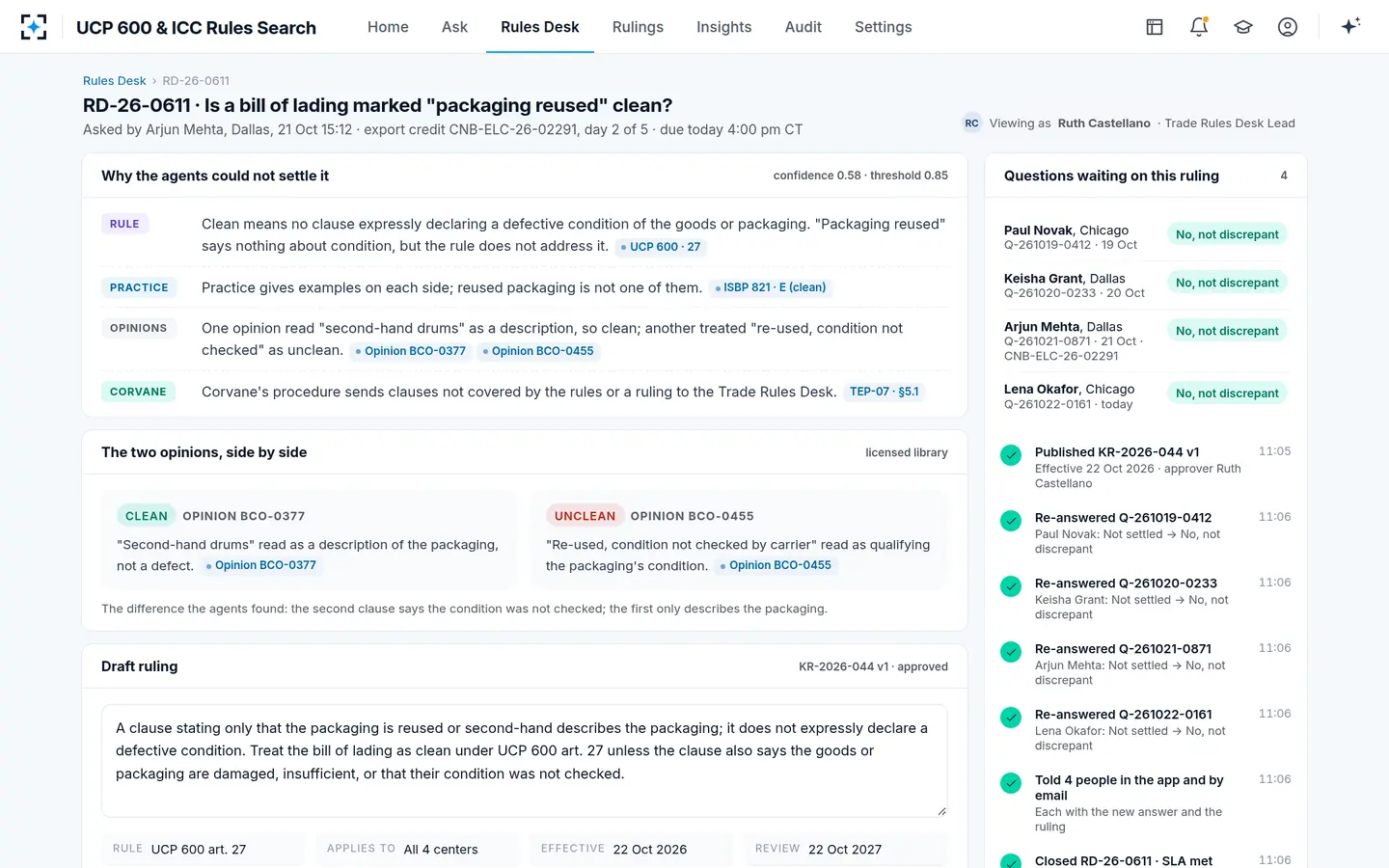
How UCP 600 & ICC Rules Search tracks versions
Every passage it cites carries its source and version, from ICC Publication No. 600 to the bank's procedure number. Superseded text, such as ISBP 745, stays searchable so an examiner can see what changed, but it is marked as superseded and never used for a new answer; the Rules researcher is built not to.
The Trade Rules Desk queue: questions the current texts do not settle, live presentations first
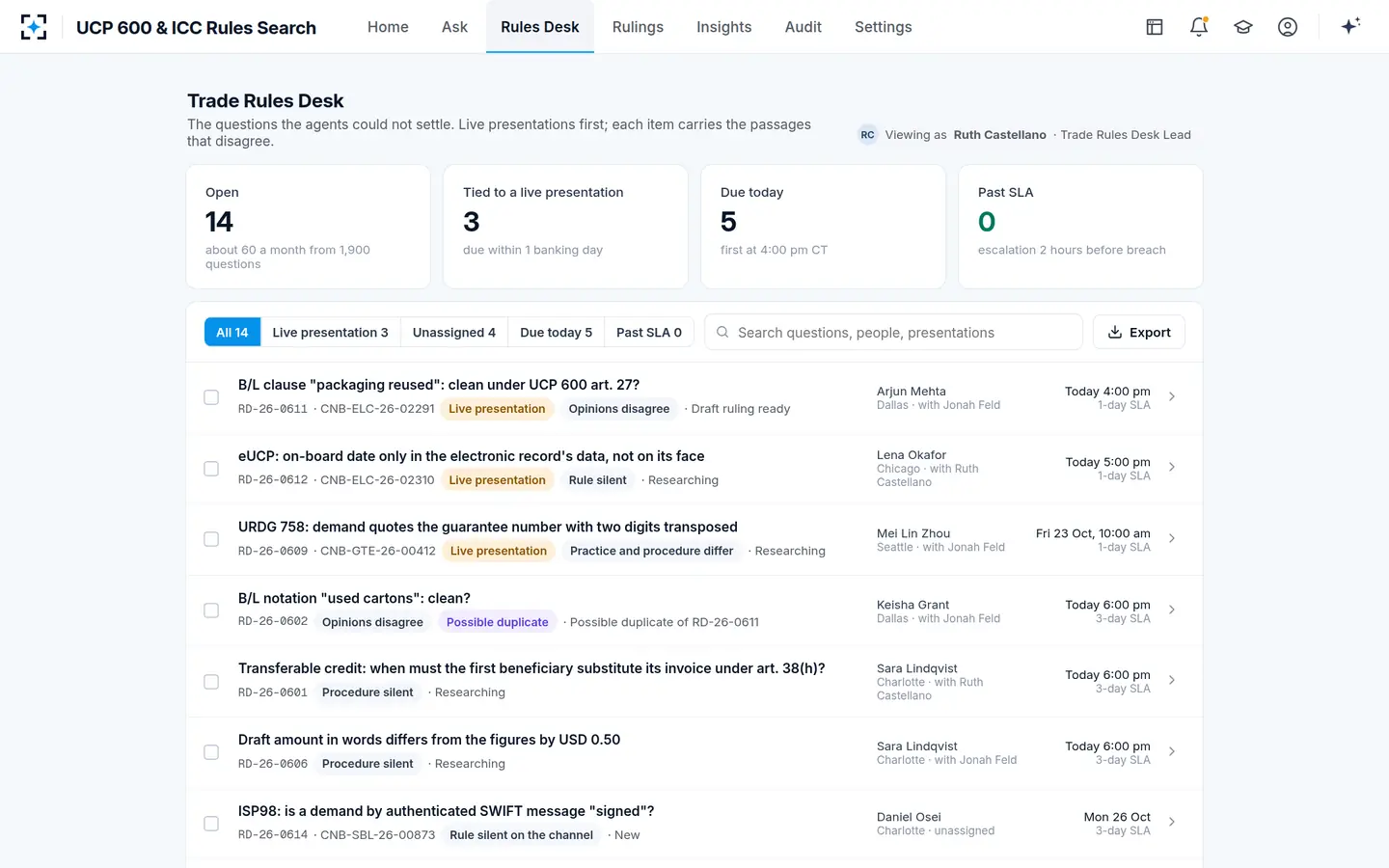
When the bank's own texts change, the agents work the same way in reverse. In the sample bank, a procedure revision due on 2 November 2026 rewrites the section on insurance dates; before it takes effect, the agents list the four rulings and 37 saved answers that rest on the current text so the desk can queue them for re-review. A new UCP would be handled the same way, credit by credit; none is due.
Questions people ask
When did UCP 600 come into force?
On 1 July 2007, replacing UCP 500. ICC authorised the revision in May 2003, and the foreword describes it as the sixth revision since the rules were first published in 1933. It has not been revised since.
Is UCP 600 being replaced?
Not on any announced timetable. ICC's Documentary Credit World said in July 2023 that it was premature to suggest a revision would follow, and the ICC Digital Library reported in August 2026 that the Banking Commission chose a 2026–27 action plan focused on clarification and education instead, a report marked as the author's view.
What is the latest version of ISBP?
ISBP 821, published on 3 July 2023, which replaced ISBP 745. It aligns standard practice with ICC opinions approved from October 2013 to January 2023, and ICC sells it in eBook and book formats. It should always be read with UCP 600.
What is the latest version of the eUCP?
Version 2.1, published on 29 June 2023 as ICC Publication 823E. ICC says it was not a revision but an alignment with the UNCITRAL Model Law on Electronic Transferable Records. Our guide to eUCP version 2.1 covers what it changes.
Do I need to update credits when ICC publishes a new ISBP?
No change to the credit is needed: UCP 600 article 2 refers to international standard banking practice, not to a numbered edition, and ICC's drafters expected ISBP's principles, "including subsequent revisions thereof", to apply while UCP 600 is in force. What changes is the practice examiners apply, so training and the bank's procedures need updating.