The most common discrepancies in a letter of credit are defective documents whose data conflict with the credit or with each other, documents missing or presented in too few originals, shipment after the latest date the credit allows, presentation more than 21 days after shipment or after expiry, and insurance cover that is too low, dated too late or in the wrong currency. They are common because a presentation can carry many documents from several issuers, each of which must agree with one credit, and because a single date or amount out of line is enough for a bank to refuse. Botminds' Letter of Credit Document Checking reads every value in a presentation onto the credit's own terms and cites each conflict to the credit field, the page and the UCP 600 article, so these discrepancies surface on the first read rather than the fourth.
The frequencies below come from the only published measured sample, 500 US bank files collected in 1999, and from the ICC's own account of the surveys behind UCP 600. Both are dated, and we found no current published rate. The rules are quoted from UCP 600 as the ICC publishes it free; they bind because the credit incorporates them.
What the discrepancies were: 554 in 343 examined discrepant files
What are the most common discrepancies in a letter of credit?
On the measured evidence, the most common discrepancy is a defective document, found in 85% of discrepant files, followed by missing documents (22%), late shipment (18%), late presentation (14%) and an expired credit (11%). "Defective document" is Mann's broadest category, for documents that were presented but failed on their face, and it is where most of an examiner's judgment goes. Mann notes that many were plainly objective, "upon which no informed document examiner could disagree" (Mann, 2000).
Most discrepancies were not signs of a failed sale. In 201 of the 343 examined discrepant files, 59%, the defects did not suggest a contractual default by the seller, and Mann gives the typical examples: "an inadequate signature on a bill of lading or a technical inaccuracy in describing the collateral". In 98 files, 29%, the discrepancies did point to a default on the underlying contract. That split is why applicants waive so often, and why the examiner still has to find every one.
What percentage of LC presentations are discrepant?
There is no current, published rate. The two figures in the public record are both dated, and they measure slightly different things. The ICC's introduction to UCP 600 says that when work on the revision started in 2003, "a number of global surveys indicated that, because of discrepancies, approximately 70% of documents presented under letters of credit were being rejected on first presentation" (ICC, UCP 600 Introduction). Mann's study found that "the documents presented in the 500 transactions I examined conformed to the letter of credit only 27% of the time".
Two dated measures of how often presentations fail, and how much banks differed
~70%
rejected on first presentation, by global surveys when the UCP 600 revision began in 2003
73%
of 500 US bank files discrepant, measured in 1999
17–36%
range of conforming presentations across the five banks studied
"Rejected" in the ICC's sentence most likely means found discrepant, not refused for good. Mann made the same point about a similar line in the UCP 500 preface, which spoke of about fifty percent: he could "make that statement correct by interpreting the reference to 'reject[ion]' to mean only a determination of discrepancy". In his files applicants waived almost every discrepancy, so the rate of final refusal was close to zero. Why applicants waive almost every time takes up that side.
Late shipment: the on-board date against field 44C
Late shipment means the transport document shows a date of shipment after the latest date the credit allows, usually field 44C. On a bill of lading the date of shipment is the date of issue unless the bill carries an on-board notation, in which case the notation's date counts (art. 20(a)(ii)). The check is therefore not "what date is on the bill" but "which date is the shipment date, and is it on or before 44C as amended".
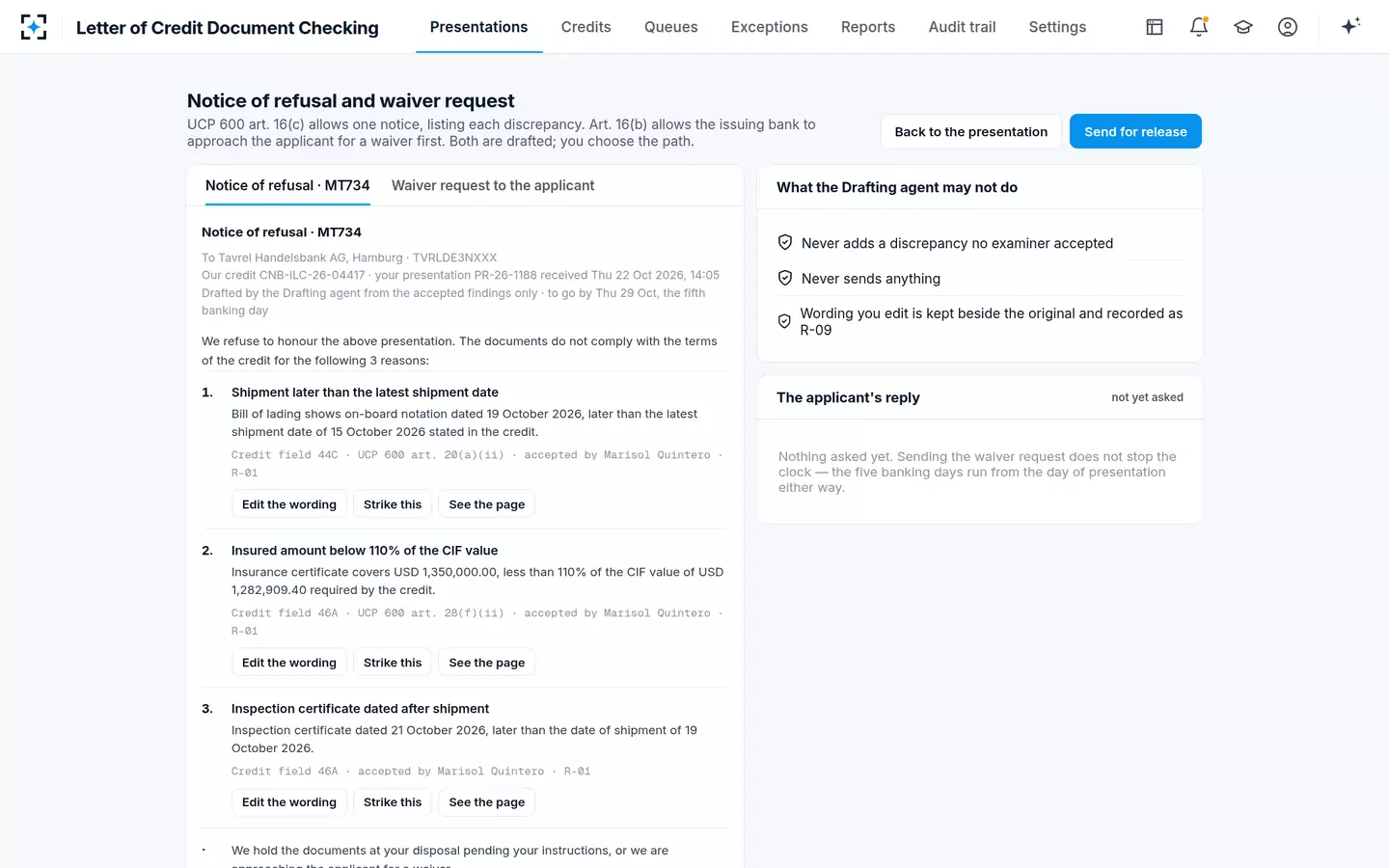
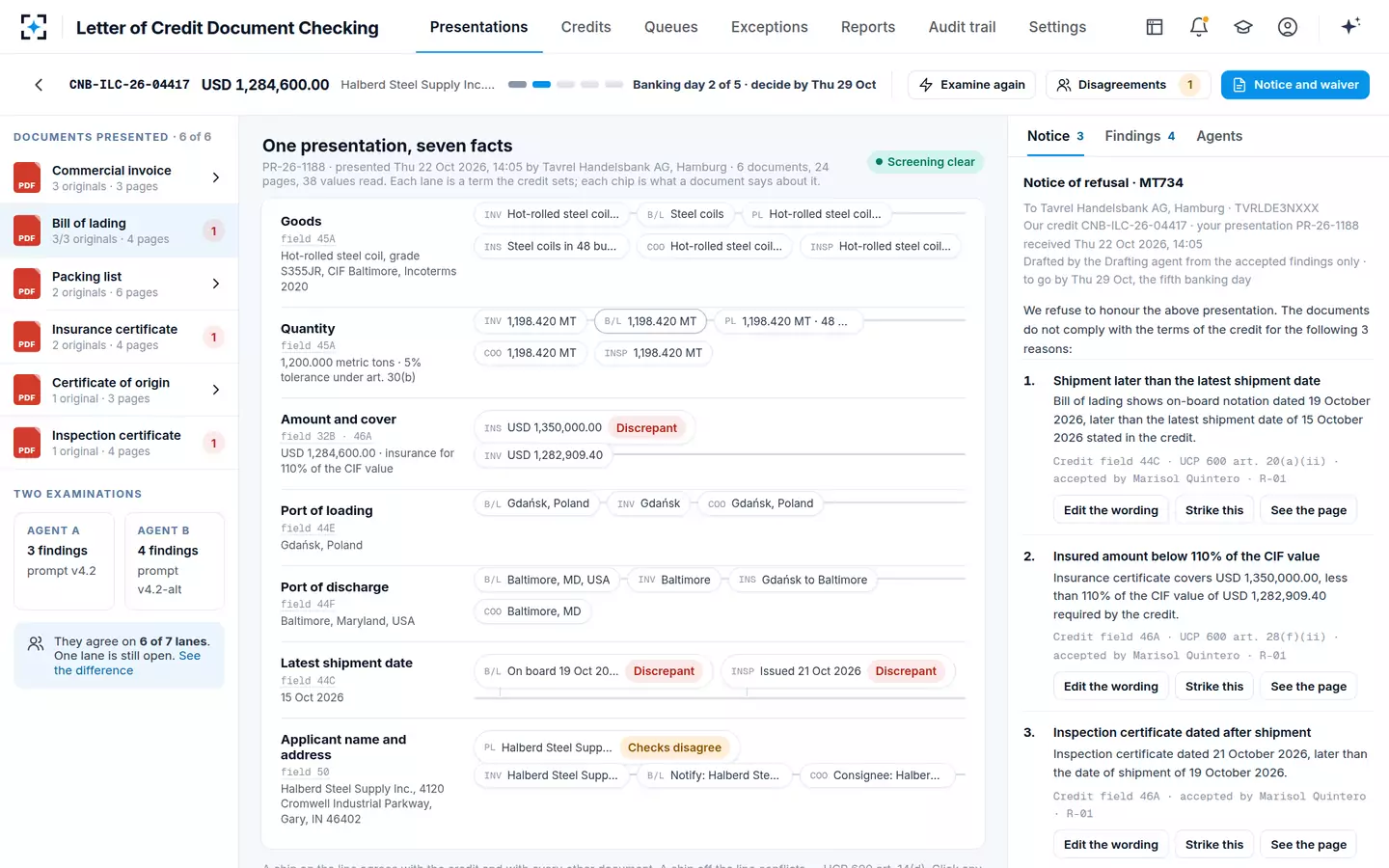
Two rules catch examiners out. Art. 3 fixes the words that set a period of shipment: "to", "until", "till", "from" and "between" include the dates mentioned, while "before" and "after" exclude them, and "on or about" means five calendar days either side, counting both end dates. And art. 29(c) is blunt: "The latest date for shipment will not be extended as a result of sub-article 29 (a)", so a bank holiday that extends the expiry does not extend the shipment date. In the fictional sample presentation the bill of lading carries an on-board stamp of 19 October 2026 against a latest shipment date of 15 October, as amended; the shipment is four days late.
Late presentation and the 21-day rule
Late presentation means the documents reached the bank after the period the credit or the rules allow. UCP 600 art. 14(c) sets the default for a presentation that includes original transport documents: the beneficiary must present within 21 calendar days after the date of shipment, and never after the credit expires (ICC, UCP 600; article 14 explained quotes the paragraph). A credit can set a different period, usually in field 48.
The check needs three dates, not one: the shipment date as the rules define it, the period for presentation, and the expiry. The earlier of 21 days after shipment and expiry is the deadline. In Mann's files late presentation appeared in 14% of discrepant files and an expired credit in 11%. Art. 29(a) extends an expiry date or last day for presentation that falls when the bank is closed for reasons other than force majeure to the first following banking day, and a nominated bank must then say so on its covering schedule (art. 29(b)).
Insurance amount, date and cover
Insurance discrepancies are common because art. 28 sets several independent tests, and the default amount is arithmetic that is easy to get wrong. The insurance document must be dated no later than shipment unless it shows cover effective from a date no later than shipment (art. 28(e)). It must state the amount of cover in the same currency as the credit. And where the credit says nothing about the amount, "the amount of insurance coverage must be at least 110% of the CIF or CIP value of the goods" (art. 28(f)(ii)). Cover notes "will not be accepted" (art. 28(c)), and where an insurance document was issued in more than one original, all must be presented.
The sample presentation shows how the arithmetic bites. The credit asks for insurance for 110% of the CIF value; the invoice shows a CIF value of USD 1,282,909.40, so cover must be at least USD 1,411,200.34. The certificate covers USD 1,350,000.00, which is 105% of the invoice value and USD 61,200.34 short. A checker comparing the certificate with the credit amount, USD 1,284,600.00, would see cover above the credit and might pass it.
One notice, three of the common discrepancies, each cited to its field and article
Invoice description, amounts and tolerances
The commercial invoice is held to a stricter description test than any other document. Art. 18 requires it to appear to be issued by the beneficiary, be made out in the name of the applicant and in the currency of the credit, and it need not be signed; under art. 18(c) its description of the goods must match the credit's. Other documents may describe the goods in general terms that do not conflict; how to check letter of credit documents sets the two tests side by side.
Amounts and quantities have their own arithmetic. Art. 30(a) reads the words "about" or "approximately" before an amount, quantity or unit price as allowing up to 10% either way on that figure, and on that figure only, as UCP 600 questions and answers shows with a worked case. Without those words, art. 30(b) allows 5% more or less on quantity where the credit does not count packing units or items and the drawings stay within the credit amount. The sample bill of lading shows 1,198.420 metric tons against 1,200 in the credit, 0.13% short and inside the 5% band; a check that raised it would be a false call. The OCC's list of common invoice errors includes unit prices or extensions that are wrong and quantities that do not agree with other documents (OCC, Trade Finance and Services).
What are common bill of lading discrepancies?
The common bill of lading discrepancies, in the OCC's list, are a bill that is not clean, ports different from those in the credit, no indication whether freight is prepaid, a shipment date later than the credit allows, and a description of the goods inconsistent with other documents. To those the rules add the signature and the set: art. 20(a)(i) requires the bill to name the carrier and be signed by the carrier, the master or a named agent, with the capacity of the signer identified, and art. 20(a)(iv) requires the full set of originals where more than one was issued.
The OCC's common errors, the rule behind each and the check that catches it
| Document | Common error in the OCC list | UCP 600 rule | The check |
|---|---|---|---|
| Bill of lading | It is unclean | Art. 27: a clean transport document bears no clause or notation expressly declaring a defective condition of the goods or packaging | Read every clause and stamp on the face, not just the header fields |
| Bill of lading | Ports differ from the credit | Art. 20(a)(iii): shipment from the port of loading to the port of discharge stated in the credit | Compare with 44E and 44F; an "intended" port needs an on-board notation |
| Bill of lading | Later shipment date than allowed | Art. 20(a)(ii): the on-board notation date, if any, is the shipment date | Find the on-board stamp first; then compare with 44C as amended |
| Invoice | Name and address do not agree with the credit | Art. 18(a)(ii): made out in the name of the applicant | The name must match; the address need only be in the same country (art. 14(j)) |
| Invoice | Quantity disagrees with other documents | Art. 14(d): data must not conflict | Cross-check against the bill of lading and packing list, within art. 30 tolerances |
| Insurance | Coverage differs from the credit | Art. 28(f): at least the required percentage, or 110% of CIF or CIP by default | Compute the minimum from the invoice's CIF value, not the credit amount |
| Insurance | Claims payable in another currency | Art. 28(f)(i): same currency as the credit | Check the currency of the cover, not just the amount |
| Other documents | Certificate of origin does not comply | Art. 14(f): content must appear to fulfil the function of the document | Read the 46A wording for the certificate and test against it |
The clean bill is worth a sentence of its own. Art. 27 says "The word 'clean' need not appear on a transport document, even if a credit has a requirement for that transport document to be 'clean on board'." A bill is unclean because of a clause declaring the goods or packaging defective, not because a word is missing, so the check is to read the face of the document, stamps included.
Missing documents and short originals
A missing document is the plainest discrepancy and, in Mann's sample, the second most common, in 22% of discrepant files. Art. 17(a) requires at least one original of each document the credit stipulates, and specific articles demand full sets of bills of lading and insurance originals. A presentation that substitutes one document for another fails too: in MAM Apparel v NCL, a federal court in New York held that an air waybill presented where the credit required an ocean bill of lading did not comply, and that leaving documents out or presenting the wrong transport document is no minor variance (MAM Apparel & Textiles v NCL Worldwide Logistics, E.D.N.Y. 2020; the holding is quoted in the doctrine of strict compliance).
Is a typo a discrepancy in a letter of credit?
Sometimes. A typing error that leaves the meaning unmistakable is usually not treated as a discrepancy; one that changes the meaning, or that a checker cannot resolve from the documents alone, is. US courts allow only a narrow exception to strict compliance: in the same MAM decision the court said that "This exception is very narrow, and the variation must be minor, such as where a word in a document is unmistakably clear despite a typographical error."
The harder cases are not typos but single words that change who did what. In an English Court of Appeal case a certificate that said documents were couriered at the "issuing bank's" cost, where the credit required "our" cost, was a real discrepancy. How to check letter of credit documents against each other walks through that case and the rule on data that must not conflict.
One presentation, seven terms, every document's value on each: the discrepancies sit off the line
How do exporters avoid LC discrepancies?
Exporters avoid discrepancies mostly before shipment, by reading the credit the day it arrives and asking for an amendment to anything they cannot meet. Under art. 10, a credit can be amended only with the agreement of the issuing bank, any confirming bank and the beneficiary, so a term that cannot be met should be raised early, not discovered at presentation.
A pre-presentation check for exporters, in the order discrepancies are most often found
- Read the credit on arrival, against the sales contract
Every document in 46A, every condition in 47A, the latest shipment date, the period for presentation and the expiry.
- Ask for amendments early
A term you cannot meet is an amendment request now, or a discrepancy later.
- Diary three dates
The latest shipment date, 21 days after shipment unless the credit says otherwise, and expiry. The earliest deadline wins.
- Copy the goods description onto the invoice exactly
Other documents may be general; the invoice must correspond with the credit.
- Compute insurance from the CIF value
At least 110% unless the credit says otherwise, in the credit currency, dated no later than shipment.
- Check the bill of lading face
On-board notation date, ports as in the credit, carrier named and signer identified, full set, no clause declaring a defect.
- Count originals and copies
At least one original of each document; full sets where issued in more than one original.
- Date nothing after presentation
Art. 14(i): a document may be dated before the credit, but not after its presentation.
For the bank, the same list is the order in which to look. The solution reads all of it on every presentation, cites each conflict to its page and article, and leaves the examiner to decide which ones are discrepancies. To see the same lanes on your own presentations, start from Letter of Credit Document Checking.
Questions people ask
Are late shipment and late presentation the same discrepancy?
No. Late shipment means the goods shipped after the latest shipment date in the credit; late presentation means the documents reached the bank after the period for presentation, 21 days after shipment by default, or after expiry. A presentation can have either, both or neither, and in Mann's sample they appeared in 18% and 14% of discrepant files respectively.
What are common insurance document discrepancies?
Cover below the required amount, often because 110% was computed on the wrong base; an insurance document dated after shipment without cover effective from shipment; claims payable in a different currency; a cover note presented instead of a policy or certificate; and missing originals. Each is a separate test under UCP 600 art. 28.
Is a stale bill of lading a discrepancy?
A bill of lading presented more than 21 days after the date of shipment, or after the credit's expiry, makes the presentation late under art. 14(c), unless the credit sets its own period. Practitioners call such a bill stale; under UCP 600 the discrepancy is late presentation.
Can a document be dated before the credit was issued?
Yes. Art. 14(i) allows a document to be dated before the issuance date of the credit, but never after the date it is presented. An inspection certificate or a certificate of origin issued before the credit is therefore not a discrepancy for that reason alone.
Do discrepancies mean the exporter will not be paid?
Not usually. In Mann's sample the applicant waived the discrepancies and allowed full payment in all but one of 365 discrepant files. A discrepancy removes the bank's obligation to pay on the documents alone; it leaves payment to the applicant's waiver and the bank's acceptance of it.