If there is a discrepancy in a letter of credit, the bank that finds it is no longer bound to pay on the documents and may refuse. Under UCP 600 it then has to act within five banking days after the day of presentation: either accept the documents anyway, usually after the applicant agrees to waive the discrepancy, or send the presenter a single notice of refusal that lists every discrepancy and says what the bank is doing with the documents. A late or incomplete notice costs the bank its right to refuse. For the exporter, a discrepancy turns a promise of payment into a request: payment then depends on the buyer's waiver, or on correcting the documents and presenting again while the credit is still open. Botminds' Letter of Credit Document Checking runs this sequence against the clock, with an examiner deciding and a senior checker releasing. This guide follows one presentation from arrival to payment.
The presentation belongs to a fictional sample bank, Corvane National Bank, and its fictional customers; the dates are real calendar days in October 2026. The rules are quoted from UCP 600 as the ICC publishes it free, and from the courts that have applied them.
One discrepant presentation, from arrival to payment in two banking days
Agent
Thursday 22 Oct, 14:05 · arrivalDocuments arrive from a Hamburg bank. Agents split 24 pages into six documents, read the credit and both amendments, place 38 values and examine twice. Screening finds no hit.
Never: decides, or starts the clock on the wrong day
A person decides
Monday 26 Oct, 09:12 · day 2The examiner accepts three discrepancies, each against its page, and strikes a fourth where the two examinations disagreed.
Agent
Monday 09:28 · draftsOne notice of refusal and one waiver request, both from the accepted findings only.
Never: adds a discrepancy, or sends anything
A person decides
Monday 13:48 to 14:36 · the waiverThe client service officer asks the applicant to waive by Wednesday, saying asking does not stop the clock. The applicant waives all three in writing 48 minutes later.
A person decides
Monday 14:52 · releaseA senior checker reads the on-board stamp herself and releases payment, value Tuesday 27 October. The drafted notice is cancelled and kept.
What happens if there is a discrepancy in a letter of credit?
The bank that finds a discrepancy may refuse, and the rest of the process is about doing that correctly or avoiding the need to. Under UCP 600 art. 16(a), a nominated bank acting on its nomination, a confirming bank or the issuing bank that finds a presentation does not comply may refuse to honor or negotiate (ICC, UCP 600). The word is "may". The issuing bank can also ask the applicant for a waiver under art. 16(b), and it can pay if it is satisfied it will be reimbursed.
For the beneficiary, the discrepancy changes the nature of the credit. A complying presentation obliges the issuing bank to honor; a discrepant one does not. In Ronald Mann's study of 500 US files, that made payment depend on the applicant, and applicants waived and paid in full in all but one of 365 discrepant files (Mann, 2000). The exporter almost always gets paid, but later, and at the buyer's discretion rather than the bank's obligation.
Day 0: when the clock starts
The clock starts the day after the documents are delivered, not the day they are sent. UCP 600 art. 2 defines presentation as the delivery of documents to the issuing or nominated bank, and a federal court in New York applied that literally: documents sent by courier were presented when they arrived, not when they left (MAM Apparel & Textiles v NCL Worldwide Logistics, E.D.N.Y. 2020). Art. 33 adds that a bank need not accept a presentation outside its banking hours. UCP 600's five banking days quotes each of these rules and counts a worked clock.
The sample presentation arrived at 14:05 on Thursday 22 October 2026. Thursday is the day of presentation and does not count. Within five minutes the agents had split the scan, read the credit and both amendments, placed every value and run both examinations; the screening agent had sent the four parties, the vessel, both ports and the goods to the bank's screening system and found no hit. The findings were waiting for an examiner before banking day 1 began.
How long does the bank have to refuse documents?
Under UCP 600 each bank has at most five banking days. Art. 14(b) gives a nominated bank acting on its nomination, any confirming bank and the issuing bank five banking days each, counted from the day after presentation, to decide whether the presentation complies, and an expiry date or last day for presentation that falls inside that period does not shorten it. A credit that expires on day 2 still gives the bank its five days.
Five banking days on the calendar: Thursday's presentation must be decided by Thursday
- Not countedThu 22
- Day 1Fri 23
- WeekendSat–Sun
- Day 2: paidMon 26
- Days 3 to 5Tue–Thu
Courts count those days strictly. In MAM Apparel, the court took "judicial notice of the facts that April 22, 2017 was a Saturday, April 23, 2017 was a Sunday, and that Saturday and Sunday are not banking days", so the fifth banking day after a presentation on 18 April 2017 was 25 April, and a notice sent that day was on time. Under US law alone, UCC §5-108(b) allows the issuer a reasonable time, capped at the end of its seventh business day after the day it received the documents (UCC §5-108); a credit that incorporates UCP 600 gets the shorter period.
Day 2: the examiner decides each finding
On Monday morning, banking day 2, the examiner opened the presentation with four findings waiting. She accepted three: the bill of lading's on-board notation of 19 October was four days after the latest shipment date of 15 October; the insurance cover of USD 1,350,000.00 was below the USD 1,411,200.34 that 110% of the CIF value requires; and the inspection certificate was dated 21 October, after shipment. She struck the fourth, an abbreviated street name on the packing list, with a reason code. The decisions took 21 minutes.
The sample presentation, at the point of decision
Day 2
of five banking days when the findings were decided
3
discrepancies accepted, each cited to the credit field and the article
1
finding struck by the examiner, with a reason code
3 days
left for a full notice if the applicant had refused
What must a refusal notice say?
A refusal notice must say three things, once. Art. 16(c): the bank "must give a single notice to that effect to the presenter. The notice must state: i. that the bank is refusing to honour or negotiate; and ii. each discrepancy in respect of which the bank refuses to honour or negotiate; and iii." what it is doing with the documents, from four options. Art. 16(d) sets the means and the deadline: by telecommunication or, failing that, another fast means, no later than the close of the fifth banking day after the day of presentation.
"Single" and "each" are the words that bite. A discrepancy left out of the notice cannot be added by a second one, and a notice that omits the documents' disposition is not a complete notice. Art. 16(f) makes the price of either failure the loss of the right to say the documents did not comply. What a missed or mishandled discrepancy costs sets out that outcome in an English case where a valid discrepancy was lost.
The single notice of refusal, drafted from the three accepted findings and dated to day 5
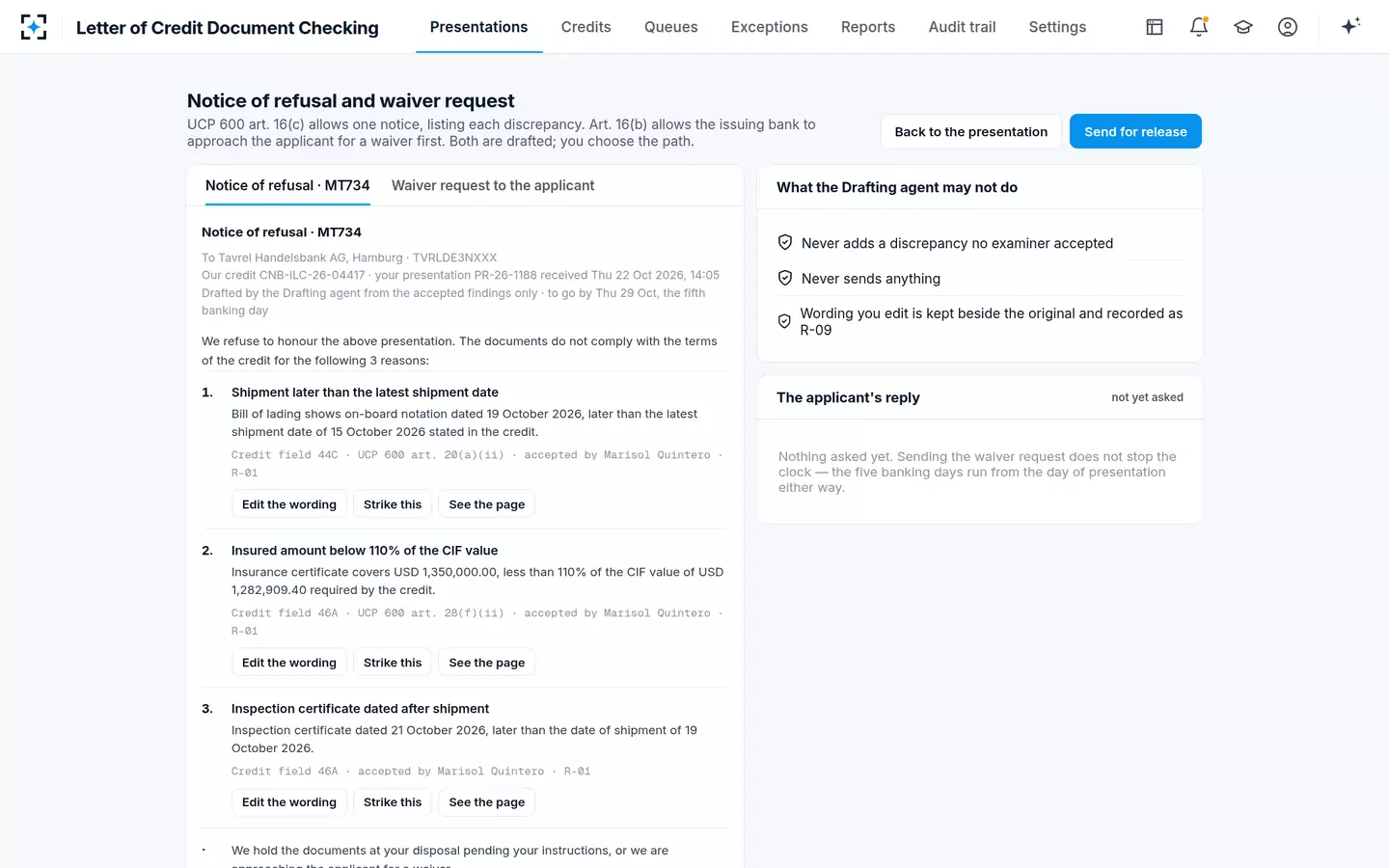
What is an MT734?
An MT734 is the SWIFT message type for an advice of refusal under a documentary credit: the notice art. 16(c) requires, sent bank to bank over the SWIFT network. A US court has treated SWIFT messages as the telecommunication art. 16(d) asks for; in MAM Apparel it said simply: "SWIFT messages are a form of telecommunication."
The same decision shows how a code in the message carries the disposition. The issuing bank's refusal messages contained a "77B /NOTIFY/" code, which the court read, from SWIFT's published standards, as "indicating that the documents are being held until the issuing bank receives a waiver from the applicant and agrees to accept it or receives further instructions from the presenter." That satisfied the requirement to say what the bank was doing with the documents, and the court held the notices timely and adequate.
Can the bank hold the documents after refusing?
Yes, but only on terms it states in the notice and then follows. Art. 16(c)(iii) gives four options, and art. 16(e) lets a bank that chose either holding option "return the documents to the presenter at any time." The table sets them out.
The four things a refusing bank can say about the documents, under art. 16(c)(iii)
| Option | What the notice says | What the bank must then do |
|---|---|---|
| (a) Hold for the presenter | Holding the documents pending further instructions from the presenter | Follow the presenter's instructions promptly when they come; may return the documents at any time (art. 16(e)). |
| (b) Hold for a waiver | The issuing bank keeps the documents until the applicant waives and the bank agrees to accept the waiver, unless the presenter sends instructions first | Pay if a waiver arrives and it accepts it; follow the presenter's instructions if they arrive first. Issuing bank only. |
| (c) Return | Returning the documents | Return them with reasonable promptness; an English court held a bank precluded after 89 to 104 days. |
| (d) Prior instructions | Acting in accordance with instructions previously received from the presenter | Do what those instructions say. |
Holding is not owning. The documents usually include the bill of lading, which controls the cargo, so a bank that holds them is holding the beneficiary's goods in effect. That is why the English courts read a duty of prompt action into the notice, and why the presenter's instructions take priority over a waiver that has not yet arrived.
Day 2, afternoon: the waiver, and payment
In the sample the bank took the faster path. The waiver request and the notice had been drafted at the same moment from the same findings, so at 13:48 the client service officer sent the request, asking for an answer by Wednesday and stating that asking did not extend the five banking days. The applicant waived all three discrepancies in writing at 14:36. At 14:52 a senior checker, who had not prepared the presentation, read the on-board stamp on page 1 of the bill of lading herself and released USD 1,282,909.40, the invoice value, to the presenting bank, value 27 October. The drafted notice was cancelled and kept on the trail.
Released on banking day 2 of 5, with the waiver held in writing
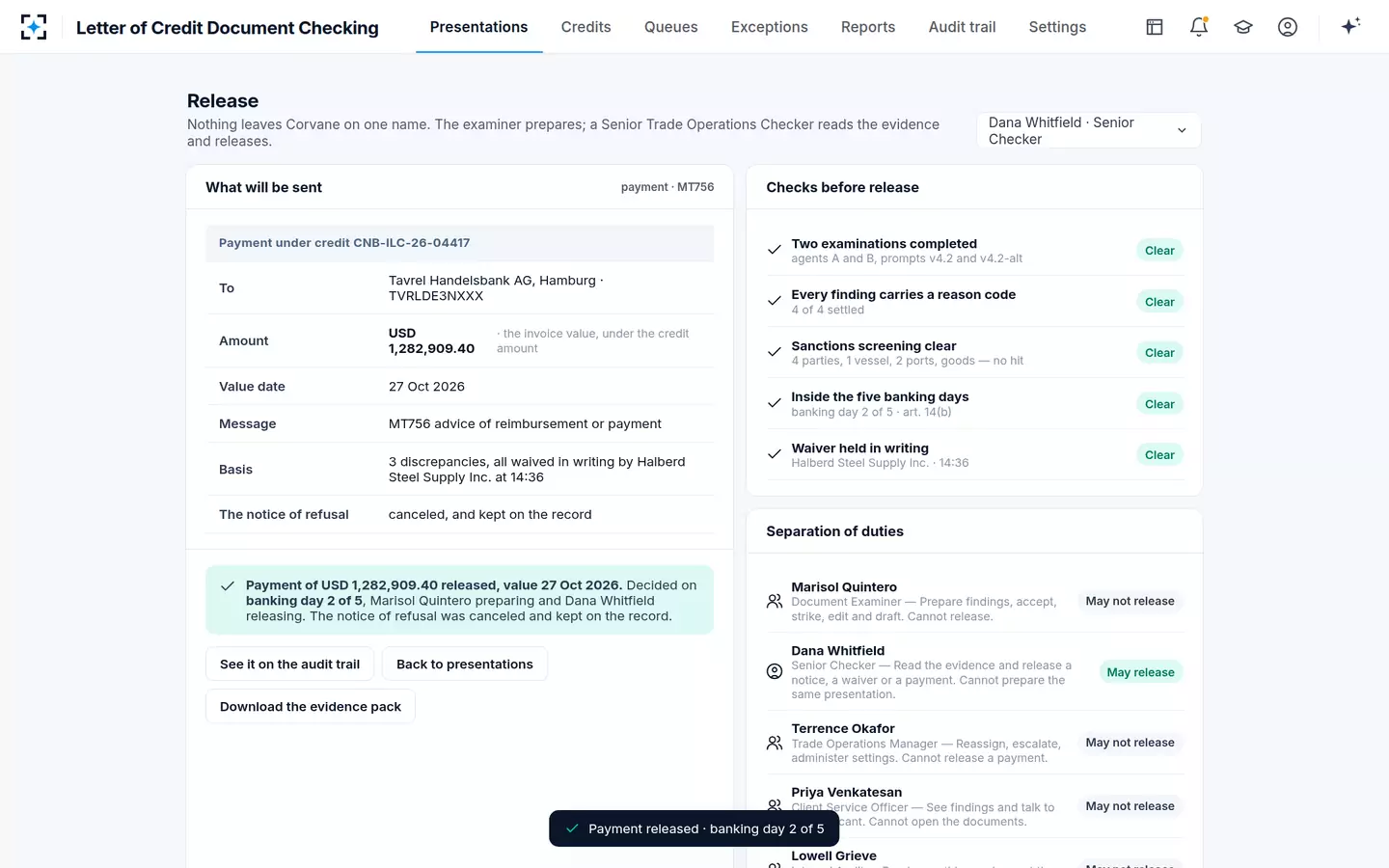
Had the applicant said no, the bank would have had banking days 3, 4 and 5 to send the notice, with the documents held pending the presenter's instructions or returned. Waiving discrepancies before day five ends looks at that choice from the applicant's side.
Can the exporter correct and re-present documents?
Yes, if there is time left under the credit. A corrected presentation is a new presentation, examined afresh, and it must still meet the credit's deadlines: the expiry date under art. 6(e), and for original transport documents the 21-day limit in art. 14(c), which never runs past the expiry date of the credit. Some discrepancies cannot be corrected at all; a late on-board date stays late.
The deadline is unforgiving. In Mago International v LHB AG, the beneficiary presented three times; its third tender came on the last possible day, and when it finally presented signed bills of lading three days later, the confirming bank rejected the tender as untimely. The Second Circuit upheld the bank (Mago International v LHB AG, 2d Cir. 2016). A beneficiary that expects to cure a discrepancy needs to know about it early, which is one more reason a bank's notice should go out as soon as its findings are decided, not on day 5.
Will the exporter still get paid?
Usually yes, but no longer as of right. After a discrepancy, payment depends on one of three things: the applicant's waiver and the issuing bank's acceptance of it, a corrected presentation within the credit's deadlines, or a negotiation outside the credit. The measured data favor the first: in Mann's study, 53% of discrepant import files were waived within one business day of the bank's contact and 84% within a week.
What the beneficiary loses is certainty and time. A complying presentation obliges the issuing bank to honor under art. 15(a); a discrepant one leaves the beneficiary's goods, often already at sea, controlled by documents a refusing bank is holding. That is why exporters' banks check before forwarding, and why the most useful thing an issuing bank can do for a good customer on either side is decide early. To see the full sequence on one screen, start from Letter of Credit Document Checking.
Questions people ask
Does a confirming bank get its own five banking days?
Yes. Art. 14(b) gives the nominated bank acting on its nomination, the confirming bank and the issuing bank five banking days each, counted from the day after presentation to it. A presentation that passes through a confirming bank to the issuing bank therefore runs on two clocks, one at each bank.
Do bank holidays count as banking days?
No. UCP 600 art. 2 defines a banking day as a day the bank is regularly open at the place where the act is to be done, so weekends and the bank's own holidays at that place fall out of the count. The sample bank counts on a calendar of US federal holidays, Monday to Friday.
Can a bank refuse for a reason it did not list in the notice?
Not under UCP 600: the notice must state each discrepancy, and a bank that fails to act in accordance with art. 16 is precluded from claiming the documents did not comply. UCC §5-108(c) is to the same effect for credits it governs, though §5-108(d) preserves fraud, forgery and expiry before presentation as defences.
Can the applicant stop payment if the documents comply?
No. Under art. 15(a), when an issuing bank determines that a presentation is complying, "it must honour". The credit is separate from the sale contract under art. 4, so a buyer's complaint about the goods is not a ground to refuse complying documents, outside the narrow fraud exceptions national law provides.
What does "77B /NOTIFY/" mean in a refusal message?
In MAM Apparel the court read the code, from SWIFT's published standards, as meaning the documents are held until the issuing bank receives the applicant's waiver and agrees to accept it, or receives further instructions from the presenter. It is the coded form of option (b) in art. 16(c)(iii).