Trade finance automation software for letter of credit document checking takes one of three approaches: a rules engine that compares fields extracted from the documents with the terms of the credit, AI agents that read the documents, cross-check them and draft the notice for an examiner to decide, or a manual desk where a trade finance system keeps the records and people do the reading. Each can be run well, and each leaves different work, and different risk, with the examiner. The right choice depends on which errors a bank can least afford: misses that make it pay against bad documents, false calls that make it refuse good ones, or a notice that arrives after the fifth banking day. Botminds' Letter of Credit Document Checking takes the agent approach, examines every presentation twice and leaves every decision and release to named people; this guide compares it honestly with the alternatives.
Regulatory and research sources are linked where they appear. Product examples come from a fictional sample bank, Corvane National Bank, as it runs through the solution.
Three approaches to LC document checking, judged by what each leaves the examiner
| Question | Manual desk with a trade system | Rules engine | Agents with two examinations |
|---|---|---|---|
| Who reads the documents | The examiner, every page, every time. | An extraction step feeds fields to rules; the examiner reads whatever extraction misses. | Agents read every page and place each value with its page and line; the examiner reads what is flagged. |
| Dates, amounts, counts, tolerances | By hand, with a calculator. | Strong: deterministic checks such as latest shipment, 110% cover, the 5% quantity tolerance, 21 days. | Checked, and shown with the arithmetic and the article. |
| Different wording that does not conflict (art. 14(d)) | Examiner judgment, under time pressure. | Weak: a rule either matches strings or needs a list of every acceptable variant. | Agents reason about conflict; where two independent examinations differ, a person decides. |
| Evidence for the checker | In the examiner's notes and the scan. | A rule ID and the field values. | The page, the line, the credit clause and the article, one click from the finding. |
| The five banking days | A spreadsheet or the trade system's diary. | Usually outside the engine. | Counted on the bank's calendar, escalated and blocked at day 5. |
| The single notice | Typed by the examiner. | Often a template filled from rule hits. | Drafted from accepted findings only, with the waiver request alongside. |
| What the examiner still owns | Everything. | Every judgment call, and every case the rules did not anticipate. | Every decision, every release, and the rules of the desk itself. |
What should trade finance automation software do?
Trade finance automation software for document checking should do the reading, the counting, the cross-checking and the drafting, show its evidence for every finding, enforce the clock, and keep a record of who decided what. It should not decide whether a presentation complies. That split follows the rules: UCP 600 art. 14(a) puts the duty to examine on the banks, and art. 16 makes a refusal the bank's own act, with consequences the bank alone bears (ICC, UCP 600).
The OCC already expects systems in this role. Its trade finance booklet notes that banks "have increasingly turned to technology to automate key aspects of their operations", and that "These systems may handle such functions as electronic documentation, discrepancy detection, matching and filtering names against Office of Foreign Assets Control (OFAC) sanction lists, payment processing, and other trade-related functions" (OCC, Trade Finance and Services, version 1.1). The same booklet adds that such systems "may entail certain operational risks that banks should mitigate". Discrepancy detection is not new; the question is how a system detects, and what it does with the judgment calls.
Rules engine or AI for LC document checking?
Use rules where the test is arithmetic and AI where the test is meaning, and keep a person on every judgment either one produces. A rules engine is excellent at the checks UCP 600 states as numbers: whether the on-board date is after field 44C, whether insurance covers at least 110% of the CIF value, whether the quantity is within 5% under art. 30(b), whether the presentation came within 21 days of shipment. Those checks are deterministic, explainable and cheap to test.
A rules engine struggles where the rules themselves ask for judgment. Art. 14(d) lets data differ from the credit and the other documents so long as it does not conflict with them. Art. 14(e) lets documents other than the invoice describe goods "in general terms". Art. 14(j) says an applicant's address on most documents need not match the credit, only be in the same country. A rule that matches strings raises false calls on all three; a rule loose enough to avoid them misses real conflicts. That is the gap AI agents are meant to fill, and the reason they need a second, independent examination and a person behind them.
Where a rules engine is the right tool, and where agents earn their place
Rules engine: Dates, amounts, counts, tolerances, presence of a document.
Agents with a second examination: Reading varied layouts, deciding whether two wordings conflict, citing the page.
Rules engine: False calls on harmless variants, or misses when loosened to avoid them.
Agents with a second examination: A confident wrong reading, which is why two independent readings must agree.
Rules engine: The rule that fired.
Agents with a second examination: The clause, the line, the article and the reasoning, kept with the finding.
Rules engine: Someone edits a rule.
Agents with a second examination: Someone changes a model or prompt, which should be pinned and re-tested.
Rules engine: Deterministic rule-based processes are excluded from the 2026 interagency definition of a model.
Agents with a second examination: Generative and agentic AI are outside the 2026 guidance's scope, pending a planned request for information.
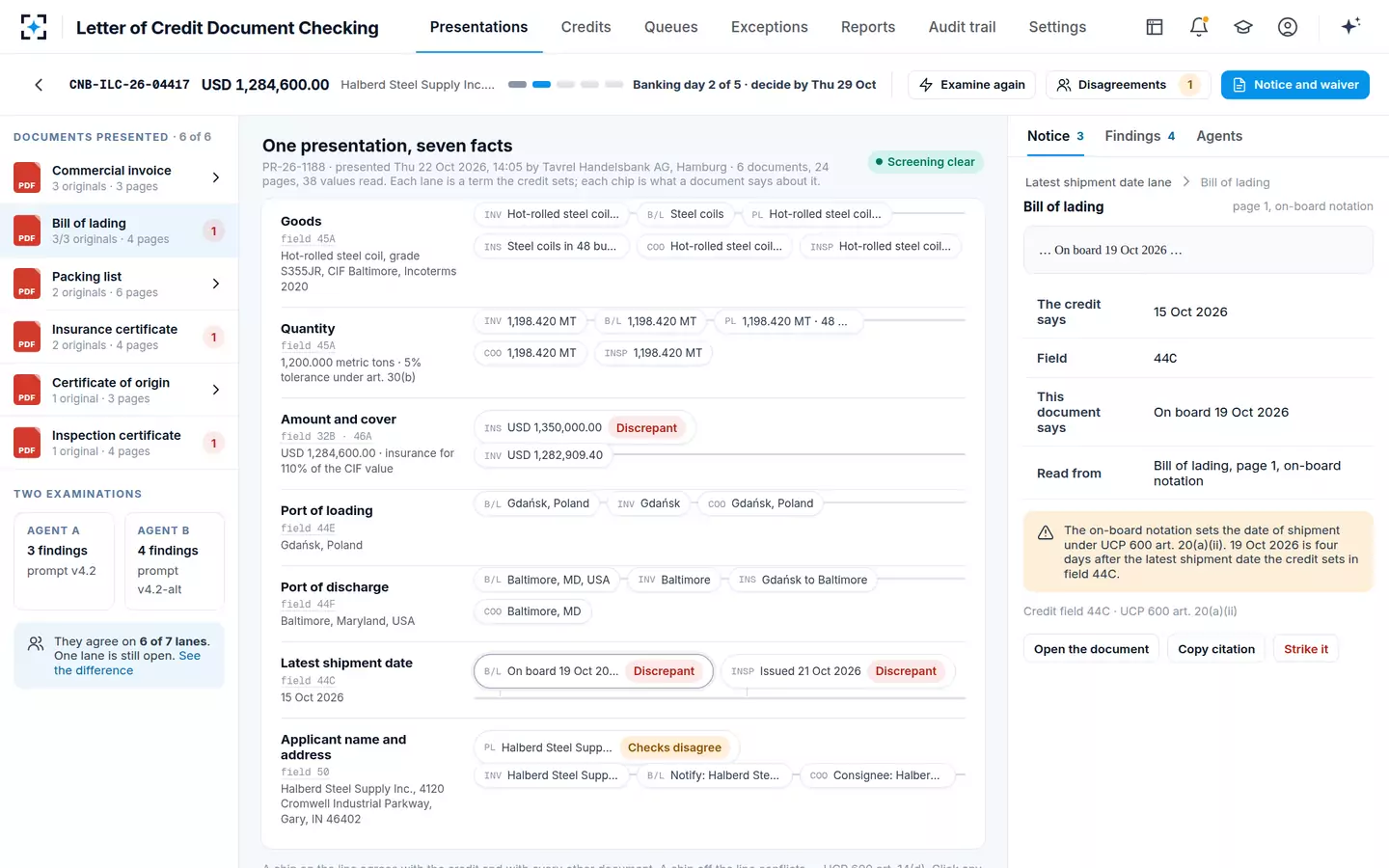
The solution's design answers the agents' failure mode directly. Two examiner agents, on different models and different prompts, test every lane without seeing each other's work. Where they agree above the bank's confidence threshold, the finding goes to the examiner to accept or strike; where they differ, or either is below the threshold, the lane goes to the examiner as a question with both reasonings attached. Because a single engine has nothing to disagree with, its errors look exactly like its right answers.
Every value opens the line it came from, with the clause and the article beside it
How much of LC checking can software take?
The reading and the cross-checking, but not the review as a whole, and the industry's own standard says so. The Wolfsberg Group, the ICC and BAFT, in their 2019 Trade Finance Principles, accept that some elements, such as screening against sanctions lists, may be automated, but say the overall review of trade documents is by its nature not something automation can do successfully, and that financial crime controls need a mix of automated and manual checks (Wolfsberg Group, ICC and BAFT, 2019 amendment; quoted in how technology can assist in combating TBML). Peer-reviewed research on AI in LC examination likewise finds that it still needs human checkers to verify what the AI proposes (Khalil et al., 2025).
Any vendor that claims to automate LC checking end to end is claiming something the standard-setters and the research say cannot be done safely. The honest claim is narrower and still worth a great deal: automate the reading, the extraction, the cross-checking and the drafting, which are the error-prone and time-consuming steps, and give the examiner a decision-ready file with the evidence attached. Agents prepare, the examiner decides sets out exactly where that line falls.
Do we still need examiners with automation?
Yes, and the regulator expects them. The OCC's booklet says banks should have competent managers and experienced staff for trade operations, and its procedures tell examiners to assess the expertise, training, number and turnover of trade staff. Automation changes what those people spend their day on, not whether they are needed.
What automation can change is how a desk copes with peaks. The five banking days do not stretch at quarter end: the sample bank's trade processing center runs about 31 presentations a banking day but peaks at 60, inside the same clock. A desk staffed to read every page at the average has no slack at the peak; a desk whose examiners start from findings can absorb it with the same people. A trade finance document checker's day shows where the minutes move.
What do bank examiners expect of trade finance systems?
Bank examiners expect trade systems to sit inside the bank's controls, not beside them. The OCC's procedures tell examiners to check that adequate controls, including segregation of duties and dual controls, have been established for transaction processing, and that processes are adequate for "assimilating regulatory changes and, as applicable, governing international practices into the systems." For a document checking system that second line has a concrete meaning: when the ICC published ISBP 821 on 3 July 2023 to replace ISBP 745, a bank needed to know how its system's checks changed (ICC Digital Library, Documentary Credit World).
They also expect evidence. The same procedures ask for the volume and nature of document discrepancies and their resolutions. A system that records each finding, the examiner's decision and the reason, on a trail that cannot be edited, turns that request from a project into a download.
The US commercial letter of credit book is large, growing and concentrated
$24.5bn
commercial letters of credit outstanding at FDIC-insured institutions, 30 June 2026
+15%
from $21.2bn a year earlier, 30 June 2025
486
institutions reporting any commercial letters of credit
~90%
of the total held by the ten largest reporters
The concentration shapes the buying question. The largest reporters run processing centers at a scale where a vendor's throughput claims are tested daily. The other four hundred-odd banks run small desks, where one examiner's absence near quarter end is the real risk, and where the value of software is consistency and a reliable clock as much as speed.
How do we compare trade finance software vendors?
Compare them on your own closed presentations and on a short list of questions whose answers can be checked. The list below applies to any product, ours included; each question is one an examiner, an auditor or a senior checker would ask after go-live.
Twelve questions to put to any trade finance automation software for LC checking
- Will you run on our last quarter's closed presentations?
Scored by discrepancy type, with misses and false calls counted separately.
- What does the system decide on its own?
The acceptable answer for a refusal, a waiver or a payment is: nothing.
- Does every finding open the page and line it came from?
A finding without its source is a claim the senior checker has to re-verify by hand.
- How does it tell a difference from a conflict?
Ask for examples of differences it correctly does not raise: abbreviations, general goods descriptions, addresses in the same country.
- What happens when it is unsure?
It should route to a person, with a threshold the bank sets and can see.
- Is there an independent second examination?
Two readings that agree mean more than one confident one.
- Who writes the notice, and from what?
One notice, from accepted findings only, with the holding option the bank chooses.
- Does it count banking days on our calendar?
Including our holidays, with escalation before day 5, not a report after it.
- How are model and prompt changes controlled?
Pinned versions, a re-test on past presentations before use, and the change on the audit trail.
- Does it fit our systems?
The trade finance system, SWIFT messages, imaging, sanctions screening and the general ledger.
- What does the audit trail contain, and who can change it?
Every agent step and human decision, with reasons, kept for the bank's retention period, and editable by no one.
- Which rule sets does it apply?
UCP 600 and ISBP 821 at least; eUCP 2.1 if you take electronic presentations; how it learns your bank's own rulings.
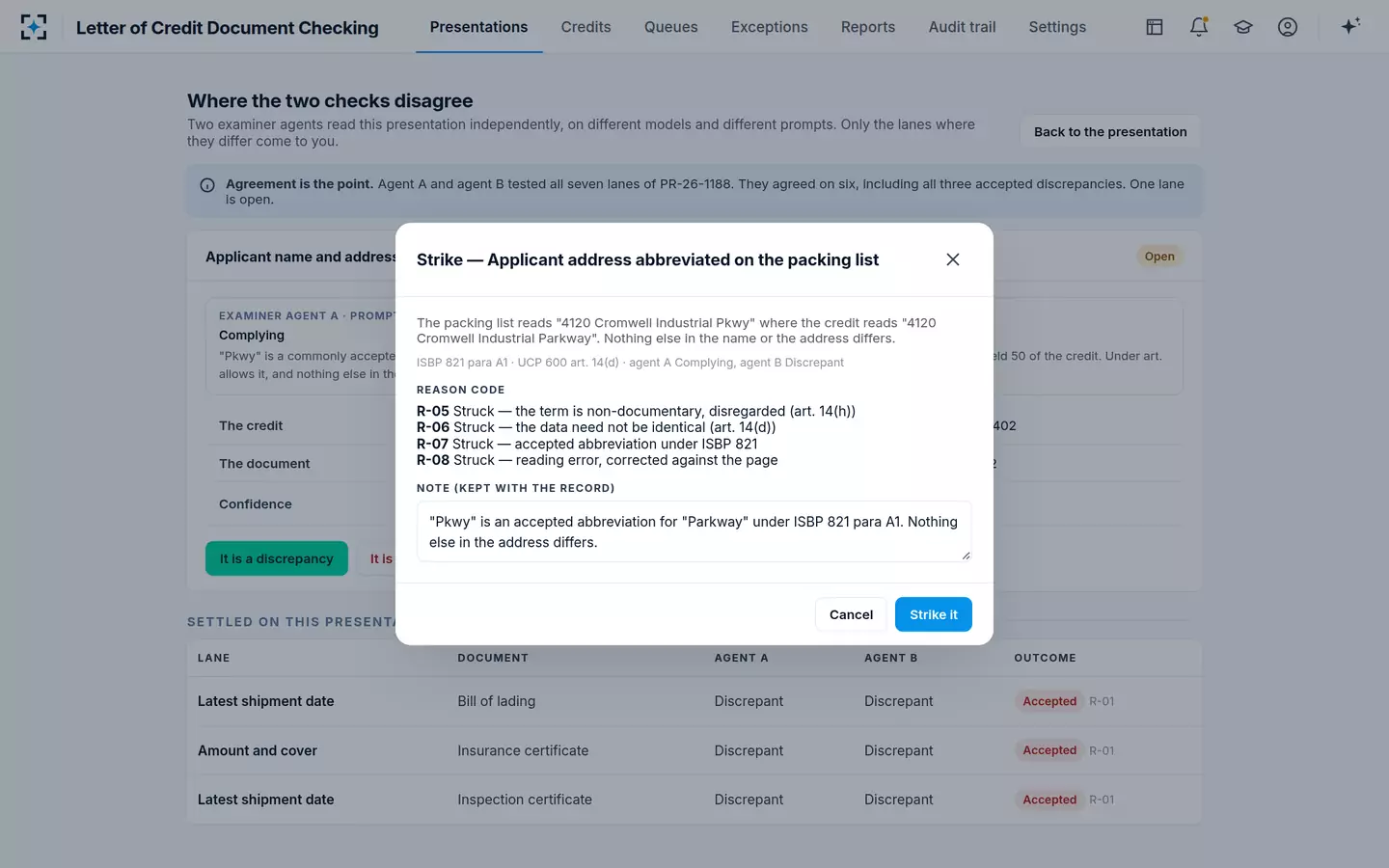
A reason code on every decision, from the bank's own list
How to run a fair bake-off between vendors
A fair comparison gives every product the same presentations, the same answer key and the same rules of engagement, and decides in advance what counts as a pass. Pick one quarter's closed presentations, with the credits as they stood on each day of presentation, and include clean presentations as well as waived and refused ones. Give each vendor the documents without the decisions. Fix the settings each must declare up front: the confidence threshold, whether a second examination is on, and which rule sets apply.
Score the results the same way for every vendor: discrepancies found, missed and falsely raised, per discrepancy type; how many lanes each routed to a person; whether each finding cited the right page and article. Have one senior examiner, who did not make the original decisions, adjudicate every disagreement for all vendors at once, so that the answer key moves for everyone or no one. Set the pass mark per type before the results arrive. A product that wins on its average while missing one whole category, late presentation say, has failed the test that matters. Testing trade finance document automation on last quarter's files sets out the scoring sheet and the sample sizes in full.
One more rule keeps the comparison honest: count what each product did without being asked. A system that sent a message, released a payment or cleared a screening hit during a test has answered the most important question on the checklist, whatever its score.
Where Letter of Credit Document Checking fits, and where it does not
The solution fits a bank that examines presentations under documentary credits subject to UCP 600, on paper or scanned, and wants its examiners to start each presentation from cited findings rather than a stack of documents. It connects to the systems a trade desk already runs: the trade finance system for the credit and amendments, the SWIFT gateway for the MT700 and MT707 in and the MT734, MT750 and MT756 out, document imaging, the sanctions screening system and the general ledger. It is configured with the bank's own reason codes, banking-day calendar, escalation and separation of duties.
It does not issue or manage credits for the bank's customers, which is a different job. It does not replace the sanctions screening system: it sends the parties, vessel, ports and goods to it and holds a presentation on a hit, and only the financial crime team clears one. Standby letters of credit and demand guarantees under ISP98 or URDG 758 run on different rules, set out in the difference between a bank guarantee and a standby, and belong to Bank Guarantee & Standby LC Issuance. And it does not decide: every acceptance, strike, notice and payment carries a person's name. To see it on your own presentations, start from Letter of Credit Document Checking.
Questions people ask
What is the best trade finance automation software?
We found no independent public ranking of LC checking software. The best one for a bank is the one that scores well on its own closed presentations, leaves every decision with its examiners, and passes the bank's own audit of its trail. Ask for the replay before the reference calls.
Can a rules engine and AI agents work together?
Yes, and they should. Arithmetic checks such as dates, amounts, the 110% insurance default and quantity tolerances are well suited to deterministic rules; questions of conflict, general description and document function need reading. A combined design uses each where it is strong and routes disagreements to a person.
Does LC checking software replace the trade finance system?
No. The trade finance system holds the credit, its amendments, the presentation record and the accounting; document checking software reads the presentation against the credit and hands back findings and drafts. Replacing the system of record is a far larger project and a different decision.
Can trade finance automation handle electronic presentations?
Electronic presentations under a credit subject to eUCP 2.1 follow their own examination rules, including when the clock starts. Software should say which rule sets it applies and treat an eUCP credit differently from a paper one; the solution's rules library includes UCP 600, ISBP 821, eUCP 2.1 and published ICC opinions.
How long does it take to implement LC checking software?
No independent study measures implementation times, and any vendor figure is a sales estimate. The parts that take time are connecting the trade finance system, SWIFT and imaging, loading the bank's reason codes and calendar, and running the replay on past presentations that should come before anything goes live.