The difference between a bank guarantee and a standby letter of credit is mostly the rulebook, not the function. Both are a bank's independent promise to pay a beneficiary against a documentary demand if its client fails to perform or to pay. A demand guarantee is usually issued under the ICC's Uniform Rules for Demand Guarantees, URDG 758, and a standby under ISP98 or UCP 600; the two rule sets differ on what a demand must say, how long the bank has to examine it, what happens if the instrument names no expiry, and what force majeure does to the deadline. The label on the instrument matters less than its terms, and courts say so. Botminds' Bank Guarantee & Standby LC Issuance holds model forms for both, reads every requested clause against the right one, and examines each demand under the rules its instrument is actually subject to.
The comparison below quotes ICC's free texts of URDG 758, ISP98 and UCP 600, which apply only when an instrument incorporates them, and the UN and court texts linked where they appear. A "bank guarantee" here means an independent demand guarantee; a "see to it" guarantee, in which the bank answers only if the client is actually liable, is a different instrument and is covered below.
Two instruments, two default clocks
5days
business days to examine a demand under a URDG 758 guarantee
3–7days
business days for notice of dishonour under an ISP98 standby: within 3 is not unreasonable, beyond 7 is
3years
when a URDG 758 guarantee with no expiry ends; ISP98 requires an expiry or a right to terminate
What is the difference between a bank guarantee and a standby letter of credit?
Functionally, very little. UNCITRAL, which wrote the UN Convention covering both, says the two "can be covered by the umbrella of the Convention because they share a wide area of common use. Both types of instruments, which are payable upon presentation of any stipulated documents, are used to secure against the possibility that some contingency may occur (e.g. a breach of a contract)" (UNCITRAL secretariat, Explanatory Note to the Convention on Independent Guarantees and Stand-by Letters of Credit). The same note adds one use that is more typical of standbys: "to effectuate payment of mature indebtedness ("financial" or "direct pay" stand-by letters of credit)."
The practical differences come from the rules. The industry's 2019 principles put the distinction in one sentence: "SBLCs usually only require a simple demand for payment along with a statement of default and are subject to either ISP98 or UCP600, while Guarantees usually subject to URDG 758 more often require a simple demand with a statement of the nature of the default or claim" (Wolfsberg Group, ICC and BAFT, Trade Finance Principles, Appendix III, 1.3). The same paragraph notes that the choice "may also vary based on local law or prevailing business practice".
"ISP 98 … provides separate rules for standby letters of credit in the same sense that the Uniform Customs and Practice for Documentary Credits (UCP) and the Uniform Rules for Demand Guarantees (URDG) do for commercial letters of credit and independent bank guarantees."
U.N. Secretary-General, quoted by the US Court of Appeals for the Tenth Circuit, EFLO Energy v. Devon Energy (2023)
Which rules govern a bank guarantee and a standby letter of credit?
A demand guarantee is governed by URDG 758 when it "expressly indicates it is subject to them" (art. 1(a)), or otherwise by the local law of guarantees where it is issued. A standby is governed by ISP98 when it makes "express reference" to it (rule 1.01(b)), or by UCP 600, which applies to any documentary credit, "including, to the extent to which they may be applicable, any standby letter of credit", when the credit says so (UCP 600, art. 1). Behind each sits the governing law; in the United States that is usually Article 5 of the Uniform Commercial Code.
US banking regulation names some of these and not others. The examples of rules for independent undertakings listed in the OCC's regulation include UCP 600, the electronic supplements to the UCP, ISP98, the UN Convention and the ICC's bank-to-bank reimbursement rules, but not URDG 758 (12 CFR 7.1016, footnote 1). The list is introduced as examples, so the omission is not a prohibition. Why US banks issue standbys at all, rather than guarantees, is a separate question of bank powers, which can US banks issue bank guarantees? answers.
Side by side: what each rule set says
Read clause by clause, the rule sets agree on the essentials, independence and examination on the face of documents, and differ on the details that decide disputes.
Demand guarantee under URDG 758, standby under ISP98, standby under UCP 600
| Question | URDG 758 guarantee | ISP98 standby | UCP 600 standby |
|---|---|---|---|
| What a demand needs by default | Demand plus a statement of the respect in which the applicant is in breach (art. 15(a)), unless excluded | A documentary demand (rule 4.08); a statement of default only if required (rule 4.17) | The documents the credit requires |
| Time to examine | Five business days after presentation (art. 20(a)) | Notice within 3 business days not unreasonable, beyond 7 unreasonable (rule 5.01) | Maximum five banking days (art. 14(b)) |
| Refusal notice | Single notice, each discrepancy (art. 24(d)) | All discrepancies (rule 5.02) | Single notice, each discrepancy (art. 16(c)) |
| No expiry stated | Ends three years after issue (art. 25(c)) | Not allowed: expiry date or termination right required (rule 9.01) | A credit "must state an expiry date for presentation" (art. 6(d)) |
| Office closed by force majeure at expiry | Extended 30 calendar days (art. 26) | Extended to 30 calendar days after reopening (rule 3.14) | No honour after resumption if it expired meanwhile (art. 36) |
| Extend-or-pay demand | Payment may be suspended up to 30 calendar days (art. 23) | A presentation, examined as such (rule 3.09) | No specific rule |
| Condition with no document | Disregarded (art. 7) | Disregarded (rule 4.11) | Disregarded (art. 14(h)) |
The force majeure row is the one practitioners most often miss. Under UCP 600 a bank "will not, upon resumption of its business, honour or negotiate under a credit that expired during such interruption of its business" (art. 36), which shifts the whole risk of a closure to the beneficiary; ISP98 and URDG 758 both give the beneficiary 30 more days. It is one of the gaps behind an observation in the industry's 2019 principles: standbys issued under UCP 600, rules designed primarily for documentary credits, often carry exclusions and variations of those rules.
Is an SBLC a guarantee?
An SBLC is a guarantee in function but not in legal form. ISP98 rule 1.06 makes a standby irrevocable, independent and documentary by its nature, whether or not it says so (ISP98): the bank pays against documents, not against proof that its client is liable. A demand guarantee works the same way under URDG 758, which defines it as "any signed undertaking, however named or described, providing for payment on presentation of a complying demand" (art. 2). Both are guarantees in the business sense of securing someone else's performance.
What neither is, is a classic suretyship or "see to it" guarantee. US law states the independence directly: the issuer's obligations "are independent of the existence, performance, or nonperformance of a contract or arrangement out of which the letter of credit arises or which underlies it" (UCC § 5-103(d)).
What is a demand guarantee, and how is it different from a see-to-it guarantee?
A demand guarantee pays on a complying demand; a see-to-it guarantee pays only if, and to the extent that, the principal is actually liable under the contract. English courts have set out how to tell them apart, and the starting point is that the name on the document does not settle it.
Demand guarantee or see-to-it guarantee: what an English court looks at
Points towards a demand guarantee: A bank or other financial institution.
Points towards a see-to-it guarantee: Not a bank: there is a presumption against a demand bond.
Points towards a demand guarantee: Underlying deal between parties in different jurisdictions.
Points towards a see-to-it guarantee: No such pointer from the transaction itself.
Points towards a demand guarantee: Pay "on demand", with or without a supporting document.
Points towards a see-to-it guarantee: Pay what the principal is proved to owe.
Points towards a demand guarantee: Absent.
Points towards a see-to-it guarantee: Present: clauses preserving the guarantor's defences.
Points towards a demand guarantee: URDG, which is "likely to be determinative".
Points towards a see-to-it guarantee: None.
The judgment's second principle is the one to remember: what an instrument is labelled, and the use of words such as "on demand", "may be of limited value in determining its legal nature". Its fourth gives the strongest pointer: an instrument issued by a financial institution for a cross-border transaction, containing an undertaking to pay "on demand" and no clauses limiting the guarantor's defences, "will almost always be construed as a demand guarantee" (Panama v Sacyr, para 81).
Incorporating URDG 758 settles a great deal, and English judges treat the rules as more than boilerplate. In a 2020 case on a guarantee subject to URDG 758, the High Court said the rules are "an internationally recognised set of rules which are contributed to and revised from time to time by a group of international users, including banks, so as to provide clarity and certainty to the creation and the performance of demand guarantees", and held, in the alternative, that article 7 removed a condition that had no document attached (Tecnicas Reunidas Saudia v Korea Development Bank [2020] EWHC 968 (TCC)).
Which is better for the beneficiary, a bank guarantee or an SBLC?
Neither is better in general; each rule set favours the beneficiary on different points. A beneficiary that wants the simplest possible demand does better under ISP98, where a statement of default needs only to say that a drawing event occurred, than under URDG 758, which asks in what respect the applicant is in breach. A beneficiary that wants a definite answer quickly gets a firmer clock under URDG 758, five business days, than under ISP98's "not unreasonable" standard between three and seven.
On expiry and closure both give the beneficiary more protection than a UCP 600 standby, and on extend-or-pay URDG 758 lets the guarantor suspend payment for up to 30 days, which a beneficiary may or may not welcome. In practice the choice is usually made by the beneficiary's market and law, not negotiated afresh: the 2019 principles note that "most SBLCs and Guarantees issued are not related to Trade Finance activities" (Appendix III, 1.5), and many are required in a form a ministry, landlord or regulator has already fixed.
Is a bank guarantee independent of the underlying contract?
A demand guarantee is. URDG 758 says a guarantee "is by its nature independent of the underlying relationship and the application, and the guarantor is in no way concerned with or bound by such relationship" (art. 5(a)). A dispute between the client and the beneficiary about whether the works were finished does not stop payment of a complying demand. The exception is fraud, which every system recognises, under tests set by courts rather than by the rules; the demand file that survives a challenge sets out those tests.
When a standby backs a local guarantee: counter-guarantees
The two instruments often meet in one chain. A beneficiary that will accept only a guarantee from a bank in its own country gets one from a local bank, and that bank issues it against a counter-guarantee or counter-standby from the client's own bank. URDG 758 ties the chain together: where a guarantee is issued subject to the rules at a counter-guarantor's request, "the counter-guarantee shall also be subject to the URDG, unless the counter-guarantee excludes the URDG" (art. 1(b)), and a demand under the counter-guarantee needs a statement that the local bank has itself received a complying demand (art. 15(b)).
The clocks are nested too. If the local bank suspends payment on an extend-or-pay demand, the counter-guarantor may suspend for "a period not exceeding four calendar days less than the period during which payment of the demand under the guarantee was suspended" (art. 23(b)). And the local bank does not treat the counter-guarantee as a formality: the 2019 principles say that for anti-money-laundering purposes counter-guarantees and counter-standbys "are treated in the same way as if they are an original or new issuance", with the original issuing bank treated as the applicant and "full CDD" required on it (Trade Finance Principles, Appendix III, 8.1).
How Bank Guarantee & Standby LC Issuance handles both in one book
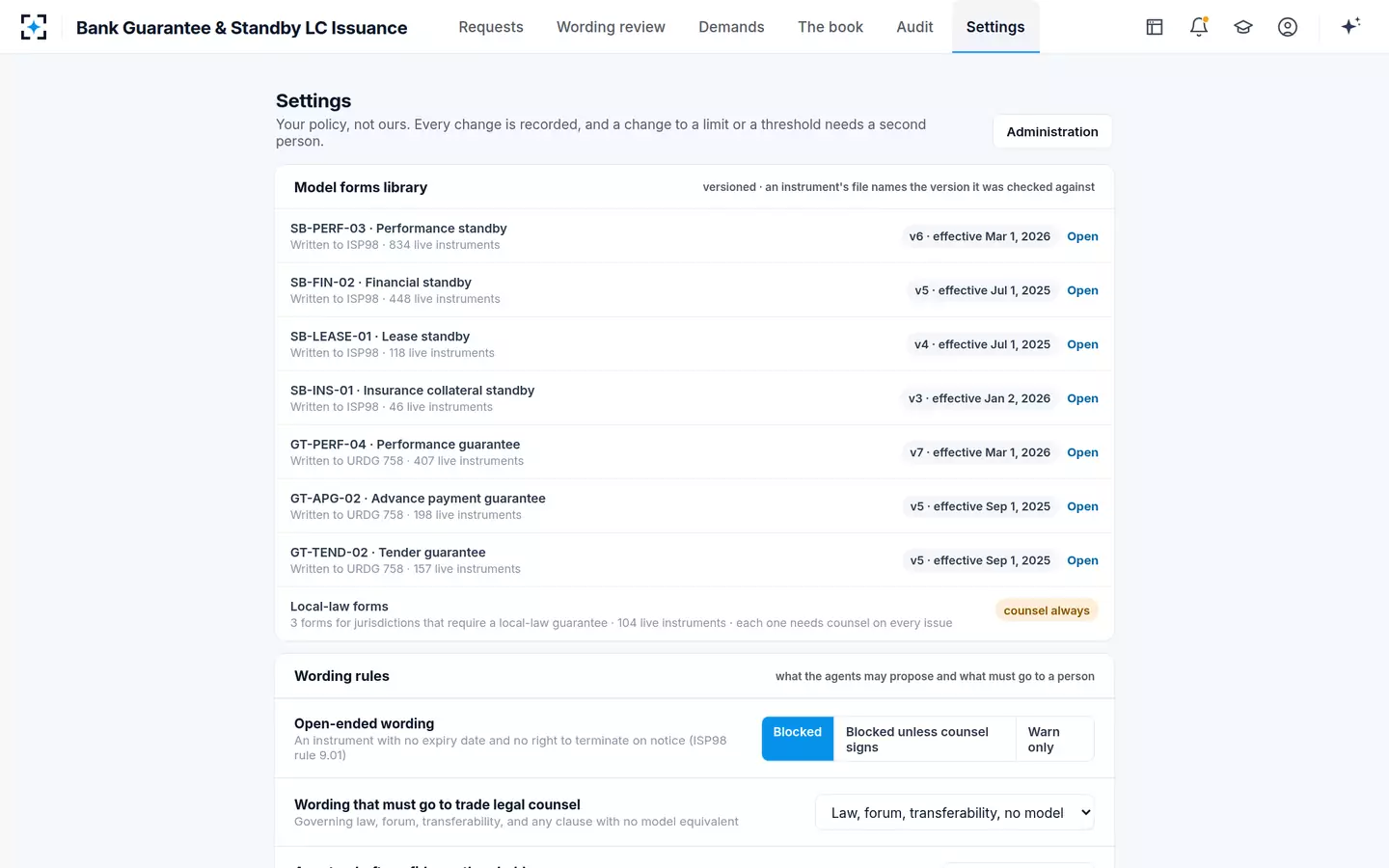
The solution keeps a versioned model form for each instrument type and rule set, so a request is read against the form it should match: a performance standby against an ISP98 form, an advance payment guarantee against a URDG 758 form, a local-law guarantee against a form that always goes to counsel. A demand is then examined under the articles of the instrument's own rule set, with the clock counted accordingly. On the sample bank's book of 2,312 live instruments, 1,446 are under ISP98, 762 under URDG 758 and 104 under local-law forms.
Model forms for each rule set, versioned in Bank Guarantee & Standby LC Issuance
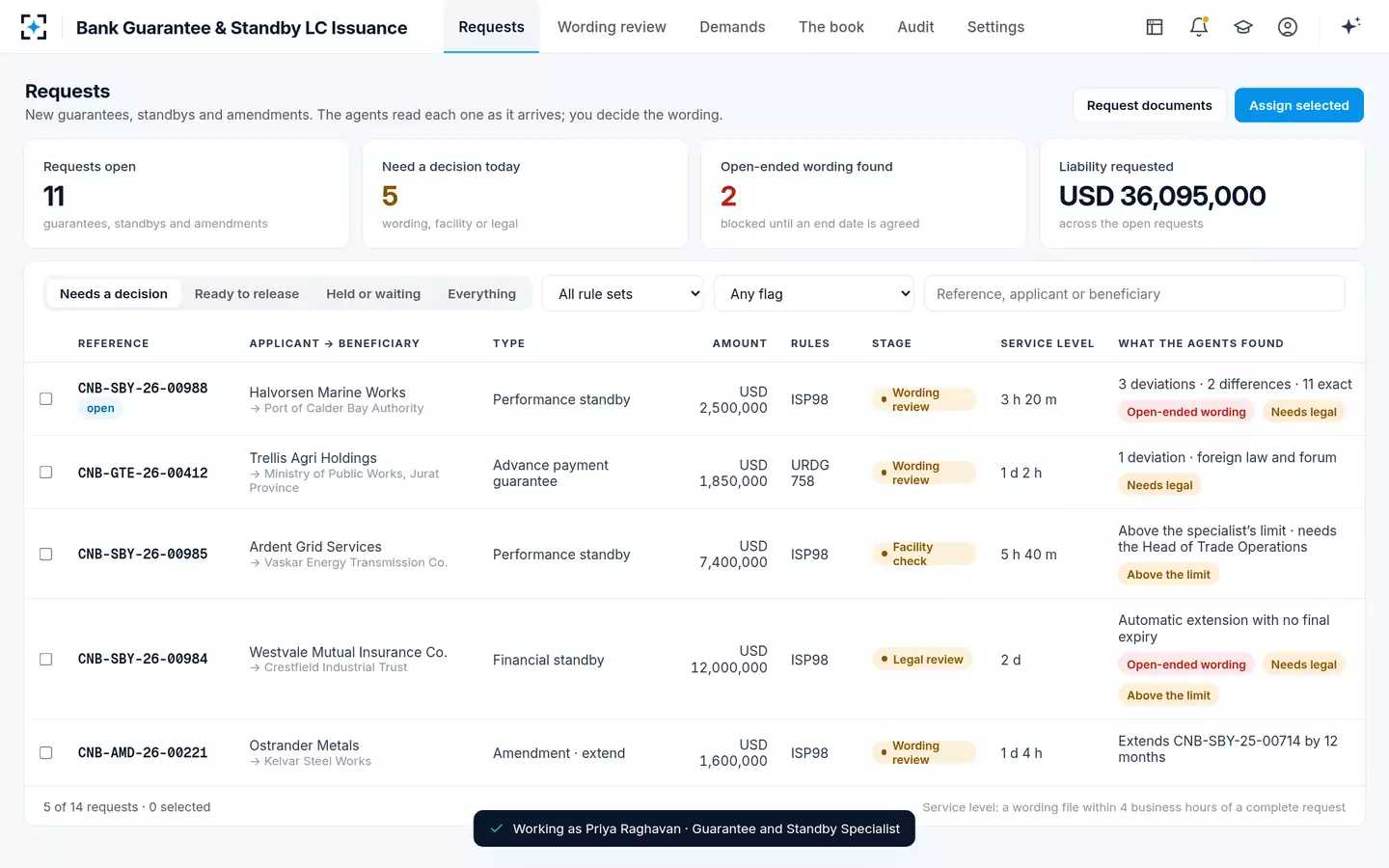
Standbys and guarantees in one queue, each with its rule set
The ISP98 side of the comparison is explained rule by rule in ISP98 rules explained for the standby desk. The solution is at Bank Guarantee & Standby LC Issuance.
Questions people ask
Is a standby letter of credit the same as a bank guarantee?
It does the same job and is legally independent in the same way, but it is issued under different rules, usually ISP98 or UCP 600 rather than URDG 758. Those rules differ on demand content, examination time and expiry.
Can a standby be issued under URDG 758?
Yes. URDG 758 applies to any demand guarantee or counter-guarantee "however named or described" that expressly indicates it is subject to the rules. What decides the rules is the incorporation clause, not the title.
Is a bank guarantee on demand the same as a first demand guarantee?
In practice yes: both pay against a complying demand without proof of the applicant's liability. English courts look past the words, though, and an instrument called "on demand" can still be construed as a see-to-it guarantee if its other terms point that way.
Which is more common in the United States?
The standby. US banks reported USD 576.5 billion of financial and performance standbys outstanding at June 30, 2026, and federal rules on national banks' guarantee powers are narrower than their powers to issue independent undertakings.
Does the UN Convention apply to my guarantee?
Only if the instrument falls within it and a party state's law applies. The Convention has eight parties; the United States signed it in 1997 but has not ratified it.