URDG 758 article 15 requires every demand under a demand guarantee to be supported by the documents the guarantee specifies and, in any event, by a statement from the beneficiary "indicating in what respect the applicant is in breach of its obligations under the underlying relationship", unless the guarantee expressly excludes that requirement. A demand without the statement, or with one that does not say in what respect, does not comply, and the guarantor may reject it, provided it examines the demand within five business days and sends a single notice that names every discrepancy. That is the whole of the bank's defence, so the file behind each demand decides whether a rejection holds. Botminds' Bank Guarantee & Standby LC Issuance builds that file for every demand: the requirements checked against the guarantee as issued, the clock counted, and the refusal or honour advice drafted for a person to release.
The rules quoted are ICC's own free text of URDG 758, the 2010 revision, which applies to a guarantee only when the guarantee says in terms that it is subject to them (art. 1(a)). Examples from the solution use fictional sample data.
Four numbers that decide whether a rejection holds
5days
business days after presentation to examine a demand and decide
1notice
a single rejection notice, stating each discrepancy
30days
calendar days a guarantor may suspend payment on an extend-or-pay demand
0days
added to the clock by asking the applicant for a waiver
What does URDG 758 article 15 require?
Article 15 has four paragraphs, and a demand file should test all four. Paragraph (a) requires, for a guarantee, the documents the guarantee specifies and the beneficiary's statement of breach, which "may be in the demand or in a separate signed document accompanying or identifying the demand". Paragraph (b) requires, under a counter-guarantee, a statement by the party to whom it was issued "indicating that such party has received a complying demand" under its own guarantee.
Paragraph (c) lets the guarantee switch the requirement off, but only expressly: exclusion terms such as "The supporting statement under article 15[(a)] [(b)] is excluded" satisfy it. Paragraph (d) governs dates: neither the demand nor the supporting statement may be dated before the beneficiary is entitled to present, and no document may be dated after its presentation (URDG 758, art. 15).
Two things article 15 does not do are just as important. It does not ask the guarantor to decide whether the applicant really is in breach, because the guarantee is independent of the underlying contract (art. 5(a)). And it does not set a form of words. The test is whether the statement indicates in what respect, read on its face.
What is a supporting statement, and when is it deficient?
A supporting statement is the beneficiary's own account of the breach: which obligation in the underlying contract the applicant failed to meet. It is deficient when it states only that a breach occurred. "The applicant has failed to perform the contract" says that the beneficiary is calling the guarantee, not in what respect; "the applicant failed to complete the berth 3 works by the contractual completion date" does.
The bar is higher than under the standby rules, which is why the same demand can comply under one rule set and fail under the other. Under ISP98, where a standby requires a statement of default without specifying its content, the document complies if it contains "a representation to the effect that payment is due because a drawing event described in the standby has occurred", a date and the beneficiary's signature (ISP98 rule 4.17). A standby that wants more must say so in its own terms, and some bank forms do.
The same breach, stated under each rule set
URDG 758 art. 15(a), demand guarantee: Yes, unless the guarantee expressly excludes it (art. 15(c)).
ISP98 rule 4.17, standby: Only if the standby requires a statement of default.
URDG 758 art. 15(a), demand guarantee: In what respect the applicant is in breach of its obligations.
ISP98 rule 4.17, standby: That payment is due because a drawing event described in the standby occurred.
URDG 758 art. 15(a), demand guarantee: Discrepant: it does not say in what respect.
ISP98 rule 4.17, standby: Complies, if the standby describes non-performance as the drawing event.
URDG 758 art. 15(a), demand guarantee: Not dated before entitlement or after presentation (art. 15(d)); signed if separate.
ISP98 rule 4.17, standby: Must carry a date and the beneficiary's signature.
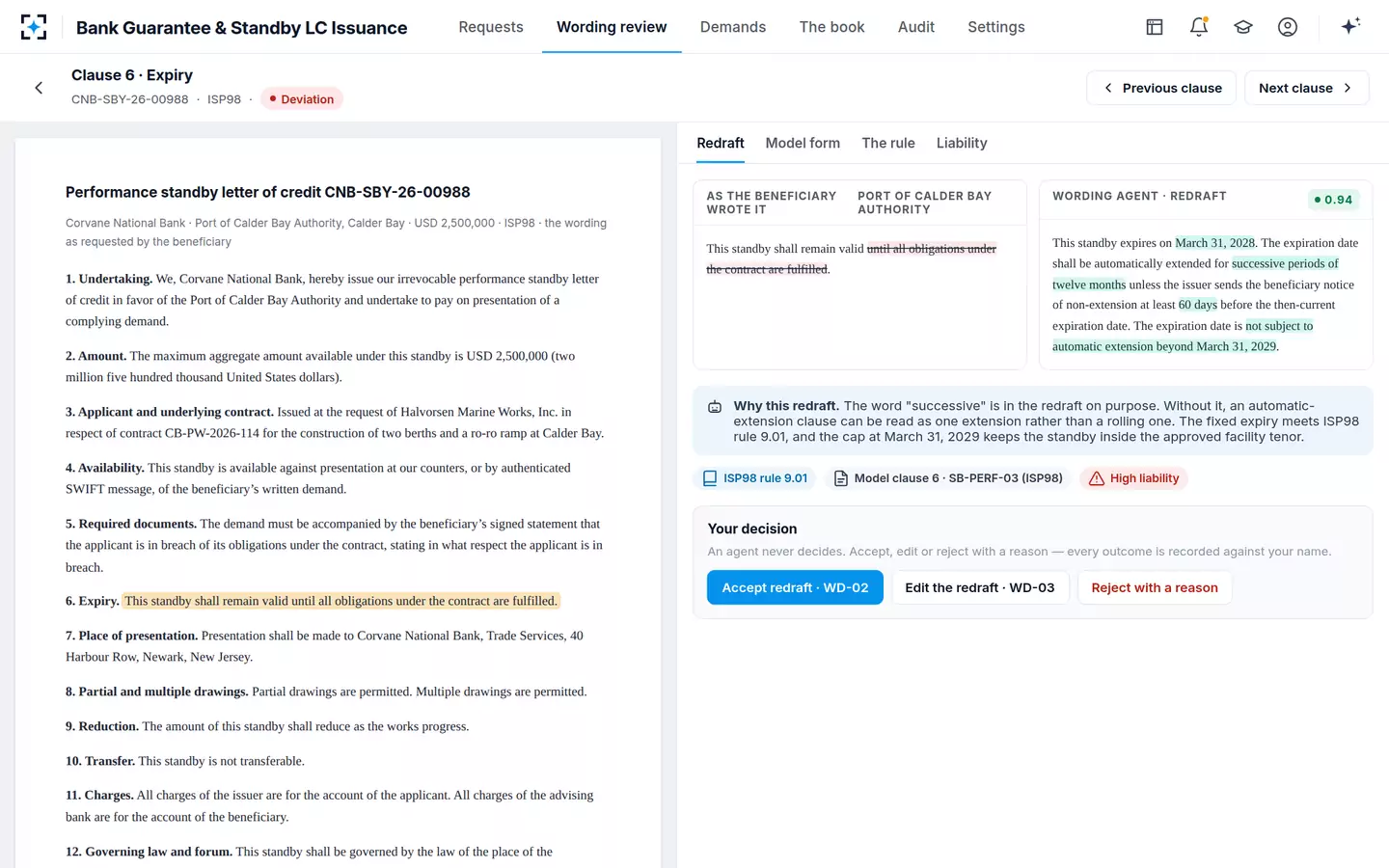
A model form can import the article 15 test into a standby, as Bank Guarantee & Standby LC Issuance reads it
Can the supporting statement be excluded?
Yes, but only by express words in the guarantee or counter-guarantee. Article 15(c) gives the model: "The supporting statement under article 15[(a)] [(b)] is excluded". A guarantee that says the beneficiary need only send "a simple demand" has not obviously done that, so the wording review at issue is the place to decide, and to note in the file, whether the bank's guarantee contains an exclusion. The demand file should then quote the exclusion or the absence of one, because that single line decides whether a missing statement is a discrepancy at all.
How long does a bank have to examine a demand?
Five business days. If a presentation does not say it will be completed later, the guarantor "shall, within five business days following the day of presentation, examine that demand and determine if it is a complying demand", and that period "is not shortened or otherwise affected by the expiry of the guarantee on or after the date of presentation" (URDG 758, art. 20(a)). A rejection notice must go "without delay but not later than the close of the fifth business day following the day of presentation" (art. 24(e)).
Three details move the count. A business day is a day on which the place where the act is to be performed is regularly open for it (art. 2), so the guarantor's own branch calendar governs. A presentation that does not identify the guarantee starts the clock only "on the date of identification" (art. 14(f)). And the waiver route does not buy time: approaching the applicant for a waiver does not "extend the period mentioned in article 20" (art. 24(c)). Meanwhile the guarantor must tell the instructing party of the demand "without delay" (art. 16).
An extend-or-pay demand adds a second clock rather than replacing the first. Where a complying demand asks, as an alternative, for a longer expiry, the guarantor may suspend payment for up to 30 calendar days following receipt (art. 23(a)); if no extension is granted in that time, the bank must pay without any further demand (art. 23(d)). The guarantor still has to decide, within the five business days, whether the demand complies.
What must a rejection notice contain?
A rejection notice must be a single notice to the presenter stating, first, that the guarantor is rejecting the demand and, second, "each discrepancy for which the guarantor rejects the demand" (URDG 758, art. 24(d)). Late or incomplete notice costs the bank everything: a guarantor that does not comply with paragraphs (d) or (e) "shall be precluded from claiming that the demand and any related documents do not constitute a complying demand" (art. 24(f)).
Preclusion is why a refusal is drafted against a list, not from memory. A specialist who finds the missing breach statement and stops reading may send a notice that omits a second discrepancy, such as a demand for more than the amount available, which article 17(e) makes non-complying. If the beneficiary cures the first, the bank cannot raise the second. In the US, Article 5 of the Uniform Commercial Code has a parallel preclusion rule for letters of credit, including standbys, as ISP98 rules explained for the standby desk sets out.
What does the guarantor not have to check?
The guarantor examines the presentation "on its face" (art. 19(a)), and the rules list what that excludes. A document the guarantee does not require is disregarded (art. 19(d)). The guarantor "need not re-calculate a beneficiary's calculations" under a formula in the guarantee (art. 19(e)). Unless the guarantee says who must sign, "any signature will be accepted and no indication of name or position of the signatory is necessary" (art. 19(c)(ii)). And it assumes no liability for the genuineness or legal effect of any document presented (art. 27).
That list matters for the file because a rejection on a ground the rules exclude is a wrongful rejection. If the bank wants to test who signed a demand, the guarantee must say so; the review at issue is where that requirement is written in or left out.
When can a bank refuse to pay a guarantee? Fraud, and the courts
Apart from a non-complying demand, the ground is fraud, and the rules leave it to the courts. URDG 758 contains no fraud rule; the guarantee's governing law supplies one. Courts in the leading trade-finance jurisdictions set the bar high, and higher for an order against the bank than against the beneficiary.
"The wholly exceptional case where an injunction may be granted is where it is proved that the bank knows that any demand for payment already made or which may thereafter be made will clearly be fraudulent. But the evidence must be clear, both as to the fact of fraud and as to the bank's knowledge."
Tetronics (International) Ltd v HSBC Bank plc [2018] EWHC 201 (TCC), quoting Bolivinter Oil v Chase Manhattan Bank [1984] 1 WLR 392
English courts still apply it. In February 2026 a contractor asked the High Court to stop Barclays paying a £2,475,441.02 demand under a performance bond worth 10% of a construction contract. The court held that the application against the bank "simply cannot succeed and must be dismissed", because the only basis for such an order against an issuing bank is fraud of which it had notice, and none was alleged; it added that "the wider reputational damage to the performance bond market" was "a very significant reason in itself" to refuse (CR Construction v Barclays [2026] EWHC 202 (TCC)).
The fraud test a bank's file has to meet, by jurisdiction
| Where | Source | What has to be shown |
|---|---|---|
| England and Wales | Tetronics v HSBC (2018); CR Construction v Barclays (2026) | Clear evidence of fraud and of the bank's knowledge; an injunction against the bank only in the wholly exceptional case. |
| Singapore | Winson Oil v OCBC [2024] SGCA 31 | The Court of Appeal applied one fraud standard to letters of credit, performance bonds and on-demand guarantees, declining a higher bar for letters of credit. |
| United States (UCC Article 5) | § 5-109 | An injunction only if the applicant is more likely than not to succeed on forgery or material fraud; otherwise the issuer, in good faith, may honour or dishonour. |
| UN Convention states (8 parties) | Art. 19 | Payment may be withheld if it is "manifest and clear" that a document is false or the demand has no conceivable basis. |
For the demand file the lesson is practical. The bank is rarely the party that proves fraud; the applicant is. What the bank needs is evidence of what it knew and when: the demand as received, the examination, any notice of an alleged fraud, and the decision. A file that shows a careful face examination inside the clock is the bank's protection whether it pays or refuses.
Which claims deserve a second look before payment?
Some demands should be read twice even when they comply. The 2019 industry principles list "some of the risk indicators" for guarantees and standbys under the heading of claims and payment instructions: "Last minute changes to payment instructions", "Claims made within a short time after issuance", "Continuous claims under various guarantee instruments" and "Claim pressure tactics" (Wolfsberg Group, ICC and BAFT, Trade Finance Principles, Appendix III, 7.5). None of these is a ground to refuse a complying demand. They are reasons to re-screen the payment instructions, check the beneficiary's account details against the guarantee, and escalate to financial crime compliance in parallel with the examination.
The demand file, item by item
A defensible file answers, for every demand, the questions a court, an examiner or the client's lawyer will ask. The list below is ordered as the work happens.
What a demand file under URDG 758 should hold
- Received: time, place and channel
Presented at the place in the guarantee, on or before expiry (art. 14(a)).
- Identified: which guarantee
If not identified, the clock starts on identification (art. 14(f)).
- The art. 15(a) statement, quoted
With the test result: does it say in what respect? Or the exclusion clause, quoted.
- Dates of demand and statement
Not before entitlement, not after presentation (art. 15(d)).
- Amount against amount available
More than available is non-complying (art. 17(e)).
- Each other required document
Examined for conflict with the guarantee and each other (art. 19(b)).
- Instructing party informed
Without delay, with the time sent (art. 16).
- Extend-or-pay handled
Suspension period and notice to the instructing party (art. 23(a), (c)).
- Parties and payment details re-screened
Including any new party or changed payment instruction.
- Decision, by a named person
Comply or reject, with the business-day count on the day decided.
- One notice, every discrepancy
Text as sent, and the time, by close of business day 5 (art. 24(d), (e)).
- Waiver request and documents
Any waiver asked and answered (art. 24(a), (c)); documents returned or held (art. 24(g)).
How to score your last ten demands
Take the ten most recent demands under guarantees subject to URDG 758, paid or refused, and check each against the file above. Four questions carry most of the risk. Was the decision made, and any notice sent, by the close of the fifth business day counted from the day after presentation, on the issuing branch's calendar? Did the notice state every discrepancy the bank later relied on? Was the instructing party told without delay, and when? And for each refusal on the supporting statement, does the file quote the statement and say why it fails the "in what respect" test?
Score one point per question per demand. Anything under forty is a finding to fix before a beneficiary finds it for you. The exercise also gives a baseline for any software a bank is evaluating: the same ten files, run again, should show whether the tool finds the discrepancies the specialists found, and any they missed.
Where Bank Guarantee & Standby LC Issuance fits in a demand
The solution's demand agent examines each demand against the instrument's own terms and rule set, counts the clock from the business day after presentation, and orders the queue by the days left. It drafts the honour advice or the refusal; it never pays or refuses, it cannot send a refusal that leaves out a discrepancy it found, and the specialist who examined a demand cannot release the refusal, which goes to a checker. On a sample demand under a URDG 758 guarantee, the agent checked seven requirements in nine seconds and failed two: the supporting statement said only that the applicant had failed to perform the contract, and the second turned on who had signed.
The guarantee forms whose demand terms every demand is checked against
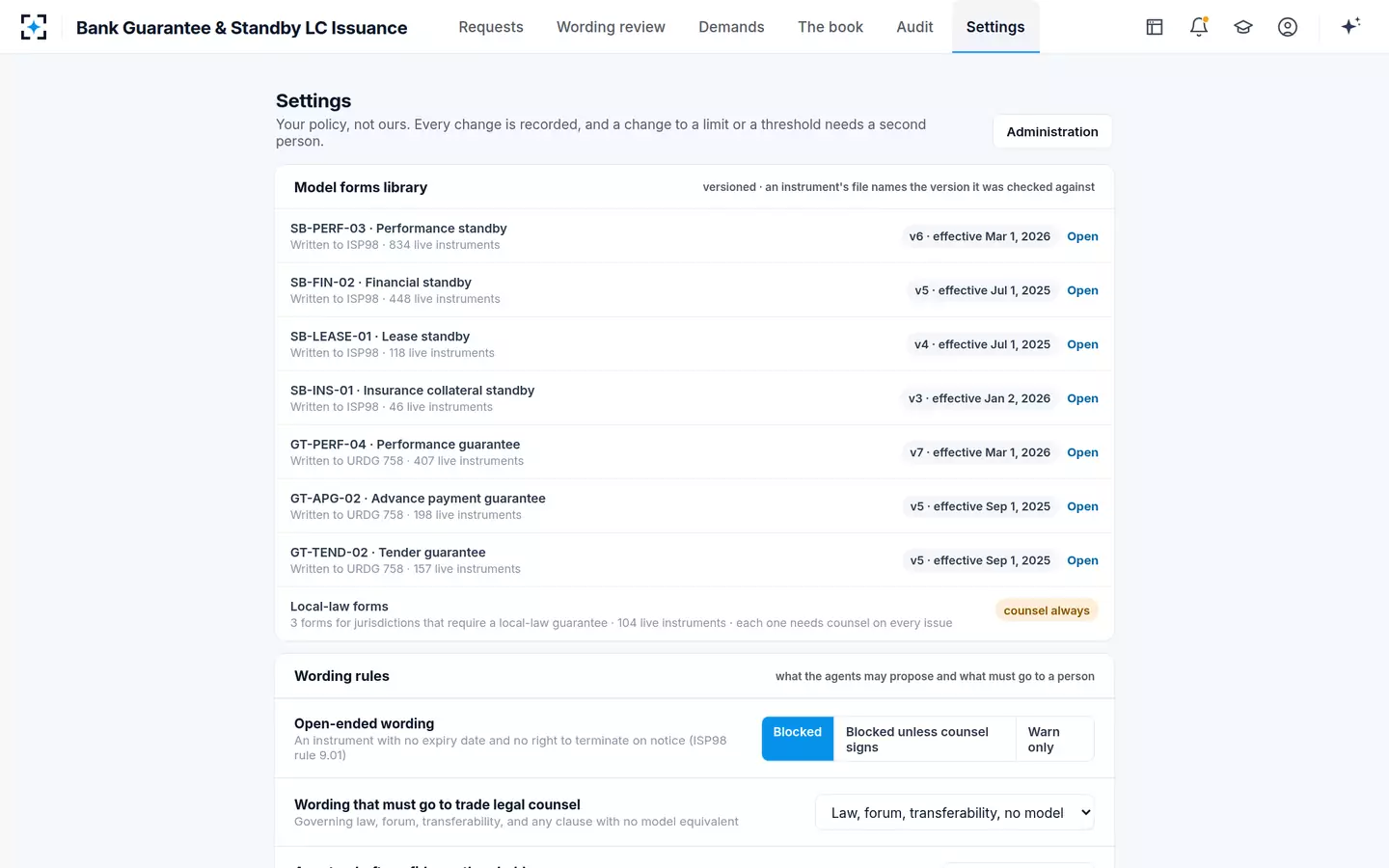
Whether the requirement exists in the first place is decided at issue, which is why the same solution reads every requested clause against the model form before release; the difference between a bank guarantee and a standby letter of credit shows how the two rule sets diverge. The full solution is at Bank Guarantee & Standby LC Issuance.
Questions people ask
What is URDG 758 article 15a?
It is the rule that a demand under a guarantee must be supported by the documents the guarantee specifies and by the beneficiary's statement of the respect in which the applicant is in breach. The statement can sit in the demand itself or in a separate signed document that accompanies or identifies it.
What is URDG 758 article 15b?
It applies to counter-guarantees. A demand under a counter-guarantee must be supported by a statement from the party to whom it was issued, usually the local guarantor, that it has received a complying demand under its own guarantee.
Does the guarantor check whether the breach really happened?
No. The guarantee is independent of the underlying contract under URDG 758 art. 5, and the guarantor examines the presentation on its face. Whether the applicant was in breach is a matter between the applicant and the beneficiary.
Can a beneficiary present a new demand after a rejection?
Yes, if the guarantee has not expired. Under art. 18 a non-complying demand does not waive the right to make another timely demand, and art. 17(d) allows another demand even where only one is permitted and the first was rejected.
What happens if the bank misses the five business days?
If no notice of rejection is sent by the close of the fifth business day after presentation, art. 24(f) precludes the guarantor from claiming the demand did not comply. In practice the bank must then treat the demand as complying.
Does URDG 758 article 15 apply to standby letters of credit?
Only if the standby is issued subject to URDG 758. Standbys are usually issued under ISP98 or UCP 600, as the industry's 2019 trade finance principles describe, and under those rules no breach statement is required unless the standby's own terms call for one.