An evergreen letter of credit is a standby or guarantee with a fixed expiry date that extends itself automatically, usually by a year at a time, unless the issuing bank sends the beneficiary a notice of non-extension before a set deadline. It is different from an instrument with no expiry date at all, and the difference decides how long the bank is on risk. A standby "valid until all obligations under the contract are fulfilled" has no date the bank can see, and the rules give four different answers to what that means: ISP98 does not allow it, URDG 758 ends it after three years, the Uniform Commercial Code after one year or five, and the UN Convention after six. Botminds' Bank Guarantee & Standby LC Issuance reads every expiry clause before issue and redrafts an open-ended one into an evergreen clause the bank can end.
The rule texts are quoted from ICC's free texts of ISP98 and URDG 758, the Uniform Commercial Code as published by Cornell's Legal Information Institute, and UNCITRAL's text of the Convention. Each applies only where the instrument incorporates it or the governing law makes it apply. The worked clause is from the solution's sample data.
One open-ended clause, four end dates, depending on the rules
- 1 year from issue1 yr
- 3 years from issue3 yrs
- 5 years from issue5 yrs
- 6 years from issue6 yrs
What is an evergreen letter of credit?
An evergreen letter of credit is one whose expiry date moves forward automatically, period after period, until the issuer chooses to stop it by giving notice. The bank stays in control because each extension is conditional on its silence; the beneficiary gains continuity because it does not need to ask for a renewal each year. Evergreen wording suits standbys that support obligations with no natural end date, such as leases or insurance arrangements.
ISP98 calls this automatic amendment. "If a standby expressly states that it is subject to "automatic amendment" by an increase or decrease in the amount available, an extension of the expiration date; or the like, the amendment is effective automatically without any further notification or consent beyond that expressly provided for in the standby" (ISP98 rule 2.06(a)). The words "expressly states" do the work: an extension is automatic only if the standby says so.
Is an evergreen clause the same as having no expiry date?
No. An evergreen clause always has a current expiry date and a mechanism to stop at the next one; an open-ended clause has neither. That is the line ISP98 draws when it says what a standby must contain.
"A standby must: a. contain an expiry date; or b. permit the issuer to terminate the standby upon reasonable prior notice or payment."
ICC, International Standby Practices (ISP98), rule 9.01
Three expiry clauses, three different liabilities
Open-ended: "Valid until all obligations under the contract are fulfilled."
Evergreen, with a final date: "Expires March 31, 2028, automatically extended for successive periods of twelve months unless 60 days' notice, not beyond March 31, 2029."
Open-ended: None; it depends on facts in a contract the bank does not monitor.
Evergreen, with a final date: Always one current date.
Open-ended: It cannot, short of the beneficiary's release.
Evergreen, with a final date: A notice of non-extension in time; and the final date.
Open-ended: Breaches it: no expiry, no termination right.
Evergreen, with a final date: Complies.
Open-ended: Outlives any facility tenor.
Evergreen, with a final date: Can be capped at the facility tenor.
Can a standby letter of credit have no expiry date?
Not under ISP98, unless the bank can end it on notice: rule 9.01 requires one or the other. Under US banking regulation the bar is similar. National banks issuing independent undertakings "should consider" whether the undertaking is limited in duration, or lets the bank terminate it "either on a periodic basis (consistent with the bank's or savings association's ability to make any necessary credit assessments) or at will upon either notice or payment to the beneficiary", or entitles the bank to cash collateral on demand (12 CFR 7.1016(b)(1)(iii)).
ISP98 does not say what happens to a standby issued in breach of rule 9.01. Its rules add to the governing law wherever that law allows (rule 1.02(a), quoted in ISP98 rules explained), so the answer comes from the governing law, and for a standby governed by the law of a US state the natural candidate is the Uniform Commercial Code's backstop. That is a question for counsel, which is the point: a bank that issues an open-ended standby has handed the question of when its liability ends to a court.
What happens to a guarantee with no expiry date? Four answers
Each text supplies its own end, and they differ by up to five years. The bank's liability is therefore decided by the rule set it agreed to and the law that governs, not by the clause the beneficiary wrote.
What each text does with an undertaking that states no expiry
| Text | What it says | Effect |
|---|---|---|
| ISP98 rule 9.01 | A standby "must" contain an expiry date or permit the issuer to terminate on reasonable prior notice or payment. | No backstop; the instrument breaks the rules it is subject to. |
| URDG 758 art. 25(c) | "the guarantee shall terminate after the lapse of three years from the date of issue and the counter-guarantee shall terminate 30 calendar days after the guarantee terminates." | 3 years; counter-guarantee 3 years and 30 days. |
| UCC § 5-106(c) | "a letter of credit expires one year after its stated date of issuance or, if none is stated, after the date on which it is issued." | 1 year, where no expiry is stated. |
| UCC § 5-106(d) | "A letter of credit that states that it is perpetual expires five years after its stated date of issuance". | 5 years, where the instrument says it is perpetual. |
| UN Convention art. 12(c) | Where no expiry date is stated, the undertaking expires "when six years have elapsed from the date of issuance of the undertaking." | 6 years, in the eight states party to the Convention. |
The URDG answer covers an expiry event as well as a date. Under art. 25(c) the three-year rule applies when the guarantee "states neither an expiry date nor an expiry event". A clause tying expiry to the completion of works is an expiry event, and URDG 758 deems such an event to occur only when a document specified in the guarantee is presented or, if none is specified, when the guarantor can tell from its own records that it has happened (art. 2, "expiry event"; article 13 applies the same test to reductions in amount, as the guarantee tracker guide shows). Read literally, an event the bank can never determine is still a stated expiry event, so the three-year backstop may not apply either; that is one more question a bank should not leave to counsel after issue.
How long is a perpetual letter of credit valid?
Under US law, five years. A letter of credit that "states that it is perpetual expires five years after its stated date of issuance, or if none is stated, after the date on which it is issued" (UCC § 5-106(d)). An instrument that is silent on duration is treated differently, expiring one year after issue under § 5-106(c). The distinction is easy to miss: the word "perpetual" makes the liability five times longer than saying nothing.
Neither period helps a bank much. A one-year backstop may cut off a beneficiary that both parties expected to be covered for longer, inviting litigation; a five-year one keeps capital and lending-limit room tied up long after the facility that approved it. The way out of both is a clause with a date.
How do automatic extensions work under ISP98?
Under ISP98 an automatic extension takes effect without a new instrument and without the beneficiary's consent, because the standby itself provides for it (rule 2.06(a)). The new period "starts on the calendar day following the stated expiry date even if either day falls on a day when the issuer is closed" (rule 9.03(b)). And if the bank stops the renewal, rule 2.07(c) protects anyone already acting under the standby: "Non-extension of an automatically extendable (renewable) standby does not affect an issuer's obligation to a nominated person who has acted within the scope of its nomination before receipt of a notice of non-extension."
The rules leave the notice itself to the wording: how long before expiry it must be sent, by what means, and to whom. That is why the notice clause deserves as much care as the extension clause. A notice period that the bank's own calendar cannot reliably meet turns an evergreen standby into a de facto open-ended one.
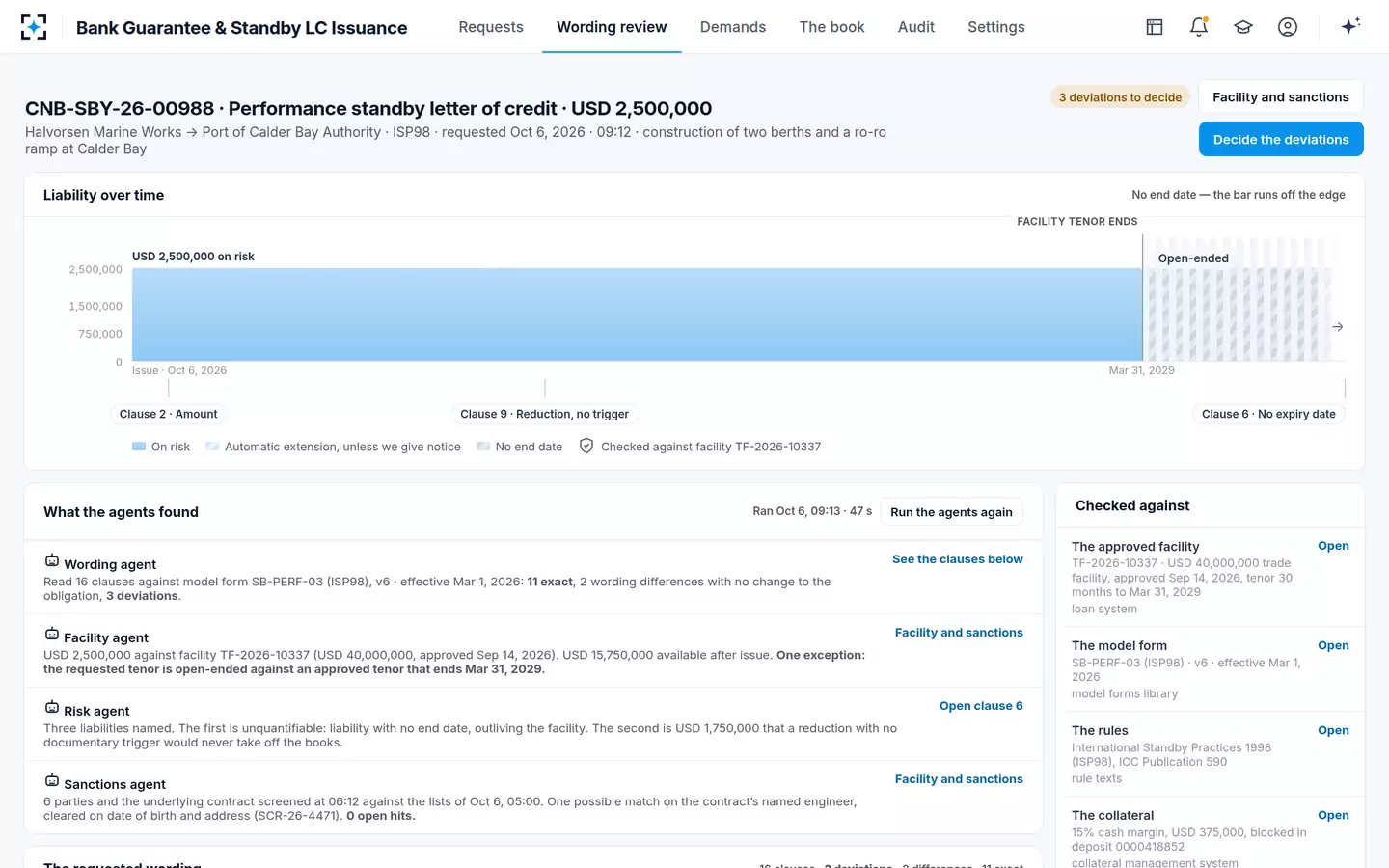
An open-ended expiry clause, drawn by Bank Guarantee & Standby LC Issuance as a bar with no end
What is a non-extension notice, and when must it go?
A non-extension notice is the issuer's message to the beneficiary that an evergreen instrument will not renew at its next expiry date. Its deadline is set by the instrument, not by ISP98 or URDG 758, and missing it renews the liability for a full period. Beneficiaries know this, and an underlying contract often treats a non-extension as a reason to draw.
A published US appeals decision shows how that plays out. Between June 2012 and June 2016, the court recounted, the standby in that case "was annually extended for an additional year", and the party it secured later told the applicant that it "consider[ed] the failure to timely extend the letter of credit as warranting a draw under the letter of credit" (EFLO Energy v. Devon Energy, No. 22-6051 (10th Cir. 2023)). For the issuing bank's client, a missed renewal under the underlying contract can trigger the draw the standby exists to cover. For the bank, every notice window is a credit decision with a deadline.
What US bank regulation expects of renewal terms
The OCC's rule on independent undertakings names automatic renewal as a special circumstance needing particular protection: "In the event that the undertaking provides for automatic renewal, the terms for renewal should be consistent with the national bank's or Federal savings association's ability to make any necessary credit assessments prior to renewal" (12 CFR 7.1016(b)(2)(ii)). A notice period must leave credit time to review the client before the window closes.
In practice that sets three tests for an evergreen clause: the notice period must be long enough for a credit review to finish before it ends; the bank's tracking must surface the window early enough to start that review; and a final date beyond which no extension occurs should line up with the facility that approved the instrument. The sample bank sets its notice lead time at 60 days and can choose 30, 45, 60 or 90.
Drafting an evergreen clause the bank can live with
The sample standby shows the redraft. The beneficiary asked for "This standby shall remain valid until all obligations under the contract are fulfilled." The solution's wording agent proposed a fixed expiry on March 31, 2028, automatic extension for successive twelve-month periods unless the bank gives 60 days' notice of non-extension, and no extension beyond March 31, 2029, when the approving facility matures. It cited ISP98 rule 9.01 and the bank's model clause, and the specialist accepted it under a reason code.
The beneficiary's clause, the redraft and the rule
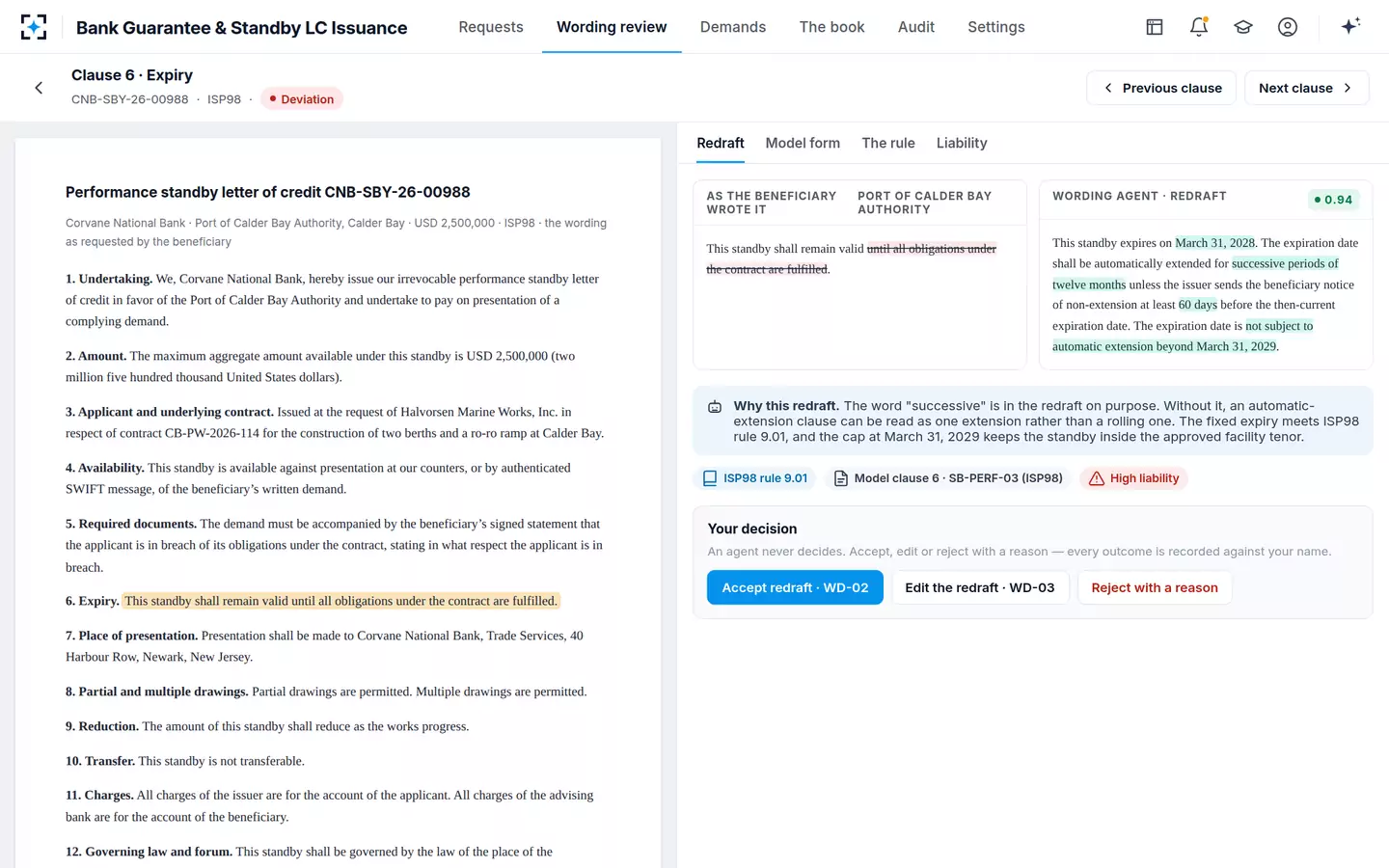
The word "successive" is there for a reason. A clause that extends the expiry "for a further period of twelve months" invites the argument that it extends once; "for successive periods" makes the roll explicit. The final date matters as much: without it an evergreen clause can renew indefinitely, which brings back the problem it was meant to solve.
Six checks for an evergreen expiry clause
- A first expiry date, stated
Not an event in the contract the bank cannot verify.
- The extension period, and that it repeats
"Successive periods of twelve months", not "a further period".
- The notice period
Long enough for a credit review before it closes (12 CFR 7.1016(b)(2)(ii)).
- How and to whom notice is given
Means, address and when notice is deemed received.
- A final expiry date
Beyond which no automatic extension occurs, aligned with the facility.
- The rule set and the backstop
ISP98, URDG 758 or UCP 600, and the governing law that fills gaps.
How Bank Guarantee & Standby LC Issuance handles open-ended wording
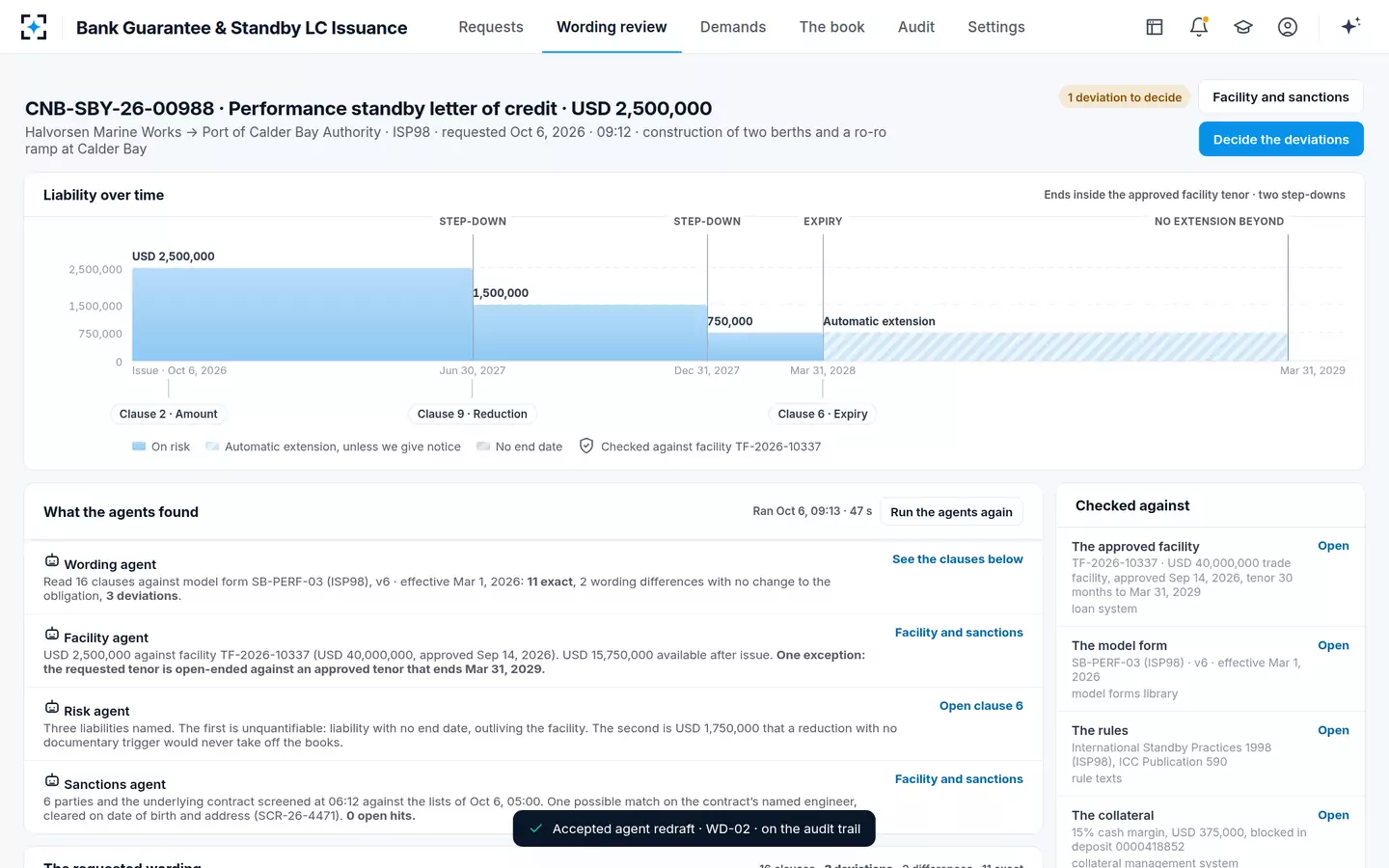
In the solution, open-ended wording is a bank setting with three choices: blocked, blocked unless counsel signs, or warn only. The sample bank blocks it, so nothing is released without a fixed end date. Once the redraft is accepted the liability bar changes shape: it ends at the first expiry, shows the automatic extension as a hatched section, and stops at the final date inside the facility tenor. Every notice window then joins the book-wide calendar, where the expiry agent drafts each notice before its window closes and a checker sends it.
The same standby, with an end date and two step-downs
Tracking those windows across a whole book is its own discipline, covered in from a spreadsheet tracker to liability you see daily; the ISP98 rules behind automatic amendment are explained in ISP98 rules explained for the standby desk. The solution is at Bank Guarantee & Standby LC Issuance.
Questions people ask
What is an evergreen standby letter of credit?
A standby that renews automatically at each expiry date for a further period unless the issuer gives notice of non-extension in time. Under ISP98 rule 2.06(a) the renewal takes effect without a new amendment because the standby expressly provides for it.
Does an evergreen clause satisfy ISP98 rule 9.01?
Yes, when it states a current expiry date: rule 9.01 requires an expiry date or a right to terminate on reasonable prior notice or payment. An evergreen clause with a stated first expiry and a notice mechanism has both.
Can the beneficiary refuse a non-extension?
No. If the standby gives the issuer the right not to extend, a notice given in time ends the renewal at the current expiry date. The beneficiary can still present a complying demand before that date, which is why a non-extension can prompt a draw.
What if the bank's office is closed on the expiry date?
Under ISP98 rule 3.13, if the last day for presentation is not a business day where presentation is to be made, a presentation on the next business day is timely. Under URDG 758 art. 26, a guarantee that expires while presentation is prevented by force majeure is extended by 30 calendar days.
Do evergreen standbys need a final expiry date?
No rule requires one, but without it the instrument can renew indefinitely. Aligning a final date with the approving facility keeps the liability inside what credit approved, which is what the sample bank's redraft does.