"Performance vs standby letter of credit" is really a question about two kinds of standby. A performance standby letter of credit obliges the bank to pay a beneficiary when its client fails to perform a non-financial obligation, such as finishing works or delivering equipment; a financial standby obliges it to pay when the client fails to repay a loan or debt. The distinction is not academic. US capital rules apply a credit conversion factor of 50% to performance standbys and 100% to financial standbys and guarantees, so the same USD 2,500,000 instrument puts USD 1,250,000 or USD 2,500,000 of exposure into the bank's risk-weighted assets. A misclassified standby is a capital error, and it is made at issue, from the wording. Botminds' Bank Guarantee & Standby LC Issuance reads that wording, checks the instrument against its credit approval, and carries its class through to the Call Report extract.
The definitions below are quoted from the FFIEC Call Report instructions and federal capital rules; the figures for the US market come from the FDIC's Call Report data for June 30, 2026. The worked example uses a fictional sample standby.
The same USD 2.5 million standby, as a credit exposure
Performance standby: 50% conversion
- Counted: USD 1.25m · 50%
- Not counted · 50%
Financial standby or guarantee: 100%
- Counted: USD 2.5m · 100%
What is the difference between a performance and a financial standby letter of credit?
The difference is the obligation the standby backs. The Call Report instructions define both. "A financial standby letter of credit irrevocably obligates the bank to pay a third-party beneficiary when a customer (account party) fails to repay an outstanding loan or debt instrument." "A performance standby letter of credit irrevocably obligates the bank to pay a third-party beneficiary when a customer (account party) fails to perform some contractual non-financial obligation" (FFIEC 031 and 041 instructions, Schedule RC-L, items 2 and 3).
The capital rule's definition is broader on the performance side. A performance standby letter of credit, "or performance bond", is an obligation to pay "when a customer (account party) fails to perform on any contractual nonfinancial or commercial obligation", and it includes arrangements backing "subcontractors' and suppliers' performance, labor and materials contracts, and construction bids" (12 CFR 217.2). The label on the instrument does not decide the class. The obligation it secures does.
Is a performance bond the same as a performance standby?
For US capital purposes, yes: the definition reads "Performance standby letter of credit (or performance bond)". The international standard groups them the same way. The Basel Committee's framework applies a 50% factor to "certain transaction-related contingent items (eg performance bonds, bid bonds, warranties and standby letters of credit related to particular transactions)", and 100% to "direct credit substitutes, eg general guarantees of indebtedness (including standby letters of credit serving as financial guarantees for loans and securities)" (Basel Framework, CRE20.95 and 20.97).
Commercially the instruments differ in where they come from, not in their capital class. A performance bond in construction may be issued by a bank or by a surety company, and a bank-issued bond may be written as a demand guarantee under URDG 758 or as a standby under ISP98. For a bank's own books, what matters is the obligation it backs and whether the bank's undertaking is independent of the contract.
How are standby letters of credit treated for capital?
A standby is an off-balance-sheet exposure, so a bank converts its face amount into an exposure amount with a credit conversion factor and then risk-weights the result. The US standardized approach sets the factors in one section, repeated for each agency's banks.
Credit conversion factors for guarantees, standbys and trade items
| Factor | What it applies to, in the rule's words | Typical trade instrument |
|---|---|---|
| 20% | "Self-liquidating, trade-related contingent items that arise from the movement of goods, with an original maturity of one year or less" | Commercial letter of credit secured by the shipment |
| 50% | "Transaction-related contingent items, including performance bonds, bid bonds, warranties, and performance standby letters of credit" | Performance standby, bid bond, warranty or retention bond |
| 100% | "Guarantees" and "Financial standby letters of credit", among other items | Standby backing a loan, a lease or an insurance obligation |
What is a credit conversion factor?
A credit conversion factor is the share of an off-balance-sheet item's face amount that capital rules treat as if it were an on-balance-sheet credit exposure. The US rule says a bank "must calculate the exposure amount of an off-balance sheet exposure using the credit conversion factors" (12 CFR 217.33(a)(1)); the Basel framework describes the same step as converting items "into credit exposure equivalents" (CRE20.94).
The factor reflects how likely the item is to turn into a funded claim on the client, and how much of the face amount is likely to be drawn. A financial standby backing a loan is drawn when the borrower defaults on money it owes, which is close to the credit risk of the loan itself. A performance standby is drawn when the client fails to perform something other than a payment, and the rules convert it at half the rate.
The same USD 2.5 million, classed two ways
Take the sample standby the solution runs on: USD 2,500,000 issued by the fictional Corvane National Bank to secure 10% of a USD 25,000,000 construction contract for two berths and a ramp. The obligation backed is completion of the works, so it is a performance standby. The arithmetic below follows the standardized approach for a client that is a corporate exposure, before any recognition of the cash margin the bank holds.
One standby, two classes: what the bank holds capital against
| Step | As a performance standby | If misclassified as financial |
|---|---|---|
| Face amount | USD 2,500,000 | USD 2,500,000 |
| Credit conversion factor (217.33(b)) | 50% | 100% |
| Exposure amount | USD 1,250,000 | USD 2,500,000 |
| Risk weight, corporate exposure (217.32(f)) | 100% | 100% |
| Risk-weighted assets | USD 1,250,000 | USD 2,500,000 |
| At the 8% minimum total capital ratio (217.10) | USD 100,000 | USD 200,000 |
The error runs in both directions. Classing a financial standby as performance understates risk-weighted assets by half the face amount, which is the error examiners care about. Classing a performance standby as financial overstates them by the same amount, which is the error the business notices: the instrument consumes twice the capital its pricing assumed. Across a book the effect compounds, because the class decided at issue is the class reported every quarter until expiry.
How big is the US standby letter of credit market?
On June 30, 2026, US banks reported USD 514.0 billion of financial standbys and USD 62.5 billion of performance standbys outstanding and unused, against USD 24.5 billion of commercial letters of credit (FDIC BankFind data from Call Report Schedule RC-L). These are amounts outstanding, not annual issuance. The two books also move differently: performance standbys grew by 31% over five years, while financial standbys were slightly lower than in June 2021.
The US standby book is large, and concentrated in a few banks
$514.0B
financial standbys outstanding, June 30, 2026
$62.5B
performance standbys outstanding, June 30, 2026
86.5%
of financial standbys held by the ten largest reporters
77.6%
of performance standbys held by the ten largest reporters
Performance standbys outstanding grew 31% in five years
The concentration matters for the argument. For the largest reporters, classification at scale is a reporting-control question. For the two thousand and more other banks that report standbys, the risk is the single instrument whose wording no one in credit read: a standby described as performance in the request that actually backs a client's repayment of money to a lessor or a lender.
Where does classification go wrong?
Classification goes wrong where the request describes the deal rather than the obligation. The industry's 2019 principles list the two families side by side: instruments "issued in support of the supply of goods or services such as (Performance Bonds, Advance Payment Guarantees, Tender Bonds, Bid Bonds)", and those "used to secure a purely financial obligation such as (Counter Indemnities, the repayment of credit facilities or the payment of leasing fees)" (Wolfsberg Group, ICC and BAFT, Trade Finance Principles, Appendix III, 1.4). A construction client's standby for an equipment lease is a financial standby, however much it relates to a construction project.
Three patterns deserve a rule in the classification step. A standby whose drawing event is non-payment of a sum of money is financial, even if the beneficiary is a customer of the client rather than a lender. A standby whose wording allows a draw "on default" without saying of what should be read for the obligation the default refers to. And a requested instrument whose type changes during negotiation, from a performance bond to a payment guarantee, needs its class confirmed again before release, not inherited from the original request.
Are standby letters of credit on the balance sheet?
Not until the bank pays. Banks report standbys in Schedule RC-L, the Call Report's schedule of derivatives and off-balance-sheet items, at "the full amount outstanding and unused" (RC-L instructions, items 2 and 3). When a standby is drawn, the bank pays the beneficiary and has a claim on its client, which becomes an asset that has to be collected.
"A standby letter of credit transaction holds more potential risk for the issuing bank than does a commercial letter of credit. Unless the transaction is fully secured, the issuer of a standby letter of credit typically retains nothing of value to protect it against loss, whereas a commercial letter of credit provides the bank with title to the goods being shipped."
OCC, Comptroller's Handbook, Trade Finance and Services
That is the reason the capital factors run from 20% for a commercial letter of credit to 100% for a financial standby. The commercial credit gives the bank title to goods in transit and is usually reimbursed by the client at once; the standby is drawn precisely when the client has failed, with nothing behind it unless the bank took collateral at issue.
Do standby letters of credit count against the lending limit?
Yes, both classes. The lending-limit rule counts an obligation to advance funds under a standby as a contractual commitment to advance funds, and its definition of a standby covers both an obligation to repay money borrowed by the account party and an obligation to pay on its default in performing an obligation (12 CFR 32.2(g) and (ee)). Performance and financial standbys alike are combined with the client's loans; the OCC's procedures exclude a standby only where the bank was paid its maximum liability, holds a segregated deposit to cover it, or the OCC has found the class of standby exposes the bank to less loss than a loan (OCC Comptroller's Handbook, Trade Finance and Services).
How Bank Guarantee & Standby LC Issuance keeps the class straight
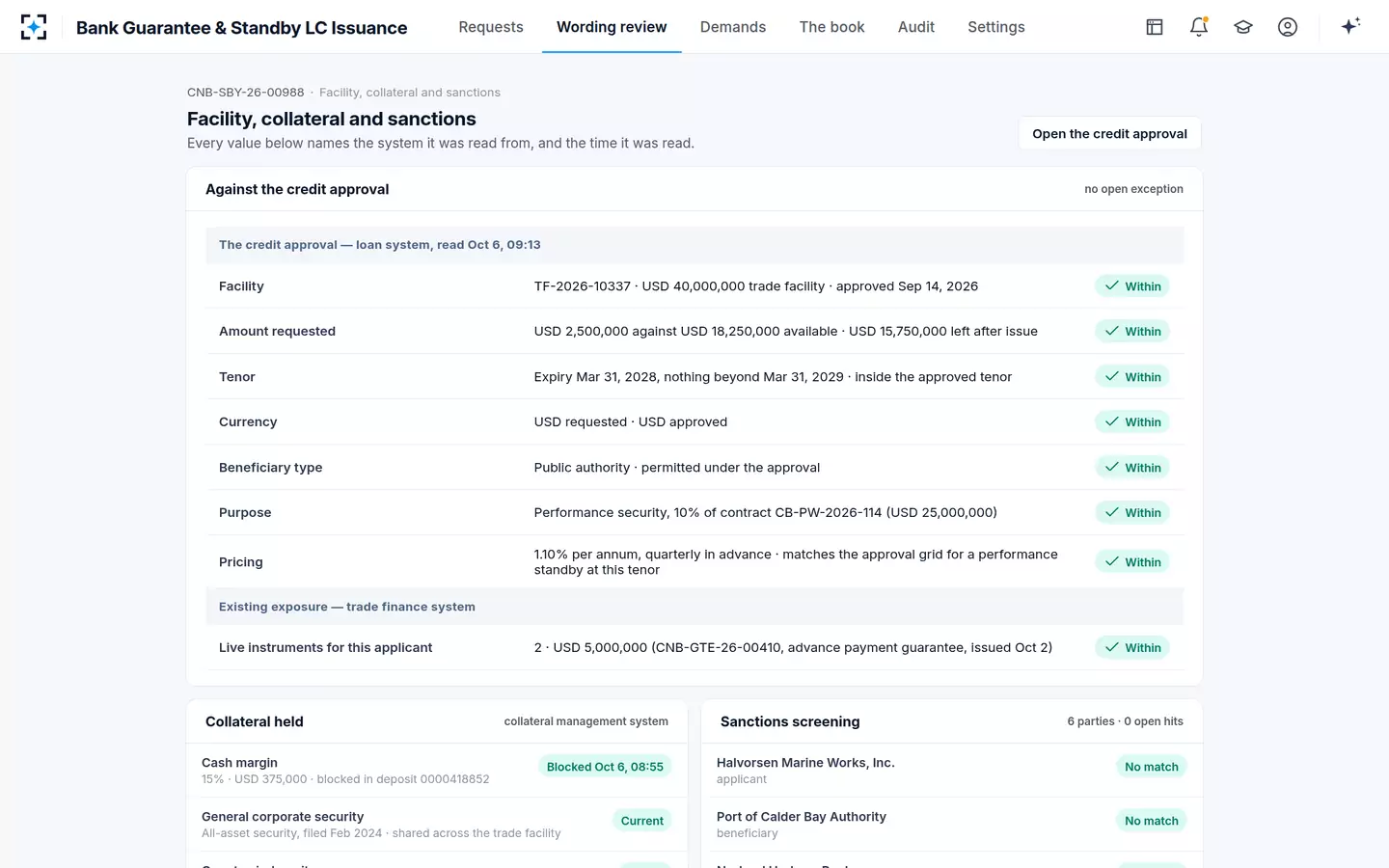
In the solution the instrument's type is set from the request and confirmed against the facility and the purpose in the credit approval before release. On the sample request the facility agent read the approval's purpose, performance security at 10% of the contract, and the pricing grid for a performance standby at that tenor, and found both consistent with the wording. The class then travels with the instrument to the contingent-liability posting and the RC-L extract, so the quarter-end report is built from the same class the specialist and credit accepted.
Bank Guarantee & Standby LC Issuance checks the purpose and the pricing against the credit approval
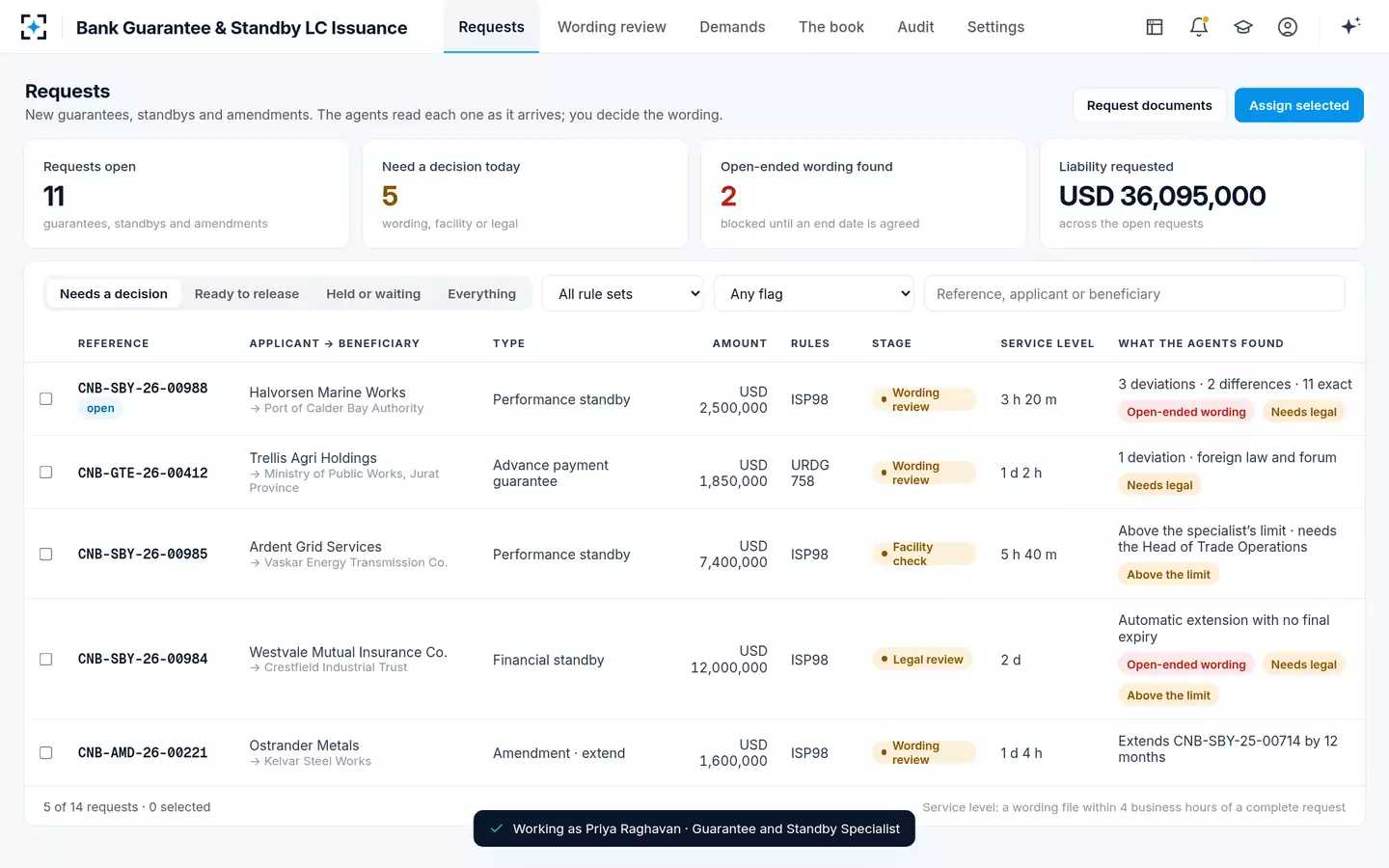
Every request carries its type and rule set from the start
The class question is one of several the wording decides. For why a US bank issues a standby at all rather than a guarantee, see what the OCC actually allows; for how the same instrument differs under URDG 758 and ISP98, see the difference between a bank guarantee and a standby letter of credit. The solution itself is at Bank Guarantee & Standby LC Issuance.
Questions people ask
Is a bid bond a performance standby?
For US capital purposes it sits in the same 50% class: 12 CFR 217.33(b)(3) lists "performance bonds, bid bonds, warranties, and performance standby letters of credit" together, and the capital rule's definition of a performance standby includes arrangements backing construction bids.
Is an advance payment guarantee financial or performance?
The industry's 2019 principles list advance payment guarantees among instruments issued in support of the supply of goods or services, alongside performance and bid bonds. For capital and Call Report purposes a bank should classify each one by the obligation its wording backs and document the reason, since the rules define the classes by obligation, not by name.
Does collateral change the capital on a standby?
It can. The conversion factor applies to the face amount, but under the simple approach in 12 CFR 217.37 a bank may recognise financial collateral, which includes cash on deposit with the bank, that meets the rule's conditions. The sample standby's 15% cash margin would be considered at that step, after classification.
What are the 2026 totals for commercial letters of credit?
USD 24.5 billion outstanding on June 30, 2026, reported by 486 institutions, against USD 576.5 billion of financial and performance standbys together. Commercial letters of credit convert at 20% when they are short-term and self-liquidating.
Where are standbys reported in the Call Report?
In Schedule RC-L: financial standbys in item 2 and performance standbys in item 3, with the amounts conveyed to others in items 2.a and 3.a for banks with USD 1 billion or more in total assets. On the FFIEC 031, financial and performance guarantees issued by foreign offices are included in the same items.