Yes, US banks can issue bank guarantees, but national banks may do so only in defined circumstances: when the bank has a substantial interest in the transaction, when the client has given it a segregated deposit covering its whole potential liability, or when it guarantees a client's financial obligation whose amount is reasonably ascertainable. What US banks can issue freely, within safe-and-sound limits, is the independent undertaking: a standby letter of credit that pays against specified documents rather than on the client's actual default. That is why the instrument a US national bank can most readily offer a foreign beneficiary asking for a "bank guarantee" is a standby, and US regulation names ISP98, the standby rules, but not URDG 758. Botminds' Bank Guarantee & Standby LC Issuance holds model forms for standbys, URDG 758 guarantees and local-law guarantees, and routes every non-standard form to counsel.
The rules quoted are the OCC's, which govern national banks and federal savings associations; a state-chartered bank's powers come first from its state's law. Figures for the US market are from the FDIC's Call Report data for June 30, 2026.
"National banks may issue guarantees and sureties in certain circumstances, including when the bank has a substantial interest in the performance of the transaction involved or the bank has a segregated deposit sufficient in amount to cover its potential liability."
OCC, Comptroller's Handbook, Trade Finance and Services
Can US banks issue bank guarantees?
A national bank can act as a guarantor in three cases set out in a single regulation. It "may lend its credit, bind itself as a surety to indemnify another, or otherwise become a guarantor" if it "has a substantial interest in the performance of the transaction involved", or if the transaction "is for the benefit of a customer and the bank obtains from the customer a segregated deposit that is sufficient in amount to cover the bank's total potential liability". Separately, it "may guarantee obligations of a customer, subsidiary or affiliate that are financial in character, provided the amount of the bank's financial obligation is reasonably ascertainable and otherwise consistent with applicable law" (12 CFR 7.1017).
When a national bank may be a guarantor under 12 CFR 7.1017
| Ground | What the rule requires | Typical fit |
|---|---|---|
| Substantial interest | The bank has "a substantial interest in the performance of the transaction involved". | The rule's own example: a bank acting as fiduciary that guarantees a co-fiduciary's bond. |
| Segregated deposit | The transaction is for a customer and the customer gives a segregated deposit "sufficient in amount to cover the bank's total potential liability". | A fully cash-collateralised guarantee for a client. |
| Financial obligation | The guaranteed obligation is "financial in character" and the bank's obligation is "reasonably ascertainable". | A guarantee of a client's, subsidiary's or affiliate's payment obligation, for a stated maximum. |
The third ground is wider than it first looks, but it does not cover the most common foreign request. A performance guarantee securing a client's obligation to build, deliver or supply is hard to describe as "financial in character", so a national bank wanting to support it as a guarantor needs one of the first two grounds. The usual answer is not a guarantee at all.
What is a segregated deposit?
A segregated deposit is collateral the bank holds against a guarantee, and the rule defines it closely. It includes collateral in which the bank "has perfected its security interest", with a market value at the close of each business day "equal to the bank's total potential liability", composed of cash, US government and agency obligations, obligations fully guaranteed by them, or notes and acceptances eligible for rediscount at a Federal Reserve Bank; state and municipal obligations qualify at 110% of the liability (12 CFR 7.1017(a)(2)).
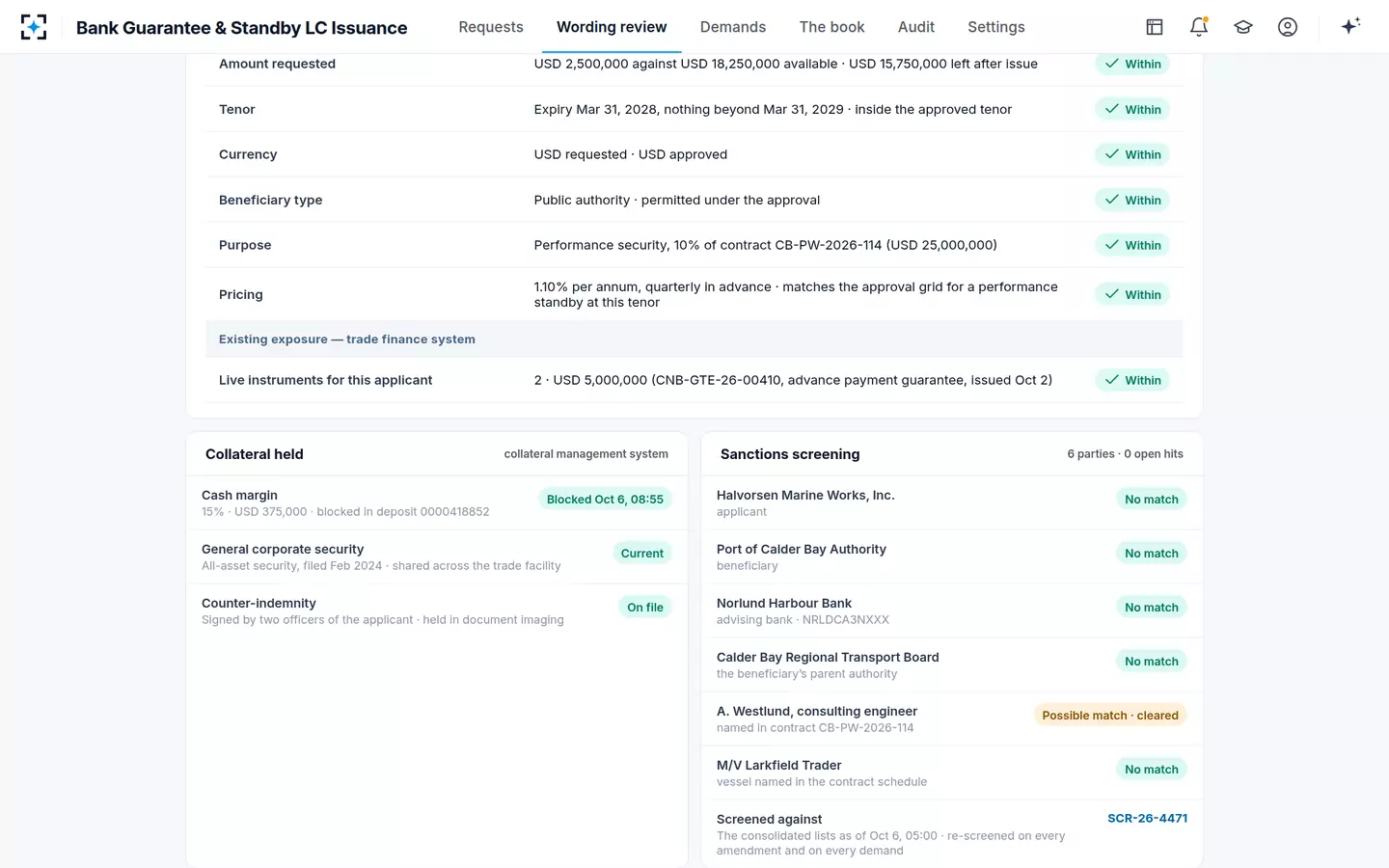
The bar is the whole liability, marked daily. That is very different from the margin a bank takes on an ordinary standby. On the solution's sample request, a USD 2,500,000 performance standby, the fictional bank holds a fifteen per cent cash margin of USD 375,000 with an all-asset security and a counter-indemnity behind it. That is credit support for an independent undertaking, not a segregated deposit, and it would not make a guarantee permissible under 7.1017.
Bank Guarantee & Standby LC Issuance: collateral held against a standby, beside every party screened
Why do US banks issue standby letters of credit instead?
Because the federal rule on independent undertakings is broader than the rule on guarantees. A national bank "may issue and commit to issue letters of credit and other independent undertakings within the scope of applicable laws or rules of practice recognized by law", and under them its obligation "depends upon the presentation of specified documents and not upon nondocumentary conditions or resolution of questions of fact or law at issue between the applicant and the beneficiary" (12 CFR 7.1016(a)).
That last phrase is the legal heart of the difference. A guarantor answers for the client's actual liability, so it is drawn into questions of fact and law about the contract. An issuer of a standby pays against documents and stays out of them. US examiners draw exactly this line; the OCC's procedures tell them to "Determine whether the undertakings are independent undertakings pursuant to 12 CFR 7.1016 rather than guarantees under 12 CFR 7.1017" (OCC Comptroller's Handbook, Trade Finance and Services). The lending-limit rule defines a standby by function, as any letter of credit "or similar arrangement" obliging the issuer to repay money borrowed by the account party, to pay its indebtedness, or "to make payment on account of any default by the account party in the performance of an obligation" (12 CFR 32.2(ee)).
US banks' answer to the guarantee question is the standby
2,893
of 4,313 FDIC-insured institutions reported standby letters of credit outstanding
$576.5B
of financial and performance standbys outstanding and unused
8
parties to the UN Convention on independent guarantees; the United States is not one
What does 12 CFR 7.1016 allow, and what does it expect?
12 CFR 7.1016 allows a national bank to issue letters of credit and other independent undertakings, and to confirm or otherwise undertake to honour another issuer's undertaking, within laws or rules of practice recognised by law. In return it sets out what "as a matter of safe and sound banking practice" a bank should consider, and examiners test each item.
What 12 CFR 7.1016(b) expects of every independent undertaking
- Independence apparent from the terms
For example, by making the undertaking subject to rules that provide for its independent character.
- Limited in amount
A stated maximum the bank can book and limit.
- Limited in duration, or terminable
Or terminable periodically or on notice, or with a right to cash collateral on demand.
- Collateral or reimbursement
Fully collateralised, or a right of reimbursement after the bank pays.
- Renewal the bank can assess
Automatic renewal terms consistent with the bank's ability to assess credit before renewal.
- Operational expertise
Commensurate with the sophistication of the bank's undertaking activities.
- Accurate records
Every undertaking reflected in the bank's records, including obligations arising from it.
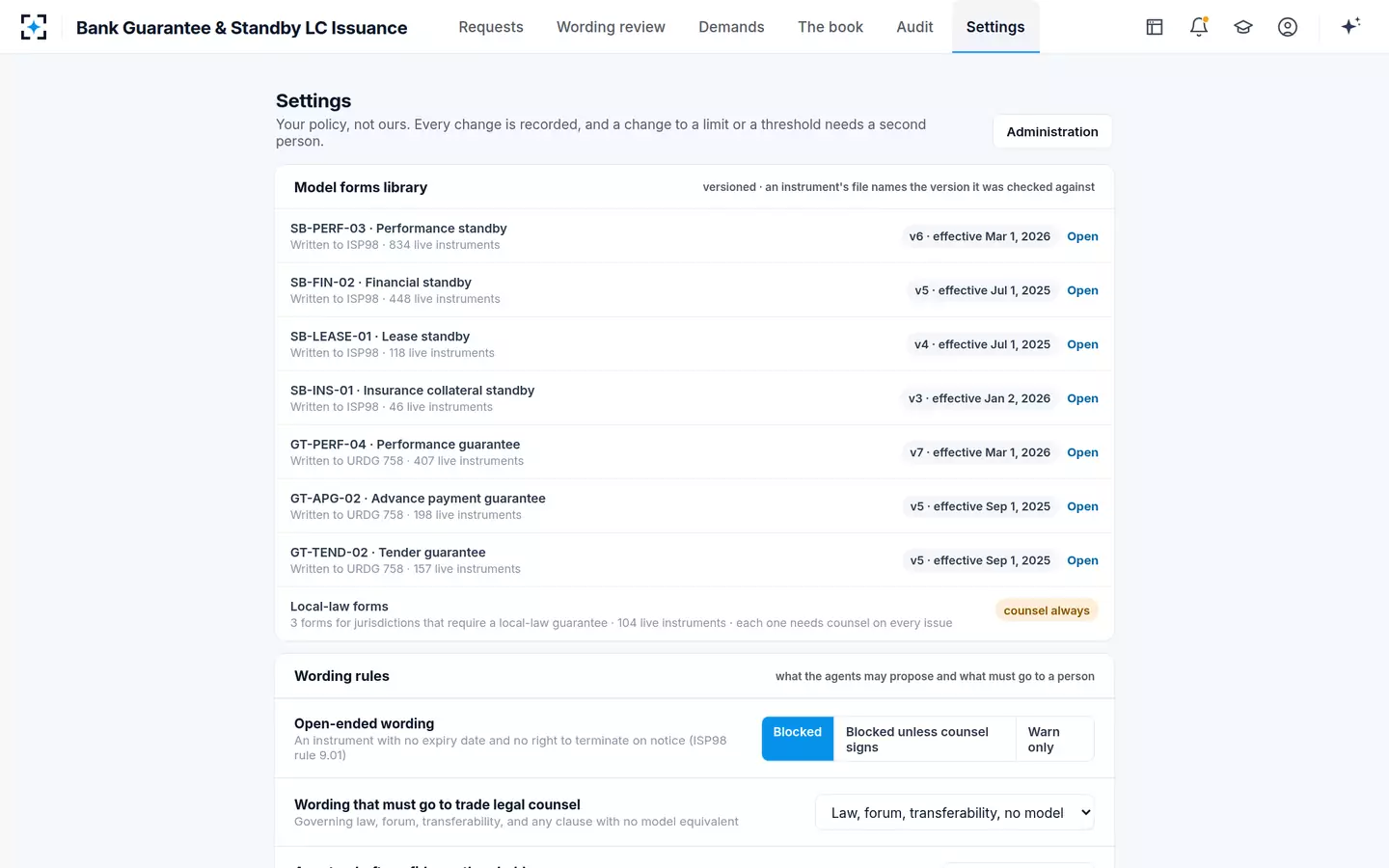
Each item is a property of the wording, which is why a regulation about bank powers reads like a wording checklist. An open-ended expiry clause fails the duration test; a reduction with no document fails the amount the bank can book; an instrument with no rules clause may fail the first item. The sample bank's settings block open-ended wording outright, so nothing is released without a fixed end date.
Do US banks follow URDG 758?
Some do, but US regulation does not name it. The footnote to 12 CFR 7.1016 lists as examples of recognised laws and rules UCC Article 5, UCP 600, the electronic supplements to the UCP, "International Standby Practices (ISP98) (ICC Publication No. 590)", the UN Convention on independent guarantees and the ICC's rules for bank-to-bank reimbursements. URDG 758 is not on the list, though the list is introduced as examples rather than an exhaustive set.
On the regulation's own terms, what matters is what the instrument does: an undertaking to pay against specified documents, independent of the underlying contract, is an independent undertaking whatever it is called, and URDG 758 makes a guarantee independent of the underlying contract by its nature (art. 5(a)). Whether a particular URDG 758 guarantee falls under 7.1016 or 7.1017 is the question the examination procedure asks of each instrument, and a bank should have counsel's view before it issues one. US banks also meet URDG 758 from the other side, as counter-guarantors to foreign banks issuing local guarantees.
Can a US bank confirm a foreign guarantee?
A national bank "may confirm or otherwise undertake to honor or purchase specified documents upon their presentation under another person's independent undertaking within the scope of such laws or rules" (12 CFR 7.1016(a)). A foreign bank's demand guarantee that pays against documents is such an undertaking, so a confirmation of it is within the rule, subject to the same safe-and-sound considerations. The commoner structure runs the other way: the US bank issues a counter-standby or counter-guarantee to a bank in the beneficiary's country, which issues a local guarantee in the form the beneficiary requires.
Foreign branches and the shipside bond
US banks' foreign branches can do more. The OCC's handbook explains that foreign branches may exercise powers of banks in the host country under 12 CFR 28.4 and the Federal Reserve's Regulation K, including "guaranteeing a customer's debts or agreeing to make payment upon certain readily ascertainable events", and that such a guarantee "must specify a maximum monetary liability" under 12 USC 604a (OCC Comptroller's Handbook, Appendix D). The Call Report reflects this: on the FFIEC 031, banks include "all financial and performance guarantees issued by foreign offices" pursuant to Regulation K with their standbys (Schedule RC-L instructions).
The handbook's example of a trade guarantee is the shipside or steamer bond, a guarantee to a shipping company that lets an importer take delivery before the correct bills of lading arrive, usually backed by a counter-guarantee from the importer.
Did the US ratify the UN Convention on independent guarantees?
No. The United Nations Convention on Independent Guarantees and Stand-by Letters of Credit, adopted in 1995, is in force for eight states: Belarus, Ecuador, El Salvador, Gabon, Kuwait, Liberia, Panama and Tunisia. The United States signed it on December 11, 1997, and is listed without ratification (UNCITRAL status table). Its text still matters to US banks, because 12 CFR 7.1016 names it among recognised rules, but it is not US law.
What this means for a US bank's guarantee desk
A US desk handles three families of instrument: standbys under ISP98 or UCP 600, which make up most of the sample bank's book; URDG 758 guarantees and counter-guarantees, where a foreign beneficiary or bank requires them; and local-law guarantees, where a beneficiary's country requires its own form. Each needs a different model form and a different set of rules in the review, and each raises a different powers question. Capital follows function rather than name: guarantees and financial standbys carry a 100% credit conversion factor and performance standbys 50% (12 CFR 217.33), as the class that doubles capital explains.
Standbys, URDG 758 guarantees and local-law forms in one Bank Guarantee & Standby LC Issuance library
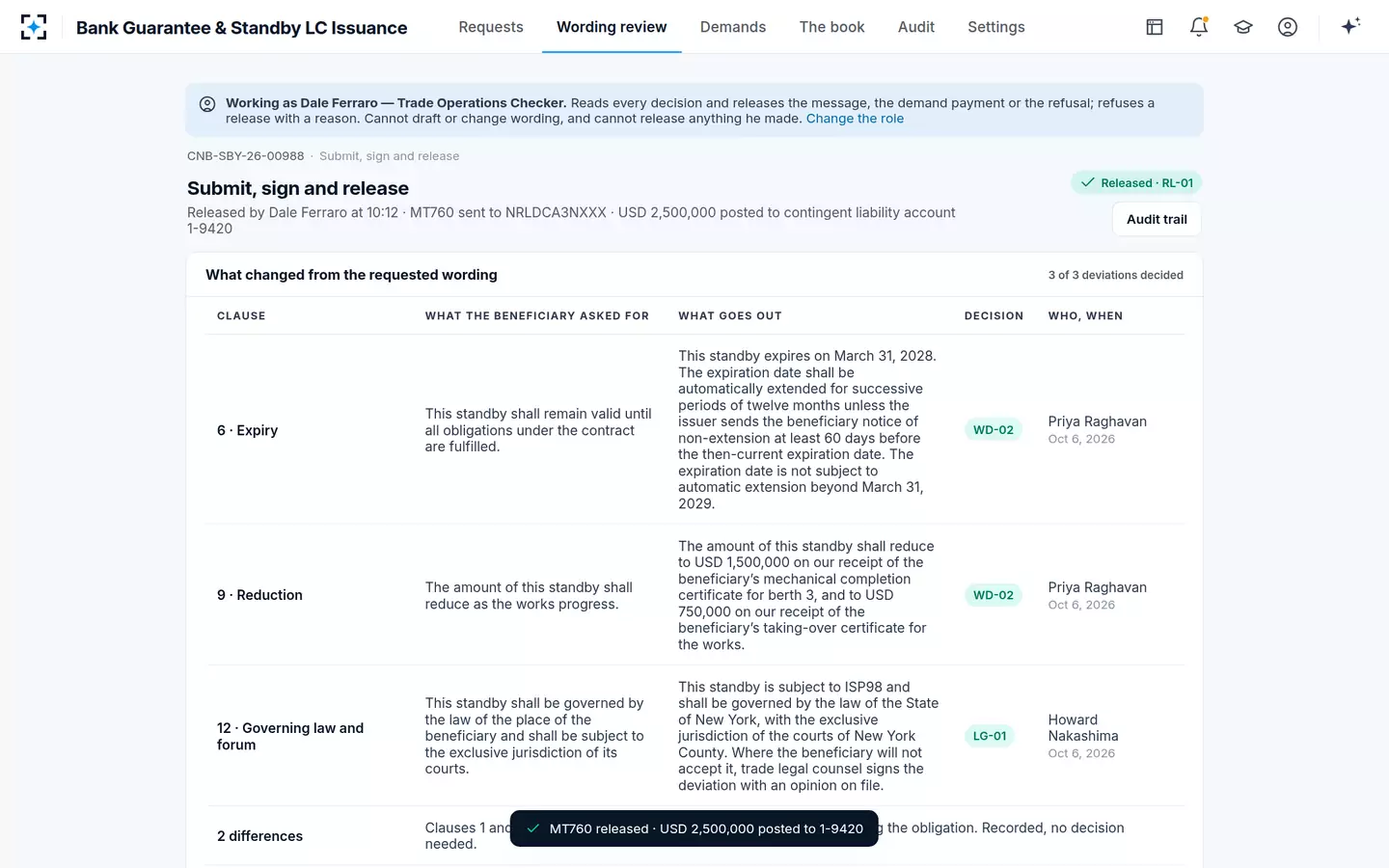
A beneficiary's own law, replaced and signed by counsel
How the two rule families differ for the beneficiary is set out in the difference between a bank guarantee and a standby letter of credit. The solution is at Bank Guarantee & Standby LC Issuance.
Questions people ask
What does 12 CFR 7.1017 allow?
It lets a national bank act as guarantor or surety when it has a substantial interest in the transaction, when a customer provides a segregated deposit covering the bank's total potential liability, or when it guarantees a customer's, subsidiary's or affiliate's financial obligation whose amount is reasonably ascertainable.
Is a standby letter of credit a guarantee under US law?
No. It is an independent undertaking under 12 CFR 7.1016 and a letter of credit under UCC Article 5: the bank pays against specified documents, not on proof that the client is liable. Functionally it serves the same purpose as a guarantee.
Do standbys count against a US bank's lending limit?
Yes. 12 CFR 32.2 treats an obligation to advance funds under a standby as a contractual commitment to advance funds, and the OCC's procedures combine standbys with the client's other loans unless the bank was prepaid, holds a segregated deposit for the maximum liability, or the OCC has found the class of standby carries less risk than a loan.
Can a US bank issue a guarantee under a foreign country's law?
A US bank can agree to a foreign governing law, and some beneficiaries require it. Whether the instrument is within the bank's powers is a separate question under 7.1016 and 7.1017, and the sample bank sends every local-law form to counsel on every issue.
Do state-chartered banks follow the same rules?
The OCC rules quoted here apply to national banks and federal savings associations. A state-chartered bank's powers come from its state's law, though the capital rules and the Call Report treatment of standbys apply to all insured banks.