The ISP98 rules are the International Standby Practices, ICC Publication No. 590, a set of ten rules written specifically for standby letters of credit. They apply when a standby makes "express reference" to them, and they govern what a standby is, how amendments bind, how and where a demand is presented, how documents are examined, how quickly a bank must give notice of dishonour, and how the standby ends. For a standby desk the rules that matter week to week are few: independence, automatic amendment, the medium of presentation, extend-or-pay, non-documentary conditions, the three-and-seven-day notice rule and the expiry requirement. Botminds' Bank Guarantee & Standby LC Issuance reads requested standby wording against the bank's ISP98 model forms and cites the rule behind every redraft, and this guide explains those rules.
Quotations are from ICC's own free text of ISP98 on its Digital Library. The rules bind only because a standby incorporates them, and they "supplement the applicable law to the extent not prohibited by that law" (rule 1.02(a)).
From presentation to notice: the ISP98 path of a demand
A person decides
Beneficiary presentsAt the place, time and in the medium the standby names (rules 3.01, 3.04, 3.06).
Agent
Identify the standbyIf it cannot be identified, presentation dates from identification (rule 3.03).
Agent
Examine on its faceAgainst the standby's terms, read with the rules; non-documentary terms disregarded (rules 4.01, 4.11).
A person decides
Decide: honour or dishonourThe issuer, or a waiver request to the applicant within the time, without extending it (rule 5.05).
A person decides
Give notice of dishonourWithin 3 business days is not unreasonable; beyond 7 is unreasonable; all discrepancies stated (rules 5.01, 5.02).
What are the ISP98 rules?
ISP98 is a ten-rule code for standbys: general provisions (rule 1), obligations (2), presentation (3), examination (4), notice and dishonour (5), transfer and assignment (6), cancellation (7), reimbursement (8), timing (9) and syndication (10). Rule 1.01 says they are "intended to be applied to standby letters of credit (including performance, financial, and direct pay standby letters of credit)", and that any similar undertaking "however named or described" may be made subject to them by express reference.
Two provisions of rule 1 settle how ISP98 sits with other rules. It "supersede[s] conflicting provisions in any other rules of practice to which a standby letter of credit is also made subject" (rule 1.02(b)), so a standby subject to both ISP98 and UCP 600 follows ISP98 where they conflict. And it leaves some questions entirely to law: the "power or authority to issue a standby", formal requirements, and "defenses to honour based on fraud, abuse, or similar matters" (rule 1.05). In the United States, the OCC's rule on independent undertakings lists ISP98 by name among recognized rules of practice (12 CFR 7.1016).
Rule 1: what a standby is, and the words ISP98 ignores
Rule 1.06 is the foundation: "A standby is an irrevocable, independent, documentary, and binding undertaking when issued and need not so state." Each adjective carries a consequence the rule spells out. Irrevocable means the issuer cannot amend or cancel without consent; independent means its obligation does not depend on reimbursement from the applicant or on the underlying deal; documentary means its obligations depend on presented documents and "an examination of required documents on their face"; binding means it is enforceable from issue.
Rule 1.10 is the one a wording reviewer uses most. It lists terms a standby has no need to state, such as unconditional, absolute, primary or payable on demand, and says what each means if it appears anyway. It also lists words that "have no single accepted meaning" and "shall be disregarded": "callable", "divisible", "fractionable", "indivisible" and "transmissible". A beneficiary's text that insists on any of them changes nothing under ISP98, and a reviewer can leave it or remove it without changing the obligation.
Rule 2: when a standby is issued and amended
A standby "is issued when it leaves an issuer's control unless it clearly specifies that it is not then "issued" or "enforceable"" (rule 2.03). Words such as "not available" or "not operative" do not delay that moment. For the desk, the release of the issuing message is therefore the moment the bank is bound.
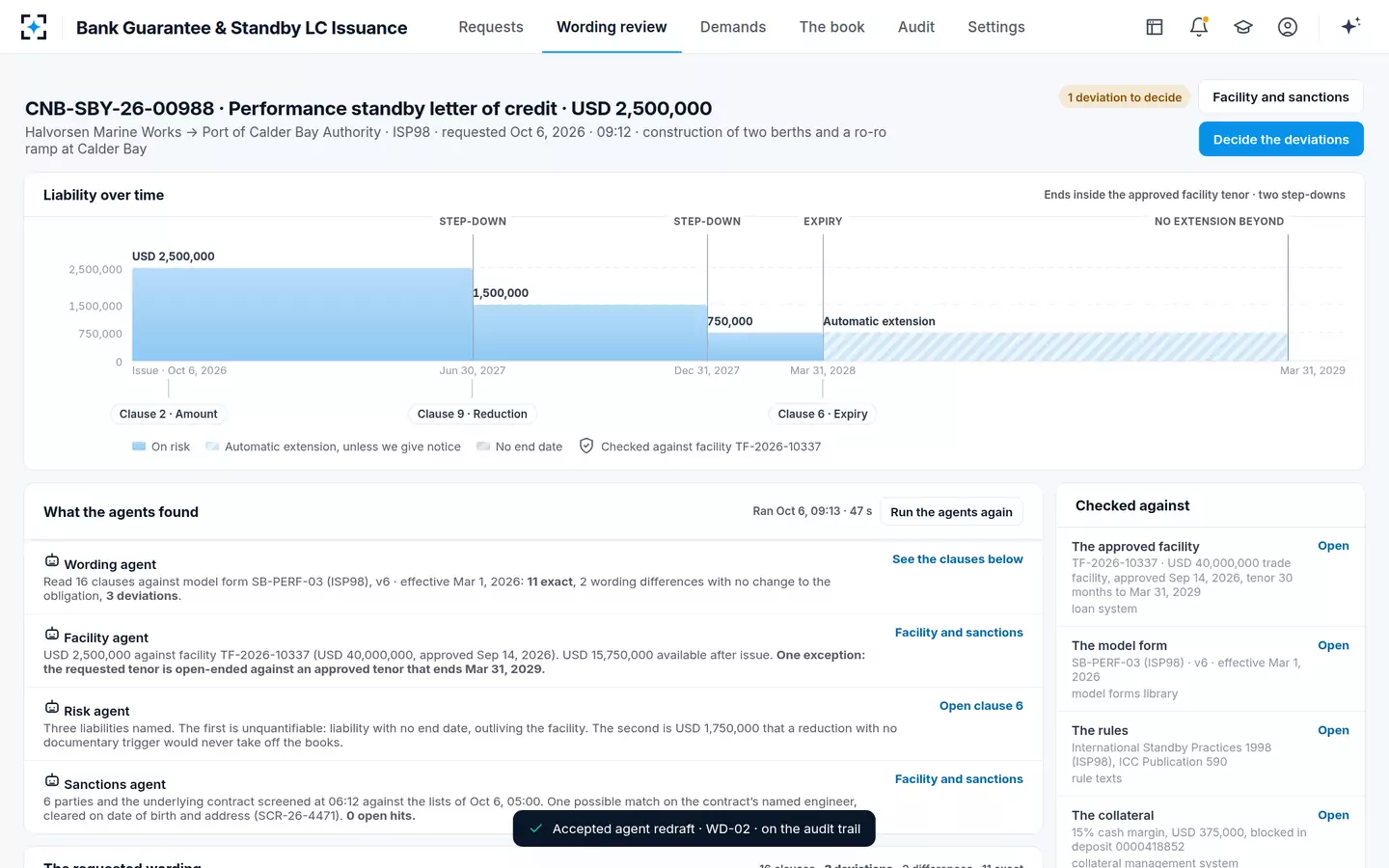
Amendments follow two paths. If the standby provides for "automatic amendment", such as an increase or decrease in amount or an extension of expiry, the change takes effect by itself, with no further notice or consent beyond what the standby provides (rule 2.06(a)). Otherwise the beneficiary must consent, expressly or by presenting documents that comply only with the amended standby (rule 2.06(c)). Automatic extension, and the notice that stops it, are the subject of four legal answers to "no expiry date".
Rule 3: presentation, extend-or-pay and closures
A standby "should indicate the time, place and location within that place, person to whom, and medium in which presentation should be made" (rule 3.01), and if it does, presentation must follow it. Receipt of any required document is a presentation that must be examined, "even if not all of the required documents have been presented" (rule 3.02). Where no medium is named, documents must be on paper, except that a demand alone may come by SWIFT or similar authenticated means from a bank or SWIFT participant (rule 3.06).
Rule 3.09 handles the demand that asks for an extension in the alternative. Such a request "is a presentation demanding payment under the standby, to be examined as such", and it implies that the beneficiary consents to the extension, asks the issuer to seek the applicant's approval, retracts its demand once the extension is issued, and "consents to the maximum time available under these Rules for examination and notice of dishonour". The issuer is not obliged to extend.
Rule 3.14 protects the beneficiary when the place for presentation is closed on the last day: the last day "is automatically extended to the day occurring thirty calendar days after the place for presentation re-opens for business, unless the standby otherwise provides". Banks sometimes exclude it. In one standby that reached a US appeals court, the text read: "This letter of credit is subject to International Standby Practices (ISP 98) International Chamber of Commerce. In this respect[,] article 3.14 of the ISP98 is hereby expressly waived" (EFLO Energy v. Devon Energy (10th Cir. 2023)).
What are non-documentary conditions under ISP98?
A non-documentary condition is a term the standby does not require to be evidenced in a document and that the issuer cannot determine "from the issuer's own records or within the issuer's normal operations" (rule 4.11(b)). ISP98's answer is blunt: such a term "must be disregarded whether or not it affects the issuer's obligation to treat a presentation as complying or to treat the standby as issued, amended, or terminated" (rule 4.11(a)).
The rule names what the issuer can determine itself: when and how documents and communications are delivered, amounts moving through accounts with the issuer, and amounts from a published index (rule 4.11(c)). Everything else needs a document. A clause saying the amount "shall reduce as the works progress" names no document and nothing the bank can see in its own records, so under rule 4.11 the reduction never takes effect and the full amount stays available. The fix is to name the document, such as a completion certificate, that triggers each step-down.
Rule 4: how documents are examined
Examination is "on its face against the terms and conditions stated in the standby as interpreted and supplemented by these Rules" (rule 4.01(b)). Several rules then narrow what the issuer must check. Documents not required are disregarded (rule 4.02). Documents are examined for inconsistency with each other "only to the extent provided in the standby" (rule 4.03), a lighter standard than UCP 600, under which data in documents must not conflict. If a standby names no document at all, it is still "deemed to require a documentary demand for payment" (rule 4.08).
Wording requirements have a precise scale in rule 4.09. A statement without specified wording need only "convey the same meaning". Wording in quotation marks or an attached form need not reproduce obvious typing errors. Only wording required to be "exact" or "identical" must be reproduced character for character, typos included. A separate demand must contain a demand directed to the issuer, a date, the amount and the beneficiary's signature (rule 4.16), and a required statement of default needs only a representation that a drawing event occurred, a date and a signature (rule 4.17).
How long does a bank have to dishonour under ISP98?
ISP98 sets a reasonableness standard with two fixed points rather than a single deadline.
"Notice given within three business days is deemed to be not unreasonable and beyond seven business days is deemed to be unreasonable."
ICC, ISP98, rule 5.01(a)(i)
Between three and seven business days, whether notice was timely depends on the circumstances, and an imminent expiry does not shorten the time (rule 5.01(a)(ii)). The count "begins on the business day following the business day of presentation" (rule 5.01(a)(iii)), and unless the standby states a shorter time "the issuer has no obligation to accelerate its examination" (rule 5.01(a)(iv)). The notice "shall state all discrepancies upon which dishonour is based" (rule 5.02), and a discrepancy not notified in time cannot be asserted against the same documents later (rule 5.03(a)). An issuer may ask the applicant to waive discrepancies, but only "within the time available for giving notice of dishonour but without extending it" (rule 5.05).
How many business days a bank has to give notice, by rule set
- Not unreasonable1–3
- Depends on the facts4–7
- Examine and notify1–5
- Reasonable time, not beyond the seventh1–7
In the United States the statute supplies its own outer limit for letters of credit, standbys included: an issuer has "a reasonable time after presentation, but not beyond the end of the seventh business day of the issuer after the day of its receipt of documents" to honour or give notice of discrepancies (UCC § 5-108(b)). Where a standby incorporates ISP98, Article 5 lets the incorporated rules govern the issuer's liability, subject to a short list of provisions the parties cannot vary (UCC § 5-116(c)).
Rules 6 to 10 in brief: transfer, cancellation, reimbursement, timing
The rest of ISP98, in one line each
| Rule | What it says | Why the desk cares |
|---|---|---|
| 6.02 Transfer | A standby "is not transferable unless it so states", and then only in full, possibly more than once. | A transfer clause is counsel's decision at issue. |
| 6.06 to 6.10 Assignment of proceeds | The issuer need not give effect to an assignment it has not acknowledged, and need not acknowledge it. | Acknowledgement can be conditioned on documents and indemnities. |
| 7.01 Cancellation | A beneficiary's rights cannot be cancelled without its consent, which may be shown by returning the original. | Early release needs the beneficiary, not the client. |
| 8.01 Reimbursement | The applicant must reimburse an issuer that paid a complying presentation and indemnify it for listed risks. | The counter-indemnity should match. |
| 9.01 to 9.05 Timing | Expiry date or termination right required; expiry at close of business; keeping the original standby preserves no rights after expiry. | Every standby needs an end the bank can see. |
| 10.01 to 10.02 Syndication | Presentation to any issuer binds all if the standby does not say otherwise; participations do not change the issuer's obligations. | Matters for large syndicated standbys. |
When is ISP98 used instead of UCP 600?
ISP98 is the better fit whenever the instrument is truly a standby, because UCP 600 was written for documentary credits that pay against shipping documents. UCP 600 applies to standbys only so far as its articles can apply to them (UCP 600, art. 1; see the difference between a bank guarantee and a standby). The OCC's examiners' handbook puts the relationship this way:
"The generally accepted international practices governing standby letters of credit are contained in the UCP and the International Standby Practices, 1998 edition (ISP98), also published by the ICC. ISP98 provides separate rules for standby letters of credit that are more specialized than those outlined in the UCP."
OCC, Comptroller's Handbook, Trade Finance and Services
Standbys are still issued under UCP 600, and the industry's 2019 principles note the cost: "SBLCs are often issued subject to the UCP, which was designed primarily for DCs, and as a result exclusions and variations of its rules are often used" (Wolfsberg Group, ICC and BAFT, Trade Finance Principles, Appendix III, 1.9). The differences that most often decide a dispute are below.
ISP98 or UCP 600 for a standby: where the rules part
ISP98: Standby letters of credit, including financial and direct-pay standbys.
UCP 600: Documentary credits, applied to standbys "to the extent … applicable".
ISP98: Last day extended to 30 calendar days after reopening (rule 3.14).
UCP 600: No honour after resumption if the credit expired during the interruption (art. 36).
ISP98: Examined for inconsistency only as the standby provides (rule 4.03).
UCP 600: Data must not conflict with other documents or the credit (art. 14(d)).
ISP98: 3 business days not unreasonable, beyond 7 unreasonable (rule 5.01).
UCP 600: Maximum five banking days to decide (art. 14(b)).
ISP98: Specific rule (3.09).
UCP 600: No specific rule.
ISP98: Examined in the context of standby practice (rule 4.20(b)).
UCP 600: Detailed rules for invoices, transport and insurance documents.
How Bank Guarantee & Standby LC Issuance applies ISP98
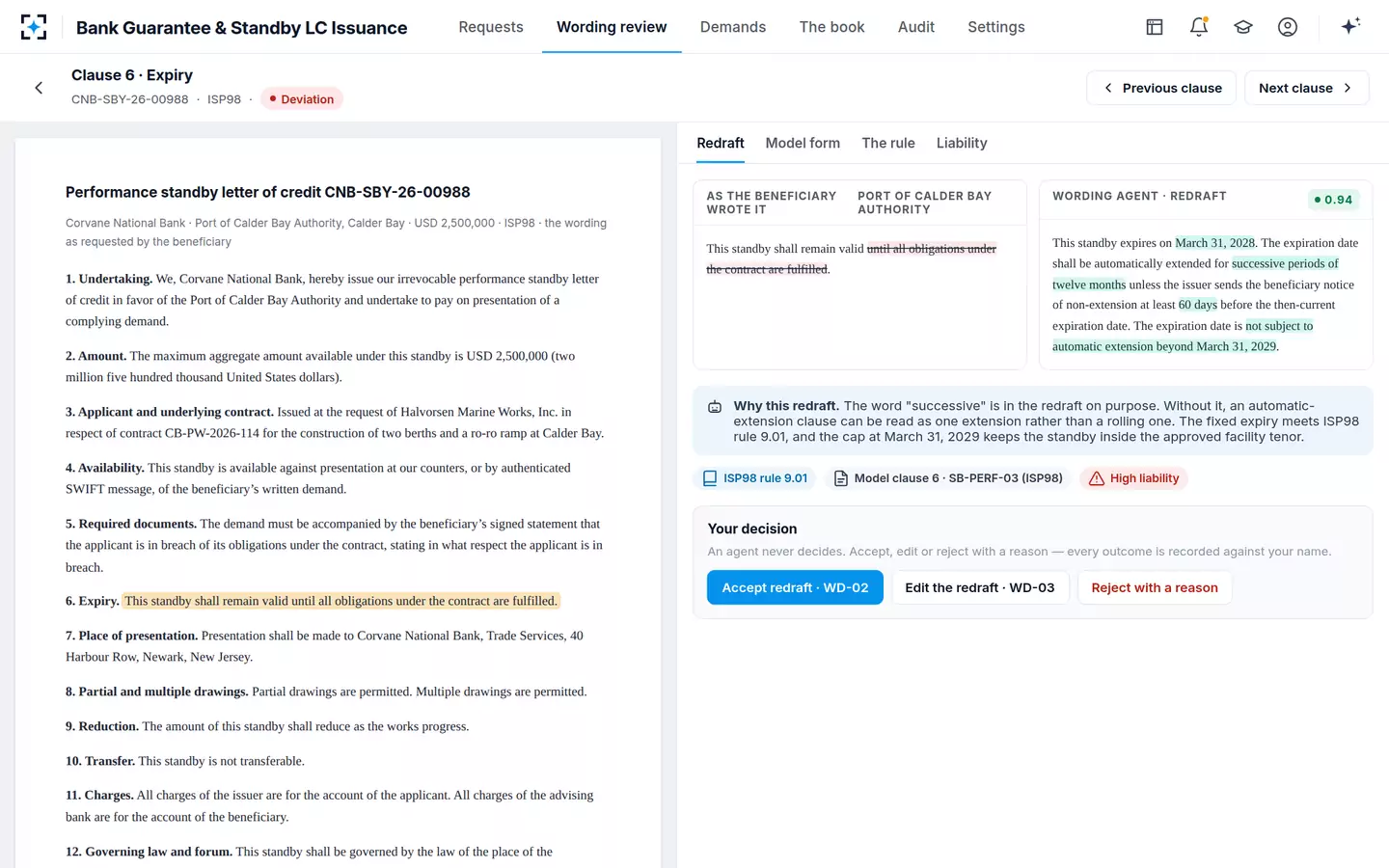
In the solution, each ISP98 model form is versioned and every redraft cites the rule behind it, so a specialist reviewing a change sees the provision as well as the wording. On the sample performance standby, the beneficiary's open-ended expiry clause was redrafted with a citation to rule 9.01, and the reduction "as the works progress" was redrafted into two step-downs triggered by named certificates. For demands, the sample bank's examination target is three business days for ISP98 standbys and five for URDG 758 guarantees, inside the periods the rules allow.
A Bank Guarantee & Standby LC Issuance redraft that cites ISP98 rule 9.01
Automatic amendment, drawn on the liability bar
The demand side of the same comparison, under URDG 758, is set out in the demand file that survives a challenge, and the choice between the two families of rules in the difference between a bank guarantee and a standby letter of credit. The solution is at Bank Guarantee & Standby LC Issuance.
Questions people ask
What does ISP98 rule 9.01 require?
That a standby either contain an expiry date or permit the issuer to terminate it on reasonable prior notice or payment. A standby "valid until all obligations are fulfilled" does neither, and should be redrafted before it is issued.
What is ISP98 rule 3.14?
It extends the last day for presentation to thirty calendar days after the place for presentation reopens, if it was closed on the last business day for presentation, unless the standby provides otherwise. Some standbys expressly waive it.
Is ISP98 law?
No. It is a set of private rules that apply because a standby incorporates them; rule 1.02(a) says they supplement the applicable law to the extent not prohibited by it. In the United States, UCC § 5-116(c) lets incorporated rules govern most questions of an issuer's liability.
Does ISP98 deal with fraud?
No. Rule 1.05 leaves "defenses to honour based on fraud, abuse, or similar matters" to applicable law, which in the US is UCC § 5-109 and in England the case law on the fraud exception.
Is ISP98 still current?
Yes. ICC's Digital Library serves the current text free, and US regulation cites it as ICC Publication No. 590 in 12 CFR 7.1016.