A bank guarantee tracker is the register a bank, or its client, keeps of every live guarantee and standby letter of credit: who it is for, how much, under which rules and until when. The usual tracker is a spreadsheet with one row per instrument, and its weakness is that the liability does not sit still between reviews. It falls when a beneficiary presents a completion certificate, renews itself when a non-extension notice is not sent in time, is suspended for up to 30 days when a demand asks to extend or pay, and ends on dates the rules supply when the wording does not. A tracker that holds only the issue amount and the stated expiry reports a liability the bank no longer has, or misses one it still does. Botminds' Bank Guarantee & Standby LC Issuance draws each instrument's liability from its clauses as a bar over time, and puts every date that moves it on one calendar across the book.
The rules quoted are ICC's free texts of URDG 758 and ISP98, which apply because an instrument incorporates them. The worked example is the solution's sample data on a fictional bank.
Bank Guarantee & Standby LC Issuance: one sample standby's liability, period by period
How do you track bank guarantees?
Track bank guarantees by the events in their wording, not only by instrument. Each guarantee needs its fixed data, the amount, parties, rules and expiry, but the liability is decided by the events the clauses attach to it: reductions on named documents, automatic extensions and the deadline to stop them, payments and partial releases, demands, and expiry. A tracker that dates each of those events, and values the liability after each, can say on any day what the bank is on risk for and what decision falls due next.
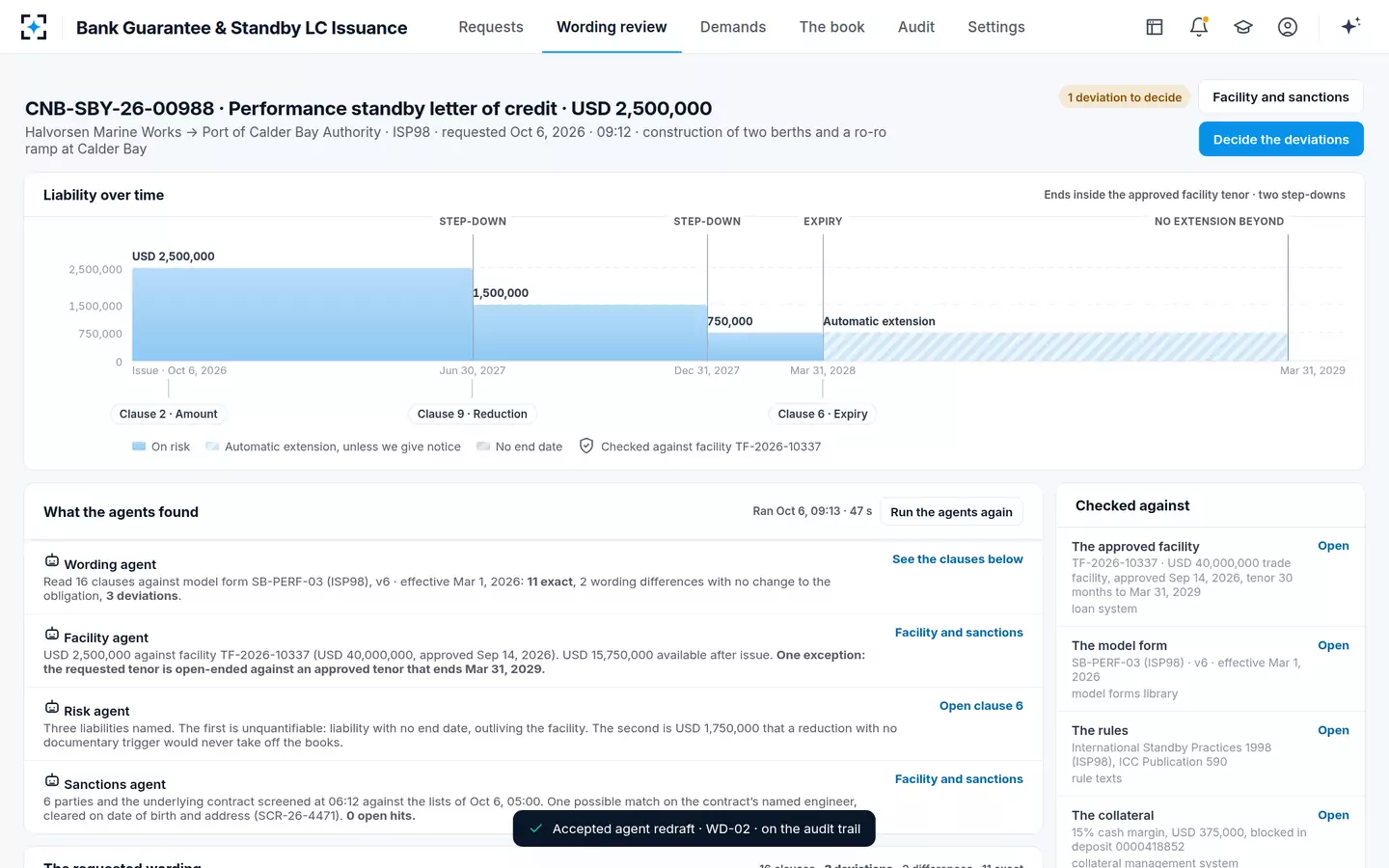
The difference shows on the sample standby above. Its reduction clause, once redrafted, takes USD 1,750,000 off the bank's liability in two steps, each on a certificate from the beneficiary. Its expiry clause extends the instrument for a year at a time unless the bank sends notice 60 days before each expiry. Neither event changes a spreadsheet row unless someone remembers to change it.
A static tracker and a clause-driven one, on the same instrument
Spreadsheet tracker: Issue amount, until someone edits it.
Liability drawn from the clauses: Steps down when the certificate named in the clause is presented.
Spreadsheet tracker: The first expiry date.
Liability drawn from the clauses: Current expiry, extension terms and the final date beyond which none occurs.
Spreadsheet tracker: Not shown.
Liability drawn from the clauses: Non-extension notice due 60 days before expiry, with the liability it decides.
Spreadsheet tracker: A note in a comments column.
Liability drawn from the clauses: The suspension period counted, and the instructing party told.
Spreadsheet tracker: A blank cell.
Liability drawn from the clauses: Flagged, with the backstop the rule set supplies.
What is a bank guarantee register format?
A useful register format starts from what ICC's demand-guarantee rules recommend every guarantee specify, and adds the fields that move liability. URDG 758 recommends naming the applicant, beneficiary, guarantor, underlying relationship, guarantee reference, amount and currency, expiry, terms for demanding payment, paper or electronic presentation, language and the party paying charges (art. 8). A register needs those, plus the rest of the table below.
Fields a guarantee and standby register should hold
| Field | Why it matters |
|---|---|
| Rule set and governing law | Decides the demand clock, the expiry backstop and the force majeure rule. |
| Class: financial or performance standby, or guarantee | Decides the Call Report item and the capital conversion factor. |
| Facility, approval and its tenor | The instrument must end inside what credit approved. |
| Collateral and counter-indemnity | Cash margin, security and the client's promise to reimburse. |
| Current expiry and expiry type | Fixed date, event with its document, or none. |
| Extension terms and notice deadline | Period, repetition, notice period, method and final date. |
| Reduction triggers | Each step-down, its amount and the document or date that triggers it. |
| Amount available now | After payments, reductions and partial releases. |
| Counter-guarantee or confirmation | Which other undertakings are linked, and their own expiries. |
| Demands and amendments | Each with dates, outcome and the person who decided. |
When does a guarantee reduce?
A guarantee reduces when its own terms say so and the trigger can be seen, when the bank pays part of it, or when the beneficiary releases part of it. URDG 758 lets a guarantee "provide for the reduction or the increase of its amount on specified dates or on the occurrence of a specified event", and deems the event to have occurred only "when a document specified in the guarantee as indicating the occurrence of the event is presented to the guarantor", or, if no document is named, when it "becomes determinable from the guarantor's own records or from an index specified in the guarantee" (art. 13). The amount payable also falls by amounts paid and by any signed partial release (art. 25(a)).
Under ISP98 a reduction is an automatic amendment that takes effect only if the standby expressly provides for it (rule 2.06(a)), and a condition with no document and nothing in the issuer's own records is disregarded (rule 4.11). Either way the tracker has two jobs: to know which document triggers each step-down, and to note the date it was presented, because that date, not the expected date, is when the liability falls.
The same standby, with its step-downs and its final date
What is extend or pay, and why does it belong in the tracker?
Extend or pay is a demand that asks the bank to pay or, as an alternative, to extend the instrument's expiry. Under URDG 758, where a complying demand includes that alternative, "the guarantor may suspend payment for a period not exceeding 30 calendar days following its receipt of the demand" (art. 23(a)); it must tell the instructing party of the suspension without delay (art. 23(c)); and if no extension is granted in time, the demand "shall be paid without the need to present any further demand" (art. 23(d)). Under ISP98 the same request is a presentation to be examined like any other, and the beneficiary is taken to consent to the maximum time for examination (rule 3.09).
The tracker has to hold that suspension as a dated event with a hard end. If the client and the bank decide to extend, the extension must be issued inside the 30 days; if they do not, the bank pays on the last day without a new demand. Where a counter-guarantee sits behind the guarantee, the counter-guarantor's own suspension must end four calendar days earlier (art. 23(b)), so a bank on both sides of the chain is tracking two clocks for one demand.
How do you know a guarantee has expired?
A guarantee has expired when its expiry date or expiry event has passed, and the return of the paper does not matter. URDG 758 says that "Whether or not the guarantee document is returned to the guarantor, the guarantee shall terminate" on expiry, when nothing remains payable, or on presentation of the beneficiary's signed release (art. 25(b)). ISP98 says the same from the other side: "Retention of the original standby does not preserve any rights under the standby after the right to demand payment ceases" (rule 9.05).
The tracker has to know which day that is. Under ISP98, if no time is stated the standby expires "at the close of business at the place of presentation" (rule 9.04), and if the last day is not a business day there, presentation on the next business day is timely (rule 3.13). A closure at expiry extends the last day by 30 calendar days after reopening under ISP98 rule 3.14, and a force majeure at expiry extends a URDG 758 guarantee by 30 calendar days (art. 26). An instrument that names no expiry at all takes the backstop of its rule set or law, set out in four legal answers to "no expiry date".
The notice window: why a tracker needs a calendar, not a column
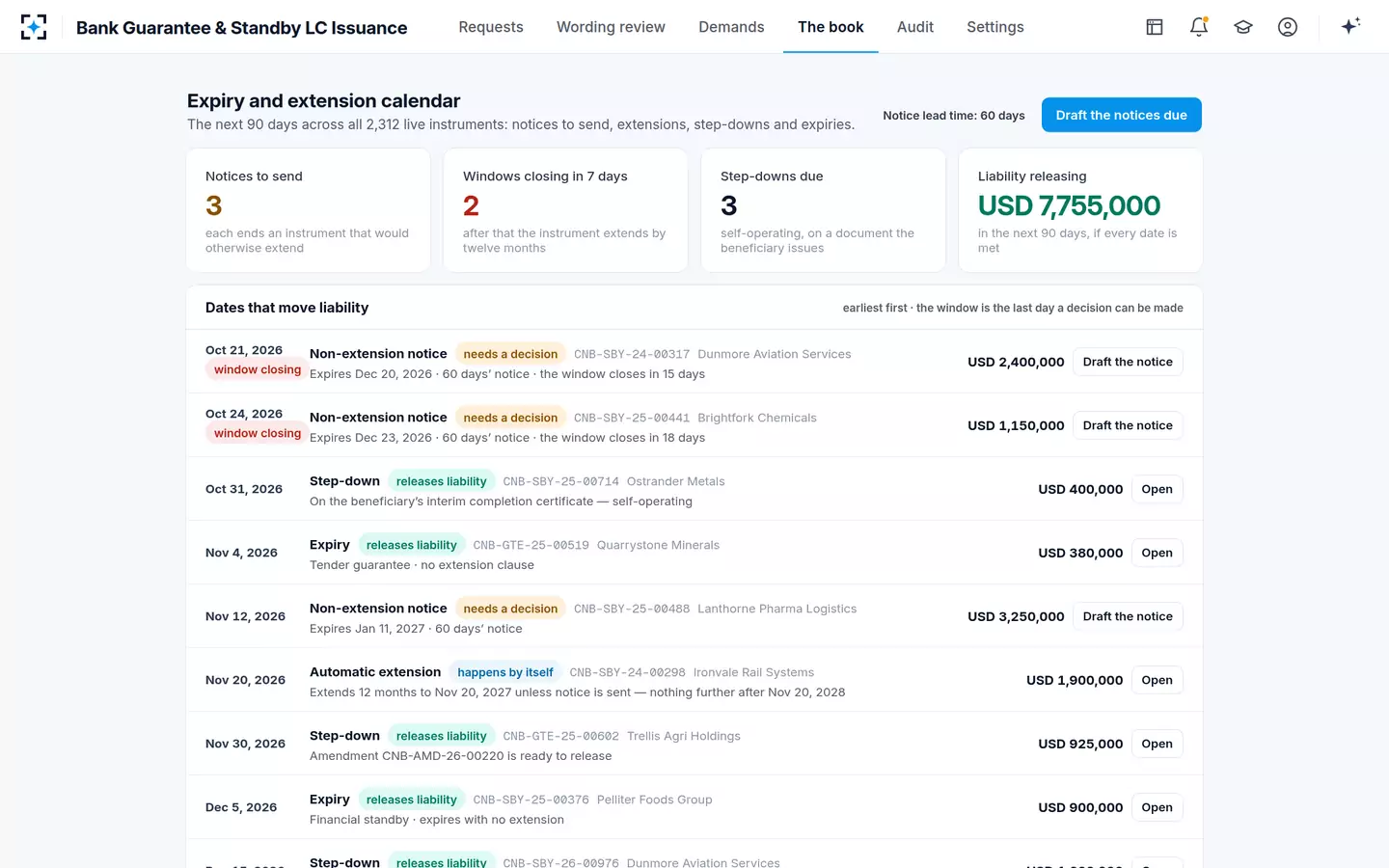
An evergreen instrument has a second date that matters more than its expiry: the last day the bank can send notice of non-extension. Miss it and the liability renews for a full period. That deadline is set by the instrument's wording, not by the rules, so it can only be tracked if the tracker reads the clause.
Long-running standbys also carry their errors forward. In a case decided by a US federal appeals court in 2023, the parties had agreed in writing that "due to scrivener's error, the beneficiary under the [SLOC] [wa]s currently listed as" the wrong company; the standby had been extended annually for years and, after a draw was threatened, extended four times on a short-term basis, and the beneficiary had "requested multiple times" that the name be amended (EFLO Energy v. Devon Energy (10th Cir. 2023)). Every renewal is a point at which a tracker that holds the wording can catch what the original issue missed.
Every date that moves liability, earliest first, in Bank Guarantee & Standby LC Issuance
Why monitoring a guarantee book is mostly about dates
For guarantees, pattern-based monitoring of transactions has limits the industry itself acknowledges. The 2019 trade finance principles say that for standbys and guarantees standard pattern-based monitoring is hard to build, if it can be built at all, because instruments supporting construction, design and supply contracts vary so widely while others, such as lease guarantees, are nearly identical (Wolfsberg Group, ICC and BAFT, Trade Finance Principles, Appendix III, 1.8(d)). The same principles say much the same of documentary trade, a point trade-based money laundering transaction monitoring quotes and measures.
What can be monitored reliably is the instrument against its own terms: the date each event falls due, whether the document that triggers it arrived, whether a notice went in time, and whether the liability on the books matches the liability the wording now creates. That is a tracking problem, and it is one where a missed day has a precise cost.
What examiners and the Call Report expect of a guarantee book
Examiners expect the books to match the instruments. Banks report standbys in Call Report Schedule RC-L each quarter at the amount still outstanding and unused (RC-L instructions, items 2 and 3), so a reduction that happened but was not booked overstates the report, and one booked before its certificate arrived understates it. The OCC's rule on independent undertakings asks national banks to reflect their undertakings accurately in their records (12 CFR 7.1016(b)(4)), and its examination procedures ask for, among other things, the "level of standby letters of credit that have been drawn" (OCC Comptroller's Handbook, Trade Finance and Services).
Seven checks a guarantee tracker should pass every day
- Every live instrument has an end the bank can see
A date, or an event with its triggering document.
- Every notice window is dated, with an owner
And drafted before it closes, not on the day.
- Every step-down names its trigger
And the amount falls only when that document arrives.
- Every extend-or-pay suspension has an end date
30 calendar days at most under URDG 758 art. 23(a).
- Amounts match the general ledger
After payments, reductions and partial releases.
- Class matches the report
Financial or performance, as booked and as reported in RC-L.
- Instruments inside their facilities
No instrument outliving the approval that supports it.
Where agents fit in tracking
In Bank Guarantee & Standby LC Issuance, the expiry agent watches expiry, automatic extension, non-extension notice and reduction dates across the whole book, lists them earliest first with the liability each one moves, and drafts the notices and reduction amendments before each window closes. It never sends a notice, never amends an instrument and never shortens a notice window; a checker releases each one. The message agent posts and releases the contingent liability at each step-down only after a person approves it.
The tracker is also where the issuing review pays off: an instrument redrafted at issue to end inside its facility, with documentary step-downs, is one the calendar can follow without judgment calls. How that review works seat by seat is in the bank guarantee process, seat by seat, and how to test a tracker on your own book in a four-week pilot. The solution is at Bank Guarantee & Standby LC Issuance.
Questions people ask
What happens if you lose a bank guarantee?
Losing the paper does not end the bank's obligation or preserve the beneficiary's rights after expiry. Under ISP98 rule 3.12 the issuer need not replace a lost standby or waive a requirement to present the original, though it may at its discretion against an indemnity; under URDG 758 art. 25(b) a guarantee terminates on expiry whether or not the document is returned.
How long does a bank guarantee last?
Until its stated expiry date or expiry event, any automatic extensions included. If none is stated, the backstop depends on the rules and law: three years under URDG 758, one year under the UCC (five if stated to be perpetual), six under the UN Convention; ISP98 does not allow a standby without an expiry or a termination right.
Can a guarantee's amount go up as well as down?
Yes, if its terms provide for it. URDG 758 art. 13 allows an increase or reduction on specified dates or events, and ISP98 rule 2.06(a) treats an expressly provided increase or decrease as an automatic amendment.
Who should own a bank guarantee tracker?
Trade operations, with credit reading it. The dates belong to the desk that sends notices and books step-downs, and the liability belongs to credit, which approved it against a facility. A shared calendar lets both see the same instrument.
Does a client need its own guarantee tracker?
A client with many guarantees outstanding has good reason to keep one, because each guarantee consumes its facility and carries fees until it expires or reduces. The fields that matter are the same: the trigger for each step-down, the expiry and any notice windows.