Bank guarantee management software holds a bank's guarantees and standby letters of credit from request to expiry: the wording, the approvals behind it, the liability over time and every demand. The useful kind also reads, comparing requested wording with the bank's model forms, drawing the liability from the clauses, and examining demands against the instrument as issued. The way to choose it is not a demonstration but a pilot on your own book: a sample of last year's requests, issued instruments and demands, run through the software and scored against the rules your instruments are already subject to. Botminds' Bank Guarantee & Standby LC Issuance is built to be tested that way, on a sample of past instruments and demands and against your own model forms.
The figures that describe the solution below come from its sample data on a fictional bank, or are design targets, and are labelled as such. Nothing here is a measured customer result; the point of the pilot is to produce yours.
What the pilot compares: your specialists' file against the software's output
What your past file shows: Which clauses the specialist changed, and why.
What the software must produce, unaided: The same deviations, each with the model clause and rule cited.
What your past file shows: Whether the instrument fit the approval.
What the software must produce, unaided: Amount, tenor, beneficiary and pricing read from the approval, with exceptions.
What your past file shows: The expiry and any reductions the desk booked.
What the software must produce, unaided: Expiry, extensions and reductions drawn from the clauses as worded.
What your past file shows: Financial or performance, as reported in RC-L.
What the software must produce, unaided: The class from the obligation the wording backs.
What your past file shows: The decision, the notice and the day it went.
What the software must produce, unaided: The same discrepancies, and the clock counted correctly.
What should bank guarantee management software do?
Bank guarantee management software should do five jobs, and a bank should know which of them it is buying. It keeps the instrument and its history; it reads the requested wording against model forms; it checks the instrument against the credit approval, collateral and sanctions lists; it tracks every date that moves the liability; and it examines demands inside the clock the rules set. Many systems do the first and the fourth well. The reading jobs are where products differ most.
The jobs map onto what US examiners already check. National banks are expected to keep independent undertakings limited in amount and in duration, or terminable, to back them with collateral or a right of reimbursement, and to show them accurately in their own books (12 CFR 7.1016(b)). The OCC's procedures ask examiners to "Determine whether standby letters of credit are correctly segregated from other types of letters of credit and guarantees" (OCC Comptroller's Handbook, Trade Finance and Services), and the Call Report separates financial from performance standbys (Schedule RC-L, items 2 and 3). Software that cannot tell those apart leaves the work where it was.
Why pilot on your own book, not on a demo
A demonstration shows the software on wording it was built around. Your book has your beneficiaries' habits, your model forms, your local-law instruments and your past mistakes, and only that tells you whether the software will catch what your desk catches. There is also no external figure to lean on: we know of no regulator or standard-setter that has published an accuracy benchmark for software reading guarantee wording or examining demands.
The industry's guidance on artificial intelligence points the same way. For financial crime compliance, the Wolfsberg Group asks institutions to keep testing, validating and re-configuring AI against the purpose it was built for (Wolfsberg Principles for AI/ML, 2022; quoted in the model risk view of a TBML tool). A pilot on past files is the first round of that testing, and its scorecard becomes the baseline every later release is measured against.
Four weeks, one question per week
- Week 1: files and baselineWk 1
- Week 2: wordingWk 2
- Week 3: liability and datesWk 3
- Week 4: demands and noticesWk 4
How many past guarantees does a pilot need?
A pilot needs enough instruments to include every kind of clause that matters and every demand, not a statistically perfect sample. Demands are rare and expensive, so take all of them from the last twelve months. Take every instrument the desk changed materially at issue, because those are where the wording reading earns its keep, and add a random draw of standard issuances to measure false alarms.
A pilot sample a desk can assemble in a week
| Draw | What to include | Why |
|---|---|---|
| Every demand, last 12 months | Paid, refused and withdrawn, with the notice as sent | Tests the clock and the notice, where errors are precluded rather than corrected |
| Every instrument with a non-standard clause | The requested wording and what was issued | Tests whether the software finds the deviations your specialists found |
| Every amendment that changed amount or expiry | Request, amendment and the beneficiary's consent | Tests reductions, extensions and consent |
| A random draw of standard issuances | For example one in ten, across rule sets | Measures false deviations on clean wording |
| Every instrument with no fixed end date | From the live book, whatever its age | Tests whether open-ended liability is found |
Week 1: the files, and a baseline you measure yourself
Week one assembles the sample and, more importantly, measures the current process. For a handful of recent requests, time the hours from a complete request to a wording file a checker could release, and count how many people touched it. No published figure tells a bank how long guarantee issuance takes; the baseline has to be your own, and without it no turnaround claim can be judged.
The week also fixes the inputs the software will need: the current and past versions of each model form, the credit policy that sets who may approve what, the release limits, and an extract of the approvals and collateral for the sampled instruments. Where a model form has changed during the sample year, give the software the version in force when each instrument was issued.
Week 2: wording against your own model forms
Week two runs the sampled requests through the wording review and compares the result, clause by clause, with what the specialist decided. Count four things: deviations the software found that the specialist also found; deviations it missed; deviations it raised that the specialist rightly ignored; and, for each redraft, whether the cited rule and model clause are correct. The last is easy to skip and the most telling, because a redraft with a wrong citation costs a reviewer more time than no redraft at all.
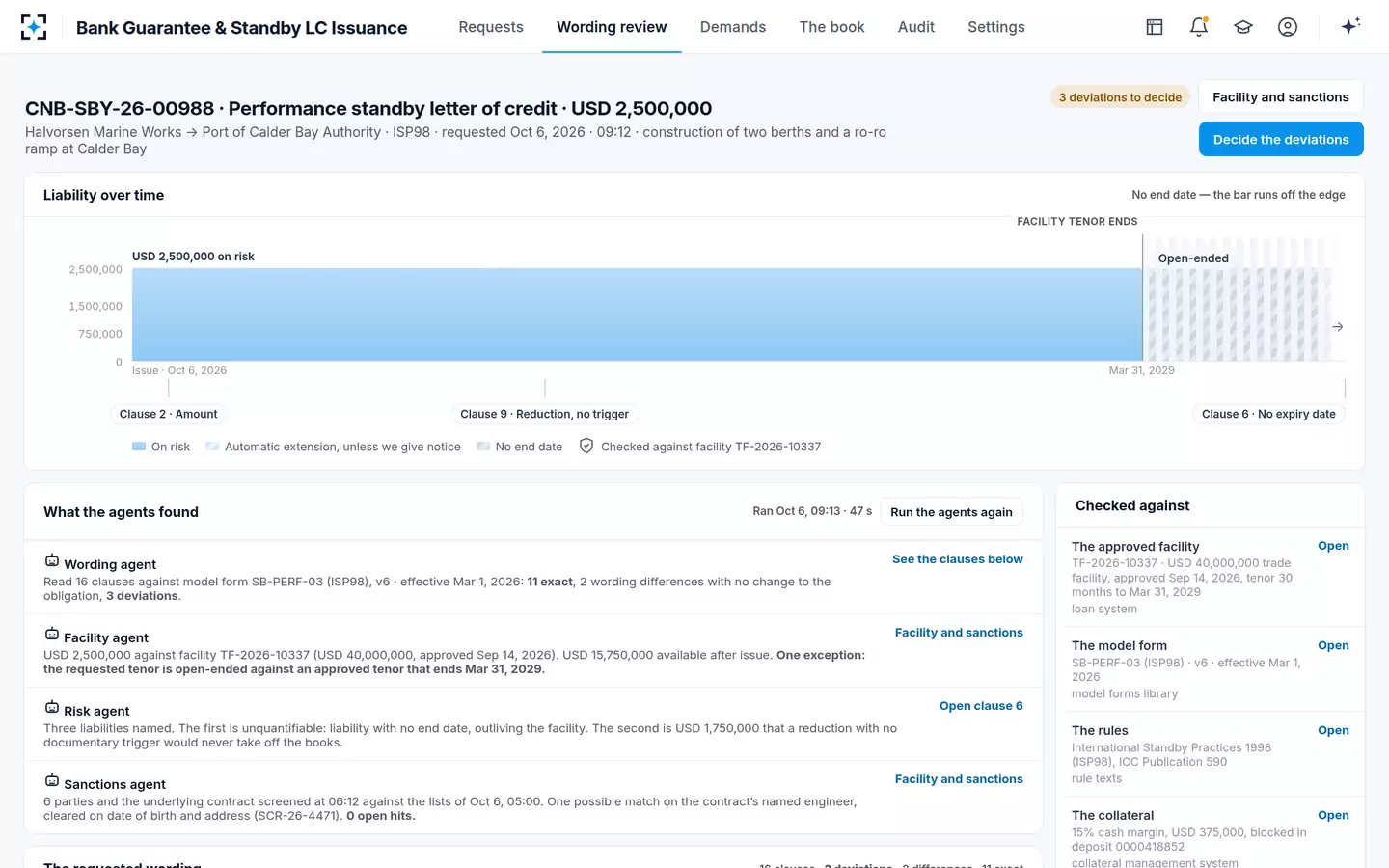
What the agents found on one request, before anyone opened it
Week 3: the liability, the dates and the class
Week three tests whether the software sees what the wording does to the liability over time. Three checks matter most. Does it flag every instrument with no expiry date and no right to terminate, which ISP98 rule 9.01 forbids for a standby and URDG 758 art. 25(c) ends after three years for a guarantee (ISP98; URDG 758)? Does it see that a reduction "as the works progress" names no document, so under URDG 758 art. 13 and ISP98 rule 4.11 it will not operate? And does it date every automatic extension and its non-extension window?
Add the class. For each sampled standby, compare the software's view of what the wording backs, a financial or a non-financial obligation, with how the instrument was reported. A disagreement is either a software miss or a reporting error worth correcting. Why that check matters is set out in the class that doubles capital, and how the dates become a book-wide calendar in from a spreadsheet tracker to liability you see daily.
Week 4: demands, clocks and refusal notices
Week four replays every demand in the sample. For each, check that the software counts the clock from the business day after presentation, on the issuing branch's calendar, under the instrument's own rule set: five business days under URDG 758 art. 20(a); notice within three business days "not unreasonable" and beyond seven "unreasonable" under ISP98 rule 5.01; and, where Article 5 of the Uniform Commercial Code governs, no later than the end of the seventh business day after receipt of documents (UCC § 5-108(b)).
Then compare discrepancies. Did the software find each one your examiner relied on, and any your examiner missed? Would its drafted notice have stated every discrepancy, as URDG 758 art. 24(d) and ISP98 rule 5.02 require? A notice that omits one is the costliest error in the process, because the bank is precluded from raising it later.
What should a pilot measure? Pass marks the rules already set
A pilot should measure against the rules' own requirements and the bank's own baseline, not against a vendor's turnaround claim. The rules give pass marks that need no negotiation: no open-ended standby, no non-documentary reduction left unflagged, no clock miscounted, no refusal missing a discrepancy. Everything else is a comparison with your week-one baseline.
Pass marks for a guarantee software pilot
- Every open-ended instrument flagged
ISP98 rule 9.01; URDG 758 art. 25(c). Pass mark: none missed.
- Every non-documentary reduction or condition flagged
URDG 758 arts. 7 and 13; ISP98 rule 4.11. Pass mark: none missed.
- Every demand clock counted correctly
URDG 758 art. 20(a); ISP98 rule 5.01. Pass mark: no error.
- Every discrepancy in each refusal found
URDG 758 art. 24(d); ISP98 rule 5.02. Pass mark: none missed.
- Deviations your specialists found, found
Report the share, and read every miss.
- False deviations on standard wording
Report the rate; it decides how much reviewer time is saved.
- Citations correct
The rule and the model clause cited for each redraft. Pass mark: no wrong citation accepted.
- Class and facility checks agree with the approval
Financial or performance; amount and tenor inside the approval.
- Time to a releasable wording file
Against your week-one baseline, on the same requests.
- Evidence complete for every decision
Who, when, why and on which documents, exportable per instrument.
What turnaround is realistic for guarantee issuance?
Realistic turnaround is whatever your own baseline says, improved by the share of reading the software takes off the specialist. No regulator or standard-setter publishes issuance times, and the figures that circulate in vendor material cannot be checked. What a pilot can show is where your hours go: reading, chasing approvals, waiting for counsel, or waiting for the beneficiary to accept a redraft. Software can shorten the first two; the last is a negotiation.
For reference, the design target for Bank Guarantee & Standby LC Issuance is a complete, cited wording file on a new standby in about six minutes, and on the sample request the wording agent read sixteen clauses in 47 seconds. Those are a target and a sample run, not a promise about your book, which is why the pilot exists.
What does guarantee software need from our systems?
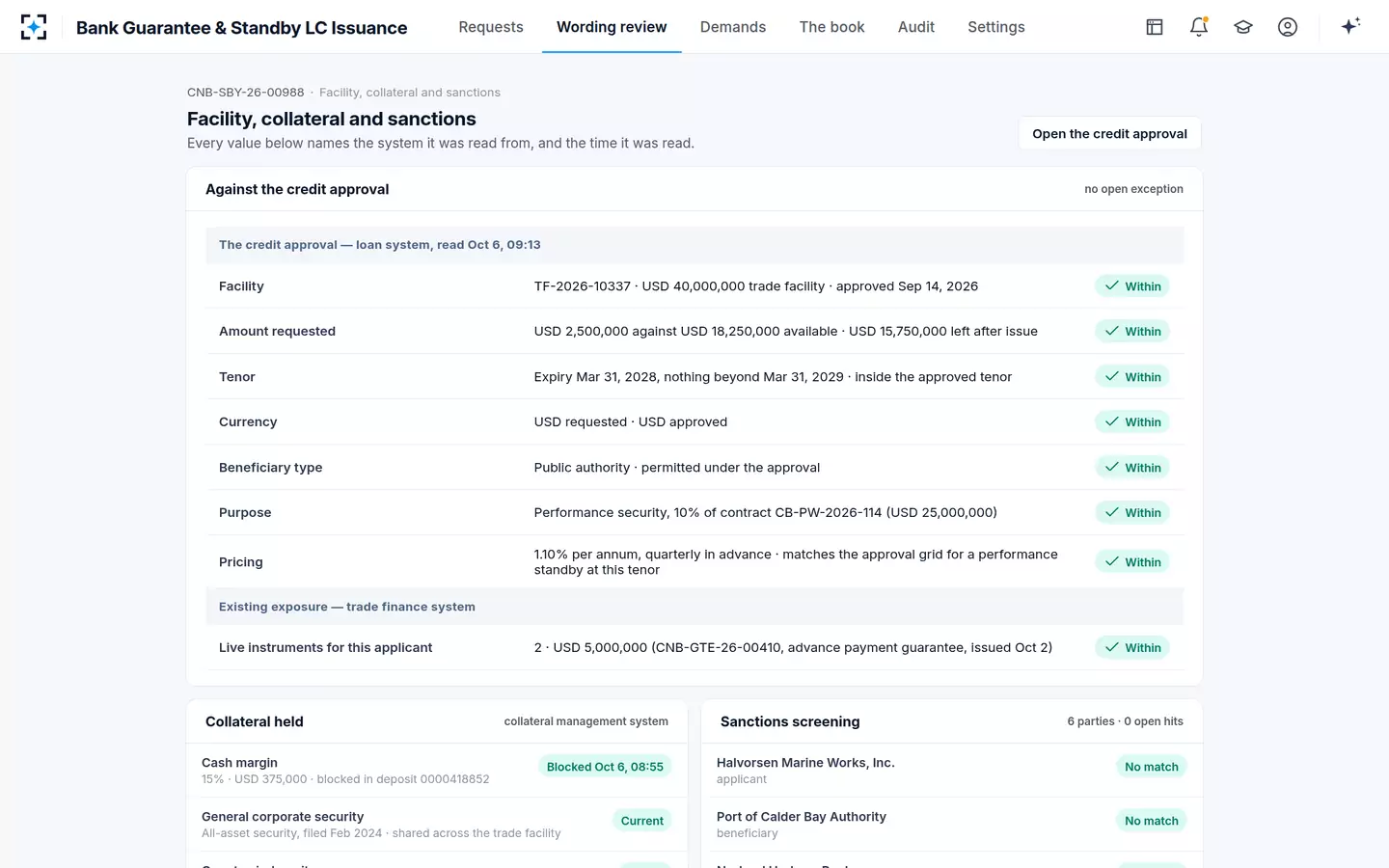
Guarantee software needs read access to the systems an instrument already depends on, and a way to draft back into them. The list is short but specific, and agreeing it in week one avoids a pilot that runs on exported spreadsheets.
The systems a guarantee touches, and what the software needs from each
| System | What the software reads or drafts |
|---|---|
| Trade finance system | Instruments, amendments, demands and existing exposure; the issued wording. |
| SWIFT gateway | Issue, amendment and demand messages, drafted from approved wording for a person to release. |
| Loan system | The credit approval, the facility, its tenor and its pricing grid. |
| Collateral management | Cash margin, security and the counter-indemnity. |
| Document imaging | Contract extracts, opinions and demand documents. |
| General ledger and regulatory reporting | The contingent liability account and the off-balance-sheet extract. |
Each value read from the system that holds it, with the time it was read
Where Bank Guarantee & Standby LC Issuance fits, and where it does not
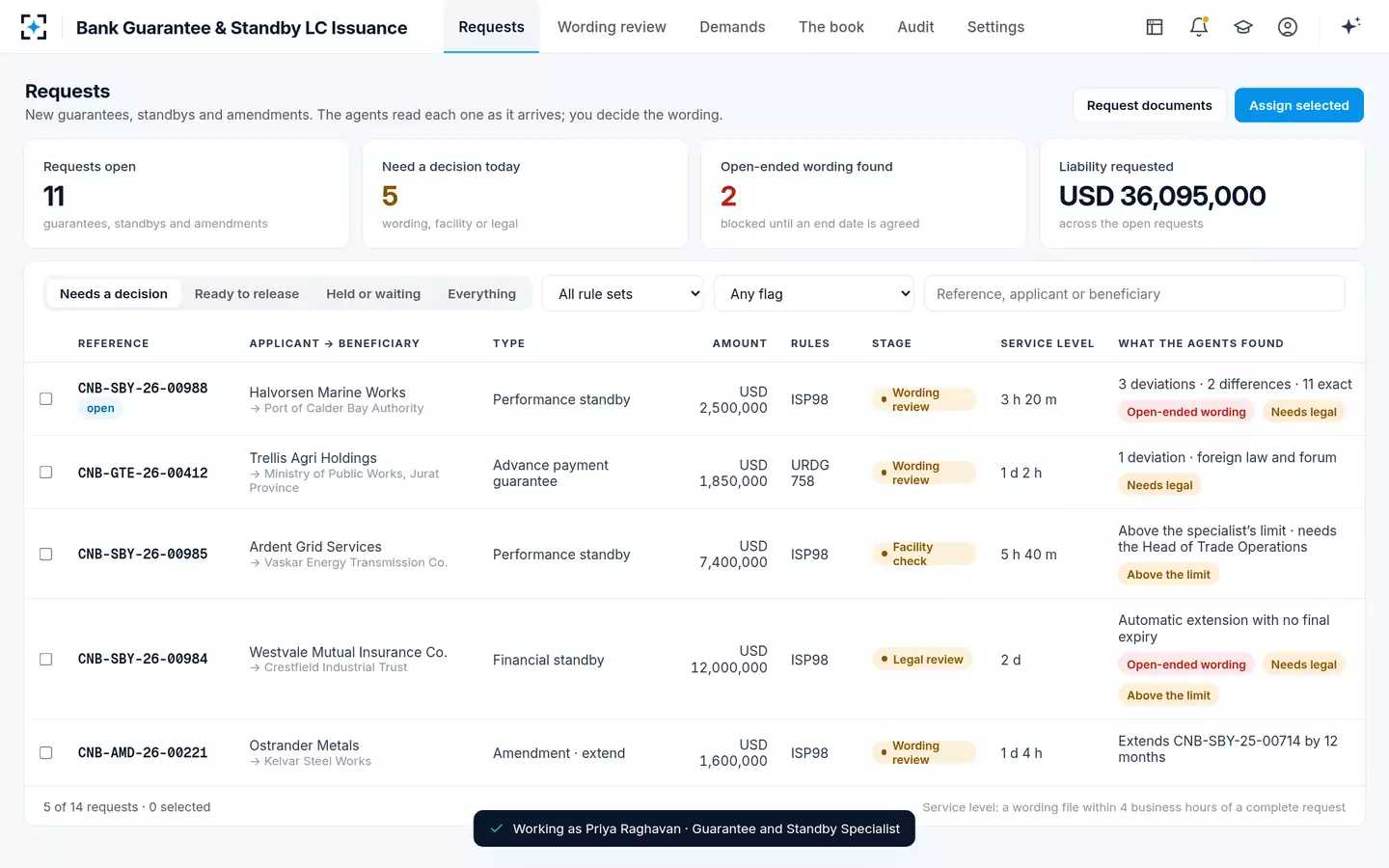
The solution fits alongside a trade finance system, not in place of it. It reads requests, approvals, collateral and demands; it drafts redrafts, notices, messages and postings; and a named person accepts, signs or releases every one. It does not book or service the instrument, price it, decide whether to issue it, or negotiate with the beneficiary. Its agents cannot issue, amend, pay, refuse or release, and the reasons are set out in seven agents and what none may do.
Every open request in Bank Guarantee & Standby LC Issuance, with what the agents already found
A pilot ends with a decision a bank can defend: a scorecard on its own files, every miss read, and a baseline against which the next release will be tested. To start one on your wording, see Bank Guarantee & Standby LC Issuance.
Questions people ask
What is a bank guarantee management system?
It is the system that holds a bank's guarantees and standbys through their life: issue, amendment, extension, reduction, demand and expiry. Some are modules of a trade finance system; others sit beside it and add the reading of wording and demands.
How long should a guarantee software pilot take?
Four weeks is enough for a desk to assemble the files, replay the wording and the dates, and replay a year's demands. A bank with many local-law forms or several rule sets may add a week for wording.
Can a pilot run without connecting live systems?
Yes, on extracts of the approvals, collateral, issued wording and demands for the sampled instruments. Live connections matter for production, where the value comes from reading approvals and collateral as they stand on the day.
What if the software finds a deviation our specialists missed?
Treat it as a finding about the book, not only about the software. An open-ended instrument or an unflagged non-documentary reduction found in the pilot is a live liability the bank should review now.
Does guarantee software replace trade legal counsel?
No. Clauses with no model equivalent, such as a foreign governing law, still need counsel's signature. Good software routes them to counsel every time and attaches the opinion to the instrument.
How many deviations should a pilot expect?
There is no published rate to compare with. On the fictional sample request, three of sixteen clauses changed the obligation and two more differed only in wording; your own rate is one of the pilot's outputs.