A digital bank guarantee platform is software that keeps a guarantee's wording, its credit approval, its liability over time and every later demand in one file, so the instrument is reviewed, issued, amended and examined from the same place instead of across email, a shared folder of model forms and the trade finance system. The test of any such platform that uses AI is not what its agents can do but what none of them may do: issue, amend, pay, refuse or release. Botminds' Bank Guarantee & Standby LC Issuance is built that way. Seven agents read the wording, the facility and every demand; a specialist accepts each clause, trade counsel signs anything outside the model forms, and a checker releases the message.
The examples come from the solution running on sample data: a fictional bank, Corvane National Bank, and a USD 2,500,000 performance standby requested by a marine contractor for a port authority. The rules quoted are ICC's own free texts of URDG 758 and ISP98 and US federal regulation.
Where each part of a guarantee lives, before and after Bank Guarantee & Standby LC Issuance
Email, a shared folder and the trade system: An attachment in the relationship manager's inbox.
One digital file per instrument: Read clause by clause on arrival, each clause matched or flagged.
Email, a shared folder and the trade system: A document in a shared folder, version unknown.
One digital file per instrument: A versioned form; the file names the version it was checked against.
Email, a shared folder and the trade system: In the loan system; re-keyed into an email.
One digital file per instrument: Read from the loan system, with the time it was read.
Email, a shared folder and the trade system: A date someone typed into a tracker, if there was one.
One digital file per instrument: Drawn from the expiry, extension and reduction clauses as worded.
Email, a shared folder and the trade system: A SWIFT message and a calendar reminder.
One digital file per instrument: Examined against the issued wording, with the days left on the clock.
Email, a shared folder and the trade system: Reconstructed from emails when an examiner asks.
One digital file per instrument: Every decision with a person, a time and a reason code.
What is a digital bank guarantee platform?
A digital bank guarantee platform does three jobs a trade finance system of record usually does not: it reads the wording against the bank's model forms, it turns the clauses into a liability with a start, steps and an end, and it examines demands against the instrument the bank actually issued. The system of record keeps the instrument's data and books it. The platform's job is the reading that happens before and after.
Each of those jobs exists because the rules make the wording decisive. A guarantee's reduction happens only on a document or an event the bank can determine from its own records (URDG 758, art. 13); a standby must carry an expiry date or a right to terminate (ISP98, rule 9.01); a demand is examined "on the basis of a presentation alone" (URDG 758, art. 19(a)). None of that is visible in a field on a booking screen. It is visible only in the clauses.
Can a bank guarantee be issued electronically?
Yes. Neither set of ICC rules requires paper. URDG 758 defines a document as "a signed or unsigned record of information, in paper or in electronic form", and recommends that every guarantee state "whether a demand or other document shall be presented in paper and/or electronic form" (arts. 2 and 8(i)). Where a guarantee calls for electronic presentation it should name the format, the system and the address; if it does not, any electronic format that can be authenticated will do, and "an electronic document that cannot be authenticated is deemed not to have been presented" (art. 14(c)). A guarantee silent on the point takes paper (art. 14(e)).
ISP98 sets a different default. Where a standby names no medium, documents must be on paper, unless only a demand is required, in which case a demand sent by SWIFT or similar authenticated means by a bank or SWIFT participant complies (rule 3.06(b)). US law agrees on form: a letter of credit or amendment "may be issued in any form that is a record and is authenticated" (UCC § 5-104). A platform therefore has to know which rule set each instrument is under before it can say whether an electronic demand is a presentation at all.
The seven agents, and the line each may not cross
The solution's agents divide the reading the way the desk already divides responsibility, and each carries limits written into it rather than left to policy. The table is the core of the design: every agent's last column is an act the rules or the bank assign to a person.
Seven agents in Bank Guarantee & Standby LC Issuance, and what none of them may do
| Agent | What it reads and drafts | What it may never do |
|---|---|---|
| Wording | Each requested clause against the bank's ISP98 and URDG 758 model forms; redrafts every deviation with the model clause and rule cited. | Issue or amend an instrument; offer a redraft below the confidence threshold; accept its own redraft. |
| Facility | Amount, tenor, currency, beneficiary type, purpose and pricing against the credit approval; collateral in the collateral system. | Raise a limit or approve an excess. An exception goes to credit, never to the desk. |
| Risk | The liability each clause creates, in money and dates: no end, beyond the facility, a reduction that never operates, foreign law and forum. | Price risk, waive a finding, or block a release on its own; it states the liability and names who decides. |
| Sanctions | The applicant, beneficiary, advising bank and the parties, vessels and ports in the contract; before issue, on each amendment and each demand. | Clear its own possible match. A possible match holds the request for the sanctions team. |
| Demand | A demand against the instrument's own terms and its rule set; counts the examination clock; drafts the honour advice or the refusal. | Pay or refuse; send a refusal that leaves out a discrepancy; let the clock pass without escalating. |
| Expiry | Expiry, automatic extension, non-extension notice and reduction dates across the book; drafts the notices and amendments. | Send a notice or amend an instrument; shorten a notice window. |
| Message | The issuing, amendment and demand messages from the approved wording; the contingent-liability postings. | Release a message; post a liability no person approved; edit approved wording. |
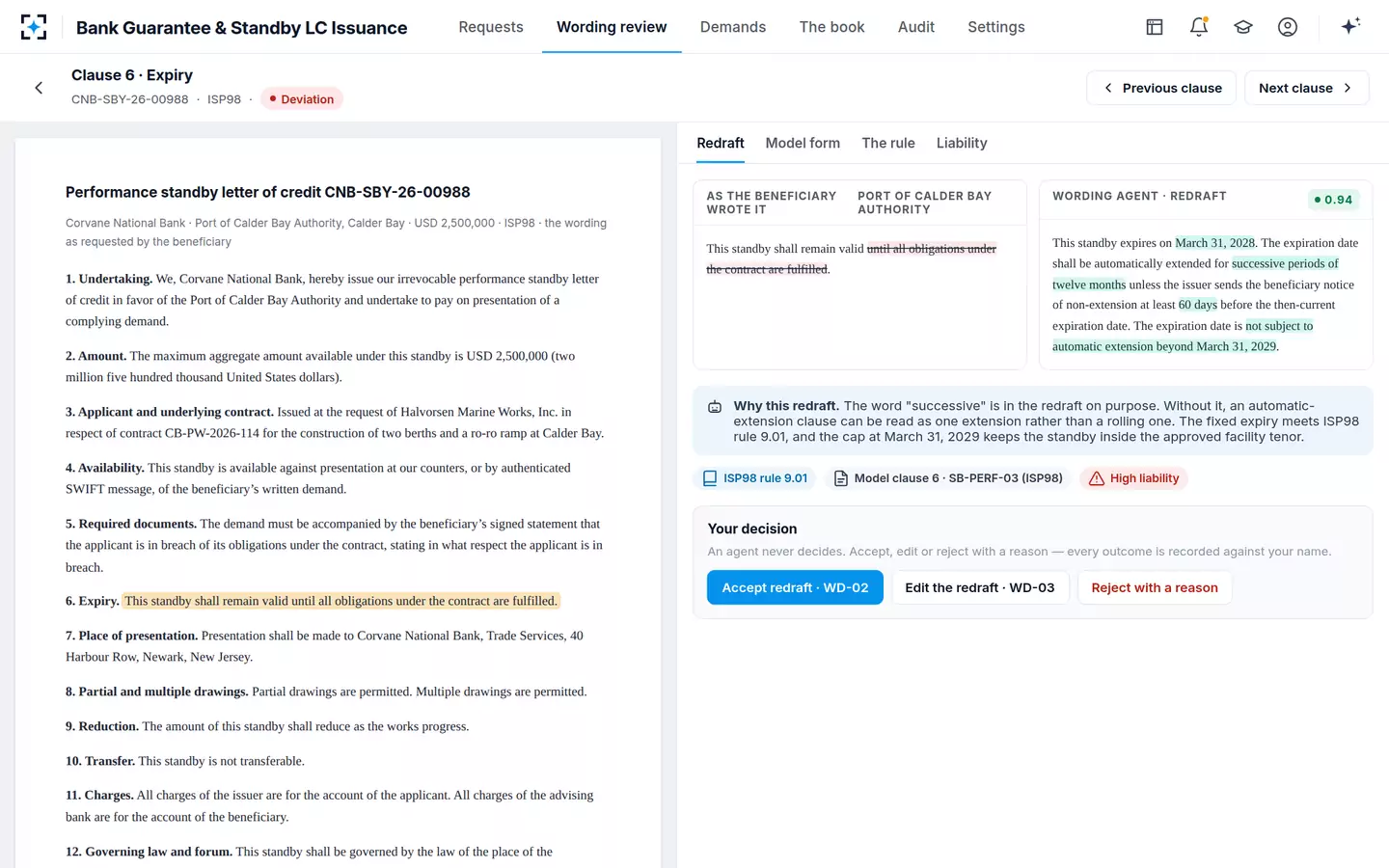
Two design choices are worth testing in any platform. First, a confidence threshold: the sample bank sets 0.85, and a redraft below it is not offered at all, so the specialist reads the clause from scratch rather than editing a weak suggestion. The sample expiry redraft scored 0.94. Second, a risk agent that cannot block: it describes the liability a clause creates and names who must decide, because a tool that silently stops a release moves a credit decision into software.
One clause, the redraft beside it, and the rule behind it
Why the limits sit where the rules put the legal acts
Each "never" in the table follows an act the rules treat as the bank's binding choice. Issue is one: a guarantee is issued, and irrevocable, the moment it leaves the guarantor's control (URDG 758, art. 4). Refusal is another: a guarantor that fails to give a single notice stating each discrepancy by the close of the fifth business day loses the right to say the demand did not comply (art. 24(f)). A refusal drafted by software and sent without a person's reading would put the bank's whole defence on an unread document.
Extend-or-pay shows why judgment cannot be delegated even where the rule looks mechanical. When a demand asks, in the alternative, for a longer expiry, the guarantor may suspend payment for up to 30 calendar days, and it "may refuse to grant any extension even if instructed to do so and shall then pay" (art. 23(a) and (e)). Whether to extend is a credit decision about the client, not a calculation. The capital class is the same: a performance standby carries a 50% credit conversion factor and a financial standby 100% (12 CFR 217.33), so classifying an instrument is credit's call, and the class that doubles capital shows what turns on it.
What should guarantee software never do?
Guarantee software should never take an act that binds the bank or clears a risk on its own: issuing, amending, paying, refusing, releasing a message, clearing a sanctions match, raising a limit or posting a liability. Everything short of that, reading, comparing, counting and drafting, is where software earns its place.
Eight things no agent in a guarantee platform should be able to do
- Release an issuing or amendment message
Issue is the moment of liability under URDG 758 art. 4 and ISP98 rule 2.03.
- Send a refusal notice
A notice that misses a discrepancy precludes the bank from relying on it.
- Pay a demand or grant an extension
Extend-or-pay is a credit decision, however short the clock.
- Clear its own sanctions match
Only the sanctions team clears or confirms a possible match.
- Accept its own redraft
A clause is accepted, edited or rejected by the specialist, with a reason.
- Raise a limit or approve an excess
Exceptions go to credit, never to the desk.
- Shorten a notice window
A late non-extension notice extends the liability by a full period.
- Change a threshold alone
A release limit or confidence threshold change needs a second person.
Can a guarantee platform automate the whole review? The industry's 2019 answer
The industry's own standard says no, and a buyer should hear that before any vendor's answer. The Wolfsberg Group, ICC and BAFT wrote in 2019 that parts of the work, such as screening against sanctions lists, can be automated, but that the review of trade documents as a whole, by its nature, cannot (Trade Finance Principles; their words are quoted in how technology can assist in combating TBML). Their appendix on guarantees and standbys is more specific.
"Reviewing SBLC or Guarantee claims is a mostly manual process, requiring that the claim and any supporting documents that may be presented for payment are compared against the terms and conditions of the SBLC or Guarantee and, where applicable, any ICC rules and international standard banking practice."
Wolfsberg Group, ICC and BAFT, Trade Finance Principles (2019), Appendix III, 7.3
The same paragraph says that the knowledge and experience of operations staff "must serve as the first and best line of defence". The honest reading is that the principles describe who must decide, and that is the boundary the agents keep: they make the comparison the paragraph describes, line by line and with the rule cited, and a specialist or checker makes every decision. What the principles do not settle is how much of the comparing a person must do by hand, and we know of no regulator that has published an accuracy benchmark for software that does it. That is why a bank should measure a platform on its own past files, as in a four-week pilot on your own book, rather than accept a vendor's figure.
Accountability does not move to the vendor either. For financial crime compliance, which includes the sanctions screening a guarantee platform does, the Wolfsberg Group's principles on artificial intelligence hold institutions responsible for their use of AI, and for decisions that rely on it, whether they built the system or bought it (Wolfsberg Principles for AI/ML, 2022; quoted in AI adverse media screening).
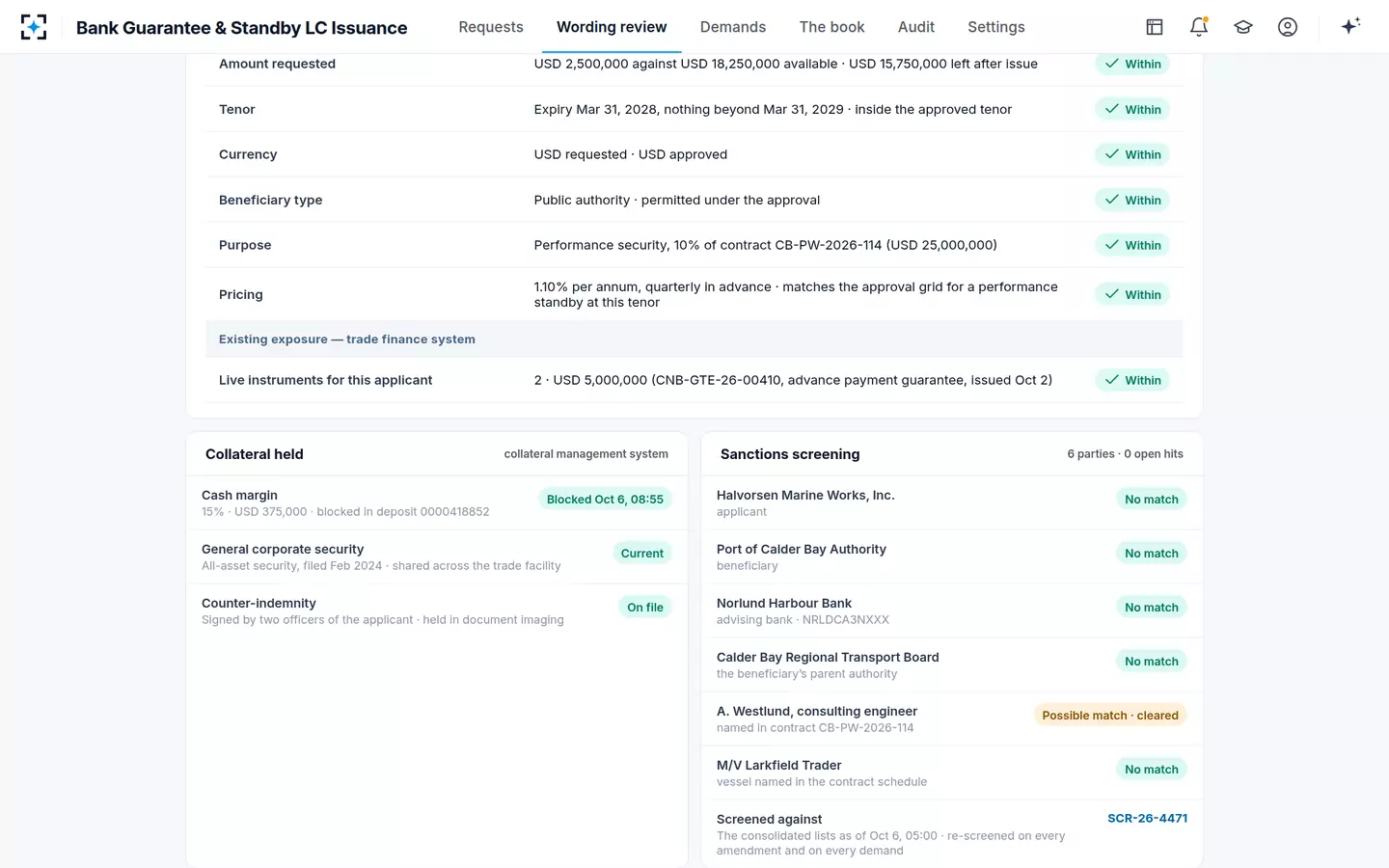
Every party screened, one possible match held for a person
How is the credit limit checked, and who releases a guarantee?
The credit limit is checked by reading the approval, not by retyping it: the facility agent reads the amount available, tenor, permitted beneficiary types and pricing grid from the loan system and the collateral from the collateral system, and raises an exception to credit when the instrument falls outside. On the sample request the amount fit within USD 18,250,000 available on a USD 40,000,000 facility; the tenor did not, until the expiry clause was redrafted.
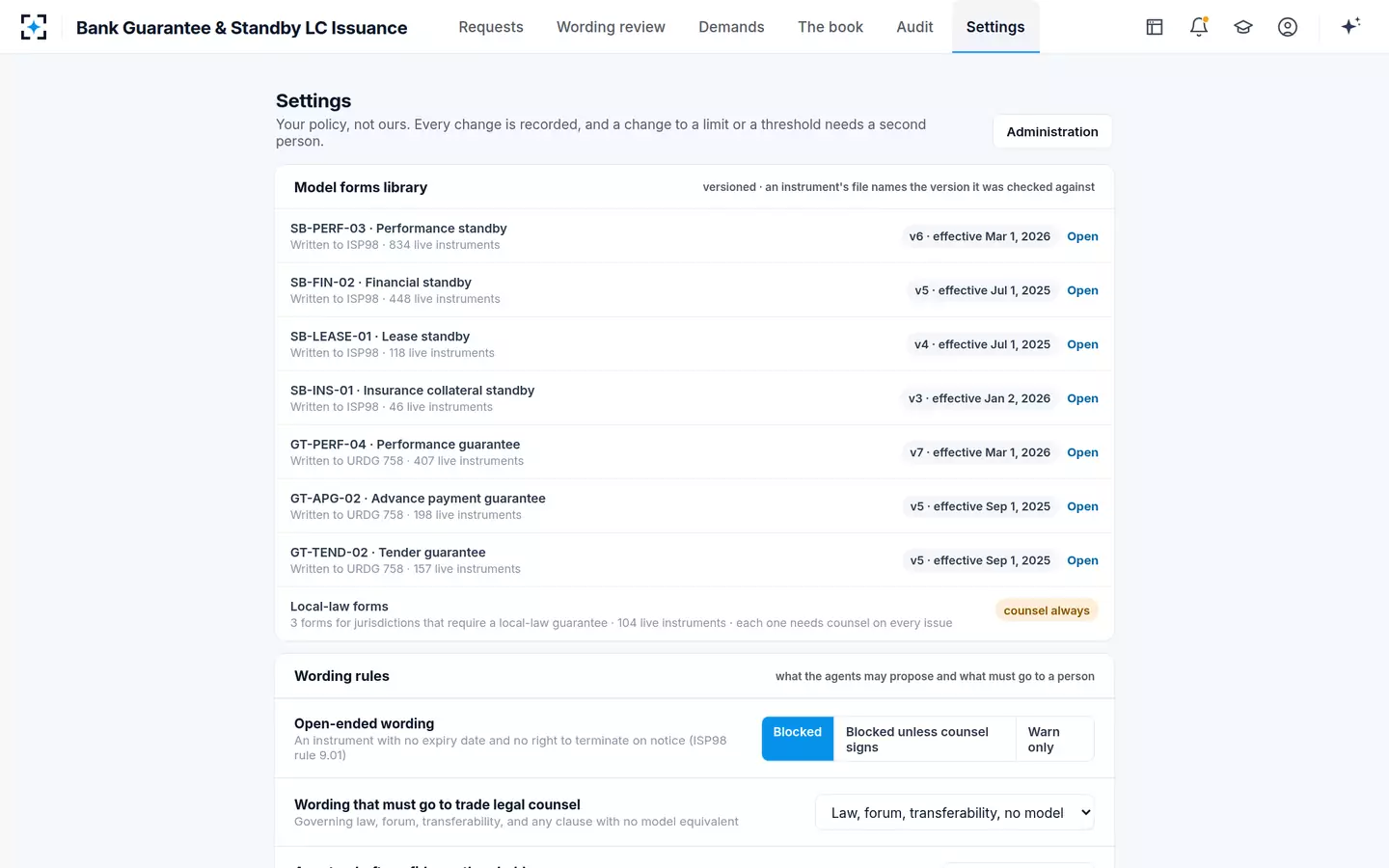
A checker releases, and never the person who prepared the instrument. National banks are expected to have "operational expertise that is commensurate with the sophistication of its independent undertaking activities" (12 CFR 7.1016(b)(3)), and a platform shows that expertise best by making separation of duties impossible to bypass. In the solution, every issuance, amendment, extension, reduction, payment and refusal needs a second person; the submitter can never release; and changing a release limit or a confidence threshold is itself a two-person action.
Your forms, your limits and your clocks, as settings
What to ask before you buy a digital guarantee platform
Ask for evidence on your own wording, not a demonstration on the vendor's. The questions below separate a platform that reads the instrument from one that only stores it.
Ten questions for any digital bank guarantee platform
- Does every redraft cite the model clause, the form version and the rule?
Without the citation, a reviewer cannot check the suggestion quickly.
- Does it handle ISP98, URDG 758, UCP 600 standbys and local-law forms?
Standbys are also issued under UCP 600, and some beneficiaries require local law.
- Can it show the liability over time from the clauses?
Expiry, extensions and reductions as worded, against the facility tenor.
- Which acts can no agent take, and can a user override that?
Issue, amend, pay, refuse and release should be impossible, not discouraged.
- How is the examination clock counted?
From the business day after presentation, under the instrument's own rule set.
- What happens below the confidence threshold?
No redraft offered, or a weak one flagged?
- Can it read approvals and collateral where they live?
Loan system, collateral system, trade finance system, general ledger.
- Is the evidence exportable per instrument?
Who decided, when, why, on which evidence, for examiners and internal audit.
- Are thresholds and limits bank settings with two-person change?
Policy belongs to the bank, under its own controls.
- Will you run it on our last year's files?
The only accuracy figure worth having is measured on your own book.
Where a platform like this does not fit
It does not replace the trade finance system that books and services the instrument, the SWIFT gateway, or the loan system that holds the approval; it reads from them and drafts into them. It does not price a guarantee or set a fee. It does not decide whether a beneficiary will accept a redraft; the relationship manager still has to win that conversation. And it cannot tell a bank whether an instrument should be issued at all, which remains a credit and relationship judgment.
The value is narrower and more measurable: every clause read against the form with the rule cited, every date that moves liability on one calendar, and every demand examined against the issued wording inside the clock. The book-wide calendar is described in from a spreadsheet tracker to liability you see daily; the whole solution is at Bank Guarantee & Standby LC Issuance.
Questions people ask
What is a digital bank guarantee?
A guarantee issued, amended and presented against electronically rather than on paper. The ICC rules allow it: URDG 758 treats an electronic record as a document, and a guarantee that calls for electronic presentation should name the format, system and address for it.
Is a SWIFT demand a valid presentation under a standby?
Under ISP98, if the standby names no medium and requires only a demand, a demand sent by SWIFT or similar authenticated means by a bank or SWIFT participant complies (rule 3.06(b)). If other documents are required and no medium is named, they must be on paper.
What does URDG 758 require a guarantee to say?
Article 8 recommends eleven items: applicant, beneficiary, guarantor, underlying-relationship reference, guarantee reference, amount and currency, expiry, terms for demanding payment, paper or electronic presentation, document language, and who pays charges. It also asks that instructions and guarantees "avoid excessive detail".
Who is liable if an agent misreads a clause?
The bank, because a person accepted the clause. That is the reason every redraft carries the rule and model clause it rests on and every acceptance carries a name and a reason code: the decision stays with the specialist, and the evidence of how it was made stays with the instrument.
How long does it take an agent to read a guarantee?
On the sample request, the wording agent read sixteen clauses against the model form in 47 seconds and found three deviations. The design target for a complete, cited wording file on a new standby is about six minutes; neither figure is a measured customer result.