AI adverse media screening uses large language models, working as agents, to do the reading that makes negative news screening slow: searching every form of a customer's name in every language tied to the customer, translating what comes back, grouping copies of one report into a single story, comparing the people in each story with the customer, and classifying what remains by crime and stage. Done well, it turns a pile of articles into a short list of decisions. Done carelessly, it adds a confident new way to be wrong, because a model that reads fluently can also match the wrong man fluently. The design question is therefore not whether AI can find bad news, but how it is stopped from believing its own matches. Botminds' Adverse Media Screening answers it with eight agents and three human signatures, and one agent whose only job is to prove each match wrong: the Different-person agent.
The examples on this page come from a fictional sample bank as it runs through the solution: Corvane National Bank, and an EDD refresh for a director of a high-risk commercial client. The customer, the articles and the people are invented. The research and guidance are real and linked where they appear.
Eight agents and three people on one adverse media review: who may do what
Agent
Review coordinatorOpens the review, runs the agents in order and keeps the review clock.
Never: Decides relevance or writes to a customer file.
Agent
Search agentBuilds the search plan from the customer file: every name form, every language tied to the customer, risk terms per category.
Never: Searches outside the bank’s approved sources or look-back.
Agent
Translation agentTranslates each article sentence by sentence, aligned to the original.
Never: Replaces an original with its translation.
Agent
Story agentGroups syndicated, rewritten and translated copies into one story per event.
Never: Drops an article: every copy stays listed under its story.
Agent
Match agentCompares six identifiers with the customer file, with age worked out on the publication date.
Never: Proposes a match below the bank’s 0.85 confidence floor; those go to a person as unsure.
Agent
Different-person agentTries to prove each matched story is about somebody else, and writes down every test.
Never: Lets a story through that it has not tried to disprove.
Agent
Risk agentClassifies each story by offense and stage and proposes relevant or not, with its confidence.
Never: Confirms anything; it proposes only.
A person decides
KYC analystConfirms or rejects relevance, with a reason code. Becomes the maker.
Agent
EDD writerDrafts the EDD paragraph and rating input from confirmed stories only, citing each sentence.
Never: Writes anything to the client lifecycle system.
A person decides
EDD reviewerAccepts the story into the customer file, or returns it. Never the person who confirmed it.
A person decides
Compliance managerApproves any rating change before it reaches the bank’s systems.
How does AI do adverse media screening?
AI does adverse media screening as a pipeline: search, read, compare, judge, with a language model doing the reading at each step. The clearest public description is an academic prototype from the University of Luxembourg, posted in December 2025 and not yet peer reviewed. Its agent queries a web search API, crawls the results, splits each page into chunks, and asks a model a fixed playbook of questions about each document, the first being "On a scale from 0 to 1, how confident are you that this document describes a person named [NAME]?", then how negative the description is and how risky the activity, before combining the answers into an "Adverse Media Index" with a written justification (Chernakov, Jafarnejad and Frank, arXiv 2602.23373).
That is the general shape, and banks are already moving that way. The US Treasury's 2024 report on AI in financial services found AI already in common use for anti-money-laundering and sanctions work, from sifting large data sets and spotting anomalies to flagging suspicious activity and verifying identities (US Treasury, Artificial Intelligence in Financial Services, December 2024). What separates one design from another is less the model than the structure around it: what each step may conclude, and who checks.
Is AI adverse media screening accurate?
The published evidence shows that a language-model agent can separate very risky names from very clean ones; it does not yet show accuracy on a bank's own customers, and no public study measures that. In the Luxembourg prototype, three models scored names from four groups. Clean names, drawn from prolific computer science authors, averaged between 0.015 and 0.029 on the 0 to 1 index; names from OFAC's sanctions list averaged between 0.730 and 0.863.
What one academic test of AI adverse media screening found, and what it did not test
0.73–0.86
mean score for names on OFAC’s sanctions list, across three models
0.02–0.03
mean score for clean names, prolific computer science authors
10
web results read per name: the top ten from one search engine
1language
English only, a limit the authors acknowledge
The authors are candid about the limits, and every one of them is a limit a bank would meet. The system's "effectiveness fundamentally depends on search engine results"; it "focuses exclusively on English-language sources"; and it "treats all retrieved content equally without weighting by recency". The test populations were also chosen to be far apart. Real reviews are hard in the middle, where a customer shares a name with someone in the news, which is where the evaluation says least.
So "accurate" has to be shown for a purpose. The NIST AI Risk Management Framework defines validation as "confirmation, through the provision of objective evidence, that the requirements for a specific intended use or application have been fulfilled" (NIST AI 100-1, 2023). For adverse media, the specific use is your customers, your languages and your policy, and the objective evidence is a run on your own past reviews, with your analysts' decisions as the comparison.
Can AI tell namesakes apart?
Sometimes, and not reliably on its own. The same paper puts it plainly: "The system may conflate distinct individuals who share names, or conversely fail to connect information about the same person appearing under different name variations." A model asked whether a document "describes a person named" the customer will often say yes when the name matches, because a matching name is exactly what it was asked about.
The fix is structural, not a better prompt. A matching step that looks for agreement should be followed by a separate step that looks for conflict, with access to the evidence a namesake would contradict: the customer's date of birth, occupation, employer, role, cities and the registry extracts in the file. Two steps with opposite jobs catch errors that one step with both jobs tends to talk itself past.
The agent that argues the other side
In Adverse Media Screening the second step is the Different-person agent. Before any story is proposed to a person, it tries to prove the story is about someone else, and it writes down every test, whether the test succeeded or not. The analyst reads the tests, not just the verdict.
On the sample review it ran three tests on a Portuguese story about a footballer named Rafael Duarte, detained after a nightclub fight in Porto. It worked out that the customer was 53 on the day the article ran, against the footballer's 27; compared the occupation, footballer against mechanical engineer; and looked for any tie to Porto in the customer file, finding no address, travel or payment to Portugal. Five identifiers conflicted, and the story was set aside with its tests kept. On the story that mattered, a procurement investigation naming "Rafael M. Duarte, 52", it ran four tests, including a check of the Brazilian registry extract for a second director named Duarte, and reported: "Could not show a different person: 5 identifiers agree, 1 is partial, none conflict."
What the Different-person agent reads, may conclude, and may never do
| As set in the solution | |
|---|---|
| Reads | Each matched story with all its copies, and the customer file: date of birth, occupation, company, role, addresses, payment countries and registry extracts. |
| May conclude | That a story is about a different person, when identifiers conflict, with each test written down for the analyst and the examiner. |
| May also conclude | That it could not show a different person, which sends the story on as a proposal, not a decision. |
| May never | Let a story through untested, delete a story it set aside, or decide that a story is relevant. |
| Who checks it | The analyst, who reads the tests; a random 5% of “nothing relevant” reviews also go to a second analyst. |
The asymmetry is deliberate. An agent that may only argue against a match cannot invent one, and an agent that must write down its tests cannot set a story aside without a reason a person can read. A story it could not disprove still goes to the analyst as a proposal, with a confidence and a recommended category and stage, and the analyst decides. The identity test itself, worked by hand on the same four stories, has its own guide.
Does AI translate articles?
Yes, and translation is where AI saves the most time and risks the most meaning. A model can translate a Portuguese report in seconds; what matters is that the bank's file cites what the source said, not what the translation said. Adverse Media Screening's Translation agent translates sentence by sentence, aligned to the original, never replaces the original with its translation, and marks any sentence below its confidence floor for a person to read.
The original beside the translation, sentence by sentence
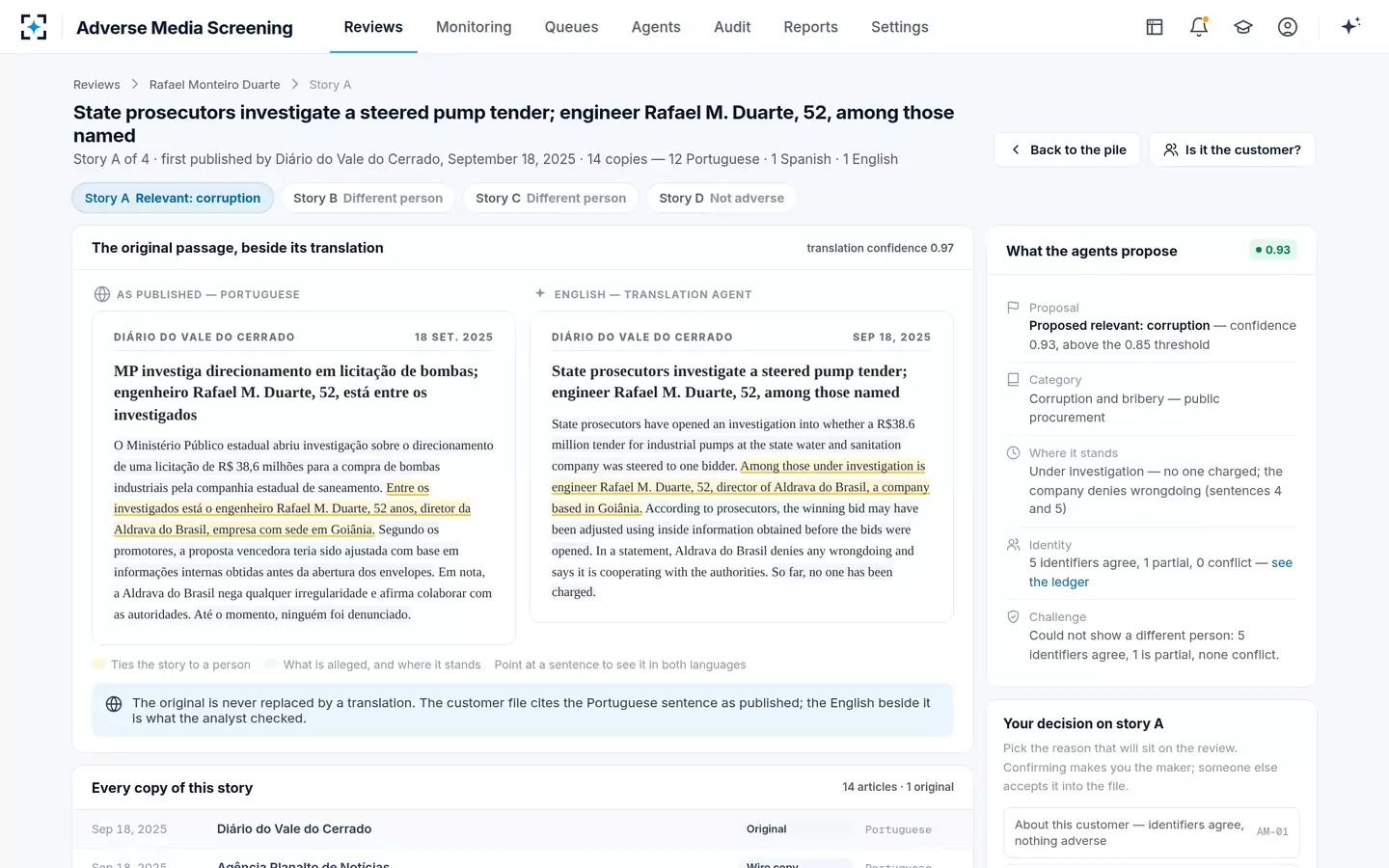
On the sample story the translation confidence was 0.97, and the sentence that ties the story to the customer is highlighted in both languages. That design answers the question an examiner asks of any machine translation: what did the source actually say? The answer is on the screen, in Portuguese, beside the English the analyst relied on.
Can AI drop an article by mistake?
Yes. Any system that cleans up results can lose them: a page that fails to load, a copy judged a duplicate, a story filtered as irrelevant. The Luxembourg prototype is explicit that pages that cannot be parsed "are logged and excluded from the set of resources used to compute the Adverse Media Index". That is reasonable for research and dangerous for a bank, because the excluded page may be the one that matters and nothing in the score says so.
The remedy is a rule that nothing is deleted. In the solution, the Story agent never drops an article: every copy stays listed under its story, with its outlet, language and date, so the file can show that 37 articles became 4 stories and none disappeared. When the adverse media service went down for 25 minutes one morning, the 22 searches it held were run again and no review lost its clock; the outage is on the screen rather than hidden in a lower count.
Who decides what goes on the customer file?
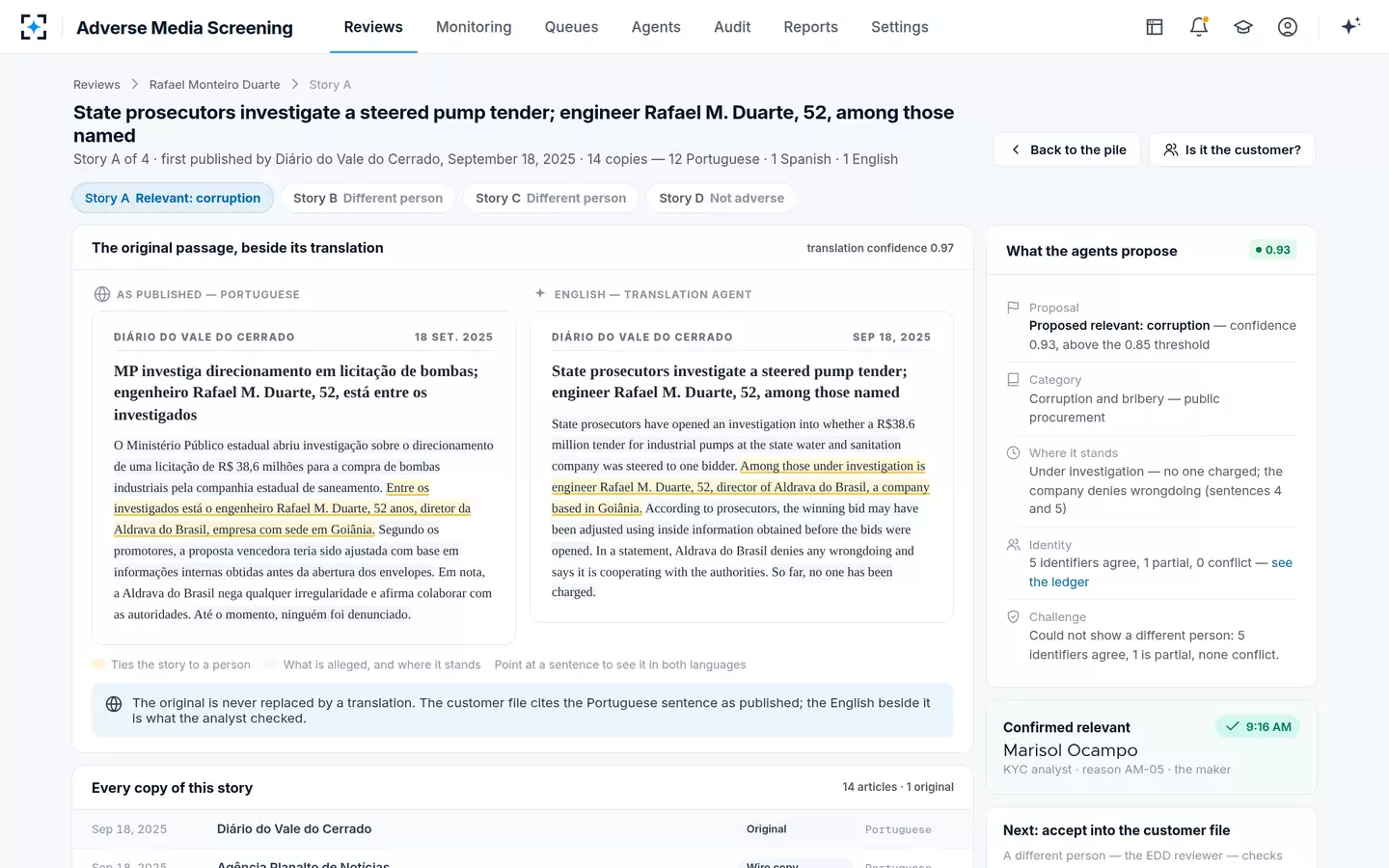
People do, and the guidance is consistent that responsibility does not move to the software. The Wolfsberg Group's principles for AI in financial crime compliance say banks "are responsible for their use of AI/ML, including for decisions that rely on AI/ML analysis, regardless of whether the AI/ML systems are developed in-house or sourced externally", and that they should test for fair, effective and explainable results before go-live and keep watching performance afterwards (Wolfsberg Group, 2022; standards guidance, not a rule). FATF's 2021 review of new technologies put it more briefly: the tools help, but a person's review stays essential (FATF, 2021).
The analyst confirms, and becomes the maker
US model risk guidance has left the question open rather than settled. The April 2026 interagency guidance, SR 26-2, puts generative and agentic AI outside its scope, while telling each bank that its own risk management and governance must still decide the controls (Federal Reserve SR 26-2; the same question for sanctions alerts is taken up in AI for sanctions screening). In practice that means the bank designs the controls itself: which steps agents may take, which only people may take, and how both are tested. In the solution, agent versions are pinned to each review, and every override carries a reason code.
What to ask before buying AI adverse media screening
Ask how the system is stopped from being wrong, not how clever it is. The questions below separate a product that shortens the analyst's day from one that moves the risk somewhere harder to see.
Questions for any AI adverse media screening vendor
- Which languages does it search, and how does it choose them for each customer?
English-only systems miss stories published locally; the choice should come from the customer’s own file.
- Is there a step that tries to disprove each match, and can I read its tests?
A matching step alone tends to accept namesakes that share the right name.
- Does every article stay on the review, or are some filtered out?
Ask what happens to pages that fail to load, duplicates and low scores.
- Does the file cite the original sentence, or only a translation or summary?
An examiner will ask what the source said.
- Who confirms relevance, who accepts into the file, and can one person do both?
Maker and checker should be enforced by the system, not by habit.
- How will we test it on our own past reviews, and against what?
Your analysts’ decisions on closed reviews, including the ones they set aside.
- What changes when the model changes, and is the version on each review?
Wolfsberg asks banks to monitor for consistent and stable performance.
Adverse Media Screening was built around those answers: the Search agent plans languages from the customer file, the Different-person agent writes down its tests, the Story agent drops nothing, the file cites the original sentence, and three named people sign. What a bank brings to set it up, and how it compares with a data API or a search engine, are covered on their own. To see the agents on one review, start from Adverse Media Screening.
Questions people ask
What is automated adverse media screening?
It is adverse media screening in which software runs the searches and sorts the results without an analyst typing each query: batch runs at onboarding and refresh, and nightly monitoring for new stories. Older automation matches keywords and names; AI automation adds reading, translation and identity comparison. Either way, the decision on relevance should stay with a named person.
Can AI replace adverse media analysts?
It can replace much of the analyst's reading, not the analyst's judgement or signature. FATF's view is that a person's review stays essential, and Wolfsberg holds banks responsible for decisions that rely on AI analysis. The realistic change is that analysts spend their minutes on the few stories that survive the agents' tests.
Is an AI adverse media tool a model under model risk guidance?
SR 26-2, issued in April 2026, places generative and agentic AI outside its scope but says the bank's own risk management and governance should set controls for them. A bank should therefore document how the tool is validated, monitored and overseen, even where model risk rules do not formally apply.
Does AI adverse media screening work for companies as well as people?
Yes, with different identifiers: registered names, trading names, registration numbers, addresses and the names of directors and owners. Most adverse stories about a company are about the people who run it, so a review of a corporate customer usually screens its owners and directors too, as the sample review did with a 30% owner.
How do I test AI adverse media screening before buying?
Run it on a sample of your own closed reviews and compare its proposals with your analysts' decisions, including the stories they set aside. Count where it agreed, where it proposed something your team missed, and where it would have misled, and read the tests behind each disagreement.